
- A recased key’s current exterior may differ from its original housing, so the vehicle model alone cannot establish which shell will fit.
- Check whether the existing key performs its required functions before buying, because a new housing will not repair faulty electronics.
- Compare visible details such as button positions, case profile and closure, but treat those matches as clues rather than proof of internal fit.
- The replacement must accommodate the components being retained, including the circuit board and any separate transponder where applicable.
- Confirm the blade’s shape and attachment method separately; a blade that fits the current case may not secure in another shell.
- If the original case is unavailable, ask for clear listing details or photographs rather than assuming the current shell identifies every hidden fitting.
If your car key has already been recased, the case in your hand shows what was assembled last time—not necessarily what the original key looked like. That matters when you need another shell. A case found by vehicle model or matched to the badge may look right but still fail to hold the parts you have.
Start with what you can see. The number and position of the buttons, the case shape, and the way the blade folds or sits can narrow down the options. Those details cannot tell you whether the circuit board will sit securely inside, whether the buttons will meet its switches, or whether your existing blade can attach to the new case. If you no longer have the original shell, you may also be missing a useful point of comparison.
If you are researching a replacement key shell for a recased key on car-keys.lt, keep the current key and any loose parts together as you compare options. The checks below separate visible clues from internal fit questions, helping you decide whether a listing gives you enough evidence to order or whether you need to confirm more details first.
Start with the key you have, not the case it came in
If your key has been recased, its present housing tells you what you are using now—not necessarily what the key looked like when it was supplied with the car. An earlier replacement may have changed the shape, button markings or other visible details. Treat those details as a record of the current key, rather than proof of its original design, when looking for a replacement key shell for a recased key.
Write down whatever you know about the earlier recasing before you shop. An old order confirmation, packaging, a product link or a photo taken before the change may identify the case that was bought. Note whether the replacement worked properly from the start, whether it needed any adjustments, and why it now needs changing. A case that served reliably for years is more useful evidence than one that never closed or operated properly. If you have no records, say so rather than filling the gap with a guess about the original case.
The reason for the previous replacement matters too. A cracked housing that was changed while every key function still worked gives you a different starting point from a key that was recased in an attempt to fix an intermittent fault. If you acquired the car with this case already fitted, you may not know which situation applies. In that case, base your notes on what you can observe now and keep its earlier history marked as unknown.
Before buying another shell, test the functions you expect to keep using. Check each button separately, confirm whether the key starts the car, and try any other function you normally rely on. Record the result, including intermittent behaviour: “unlock works, lock responds only sometimes” is more helpful than “key works”. If you have a spare key, its behaviour may help you tell whether a problem is limited to this key.
Finally, separate damage to the housing from faults that a new housing may not solve. A split seam or worn button surface is visible; a button that fails to operate the car has more than one possible cause. If a function is already failing, do not count on a new case to restore it. If you cannot test the key, note that uncertainty before ordering, so a replacement is not mistaken for a repair.
- Check the key’s required functions before ordering.
- Record any existing fault rather than assuming a new case will fix it.
Compare the visible case details without treating them as a fit test
To narrow down a replacement key shell for a recased key, compare the housing you have with listing photos feature by feature. Start with the buttons: count them, note their order and position, and check the shape of the button area. Three buttons in a vertical row are not the same layout as three arranged around a central button. Matching symbols alone are weak evidence; the surrounding shape and spacing matter too.
Next, look at the case profile. Compare its overall outline, the shape of each end, any raised areas and the way the two halves meet. Check whether the housing appears to close with visible screws, clips, or both. A listing that shows the same front face but a different seam or screw position is not an exact visual match. Conversely, similar seams do not establish that the parts inside will fit.
Use photos of both sides of your key and inspect any edge views provided in the listing. The back may reveal a screw recess, badge area or moulded contours absent from the front photo. An edge view can show a difference in thickness or where the case halves meet. Compare photos at a similar angle: perspective can make a curved corner look square or hide a feature near the edge. If a listing shows only the button side, you have less evidence—not a reason to assume the unseen side matches.
A vehicle-model label can help you find candidates, but treat it as a search filter rather than a fit result. Listings under the same model name may show different button layouts or case shapes. Give the photographed housing more weight than the title, and do not rule out a promising listing solely because its title uses a different model description. Neither observation settles compatibility on its own.
Make a shortlist of cases that match the features you can actually see, and mark what remains uncertain. A different button layout, closure style or case profile is a reason to pause rather than buy on general resemblance. Even a close exterior match only justifies the next check: whether the housing suits the parts it must hold. Visible details can eliminate poor candidates; they cannot establish internal fit.
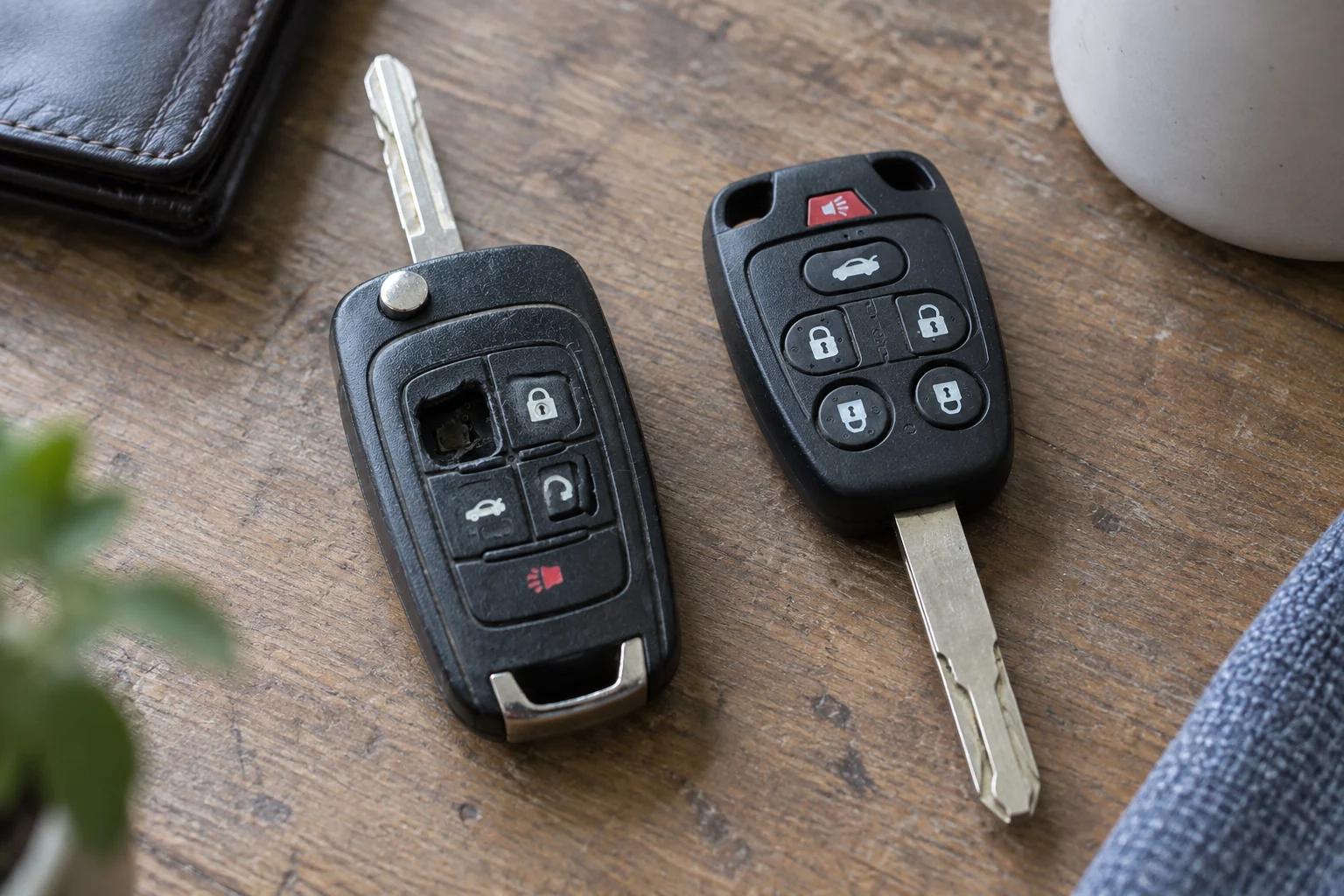
Find out what the next shell must hold inside
For a replacement key shell for a recased key, the decisive question is where the retained parts will sit. If the current case can be opened without damaging it, photograph the contents before moving anything. Capture both halves of the housing and the position of each part. If opening it risks breaking the case or disturbing a secured component, do not force it just to check the fit.
Start with the circuit board. Note its outline, the position of any projecting components, and the points where it rests or is held down. A board may need space around a raised component as well as a ledge beneath it; a housing that closes around the board is not necessarily one that seats it correctly. Look for posts, recesses or clips in the current case that correspond to holes or edges on the board. The next shell must accommodate the board without bending or pinching it.
Check how the case buttons meet the board’s contacts. Their number alone is not enough: a contact can sit slightly above, below or to one side of the part that presses it. Where the key has a battery, record how the battery and its holder sit relative to the board. Some batteries are held by the board, while others occupy a space formed by the housing. A missing recess or a misplaced pressure point can prevent the parts from sitting as intended even when the board’s outline appears to match.
Look separately for a transponder if one is present. It may be a small component seated away from the circuit board, with its own pocket in the case. Not every key has a separate transponder, so do not assume that an empty-looking recess is required—or that a key with no obvious loose chip has none. Before replacing the housing, establish whether there is a separate part to retain and whether the proposed interior gives it a suitable place.
Finally, note anything that appears to have been adapted during the earlier recasing. A board held by tape, a loose insert, a trimmed plastic support or a component secured with adhesive may mean the present case is not a reliable pattern for an unmodified replacement. Record what is actually holding each part in place rather than assuming it belongs there. The useful match is between the retained components and the new shell’s internal supports, clearances and contact positions. If those details cannot be established, the internal fit remains uncertain.
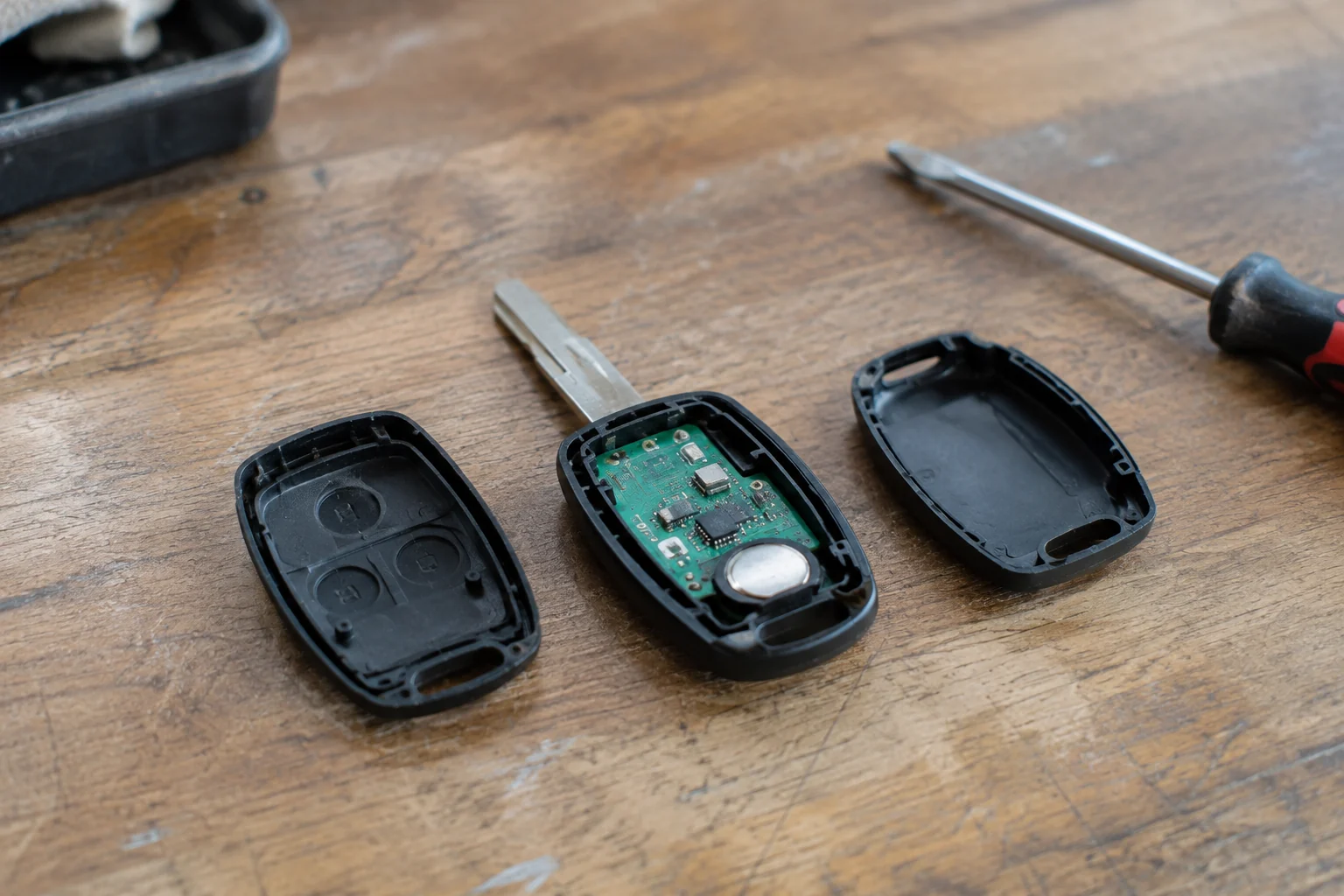
Check the blade and its attachment as a separate match
Examine the metal blade independently of the case. Compare its length, width, tip and the shape of its cut edges or grooves. A familiar-looking blade can help narrow the choice, but it does not tell you whether it will attach to another shell. For a replacement key shell for a recased key, the part hidden at the base of the blade may matter more than the part you put into the lock.
Look at where the blade meets the housing. Does it fold around a pivot, slide into a holder, or appear to be fixed in place? If you can see a retaining pin, screw or shaped base, note its position and orientation. Do not remove a pin simply to investigate: on some keys, taking the assembly apart may be harder to reverse than expected. The useful question is whether the proposed shell has a mounting arrangement for the blade assembly you actually have.
Pay particular attention to the base of a folding blade. Two blades may have the same visible cutting pattern but different pivot holes, base thicknesses or stop positions. One may fold neatly into its original housing while the other cannot sit or turn correctly in a different one. Likewise, a blade held by a separate carrier is not automatically interchangeable with a blade whose base forms part of its existing mechanism.
This is where an earlier recasing can complicate the decision. The current blade may have been fitted to the previous replacement case rather than retained in its original mounting. If its base has been altered, or if a carrier was changed, matching only the exposed blade can lead you towards another unsuitable shell. Treat any visible modification as a reason to establish how the blade is retained before deciding to reuse it.
Work out whether your plan depends on transferring the existing blade or fitting a blade supplied with the next case. Transfer is an option only if the blade and its mounting can be removed from the present case and secured in the proposed one; its appearance alone cannot establish that. A supplied blade may instead need cutting, but a matching blade shape does not establish that it has the right mounting either.
Settle the attachment question before arranging cutting or trying to move parts across. Cutting a blade for a shell that cannot hold it would not solve the fit problem. If you cannot determine how your existing blade is mounted, keep that point unresolved rather than assuming either transfer or cutting will make the new case usable.
Use listing evidence to resolve what you still cannot see
Before ordering a replacement key shell for a recased key, turn each unanswered fit question into a request the seller can check. Ask for clear photos of the actual shell offered, showing the front, back, edges and both interior halves where available. If the listing uses illustrative photos or shows several versions, ask which one would be sent. A close-up of the relevant mounting area is more useful than another general product photo.
Tell the seller which parts you intend to keep and ask whether the proposed shell accommodates them. You might write: “I need to move the parts from my current case into this one. Can you show the inside of the shell and confirm which parts it is designed to hold?” Include photos of your current case’s interior if you can take them safely. If you cannot open it, say so; do not present an exterior match as evidence of internal fit.
Ask about the specific mounting details still in doubt, rather than relying on a broad vehicle list. For example: “Does this version have the same board supports and blade mounting arrangement as the one in my photos?” A vehicle list may help you find candidates, but it cannot resolve a visible difference between your retained parts and the shell pictured. If the seller answers only with a make-and-model match, ask them to address that difference directly.
Keep track of what the reply actually establishes. A clear interior photo may let you compare a mounting point, while a written answer may clarify which version is being sold. Neither confirms a feature that remains hidden or a retained part the seller has not seen. If an answer says only “should fit”, ask what it is based on. Treat an unanswered question as unresolved, not as an implied yes.
Before paying, check that the listing and the seller’s reply refer to the same shell, and save the photos or messages you used to decide. If a critical detail—such as whether a retained part can be seated or the blade can be mounted—remains unknown, pause the purchase. Request another view or seek help examining the key first. Guessing is unlikely to become a better fit once the shell arrives.
Treat the key you have now—not a photo of the original key—as the starting point for choosing another case. Even if its housing is a replacement, it shows how the blade, buttons and internal parts are currently arranged. Compare those details with clear photos of the new shell and check dimensions where available. A matching outline alone is not enough: if the blade or circuit board cannot be transferred into the new case, it will not solve the problem. If those details are unclear, do not guess from the car model alone.
- Clear views of both sides and the edges of the current case
- Interior views of the current and proposed shells, if safely available
- Details of the retained board and any separate transponder
- A clear view of the blade base and how it attaches
- Written clarification of any fit detail the listing does not show
Choose the option that matches your vehicle and situation.
Frequently asked questions
Can another working key for the same car serve as a reference?
Yes, but check whether it actually has the same housing and retained parts before copying its details. Two keys that work with one car may not have been assembled the same way. Use the second key as another clue, not as proof that its case will accept everything from the key you plan to transfer.
What if the current case has no readable markings?
Do not guess a part number. Compare the case’s shape and openings, then look for internal views of any replacement you are considering. If you use car-keys.lt to explore possible cases, keep the comparison tied to details you can verify rather than a number you cannot read on your key.
What if the current case has been glued shut?
Do not force it open solely to choose a shell. Opening it could damage a part you need to keep, and a broken case may make the original seating harder to judge. Ask someone experienced with key transfers to assess how it can be opened before treating its contents as available for inspection.
What if the circuit board moves inside the current housing?
Treat its current position as unreliable evidence. The board may have shifted because the replacement case does not hold it properly, or because something inside has changed. Before ordering another shell, compare the board itself and the way a candidate shell is designed to retain it.
What if I cannot find a separate transponder?
Do not assume one is missing. Key designs differ, and a transponder may not be a separate piece that is obvious from a quick look. Confirm how your key is arranged before choosing a shell on the assumption that it does—or does not—need a separate place for one.
Can I reuse a blade that appears fixed in the old case?
Possibly, but its appearance alone does not tell you whether it can be removed without damage or secured in another housing. Check how it attaches before relying on a shell advertised for a reusable blade. If that attachment is unclear, leave the blade in place until it can be assessed.
Should a new blade be cut before I confirm the housing fits?
No. First establish which housing you intend to use and whether its blade arrangement suits the key you have. Cutting a blade does not resolve a mismatch between the blade mount and the case, so it is a decision to make after—not instead of—the fit check.
Should I keep the old case after transferring the key?
Yes. Keep its pieces and your photos until you have checked every function you need from the transferred key. The old housing may help explain where a retained part came from or how it sat before the transfer, even if that housing was itself a replacement.
