
Part names vary, so identify the damaged piece before comparing listings.
- “Keypad shell” is not a precise parts description; check whether a listing supplies a button layer, cover section or complete case.
- If wear is limited to the button surface and the housing remains sound, replacing the entire case may be unnecessary.
- A split casing, broken fastening point or damaged blade holder needs assessment beyond the button surface alone.
- An unresponsive remote may have an electronic fault, which a replacement outer cover would not necessarily fix.
- Button layout and housing shape must be compared with the original key; an S40 model label alone cannot establish fit.
- Check which components a part includes, because replacing an outer piece differs from obtaining new electronics or a complete key.
If the buttons on your Volvo S40 key are worn but the case is sound, a smaller outer piece may be enough. If the case is cracked, loose or no longer closes properly, you may need the full housing. The difficulty is that “keypad shell” does not mean the same thing in every listing: it might describe a button cover or an empty case.
Start with the key in your hand rather than the product name. Are only the button markings worn away, or is the plastic around them damaged too? Look along the seam for gaps or broken edges, and check whether the case shifts when you press a button. Damage on the back or side may not be visible in a listing photo that shows only the front.
This guide on car-keys.lt will help you compare the damaged area with what a listing actually includes. It will also explain why an S40/V40 label is a reason to check the details, not proof that a part will fit your key. Before ordering, compare the shape, button layout and pictured pieces with the key you already have.
Identify the part that is actually worn
Look at the button area and the case around it as two different parts. The button surface is what your thumb presses: it may be a flexible pad or individual button faces, depending on the key. The surrounding case is the firmer material that frames those buttons. When someone says the “buttons are worn”, they might mean faded markings on the button faces, not wear to the case beside them.
A Volvo S40 key button cover usually describes the visible button area, but the term is not precise on its own. It might refer to a separate button pad or to a case piece with the button area built in. Likewise, “outer cover” can mean one exterior piece rather than everything that encloses the key. The name alone does not establish where that piece begins and ends.
A complete housing generally means the outer case as a whole, rather than only the button-facing part. The case seam helps you see that distinction: it is the line where exterior pieces meet around the edge of the key. A piece that covers the buttons may stop at that seam; a full housing refers to the surrounding enclosure too. This describes the outside only, not the electronics inside.
Identify the blade holder separately as well. It is the part of the exterior assembly that holds or supports the metal key blade. Depending on the key’s construction, it may be part of a larger case piece rather than a separate cover. The point is to give the blade area its own name instead of describing every mark near it as “button damage”.
“Volvo S40 keypad shell” is therefore an ambiguous description, not a reliable name for one fixed component. Keypad points towards the buttons, while shell suggests an enclosing case; together, the words could be used for a button-side cover or for more of the housing. “Volvo S40 key housing” and “Volvo S40 key shell replacement” can be broad descriptions too.
Before using any of those terms, describe what you can actually see: button faces, the material framing them, the case seam, and the blade holder. Those boundaries give you a clearer starting point than saying only that the key is worn. The next step is to use the location of the damage to judge how much of the exterior needs attention.
Use the damage location to decide how much housing needs replacing
Start with the key closed and inspect it in good light. Press each button gently, then look along the seam, around the corners and at the points where the case halves meet. Check the area holding the blade as well. The useful question is not simply whether the key looks worn, but whether the damage stays within the button area or extends into the parts that hold the case together.
If only the button faces are rubbed smooth, torn or missing markings, while the surrounding case remains firm and closely joined, a smaller outer replacement may be enough. For example, worn car key buttons do not, by themselves, mean the entire housing needs replacing. Look closely at the edge of the damaged area, though: a tear that appears to be in a button may run into the firmer case beside it.
| What you can see or feel | What it suggests |
|---|---|
| Button faces are worn, but the case is intact and stays closed | The damage may be limited to the button area |
| A split runs through a corner or across the case seam | The wider housing needs attention, not just the buttons |
| The halves separate or shift when lightly handled | A button-only replacement is unlikely to address the loose case |
| The blade moves where it meets the case | Assess the blade holder separately before deciding what to replace |
Pay particular attention to the seam. A narrow, even line between the halves may simply be where the case opens; a gap that widens when you hold the key, or a corner that no longer sits flush, is different. Cracks near fastening points also matter because those areas help keep the housing together. If they are broken, covering the buttons will not restore that support.
Do not judge a loose case solely by how it looks at rest. With light pressure, check whether the halves remain aligned around the edges. If one side lifts, clicks out of place or has to be squeezed shut, the problem extends beyond surface wear. Avoid forcing a cracked case closed for the sake of this check; the aim is to locate the damage, not test how much strain it can take.
Treat movement at the blade holder as its own finding. A blade that feels insecure where it joins the case does not automatically tell you that every outer part is damaged. Equally, fresh-looking buttons do not rule out a damaged holder. Look for a crack or visible movement at that junction, then avoid assuming a button-area part will deal with it.
Exterior inspection has a limit: a case may look sound while a hidden fastening point is damaged, and you cannot reliably identify every internal break from a seam alone. Use what you can see to narrow the choice, not to claim certainty. If the damage is confined to the buttons, consider a smaller outer part; if the seam, corners or fastening points are damaged, consider the wider housing. Where the blade holder is involved or the halves will not stay together, resolve that physical issue before treating the buttons as the whole problem.
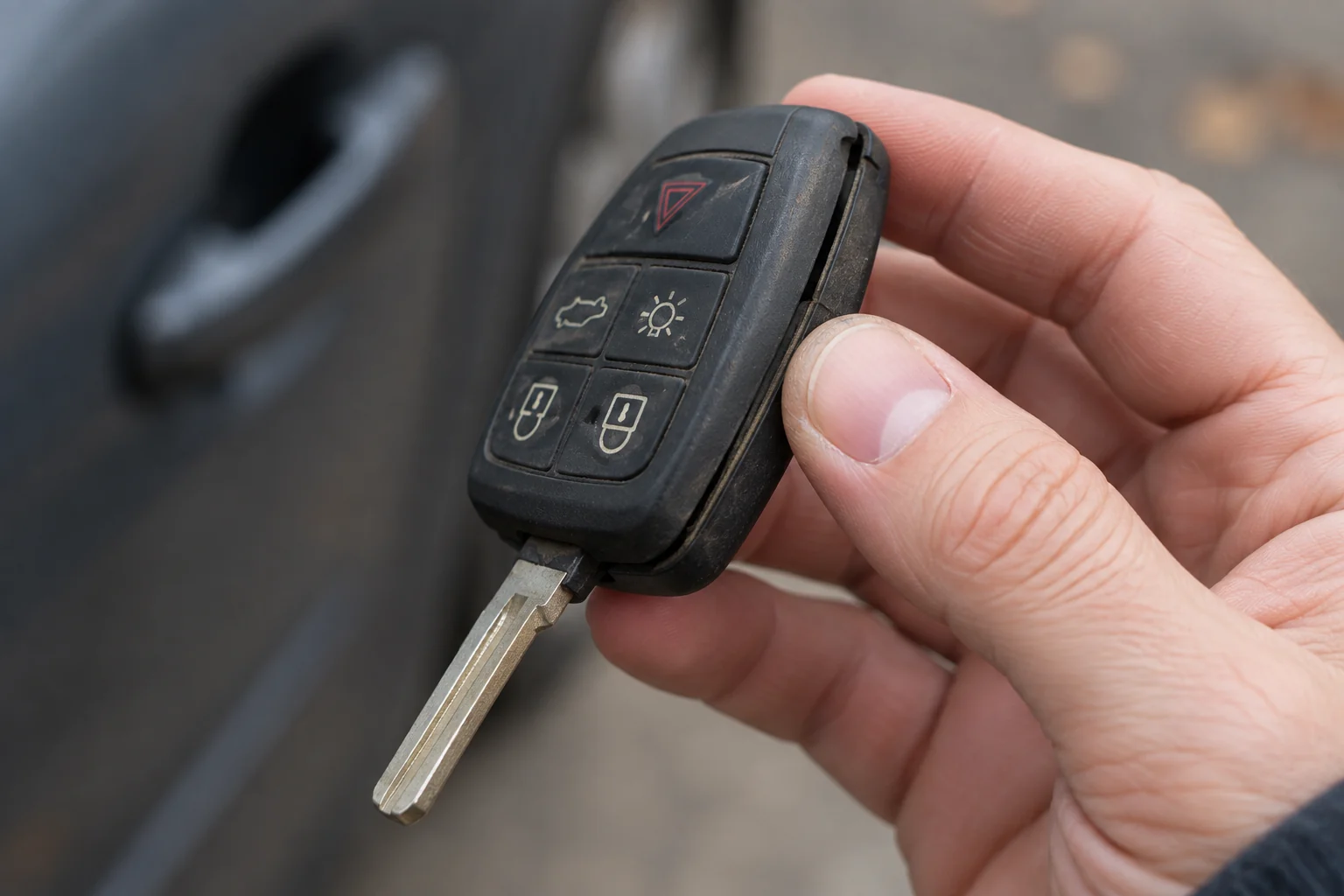
- Worn button surface, sound case: check whether a button layer or cover section is available.
- Split or loose case: assess the complete housing.
- Loose or damaged blade holder: assess the holder and case, not just the buttons.
- Unresponsive remote: investigate function separately from exterior wear.
Separate worn buttons from a remote that does not respond
Before choosing an exterior replacement, check whether the remote still does what each button is meant to do. Press each button once in a situation where you can clearly see or hear the vehicle respond, and note the result separately. A button with a faded symbol may still work every time; a button that looks intact may not. Visible wear and remote operation are separate clues.
Pay attention to what has changed. If a button still operates reliably but its surface is worn, an exterior part may address the wear you can see. If it works only after repeated presses, needs unusually firm pressure, or has stopped working, a new outer cover should not be treated as a reliable fix. Those symptoms could involve the button contact or another internal issue, even when the visible button surface looks damaged too.
If none of the remote buttons responds, consider the possibility of a depleted battery or an internal fault before assuming the Volvo S40 keypad shell is the cause. The lack of a response does not, by itself, identify which one is responsible. It also does not rule out a problem elsewhere, such as the vehicle failing to receive the signal. An exterior inspection cannot settle that question.
A mixed result can be useful, though it is still not a diagnosis. For example, if lock responds normally but unlock never does, record that difference rather than describing the whole remote as dead. If both buttons work sometimes and fail sometimes, note whether the problem occurs with ordinary presses or only when you press harder. There is no need to keep forcing a reluctant button; repeated hard presses may make it more difficult to judge how it normally behaves.
If you have another working remote for the same vehicle, comparing its behaviour in the same situation can add context. If neither remote gets a response, that points away from the worn buttons on one key as the only explanation. If the other remote works while the worn one does not, the problem is more likely to be with that key, but the comparison still cannot distinguish a battery issue from a fault inside it.
Use these observations to keep the decision narrow: an exterior replacement addresses exterior condition, not an unconfirmed electrical fault. Where button wear and unreliable operation occur together, treat them as two questions. You can assess the visible wear, but do not count on a Volvo S40 key shell replacement to restore remote operation without first establishing why the remote fails.
Check what the replacement listing includes and whether it matches
Start with the contents list, not the product title. A listing for a “Volvo S40 keypad shell” might show a button layer, a cover section or a complete case. Check the written description against the photos: does it include only the visible buttons, one piece of the outer case, or both case halves? If the photos show several pieces but the description names only one, ask the seller which pieces are supplied before ordering.
Match the buttons on your existing key one by one. Count them, compare their positions and check the symbols. Two covers can look similar at a glance but place a boot-release button in a different position, for example. Also compare the outline of the button area and how it sits within the surrounding case. A Volvo S40 key button cover with the right number of buttons is not necessarily the right cover if its edges or layout differ.
For a larger Volvo S40 key housing, compare the whole case from several angles. Look at its length and outline, the location of the seam, and the shape of the sections where the two halves meet. Photos of the front alone may hide an important difference on the back or at the blade end. If a listing offers dimensions, use them alongside the photos rather than treating a close visual resemblance as enough.
Pay particular attention to the blade-holder design. Check where the blade enters or attaches to the case, its orientation and, if your key has a folding blade, the shape of the pivot area. A case with matching buttons but a different blade holder may not be suitable. If that part is not clearly pictured, request a photo of the blade end; do not assume that every similarly shaped case accepts the same blade arrangement.
Treat “S40”, “V40” and combined S40/V40 labels as ways to find possible listings, not as confirmation of fit. Sellers may group keys under broad model names, while the physical key in your hand is the comparison that matters. A model or year stated in a title does not resolve a visible mismatch in button layout, case shape or blade holder. When the listing gives only a vehicle name and one generic image, there is not enough information to confirm the part.
Finally, check what the listing does not include. “Shell” or “case” may mean an empty exterior without a blade, circuit board or other internal components; another listing may include a blank blade. Confirm whether the pictured blade is supplied and whether the offer is for exterior pieces only. If you plan to retain parts from your existing key, check that the listing describes a place for them and shows the relevant interior, rather than assuming they will transfer between different case designs.
Before selecting a Volvo S40 key shell replacement, you should be able to identify the supplied pieces and match the button layout, exterior shape and blade end to your original key. If any of those checks depends on a photo angle the listing does not provide, get clarification first. A precise answer about the contents and physical form is more useful than another broad compatibility label.
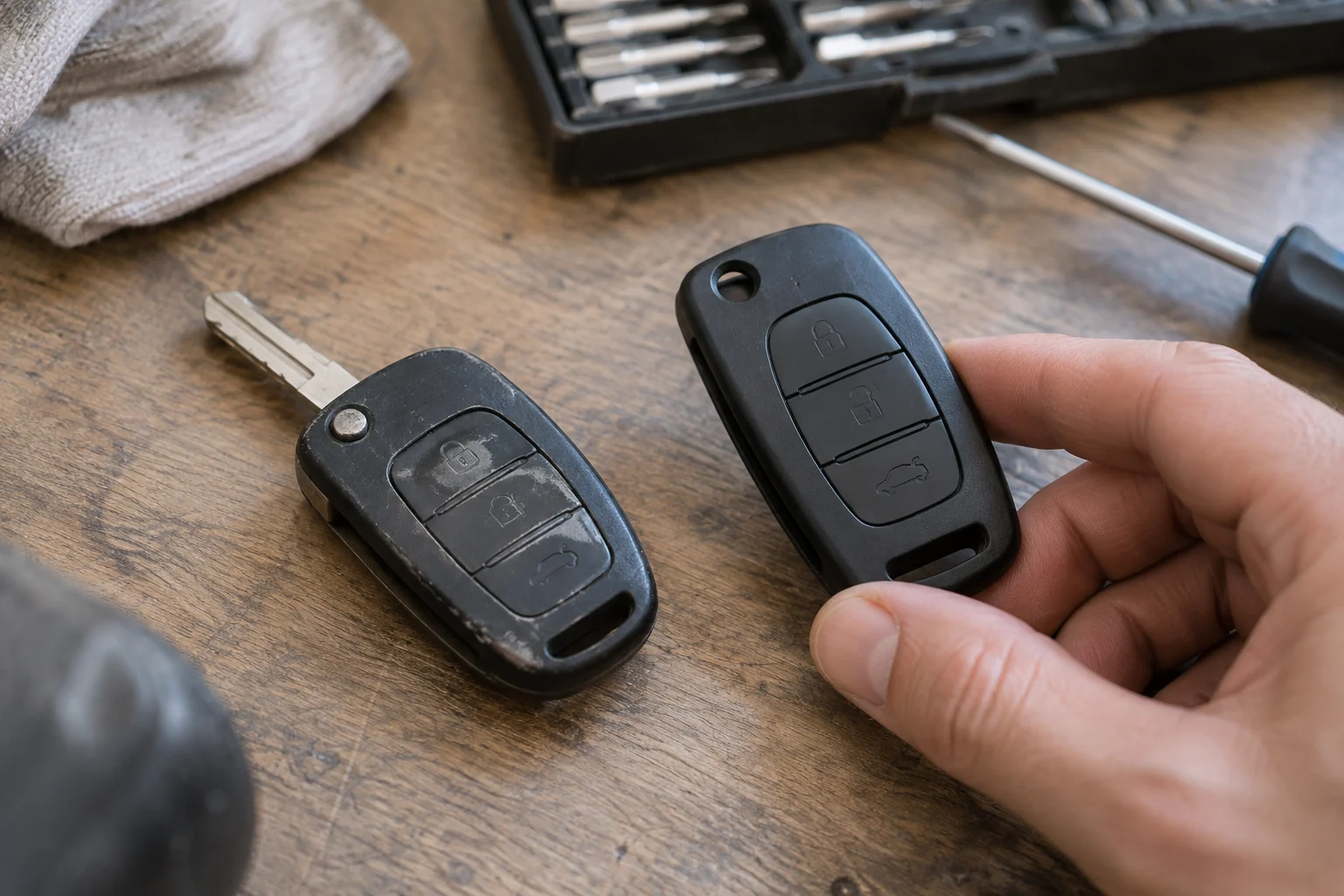
- Identify exactly which outer pieces are supplied.
- Compare button layout and housing shape with the original.
- Check blade and electronics inclusions explicitly.
- Do not treat an S40 or S40/V40 label as proof of fit.
Conclusion
Replace only the part that is damaged, but check that the replacement matches your existing key before ordering. Worn buttons may call for a keypad shell if the rest of the case still closes securely. If the housing is cracked or no longer holds together properly, a button-only replacement will not solve that problem. Compare the shape, button layout and internal mounting points shown in the listing with your key. An S40/V40 label alone is not enough to confirm that a part will fit.
Questions about a worn Volvo S40 key
What if the button symbols have worn off but the remote still works?
If the buttons still respond normally, faded symbols may be a cosmetic problem rather than a sign of another fault. Check whether you can still tell the buttons apart in everyday use. A replacement button pad may restore legibility, but confirm what the part includes before ordering.
What should I do if a missing button leaves the inside of the key exposed?
Keep the key away from moisture and loose debris, and avoid pressing exposed parts directly. A missing button may have left more than a cosmetic gap, so have the key assessed before choosing a replacement. An outer cover alone may not address damage beneath the opening.
Will changing only the outer part require remote programming?
That depends on what stays in the key and what is replaced. Moving the existing working components into a new outer part is different from replacing the remote electronics. Check the proposed part and the work involved before assuming programming is either necessary or unnecessary.
Can I keep using my existing metal key blade?
Possibly, if the blade is in good condition and the replacement part is designed to accept it. Check how your current blade is attached and what the listing supplies. Do not assume a blade can be transferred just because the new case looks similar from the outside.
What if I have only one working key?
Protect it while you decide what needs replacing. If opening the case or transferring parts is uncertain, avoid taking apart your only working key just to inspect it. An assessment before disassembly can help you choose a next step without risking the key you rely on.
Could a sticky button simply need cleaning?
Yes. Dirt on the surface or around a button can make it feel sticky, but a worn or damaged button material may feel similar. Look for visible residue and changes in the button’s shape. Avoid forcing the button or letting cleaning liquid run into the case; seek advice if the cause is unclear.
Which photos could help clarify a replacement-part enquiry?
Take clear, well-lit photos of the original key’s front, back and sides, including any worn buttons, gaps or loose areas. These views can make it easier to discuss the part with car-keys.lt. Keep personal documents and identifying details out of the frame; photos help narrow the enquiry but may not establish compatibility on their own.
Can a damaged outer case affect how the blade is held?
Yes. If the case is cracked or loose where the blade is held, the blade may move even when the metal itself looks sound. Have that area assessed rather than judging it by the blade alone. A secure-looking replacement must also suit the way your existing blade is mounted.
Choose the option that matches your vehicle and situation.
Frequently asked questions
Where can I find more information?
More information is available at car-keys.lt.
