
- Letters or numbers moulded into a key housing are clues, but their presence alone does not establish an orderable shell part number.
- Record which half of the case carries a marking; a code on the circuit board identifies a different component from the housing.
- Compare a suspected matching marking in the same location on both cases, rather than treating similar-looking numbers anywhere on the key as equivalent.
- A sealed key may not reveal its internal markings, and opening it solely to search for a code risks damaging parts you need to retain.
- Even when markings appear to match, the replacement must accommodate the original circuit board and align its buttons with the controls.
- Check the blade attachment separately: a code match cannot establish that the existing blade will secure in a replacement housing.
A number inside your BMW key may help narrow down a replacement shell, but it cannot confirm fit on its own. A marking on the circuit board, battery or another component may identify that part rather than the plastic housing you need to replace. Even a number molded into the case needs to be checked against the key’s physical construction.
On car-keys.lt, the useful question is not just “What does this code mean?” but “Where exactly is it printed?” That distinction matters when a listing pairs a familiar-looking number with photos of a housing that has different button openings, internal supports or a different blade attachment. Two keys can look alike in a small product image yet hold their components differently.
Before ordering, keep the old housing if you can and compare clear views of its outside and inside with the proposed replacement. This article explains how to treat BMW key shell identification markings as clues, what else to inspect on the case, and when a seller’s description leaves too much uncertainty to choose a shell confidently.
First identify what carries the marking
A number inside a BMW key does not, by itself, identify a replacement shell. First establish which component carries it. A mark moulded into the plastic housing is a clue about that plastic piece. A mark printed on the circuit board belongs to the electronics, even though you can see it inside the case. Treating a board marking as a housing code can lead you to search for the wrong thing.
For a mark on the housing, note whether it appears on the front half, the rear half or a separate piece, such as a battery cover. “Inside the key” is too broad a location: several components may carry letters or numbers, and their markings need not refer to the assembled case. If the same key shows one code on the button side and another on the back, keep them separate rather than combining them into a single shell identifier.
How a mark is applied also helps identify its source. Raised or recessed characters formed in the plastic are moulded housing marks. Ink or a label attached to another component is not. If a number is visible through an opening in the housing, check what surface it is actually on before calling it a case marking. The useful distinction is not simply inside versus outside; it is plastic housing versus something housed within it.
Even a clearly moulded mark is not automatically an official BMW part number or a number you can order by. Letters and digits may serve a purpose in making or tracking a plastic component, but their appearance alone does not establish what they mean. Nor does a familiar-looking format prove that the mark identifies the complete shell rather than one half of it. Without a documented interpretation for that specific code, call it a marking, not a part number.
Record the full marking exactly as seen, including letters, digits, spaces, punctuation and any characters whose reading is uncertain. Note which component carries it; for example, “recessed on the inside of the rear housing half” is more informative than “numbers inside BMW key case.” Do not silently drop a small character because it looks incidental, or change a letter that resembles a digit. An exact record preserves the clue for later comparison, while keeping its meaning open until there is evidence to support it.
What to record without risking the original key
Start with the key as it is. Photograph the front, back and sides in good light, then take a close-up of the seam around the case. Include one clear image of the whole key before taking close-ups, so you can tell later which key and which side each detail came from. If the case is already open, photograph the accessible interior before moving anything.
Keep every letter or number tied to its location. A note such as “inside rear half, beside the lower edge” is more useful than a list of codes with no context. Take one photograph wide enough to show where the marking sits and another close enough to read it. If you have several keys, keep their photos in separate folders; similar-looking cases can otherwise be easy to mix up.
Record uncertain characters as uncertain. Wear, shallow moulding and reflections can make an 8 look like a B, or hide the end of a line. Write “8 or B” rather than choosing the character that seems most likely. Try a second photograph from a different angle, with light falling across the marking instead of straight onto it. Do not scrape, ink or rub the plastic to make a code easier to read.
An interior marking is not worth damaging a working key to obtain. If the case has no obvious user-accessible opening, resists gentle handling or appears sealed, stop. Do not drive a blade into the seam or force the halves apart solely to find a code. That can mark the housing or disturb parts you still need. Avoid following opening instructions for a different-looking key: the presence of a seam does not establish that your case is meant to come apart that way.
When internal access is unsafe, work with the evidence you can collect from outside. Clear views of the overall shape, buttons, edges and seam establish what you actually have, even if they do not reveal any BMW key shell identification markings. Note plainly that the interior was not inspected. That is more useful than presenting an unread marking—or a guessed one—as confirmed evidence.
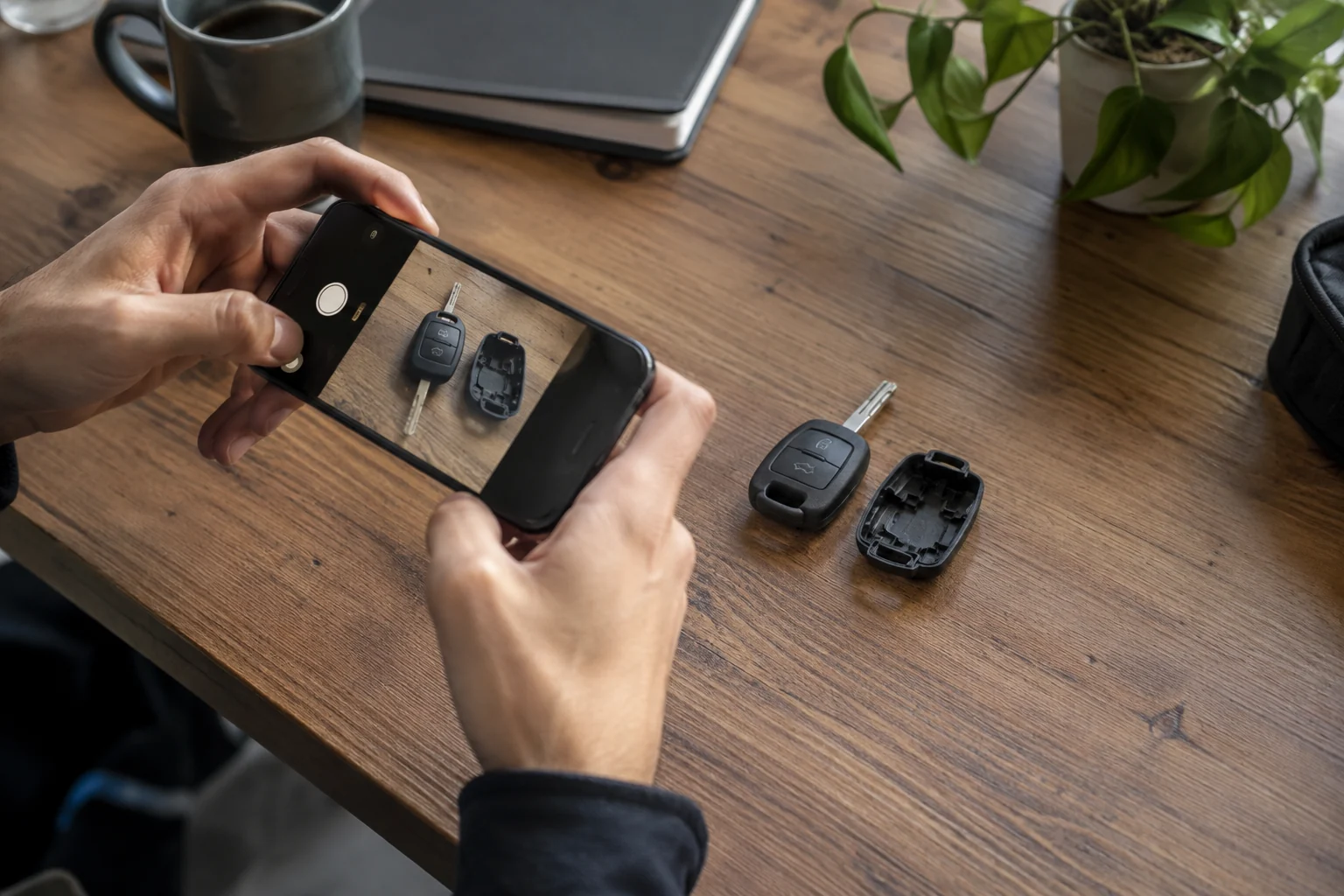
- A hidden marking may not provide enough information to choose a shell.
- Opening the case can damage components that need to be retained.
Compare like-for-like markings, not just similar numbers
A marking can help narrow a shell search only when you compare the same kind of marking in the same place. If the code on your key is moulded into the rear housing half, look for it on the rear half in the listing. A matching sequence shown on the front half is not a like-for-like comparison. Nor is a number on the circuit board evidence that the replacement case carries the same marking.
Compare the entire marking, character by character. A listing that shares 123 with your key’s A123B has not shown an exact match. Check letters before and after the numbers, punctuation, spacing and any second line. Look closely at characters that are easy to confuse in photographs, such as 0 and O, or 1 and I. If one character on either side is unreadable, call the comparison uncertain rather than filling in what you expect to see.
Position matters as much as transcription. Two photographs may show the same string, but if one crops out the edge of the housing, you may not be able to tell which half it belongs to or where it sits. Compare the mark against visible landmarks on that half, rather than relying on the seller’s typed description. If the listing offers several shell versions under one set of images, ask which photographed interior belongs to the version you would receive.
When the relevant surface is missing, request a clear interior photo of that housing half, with the marking and enough surrounding plastic visible to establish its position. You can send the seller your close-up and ask them to photograph the corresponding area of the offered shell. A reply that repeats the number in text, without showing where it appears, leaves the central comparison unresolved. The same applies if the seller supplies only an electronics photo when you need to compare a housing mark.
Even an exact, location-matched code is a lead, not a fit confirmation. It tells you that two visible markings agree; without documentation establishing what that marking denotes, it does not prove that every relevant feature of the shells is the same. Use the match to shortlist a listing, then check the other physical compatibility points before ordering. If the seller cannot show the corresponding mark clearly, treat the code comparison as incomplete rather than assuming that similar numbers are close enough.
Check whether the original electronics will fit
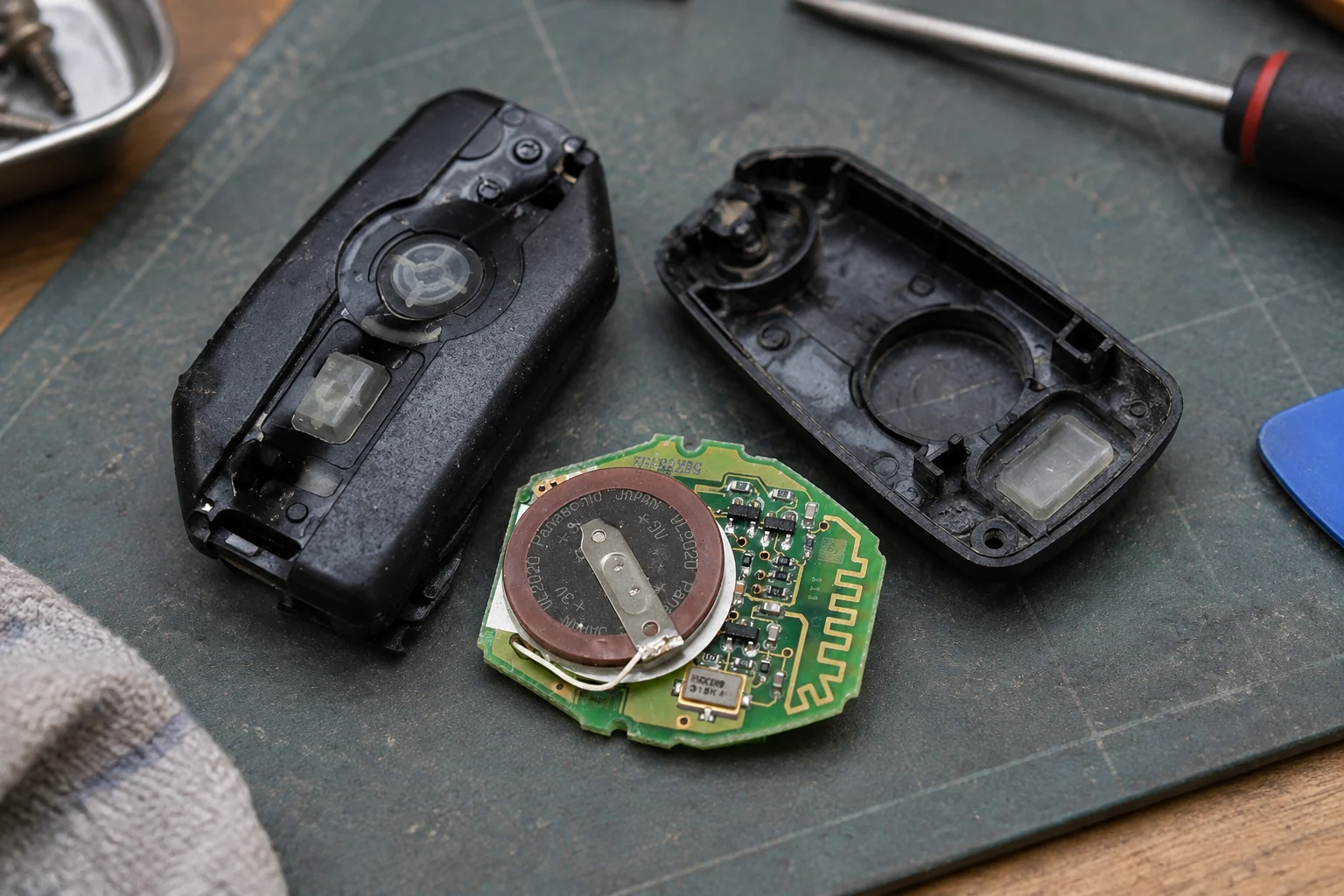
A matching marking cannot show whether your original circuit board will sit properly inside a replacement shell. Compare the inside of both case halves, not just their outline. Look at the shape and depth of the board cavity, the edges that guide the board into place, and any posts, clips or ledges that hold it steady. A shell can look identical from the outside yet press on the board or leave it loose.
Use clear interior photographs of the proposed shell alongside photographs of your open key, if you have them. Check features in relation to one another: for example, a locating post beside the board in the original should not occupy space used by a component on your board. The board’s overall shape is only a starting point; a small difference around a corner or raised component may prevent the case from closing without pressure.
Next, compare the controls with the shell’s buttons. Count the buttons, then check their order, spacing and position against the switches on the original board. Three buttons on each case are not enough if one sits higher, closer to the edge or over a different part of the board. Look at the inside of each button area as well: the part that presses a switch must reach the right place without holding the switch down when the case is closed.
Check what else the original housing holds. Depending on the key’s construction, parts such as a button pad, battery holder, contacts or an internal insert may be separate from the circuit board. Identify which parts are present in your key and whether the advertised shell includes a place for them—or expects them to be reused. Do not assume that a bare shell photograph shows every piece needed to house your existing electronics.
Photographs are more useful when they show both halves straight on, in good light, with the recesses and retaining features visible. An angled exterior shot can confirm the general appearance but cannot show whether a clip meets the board correctly or whether the buttons line up with its switches. If a listing shows only the front of the key, it provides too little evidence for this particular check.
The practical test for BMW key shell identification markings is therefore limited: a code match may point you towards a candidate, but it does not establish internal fit. The stronger comparison is between the original electronics and the proposed housing’s cavity, supports, button positions and spaces for retained components. Where those details cannot be seen, compatibility of the electronics remains unconfirmed.
Check the blade mount before deciding to order
Before ordering, check how the blade is held in your existing key and whether the proposed shell provides the same place for it to attach. A match between BMW key housing markings does not establish that the blade will be secure. The blade mount is a separate part of the fit check: two housings may look alike in a listing while differing where the blade meets the case.
First, establish what the listing actually includes. Is it an empty housing intended to take your existing blade, or does it include a blade of its own? If you plan to reuse yours, compare the part of the blade that sits inside the housing with the corresponding opening or mount in the replacement. If the listing includes a blade, do not assume it can simply replace yours. Ask the seller how they expect the blade to be used with that shell before treating the listing as compatible.
Use clear photos of the blade end of the housing, not just the button face and outer outline. Look for the features that hold the blade in place and check that they appear in the same positions relative to the blade opening on your key. For a folding key, the photos should also show enough of the blade’s attachment area to make a meaningful comparison. A closed-key photo cannot show whether the mount matches.
Pay attention to what you cannot see. A listing photo taken at an angle may hide the area where the blade is retained; a photo of a shell with a blade already fitted may obscure the connection. Neither view is enough to confirm that your blade will attach securely. Request a straight, well-lit close-up of the relevant area, and ask for views of both housing halves if the mount is partly enclosed. Tell the seller which blade you intend to keep so the answer addresses your intended use, not merely the shell’s exterior shape.
If the seller cannot provide a useful view or explain which blade the housing accepts, pause rather than order on the strength of the code alone. The same applies if your key is damaged around the blade mount: damage can make a comparison misleading, and removing the blade may risk making a working key unusable. Have a qualified key specialist assess an uncertain or damage-prone transfer before attempting it.
Order only when the available evidence supports both the housing choice and the blade attachment. If the blade connection remains a guess, the marking has helped narrow your search, but it has not finished the compatibility check.
The letters or numbers inside a BMW key can help identify it, but they are not enough to order a replacement shell with confidence. Compare the existing case with the shell you are considering, paying particular attention to its shape, button layout, blade opening and how the case closes. If the photos or description do not let you confirm those details, ask the seller to check before ordering. That extra check matters whether you are buying locally in Lithuania or from abroad: a matching marking does not, by itself, establish that the case will fit.
- A marking compared on the same housing half and in the same position
- Clear views of the original and proposed replacement interiors
- Matching button positions and room for the original electronics
- A separately checked blade attachment
- No unresolved fit question that depends on guesswork
Choose the option that matches your vehicle and situation.
Frequently asked questions
Can the code stamped on the metal blade identify the plastic shell?
Not on its own. A stamp on the blade is a marking on the metal component, not necessarily a part number for the plastic housing. It may be a useful clue, but it does not prove that a replacement shell has the right interior, blade mount or joining edges.
What if the two halves of my key have different moulded numbers?
Record each number with the half it appears on. The halves are separate pieces, so different markings do not, by themselves, mean something is wrong. When comparing a replacement, match each marking to the corresponding half rather than treating the two numbers as interchangeable.
Does a letter at the end of a moulded number indicate a different shell?
It might, but there is no safe universal meaning for a suffix without documentation for that marking. Do not assume the letter denotes a change in shape, colour or production version. Record the complete number, including the letter, and compare it on the same housing piece alongside the piece’s visible features.
Can my vehicle identification number replace photos of the original key?
A VIN identifies the vehicle, not the condition or construction of the key you currently hold. It cannot show whether that key has a replacement housing, a damaged blade mount or a particular internal layout. Photos of the actual key are still useful when assessing whether its existing parts can be transferred.
What if a replacement listing shows only the closed key?
A closed view leaves the interior and blade attachment unverified. If you are comparing an option on car-keys.lt, ask for clear views of the relevant inner surfaces and blade mount before deciding. If those details cannot be checked, a similar exterior is not enough to establish a fit.
Can I replace just the damaged half of the housing?
Possibly, but the replacement must mate with the half you intend to keep. Matching an outer shape or a moulded number alone does not establish that the clips, edges and button openings will line up. Do not force the halves together if they resist or leave an uneven gap.
Will changing only the shell require reprogramming the key?
A housing-only change is different from replacing the electronics: if the original electronics remain in use, changing the plastic shell does not itself replace their programming. That is not a guarantee of a working key afterward. Parts can be damaged during transfer, and buttons may fail to operate if the new housing does not align properly.
What if part of the marking has worn away?
Write down only the characters you can read and mark the rest as illegible. Guessing a missing digit or letter could make an unrelated shell appear to match. Use other visible evidence—such as the key’s shape, button arrangement and any undamaged markings—and pause if the remaining details do not support a confident comparison.
