
Compare the original key’s shape, controls, blade mount and internal layout before ordering.
- A BMW F Series label identifies a broad vehicle family, but it does not by itself confirm that every key shell has the same shape.
- Button count is only an initial clue; button positions, spacing and surrounding cut-outs must also correspond to the original key.
- The shell’s seam, clips, openings and overall front, rear and side profiles should match before internal components are transferred.
- The blade mount requires a separate check because a housing can appear compatible while using a different blade attachment arrangement.
- Circuit-board clearance, battery space and internal supports determine whether the original electronics can sit securely inside the replacement housing.
- Replacing a shell does not automatically cut a blade or program a key, so mechanical fit and electronic functionality remain separate questions.
A BMW F Series key shell is not automatically compatible with every F Series key. The label usually describes a broad vehicle generation, while the actual fit depends on the shape of the housing, the position and style of the buttons, the blade attachment and the space provided for the original electronics. Two keys with the same number of buttons may still use different internal layouts or mounting points.
Before ordering, compare the replacement shell with the key you already have rather than relying on the vehicle model or a product title alone. Start with the overall outline and button arrangement, then check how the blade is fitted and whether the circuit board, battery and other components can be transferred without pressure or movement. Small differences in clips, posts or button membranes can make an otherwise similar shell unusable.
This guide explains how to make those comparisons systematically and where visual similarity is not enough. It also highlights the details that product photos often fail to show, so you can identify uncertainty before opening the original key or placing an order. If any essential feature cannot be confirmed, treat the shell as unverified rather than assuming it will fit.
What “BMW F Series” Does—and Does Not—Tell You
“BMW F Series” is a broad vehicle-generation label, not a single key design. It covers multiple BMW models and production periods, and those vehicles may use different key housing shapes, internal arrangements, or mechanical blade solutions. Therefore, a listing that mentions the F Series gives you a useful starting point, but it does not confirm that the BMW F Series key shell will fit your original key.
The model family alone is not enough because shell compatibility depends on the specific key variant. Two keys associated with F Series vehicles may have a similar number of buttons while differing in their casing, component supports, or blade attachment. Conversely, a shell advertised for a particular model may apply only to certain keys or production versions. Treat labels such as “fits F10/F20/F30” as claims to verify, not as universal compatibility statements.
Assess compatibility in separate layers:
- Housing: Does the replacement casing match the original key’s overall design and component arrangement?
- Blade: Can the existing mechanical blade or blade assembly be attached and retained correctly?
- Electronics: Is there enough space, and are the original circuit board, battery area, and other components supported in the correct positions?
These checks are related but not interchangeable. A shell can resemble the original BMW key casing and still fail because the blade mount or internal layout differs. Likewise, a mechanically suitable BMW key replacement shell may not provide the correct space for the original electronics. The detailed physical and internal comparisons should be made separately rather than inferred from the vehicle name.
Before ordering, record the exact BMW model, production period if known, and the key’s identifying information. Check for a part number, label, markings, or other identifiers on the original key and photograph it from several angles. Note the button count and arrangement as identification clues, but do not use button count alone as proof of fit. If the original key has already been opened, record the shape and position of its major components without assuming that another F Series variant uses the same layout.
Be cautious with broad marketplace wording such as “BMW F Series key shell” or “BMW key fob housing.” Ask the seller to confirm the shell against your exact original key variant, preferably using clear photos or a part-number match. If the listing does not identify the relevant variant or shows a visibly different housing, blade arrangement, or internal design, compatibility remains unverified.
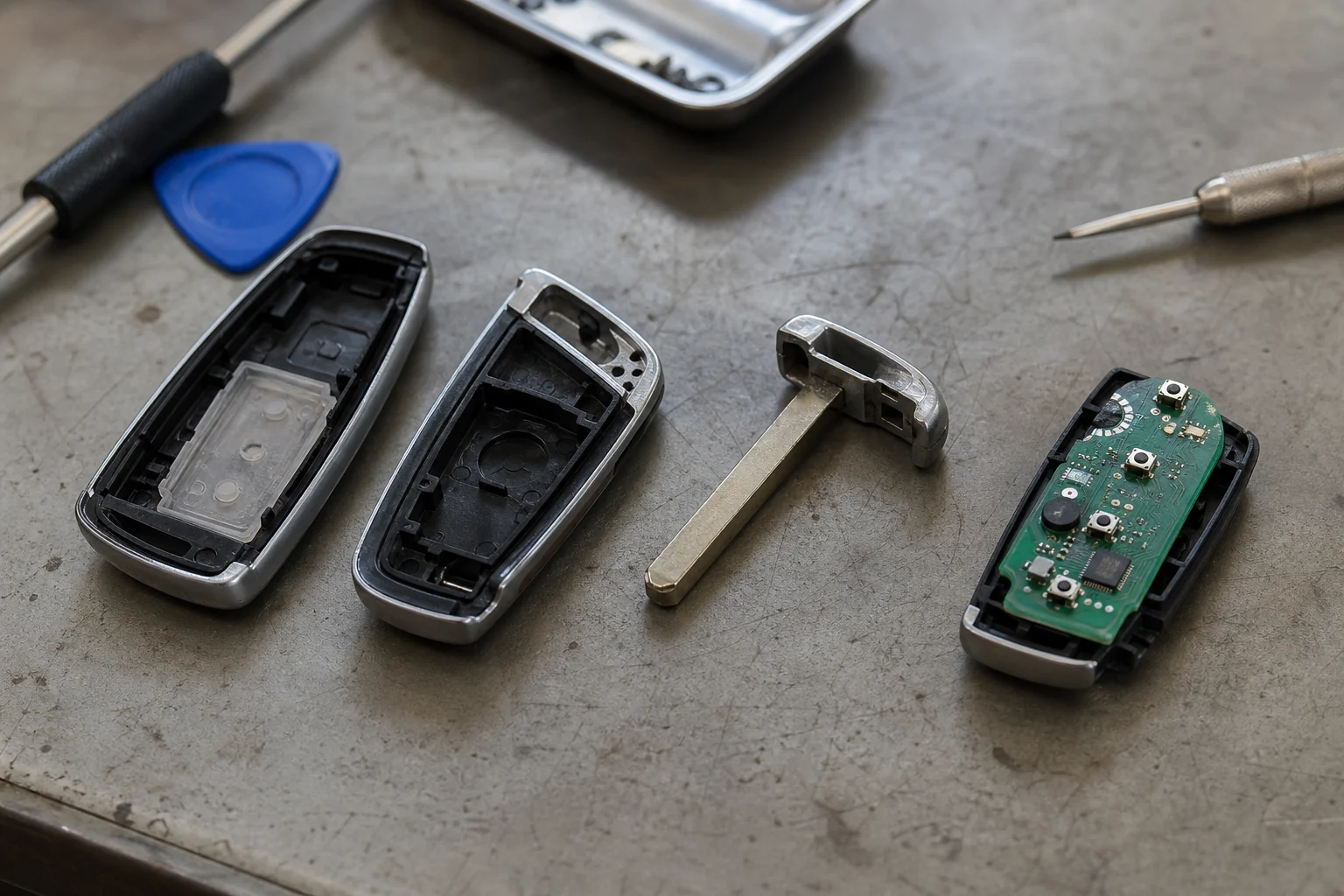
Compare the Original Housing and Button Layout
Start with the outside of your existing key, not the vehicle model listed in an advert. Compare the replacement shell with the original from the front, rear, top, bottom, and both sides. The outline should match without relying on a flexible cover to hide differences. Check the overall length, width, thickness, corner shape, button-panel angle, and any raised or recessed sections. A shell can look correct in a single front photograph yet differ noticeably at the sides or back.
Button count is only an initial clue. Two keys may both have three or four buttons but use different button positions, spacing, or panel shapes. Compare each symbol and opening individually: lock, unlock, boot or other functions should sit in the same order and at the same distance from the edges. Also check whether the original uses separate openings, one continuous rubber-button area, or a shaped insert. If a button sits partly over a curved edge or close to a seam, even a small positional difference can stop it from pressing properly.
Look around the buttons for the cut-outs and surrounding borders. The openings should match the original in shape, depth, and corner radius, rather than merely having the same number of holes. Pay attention to small details such as a narrow slot, indicator-light window, recessed logo area, or a raised guide around the control panel. Use clear, straight-on photographs of both keys where possible. Angled marketplace images can make spacing appear different, so do not judge compatibility from a single distorted picture.
Check the Shell Edges and External Features
Examine the seam where the two housing halves meet. Its path should follow the same route around the key, especially near the button panel, corners, and key-ring end. Compare visible clips, screw openings, latch points, and any small access openings on the sides or rear. These features are part of the housing design; if they are absent, shifted, or shaped differently, the replacement may not close or may leave a gap even when the front face looks similar.
The key-ring feature deserves its own comparison. Check its position, thickness, opening shape, and connection to the main body. A loop that appears similar in a photograph may be offset or too narrow for the original attachment point. Likewise, compare the rear cover’s profile and any recesses rather than assuming that a matching logo area proves the BMW key casing is correct.
Treat a near-match as unconfirmed. For example, a BMW F10 key shell, BMW F20 key shell, or BMW F30 key shell may resemble another listing’s housing in size and button count, while differing in seam placement or external cut-outs. Before ordering, place the original beside the seller’s product images and mark every visible mismatch. If the images do not show the rear and side profiles, request variant-specific photographs or reliable measurements. Do not rely on a broad “F Series” description until the exterior comparison is complete; the next checks must separately confirm the blade and internal fit.
- Photograph the original key from every side.
- Compare button positions, not only button count.
- Inspect the blade attachment arrangement.
- Check the circuit-board outline and battery space.
- Confirm what the shell purchase does and does not include.
Check the Blade Mount Separately
A replacement housing can match the outside of your key and still be unusable if the blade mount is different. Check how the blade is attached before ordering a BMW F Series key shell: it may be fixed in the housing, removable, or held by a pin, screw, clip, or pivot arrangement. Do not assume that two keys with the same number of buttons use the same mechanical blade fitting.
First, identify the blade’s position and movement. On a folding key, compare the location of the pivot, the direction in which the blade folds, and the space available for the blade when it is closed. On a key with a separate or fixed blade, check where the blade enters the casing and how it is retained. A mount that is offset by only a small amount may prevent the blade from folding correctly or leave it unable to lock in the open position.
The next question is whether you plan to transfer your existing blade or obtain another one. If your current blade is removable, compare its base, retaining hole, shoulder shape, and thickness with the replacement housing’s mount. If the old blade is fixed, it may not be transferable without the correct replacement arrangement. In that case, a shell advertised as an empty housing may not solve the problem by itself.
Read the product description carefully to establish what the shell includes. A replacement may be supplied with a blade, with an empty blade mount, or with a different blade arrangement. The word “shell” does not automatically mean that a compatible blade is included, cut to your vehicle, or ready to transfer. Cutting a new blade and physically moving an existing blade are separate tasks, so confirm these points before purchase rather than relying on the product photographs.
For a useful comparison, take clear photographs of your original key with the blade fully open and fully closed, including close-ups of the blade base, pivot or retaining point, and both sides of the housing. Place a ruler beside the blade base and record its width, thickness, and the distance from the base to the first shoulder or hole. Compare those measurements with the listing images or ask the seller to confirm them.
If the blade mount, pivot position, or retention method does not match, stop there even if the outer housing looks like a BMW F10 key shell, BMW F20 key shell, or BMW F30 key shell. The mechanical mismatch is enough to reject that option.
Verify the Electronics and Internal Layout
Once the outer housing appears to match, compare the original key’s interior with the candidate shell. Open the existing key carefully and photograph the layout before removing anything. Check the circuit board’s outline, thickness, connector openings, screw points, locating holes, and any shaped corners. The replacement must provide matching support at the correct points; a board that only fits by being squeezed into the cavity can shift, flex, or press against the cover.
Compare the circuit board and battery space
Look for the same battery position and access method. The battery may sit in a dedicated holder on the circuit board, in a separate compartment, or against contacts shaped into the housing. Compare the holder’s orientation, contact position, polarity markings, and the amount of space above and below it. A shell can have the right outside shape but leave too little room for the battery, prevent the cover from closing, or place the access opening away from the battery.
Also inspect the cavity for internal ribs, posts, ledges, clips, and clearance around delicate components. These features keep the circuit board from moving when the key is carried or a button is pressed. Compare their position and height with the original housing. A post that contacts the wrong part of the board may damage a component, while missing clips can allow intermittent operation. Do not file, bend, or remove internal supports simply to force a near-match into place; that can weaken the housing or eliminate the protection the original layout provided.
Use variant-specific information when checking the board and battery details. A listing that names only a broad model family may not show the internal version you have. Compare clear photographs of both opened housings, or ask the seller for images of the cavity and board supports if the listing does not provide them. For example, an advertised BMW F10 key shell, BMW F20 key shell, or BMW F30 key shell may still require a direct internal comparison rather than a decision based on the model name alone. This is central to BMW key shell compatibility: the board outline and support structure must agree, not merely the external casing.
Check the rubber button mat
Remove or lift the rubber button mat only as far as necessary to compare it with the replacement shell. Its button domes must sit directly over the shell’s actuator points, with the same spacing and orientation. Check the mat’s locating tabs, raised edges, and any openings around the board. If the mat is rotated, trapped under a rib, or slightly displaced, a button may feel stiff, fail to register, or remain partly pressed.
Before transferring the original components, place the board, battery, and button mat into the candidate housing without forcing the cover shut. Confirm that the board lies flat, the battery remains secure, the mat stays aligned, and the cover closes evenly along its seam. Then check that no component moves when the housing is gently handled. Secure seating matters because it protects the electronics from impact, prevents pressure on the board, and keeps each button operating consistently.
If the board, battery holder, supports, or button mat do not align naturally, treat the shell as unconfirmed rather than assuming minor adjustment will solve it. Internal compatibility cannot be guaranteed from photographs of the outside alone, so verify the specific original key and candidate shell before ordering or moving any components.
- A broad F Series description may cover multiple key variants.
- Do not force a circuit board or blade into a different internal arrangement.
- Treat shell fit, blade work and programming as separate checks.
Know What a Shell Replacement Does Not Cover
A shell replacement is a housing task: it replaces the worn or damaged outer casing while the usable parts from your existing key may be moved into it. The shell itself does not automatically become a complete replacement key. Before ordering a BMW F Series key replacement shell, check the product description to confirm whether it includes only the housing, buttons, and related casing parts, or something more.
Blade work is separate. If your original blade is reusable and the new housing accepts it, a transfer may be possible. If the blade is damaged, missing, or unsuitable for the new mount, you may need a separate blade solution. Cutting a new blade is a mechanical service based on the vehicle’s key profile; it is not provided merely because the BMW key casing looks correct. Confirm whether the seller supplies an uncut blade, cuts it, or expects you to reuse the original.
Electronic work is separate as well. A shell cannot repair a damaged circuit board, restore missing components, or replace programming. If the original board and related electronics are intact, transferring them may be an option, provided the replacement housing supports them correctly. If the board is damaged or missing, ask what electronic replacement, repair, pairing, or programming options are actually available rather than assuming the shell will solve the problem.
Before ordering, ask four practical questions: Is this a shell-only product? Are the original blade and electronics expected to be reused? Is blade cutting included, if needed? Is any programming or pairing included, or must it be arranged separately? Keep the answers with your photos and key details so BMW key shell compatibility is assessed against the actual item, not just the vehicle model.
Before ordering a BMW F Series key shell, treat the vehicle model and button count as starting clues, not proof of compatibility. The safest match is based on the complete physical design of your existing key: housing shape, button arrangement, blade attachment and the position of the circuit board, battery and other internal parts. If any of these details differ, a shell may look similar yet fail to close, hold the electronics or accept the blade correctly. Compare the old key carefully with the seller’s images and stated specifications before choosing a replacement.
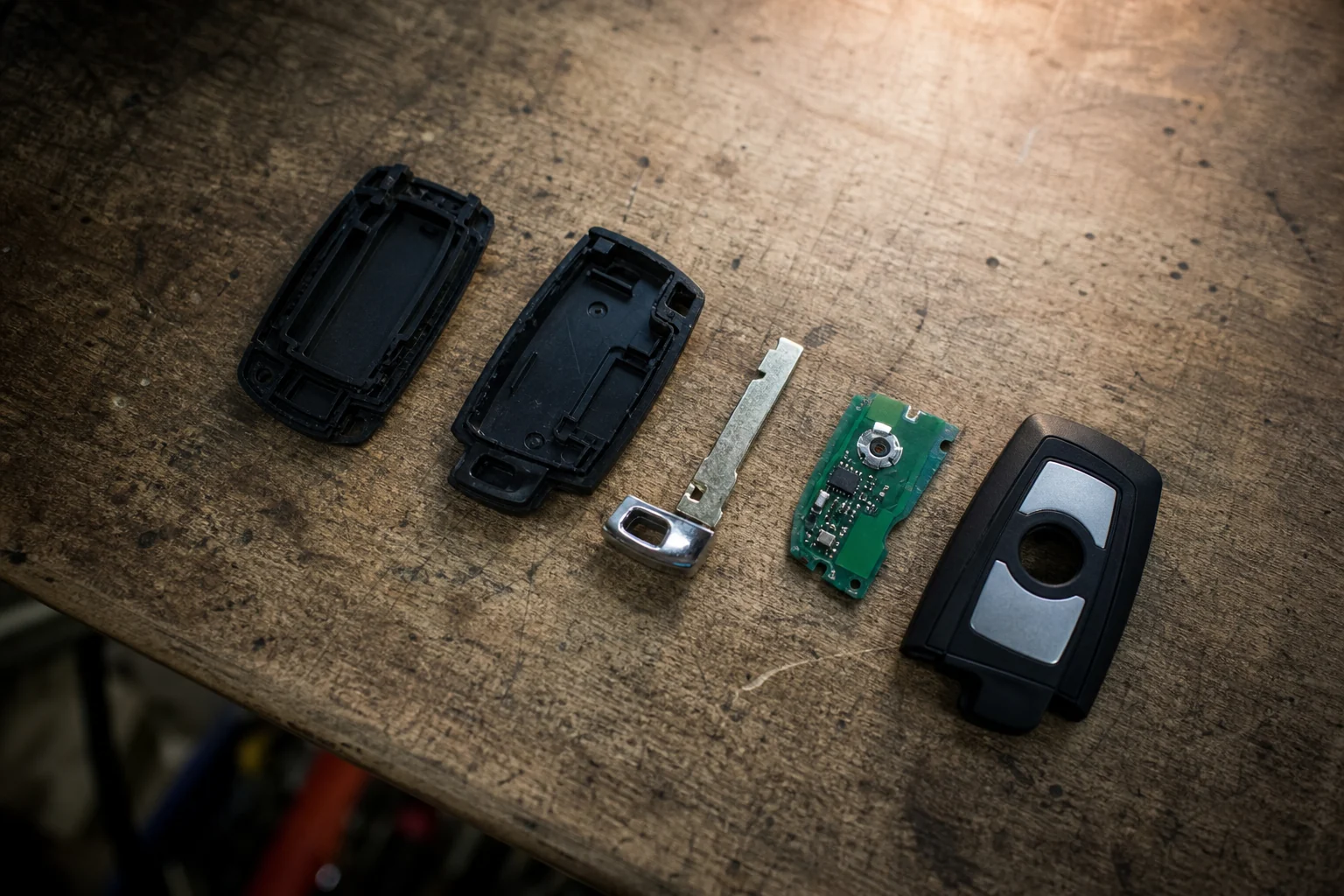
Choose the option that matches your vehicle and situation.
Frequently asked questions
Can any BMW F Series key shell fit any F Series BMW?
No. “F Series” covers multiple BMW models and key variants, so the label alone is not enough. Compare the original housing’s shape, blade attachment, button layout, internal supports and battery arrangement with the replacement shell. The safest reference is the key you already have, not only the vehicle’s model family or production period.
Does matching the number of buttons prove that a shell will fit?
No. The button count is only an initial clue. The buttons must also match in position, spacing, height and shape, while the shell’s surrounding cut-outs must align with the original board and rubber pad. A shell with the correct number of buttons can still be incompatible if its internal layout or openings differ.
What photographs should I take before ordering a BMW key shell?
Take clear, well-lit photographs of the front, back, sides, button face, blade area and shell seam. If it can be opened safely, photograph the internal cavity, circuit board position, battery area and retaining features as well. Keep the images straight and include close-ups of unusual clips, openings or blade mounts.
How can I compare the blade mount with a replacement shell?
Look at how the blade is attached and retained, rather than comparing only the outer profile. Check the pivot point, pin or other retention arrangement, the available space around it and whether the replacement shell is designed for the same blade style. Physical blade compatibility is separate from whether the blade needs cutting.
Can I move my original BMW circuit board into a new shell?
Possibly, but the transfer depends on more than the board’s general shape. Check that the board supports, locating points, battery space and button positions match, and that the original components are undamaged. Do not assume a similar-looking board will seat correctly or that the buttons will operate reliably after transfer.
What if the replacement shell looks right but the circuit board does not sit securely?
Treat that as a compatibility warning. A loose or misaligned board can affect the buttons, battery contacts or other components. Do not force the housing closed or reshape its supports unless you have the appropriate experience and tools. Recheck the internal layout and confirm that the shell is intended for your key variant.
Does replacing the shell cut or program the key?
No. A shell replacement normally concerns the physical housing and, where suitable, the transfer of existing components. Blade cutting is a separate mechanical service, while programming or electronic repair is a separate matter again. Confirm exactly what is included before ordering, especially if the original blade or electronics also need attention.
Are battery type and battery position important when checking a shell?
Yes. The replacement must provide the correct clearance, holder or contact arrangement, and access for the battery used by the relevant key variant. Even when the exterior matches, a different battery position can prevent the board from seating or the shell from closing. Compare the original internal arrangement before purchasing.
