
- A replacement shell may show three buttons yet omit a separate loose pad; confirm the exact parts supplied in the current listing.
- Identify whether the fallen piece is the visible button face, an internal rubber pad or another insert before selecting a replacement.
- Button count alone cannot establish fit; compare the original remote’s button positions, housing shape and internal layout with the replacement.
- A shell cannot repair a damaged switch on the circuit board, so an unresponsive button needs more than a casing assumption.
- Do not assume a casing-only purchase includes the circuit board, transponder, battery or blade; check each item against the listing.
- Keep the fallen piece and photograph both sides of the remote to compare the missing component with the listed shell contents.
If a button has fallen out of your Porsche remote, a replacement shell is not automatically the missing part. The button face pictured on a shell may be part of the outer housing, while a flexible pad behind it may be a separate piece. First, look at what came loose and where it sat in the remote.
That distinction matters when shopping for a Porsche three-button replacement key shell. A product photo can show the remote assembled, but it does not always tell you which loose components are included. Likewise, “three-button” describes the layout, not a promise that a separate internal pad comes in the package. Buying by appearance alone could leave you with a new case and the same missing piece.
For car-keys.lt readers, the useful starting point is the part in your hand, not the name of an online listing. The checks below will help you identify what fell out, read shell photos and descriptions more carefully, and confirm the package contents before you order. If the listing does not make those contents clear, treat them as unconfirmed rather than assuming the pictured buttons answer the question.
First, identify the piece that fell out
Keep the piece that fell out, even if it looks like a scrap of rubber or plastic. Photograph both sides beside the remote, then take a clear photo of the empty opening and the buttons still in place. A close-up of the piece on its own can hide its size and orientation; the remote provides the useful comparison.
Start with the side that normally faces your thumb. If it has a printed symbol, a shaped button surface, or a finish matching the remaining buttons, it is likely the visible button face. Check whether its outline follows the opening and whether its curve sits level with the surrounding housing. A rigid piece may also have small tabs or edges on the back; note where they are, but do not press it into place to test a guess.
A soft piece needs a closer look. What appears to be a missing Porsche key button may instead be material that sat beneath the visible surface. Compare its colour, thickness and shape with anything you can see under an intact button. A flexible piece with several raised areas may span more than one button position, even if only one part was exposed when it came loose. Conversely, a small flexible piece shaped for a single opening may be separate from the other buttons. These are clues, not names to assign from appearance alone: remote designs can put the visible surface and the material beneath it together or in separate pieces.
Look at the empty opening without pulling at the remaining buttons. Can you still see a button face sitting loosely in the opening, with a gap beneath it? Or is the visible face itself gone, leaving the material below exposed? Compare the depth and edges with a neighbouring intact button. This helps distinguish a surface that detached from something that slipped out from behind it. If the opening is too dark or narrow to tell, take an angled photo in good light rather than using a sharp tool to probe it.
Do not assume every loose insert is a button part. A plain strip or small unmarked piece that does not follow a button’s outline may have come from the surrounding housing. Set any pieces beside the remote in the positions where they seem to belong and photograph that arrangement too, without forcing them into place. If several pieces fell out, keep them together but record each side separately. The useful description is specific: for example, “the marked outer face is missing” or “the outer face remains, but a flexible piece came from underneath.” That distinction is what you will need when checking what a replacement contains.
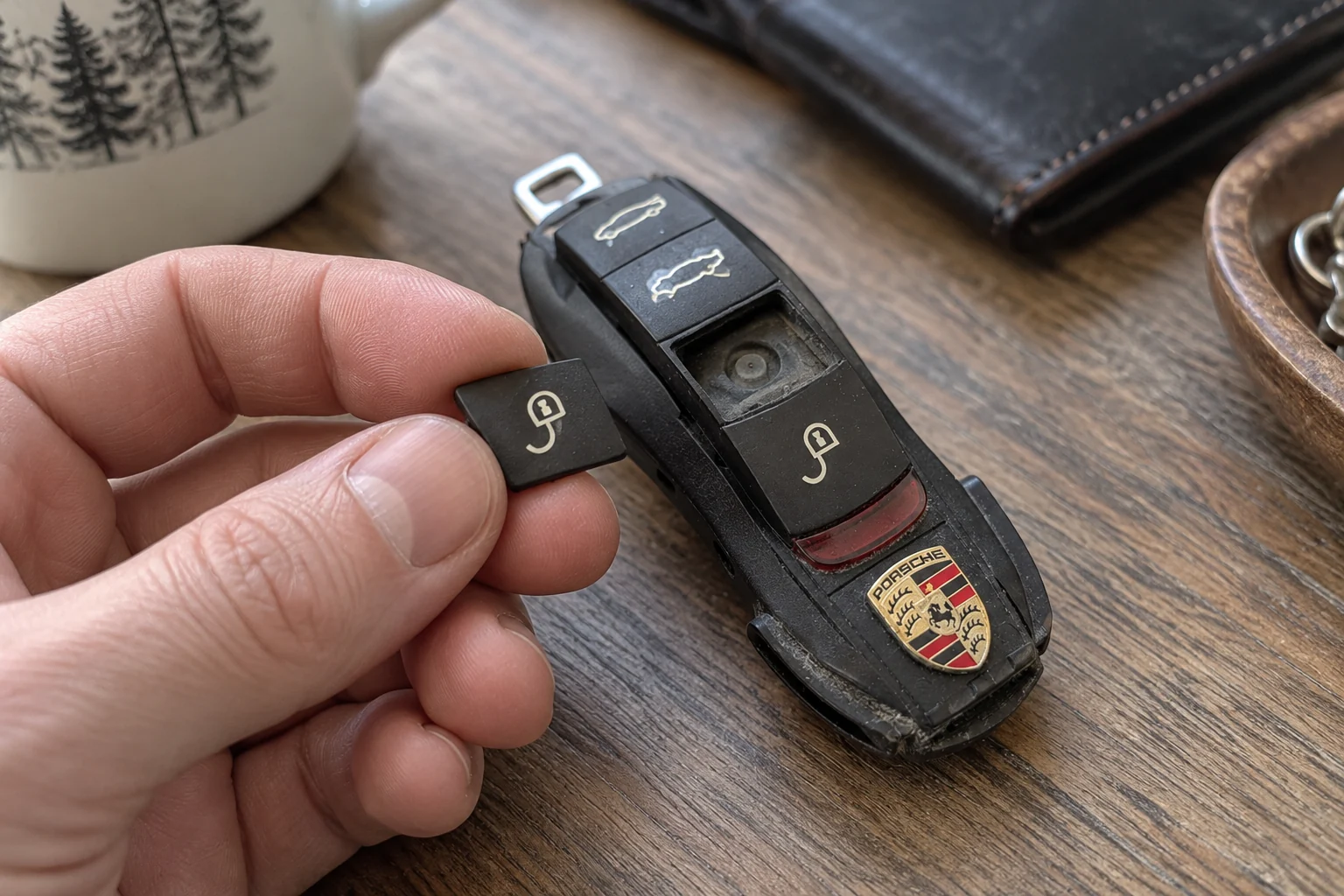
Does a replacement shell include that button piece?
Not necessarily. A listing for a Porsche three-button replacement key shell may show three buttons on the assembled casing without supplying a separate pad to replace the piece that fell out. The product photo shows what the shell looks like when assembled; it does not, by itself, establish which parts arrive loose or whether a pad beneath the visible buttons is included.
Start with the listing’s contents description, not its title or main image. “Three-button” may describe the layout, while “replacement shell” generally means casing parts rather than a complete working remote. Neither term is a promise that every button-related insert is supplied. If the missing part is described in the listing only as a “pad” or “insert,” check whether that wording appears in the included parts list, rather than in a description of the key the shell is meant to replace.
Then compare the written list with photos of the supplied pieces laid out separately. An image showing a front cover, back cover and visible button faces supports a different conclusion from an image that also shows a separate pad. An assembled front view cannot resolve that difference: a part may be fitted behind the pictured buttons, supplied loose, or absent from the product. The listing needs to make that clear before you count on it.
Read captions and image labels closely. “Buttons included” can refer to the exterior button faces; it does not necessarily include a separate internal piece. Equally, a photo of a loose insert is less useful if the listing offers multiple options and does not say which one the photo depicts. Give more weight to a parts list and photographs tied to the exact option being sold than to a gallery image that could illustrate the product range.
The reverse assumption is risky too: “shell only” does not always mean the casing arrives without any button pieces. Some shells may have visible buttons fitted to the housing. Treat the wording as a boundary around what is promised, not as a precise inventory of small parts. If the description names covers but says nothing about a Porsche remote button pad or replacement key shell button insert, its inclusion remains unconfirmed.
Finally, keep the shell’s contents separate from the contents of a complete key. A pictured key shape, button symbols or an assembled remote should not be taken to mean that electronics, a battery, a transponder or a blade are included. For the missing button piece, the useful test is narrower: does the listing explicitly name it or clearly show it among the parts supplied with the selected shell? If not, the picture alone is not enough to answer yes.
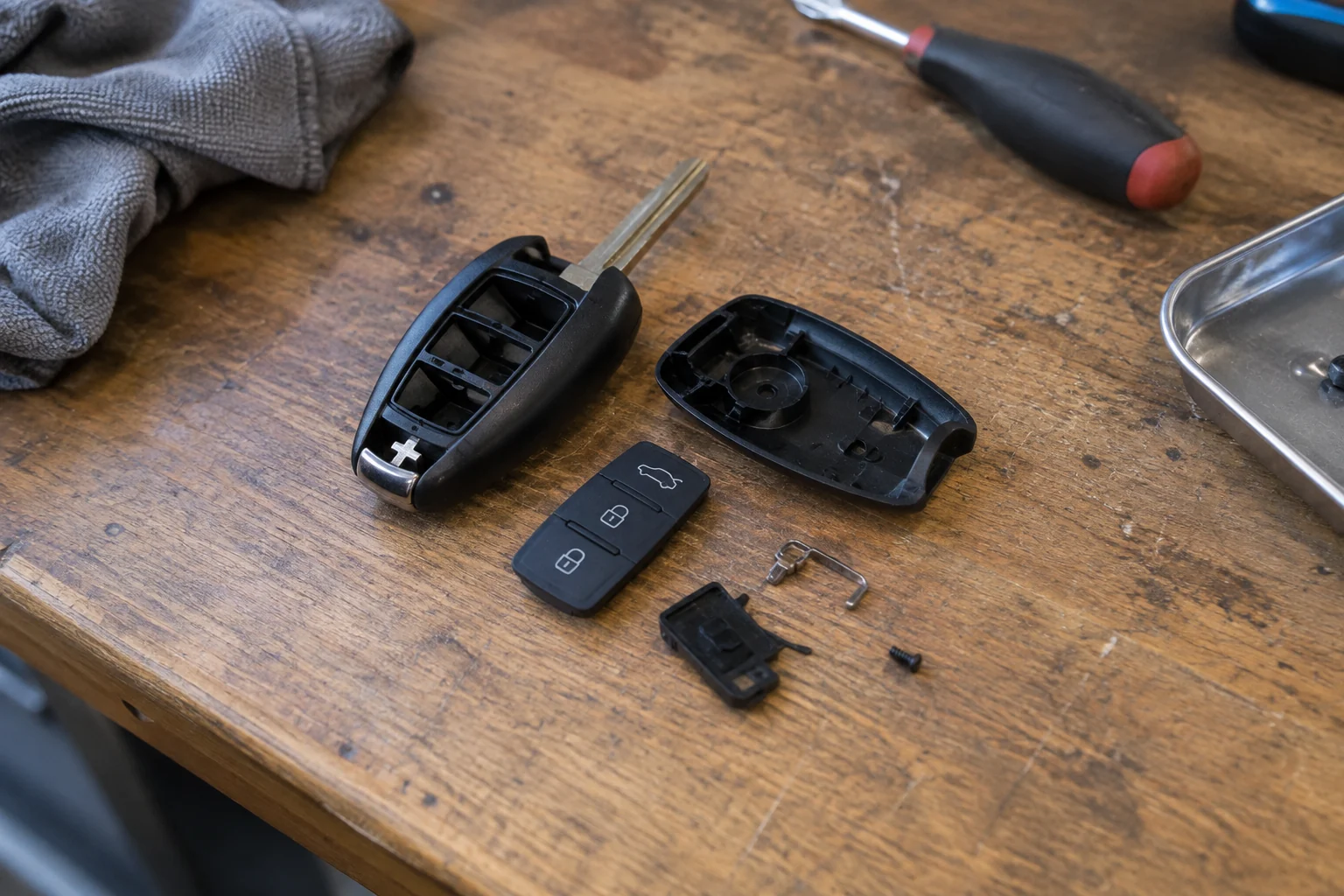
- A visible button face in a photo is not proof that a separate internal pad is included.
- An explicit parts list is more useful than button count alone.
- If the pad is not identified, ask for confirmation of that exact piece.
Check the housing, not just the button count
A Porsche three-button replacement key shell is not a match simply because it has three buttons. Put the original remote beside the listing photos and compare the position and function of each button. Check the order of the symbols, the shape of each button area and the spacing between them. A shell with the same number of buttons but a different layout may place the replacement surface over the wrong positions inside the remote.
Next, compare the housing from every angle the listing shows. Look at the outline around the top and bottom, the thickness and shape of the sides, and where the two halves meet. Pay attention to openings: a slot, blade attachment or other cut-out in a different position is a stronger warning than a minor difference in colour or finish. If the listing shows only the button side, there is not enough visible detail to judge the whole casing.
The seam is worth checking closely. Compare where it runs past the buttons and along the edges of the original remote. A shell may look similar face-on yet split differently around its sides or end. That difference matters when the original components must sit inside and the halves must close around them. Do not assume that a familiar-looking front proves the rear half has the same shape.
Use clear photos of the shell opened up to compare its internal layout. Look for the position and shape of supports, recesses, posts and clip points against the inside of your original housing. Check which way the button openings face relative to those features; a photo taken at an angle can make a mirrored or differently arranged interior look deceptively familiar. If the original remote is still assembled, avoid forcing it apart just to make this comparison.
Also compare the area directly behind the missing Porsche key button. The opening’s size and shape should line up with the corresponding area in the prospective shell, without relying on the product title to settle the question. A close-up photo can help, but only if you can tell which side of the shell it shows and how it is oriented relative to the other buttons.
Treat any model or generation named in a listing as a lead to check, not proof of fit. Remote housings can look alike in small product images. If the button layout, outer openings and visible interior features cannot all be compared with your exact remote, the most accurate conclusion is that compatibility remains unconfirmed—not that “three-button” is close enough.
When the missing piece is not the whole problem
A replacement shell can restore a missing button surface, but it cannot repair a damaged switch on the remote’s circuit board. If pressing the affected area produces no response, buying a shell is not yet a reliable fix. The missing piece may have made the control difficult to press, or there may be a separate electrical fault.
An unresponsive button alone does not tell you which part has failed. If the remote worked normally until the piece fell out, a replacement button surface may be all that is needed—but the timing does not prove it. If the button was intermittent beforehand, needed unusually firm pressure, or stopped working before the piece came loose, treat that history as a reason to investigate further.
Compare normal use of the buttons that remain intact. If they work and the affected control does not, the problem may be limited to that control, but this still does not distinguish a missing button piece from a faulty switch. If several buttons fail, a new shell is even less likely to address the whole problem. That pattern calls for assessment rather than another attempt to press the exposed area.
Do not test the remote by pushing a tool, fingernail or loose part into the opening. Extra pressure can damage exposed components or shift a loose piece inside the casing. Likewise, avoid dismantling the remote just to see whether you can make the control respond. Opening it without knowing how that remote is assembled can turn a casing problem into a more difficult repair.
If you can operate the remote normally without touching the exposed area, note which functions still work and whether the fault is constant or intermittent. That information is more useful for diagnosis than repeated pressing. If function remains uncertain, have the remote assessed before relying on a Porsche three-button replacement key shell to solve it. Explain when the piece fell out, whether the button worked beforehand, and what happens with the other buttons. A shell purchase makes sense as a casing repair; it should not be treated as confirmation that the electronics are sound.
- New casing cannot repair a damaged circuit-board switch.
- Do not treat an unresponsive button as proof that the shell is the only part needed.
What to ask when the listing leaves the pad unclear
If the listing does not settle whether the fallen piece is included, ask the seller before ordering the Porsche three-button replacement key shell. Send photos of both sides of the loose piece and the original remote with the empty area visible. Mark the piece in one photo so the seller knows exactly what you mean.
Ask about that piece, rather than whether the shell has three buttons. You need to know whether it comes attached to the supplied shell, arrives as a separate part, or is omitted. If the seller calls it a “pad” or “insert,” ask them to point it out in a photo; the name alone may not resolve which part they mean.
A short message can keep the question specific:
The piece marked in my photo fell out of my remote. Is that exact piece included with the shell in this listing? If so, is it attached or supplied separately? Could you send a photo showing all the parts supplied?
If the listing has multiple options, identify the one you intend to order when you ask. Request a photo of all parts supplied with that option, particularly if the existing images show only an assembled shell. A reply such as “yes, it has three buttons” does not confirm that the marked piece is included. Ask the seller to show where it appears in the supplied-parts photo.
Keep the seller’s written answer and any photo they provide alongside a screenshot of the selected listing option and your order details. If the seller cannot confirm whether the piece is supplied, treat its inclusion as unconfirmed. That is a better basis for a decision than assuming the product title covers the missing part.
Before ordering a replacement shell, check what fell out of the remote and what the listing actually includes. A loose outer button and a missing rubber button pad are not necessarily the same part, and product photos may show pieces that are not supplied. Compare the remaining shell, the fallen piece and the listing’s contents rather than relying on the title alone. If the pad is missing and the listing does not clearly include one, ask the seller before ordering; do not assume that a similar-looking shell will fit.
Choose the option that matches your vehicle and situation.
Frequently asked questions
Can I keep using the remote while a button piece is missing?
You may be able to use the remaining buttons temporarily, but do not rely on the exposed control working. Keep the opening away from dirt and moisture, and avoid pressing directly on anything inside it. If the remote behaves unpredictably or the loose piece could fall further inside, stop using it until you can inspect it safely.
Should I glue the fallen button piece back in place?
Check how the piece was originally held before using adhesive. Glue can stop a button moving freely or seep onto parts beneath it. If a retaining tab has broken, sticking the piece down may also hide the damage without fixing it. Set the piece aside until you can identify its attachment points.
Will changing the battery replace or repair a missing button pad?
No. A new battery cannot replace a missing physical button piece or repair its mounting. Weak-battery symptoms can happen at the same time, though, so a battery change might improve the remote’s response while leaving the missing pad unchanged. Treat the two issues separately rather than using one as a test of the other.
Does changing only the shell require the remote to be programmed again?
If you keep the original electronics and move only the housing, you are not replacing the part that stores the remote’s electronic identity. That differs from fitting a new circuit board or a complete replacement remote. Whether any further work is needed depends on the parts involved, so confirm what is being transferred before assuming programming is—or is not—required.
Can the original key blade be reused with a new shell?
Possibly, but check the exact blade and housing design. A blade may be removable, fixed to a particular holder, or shaped for a different pivot or mounting point. If you’re considering a shell on car-keys.lt, compare its blade fitting with your original rather than relying on the outside shape of the remote.
What if the missing piece has fallen inside the remote?
Keep the remote and any pieces you recover together. Avoid shaking it hard, forcing the case apart, or pressing on the exposed area to try to dislodge the piece; those actions could put pressure on the electronics. If the housing does not open readily, leave the piece in place until it can be removed carefully.
Is a loose Porsche badge the same thing as a missing button pad?
No. A badge is a decorative insert; a button pad or button face is part of the control you press. A loose badge may leave a recess without affecting button movement, while a missing control piece exposes a different area. Check a prospective shell’s contents list for either item—neither should be assumed to come with it.
Will a replacement shell make the remote waterproof?
Do not assume so. A new housing may close an opening left by a missing piece, but that does not establish a waterproof seal around the case joints, buttons or blade. Check what the specific housing says about its construction, and keep the remote away from moisture unless you have reliable information about its level of protection.
