
- A key cover goes over the existing housing; a replacement shell substitutes a housing that must accommodate the retained key components.
- Superficial scuffs on a working remote do not, by themselves, establish a need to replace its casing.
- Cracks that stop the housing from staying closed are a different problem from faded colour or surface scratches.
- A cover may change the key’s appearance, but it cannot repair broken casing clips or damaged electronic switches.
- A replacement shell does not automatically include the circuit board, transponder, battery or blade; confirm the contents of the specific listing.
- Before choosing either option, compare its shape and openings with the original key; a Porsche name or button count alone cannot establish fit.
If your Porsche remote still works, cosmetic wear alone does not mean you need to change it. A cover sits over the existing case and can hide scuffs; a replacement shell takes the place of that case. The choice depends less on how old the remote looks than on where the wear is and whether you want to conceal it or replace the worn part.
A cover may be enough if the marks are on surfaces it will hide. It will not mend a cracked case, and exposed edges may still look worn. A shell makes more sense if the case itself is what bothers you, though its appearance is only one thing to check before choosing one. A product photo does not establish that a shell will fit your remote.
This car-keys.lt guide focuses on those visible differences so you can judge what, if anything, is worth changing. You’ll see how the extent and location of wear affect the choice, what a cover might leave visible, and when a Porsche replacement key shell is worth considering. If the marks are minor and the remote is comfortable to use, leaving it alone is also a reasonable option.
First, locate the wear and check the housing
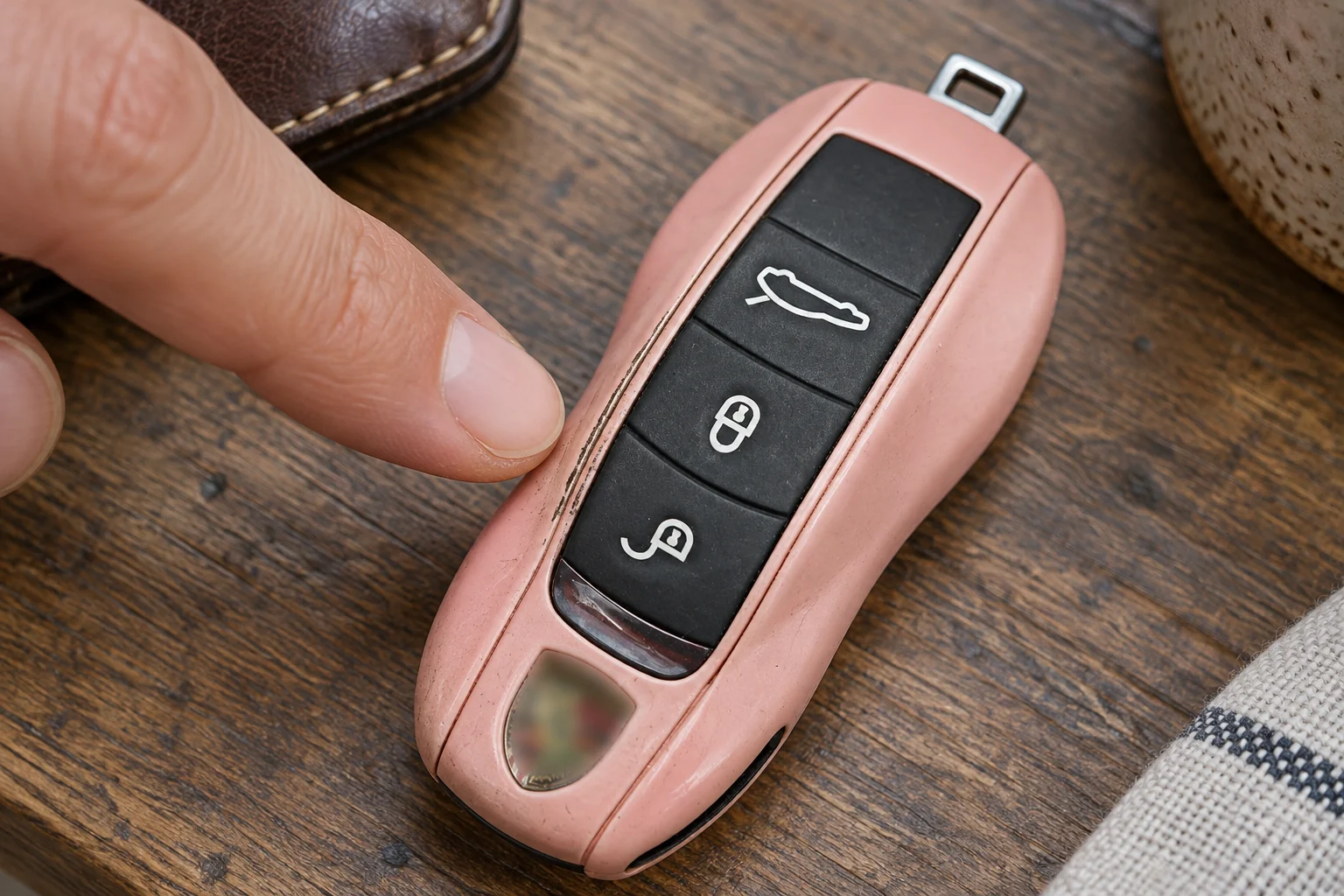
Start by looking at the whole remote in good light, then turn it over and inspect the edges. Note where scratches and fading appear. Marks on the broad outer surfaces may be only cosmetic; a mark that continues into a seam may be a crack. Wipe away dirt first so it does not make a scratch look deeper than it is.
Look closely at the buttons as well as the surrounding case. A worn symbol or shiny patch shows surface wear, but a button that sits lower than its neighbours, sticks or needs unusually firm pressure is a different observation. Do not assume that changing the exterior would address a change in how a button feels.
Next, check whether the housing stays closed. With the remote resting in your hand, look for an uneven gap between its joined edges. Press gently near any visible gap and see whether the parts move apart or settle back together. There is no need to pry at the seam: the useful question is whether the case remains secure during ordinary handling.
Pay particular attention to corners and areas beside buttons, where a chip can be easy to miss. Record any loose or missing exterior piece, even if the remote still works. A missing piece is different from faded finish: it leaves a physical gap. Likewise, a crack that opens when the case is handled is more than a surface mark.
Compare both sides rather than judging the remote by its most visible face. For example, a scratched front can draw attention away from an intact edge, while a tidy front can hide a separated seam on the back. If you cannot tell whether a line is a moulded join or a crack, check whether its edges shift under gentle pressure; do not force them.
Finally, separate appearance from operation. If the remote sometimes fails to respond, a button works only after repeated presses, or its behaviour has changed, note that as a functional symptom rather than calling it cosmetic key damage. A worn-looking case can coincide with a separate fault, but its appearance alone cannot explain one. These observations give you a clearer basis for considering an exterior change without assuming it will solve an operating problem.
When to leave it alone, add a cover or replace the shell
If the remote still works and its case stays closed, you do not need to change it just because it looks used. Choose no change when the marks do not bother you. Choose a cover when you want to hide surface wear without replacing the case. Consider a replacement shell when the existing housing itself is damaged or you want to replace its worn outer surfaces rather than cover them.
| What you see | Usually the most relevant choice | Why |
|---|---|---|
| Light scuffs on an otherwise sound case | Leave it alone, or add a cover | The marks affect appearance, not the housing’s ability to stay together. |
| Noticeable fading or widespread surface wear | Cover or replacement shell | A cover can hide much of the old finish; a shell changes the housing itself. |
| A case that will not stay closed properly | Consider a replacement shell | A cover sits over the case. It is not a substitute for a secure housing. |
A Porsche key cover sits over the existing remote casing, so the old finish remains underneath. That makes it a practical choice when you like the idea of hiding scuffs but do not want to replace a case that is otherwise sound. The trade-off is that the cover changes the remote’s feel and may make it bulkier. It also cannot make cracked plastic sound again or reliably hold together a case that has stopped closing properly.
A shell is a more direct answer to a worn Porsche remote casing: it replaces the housing instead of concealing it. That distinction matters if you would still dislike seeing the original scuffs whenever you remove a cover. It matters more when the housing is damaged. If the problem is a broken or loose outer case, covering it leaves that problem in place; replacing the housing addresses the part that is worn or damaged.
Do not assume every visible defect calls for the same purchase. A small patch of fading may be easier to live with than the added bulk of a Porsche key fob cover. Conversely, if most of the casing looks worn, a cover may give you the appearance you want without replacing the housing. Let the extent of the wear—and whether the case still holds together—drive the choice, rather than the fact that a product is labelled for Porsche keys.
Keep the decision strictly about the exterior. Neither a cover nor a replacement shell repairs damaged switches inside the remote. If a button’s operation is the concern, a better-looking case can leave that problem unchanged. Similarly, if the remote works well and the wear is only cosmetic, doing nothing is a valid decision: it avoids buying an exterior part that solves no problem you actually mind.
- Leave it alone: appearance is the only concern and the key remains usable.
- Consider a cover: the existing housing is sound but its visible surface is worn.
- Consider a shell: the housing itself needs replacing; confirm fit and retained parts first.
What replacing the shell does—and what you may need to retain
A Porsche replacement key shell changes the housing, not necessarily the working key inside it. “Shell” may mean empty outer pieces, or a set that also includes buttons and a metal blade. It does not, by itself, mean you are buying a programmed remote. If your key works and your aim is to improve its appearance, the purchase only makes sense if you know which original parts must go into the new housing.
Read the listing’s included contents and exclusions, not just its title or photographs. Check four items separately: the electronic board, any separate transponder, the battery and the metal blade. A photo showing a blade or battery is not enough to establish that it is supplied. If the description is unclear, ask the seller what arrives in the package before ordering.
The original board is generally the part you need to preserve if you want to keep using the working remote electronics. Depending on the key’s construction, the transponder used for vehicle recognition may be a separate piece or incorporated into another component. Do not assume an empty shell includes it or that it can be left behind. The battery may also need to move across, though a new one may be supplied; confirm rather than treating “replacement shell” as a complete parts list.
Treat the blade as a separate question. Some shells are sold without one, while others include an uncut blade that is not automatically a substitute for your existing metal key. If the original blade needs to be retained, establish how it is held before committing to a housing swap. Likewise, note any small inserts or button pieces that the new shell does not provide. What must be transferred depends on both the original key and the contents of the chosen shell.
A housing swap should not require guesswork with parts you cannot identify. If you cannot tell where a working component is housed, or the old casing does not open in an obvious way, do not force it apart just to improve its appearance. Keep the original housing and its parts together until you are sure what the replacement supplies and what it requires.
Finally, keep the decision cosmetic. A fresh shell does not repair a faulty board, restore unreliable buttons caused by an internal fault or resolve a recognition problem. If the remote has an electronic fault, deal with that separately rather than buying a shell in the hope that a new exterior will fix it.
Check the key’s shape before relying on a product listing
Place your remote beside the photographs of the Porsche key cover or replacement shell you are considering. Compare the front, back and side views, not just the most prominent product photo. The outline matters: look at the shape of the head, the width and thickness of the body, and any taper or raised edge. A listing that shows only a front view leaves too much unseen to confirm the match.
Next, compare the seams. On a shell, check where the pictured housing separates and whether its edges follow the same path as your original key. On a cover, look at where the cover wraps around the case and whether it leaves the parts you need exposed. Check the position of any opening, recess or attachment point against the key in your hand. A similar silhouette can still hide a different edge design.
Match the button layout, not merely the number of buttons. Compare their shapes, spacing and positions relative to the case edges. For example, two remotes may both have three buttons but arrange them differently or use a different-sized button area. A photograph of another key with the same Porsche name or button count is not evidence that a cover or shell will suit yours.
If your key has a blade or a release mechanism, identify exactly where it moves and how you reach it. Check that the listing images show a corresponding slot, opening or accessible control. An opening that appears to be in roughly the right place may not be enough if the surrounding shape differs. Do not assume a product is suitable simply because the listing mentions a Porsche model; compatibility with the particular key variant still needs confirmation.
Use the actual listing’s photographs and stated dimensions, rather than a similar-looking image found elsewhere. Compare any measurements with your key, and check what the seller measured: the outside of a cover is not the same as the space available inside it. Dimensions can help rule out an obvious mismatch, but they cannot establish that buttons, seams and openings line up.
If the pictures are generic, too small or missing a useful angle, ask the seller to confirm the physical match before ordering. Send clear photos of both sides and the edges of your key, along with any relevant measurements, and ask about the specific item offered in that listing. If the answer relies only on the brand or vehicle name, you still lack confirmation of the key’s shape.
- Compare its shape, seams and openings with the original key.
- Check blade access and button layout.
- Read the exact listing to see what is included.
- Seek confirmation rather than assuming a Porsche label establishes fit.
After the exterior change, make sure the key still works as expected
Follow the fitting instructions supplied with the specific cover or shell. Pay particular attention to any directions for clips, adhesive or a removable blade. If the instructions are missing or unclear, do not improvise with a tool or push harder to make the part fit. Improving the appearance of a working remote is not worth damaging it.
Apply pressure only where the instructions direct. A cover should sit securely without holding a button down or blocking an opening. A replacement shell should close along its intended seam, without a corner springing back or a gap that will not close. If a part will not seat properly, stop rather than repeatedly squeezing it. Do not use glue or tape to hide a poor fit unless the product instructions call for it.
Before putting the key back into everyday use, press and release each button. It should move freely, return to its normal position and not catch on the new exterior. Check that openings you normally use remain accessible. If the key has a removable blade, make sure it releases and returns without snagging. Choose a place where testing a boot-release or alarm button will not cause a problem.
Then test the remote’s usual functions with the vehicle in view. Check for the response you normally expect; do not assume fitting a cover or shell leaves operation unchanged. If a button sticks, a function stops responding or the housing begins to separate, stop using the altered key. Remove a cover only if it comes off without force. If a shell does not close properly, seek fitting guidance for that product rather than prying at the working parts inside.
Choose the part that addresses the wear you can see, rather than buying a new-looking remote by default. If the existing housing is sound and you mainly want to hide scuffs, a cover may be enough. If the housing is cracked or the buttons are worn through, a cover will only conceal the problem; a replacement shell is the more relevant option. Before ordering either part, compare its shape and button layout with your remote, and confirm that a replacement shell can accommodate its internal components.
Choose the option that matches your vehicle and situation.
Frequently asked questions
Will a cover make my Porsche key noticeably bulkier?
Any cover adds some material around the key, but whether you notice it depends on the cover’s thickness and shape. Check the product dimensions and photos, especially around the edges you hold or press. If the key already fits tightly in a pocket or holder, even a small increase may matter.
Can grit caught under a cover mark the original casing?
Yes. Small particles trapped between a cover and the casing can rub against the finish as the key moves. Clean and dry the casing before fitting the cover, and follow the cover maker’s care instructions. If you remove the cover later, check for trapped dirt before putting it back on.
Do replacement shell buttons always match the original buttons?
No. Shells that look similar from the outside may have different button pieces, symbols or layouts. Check the photos and description for the exact shell you intend to buy, including whether the buttons are supplied or must be transferred. Don’t rely on the number of buttons alone.
Does changing only the shell mean the key needs programming?
A shell is the housing, not the remote’s electronics. If the working components are retained, a housing change is different from replacing the complete key. That distinction does not guarantee that every transfer will leave operation unaffected, so check the key’s functions afterwards and seek help if something no longer works.
What if the original key housing appears sealed?
Don’t pry it open simply because a replacement shell is available. A housing that appears sealed may not separate in the way a listing suggests, and forcing it risks damaging parts you need to keep. If the transfer method is unclear, car-keys.lt is a useful next step for making an enquiry before attempting it.
Can a cover interfere with access to a removable key blade?
It can if the cover obstructs the blade release or the opening through which the blade comes out. Compare those areas on your key with the product photos before ordering. Once fitted, make sure you can release and return the blade normally; don’t assume a cover fits properly just because it fits around the buttons.
Will a new shell fix a worn metal key blade?
No. A replacement shell changes the housing; it does not restore worn metal on the blade. If the blade is bent, damaged or difficult to use, have that issue assessed separately. Check what the shell listing includes, too, rather than assuming a pictured blade is ready to replace yours.
What if the remote works only intermittently?
Treat that as a functional problem, not ordinary casing wear. A cover or new shell may improve the exterior, but you should not expect either to resolve intermittent operation. Note when the fault occurs and have the key assessed before spending time on an appearance-only change.
