
The answer depends on which part of the blade-release assembly is damaged.
- If the emergency blade will not release, identify whether the control moves and where the blade remains held before choosing a replacement.
- A shell can address damage to its housing or built-in release parts, but it cannot repair a damaged metal blade.
- If the blade no longer stays secured, compare its retaining connection with the replacement rather than relying on exterior shape.
- Matching button counts do not establish that a replacement shell has the same blade-release arrangement or internal layout.
- Check whether a listing includes a blade, a retainer and the release parts you need; a shell-only listing may omit them.
- Replacing an empty housing does not replace faulty remote electronics, so a separate remote problem needs its own assessment.
A replacement shell may fix an emergency blade that will not release or stay secured, but only if the damaged part is in the shell. If the blade’s connection is worn or broken, moving it to a new housing may leave the problem unchanged.
Start with what happens when you press the release. Does the button move while the blade remains stuck? Does the blade come out but no longer lock in place? Those symptoms are worth distinguishing before you order anything. A cracked housing does not necessarily mean the blade is damaged, and a blade that looks intact may still have a damaged mounting point. Avoid forcing a jammed blade, which can make the failure harder to assess.
For readers on car-keys.lt, the key question is whether the original blade connection and the replacement shell’s retaining parts match. The outside shape and button count alone cannot answer that. The new shell must also have an internal layout that accommodates the parts you need to transfer from the original key.
The checks below will help you identify the likely point of failure and compare a candidate shell with the key in your hand, rather than relying on a similar-looking product photo.
First, locate where the release fails
Before looking for a replacement shell, note exactly what happens to the emergency blade. Does it stay in the key and refuse to come out, come out only partway, or slide out when you have not touched the release? A stuck blade and a blade that falls out are different observations. Write down which one you see rather than treating both as a “broken release.”
With the key in your hand, operate the release control gently and watch whether it moves. Does it travel as it normally did, barely move, or feel loose with no clear resistance? Listen for a click, but do not take a click alone as proof that the blade has disengaged. Release controls differ between keys, so check the instructions for your particular key before trying an unfamiliar motion.
If the blade is stuck, look along the opening without levering anything apart. Check whether the blade sits straight and whether an edge appears caught against the surrounding plastic. A blade that moves a few millimetres and stops gives you a more precise description of the fault than one that does not move at all. Also note whether the release control moves at the same time as the blade.
If the blade comes out too easily, observe when it happens. Does it slip out while the key is still, or only when you handle the release control? If it is already out, look for obvious damage around the opening and on the part of the blade that enters the key. Keep any small loose piece you find; its position may help identify what came away, but avoid putting it back by force.
Inspect the shell under good light, especially around the blade opening, release control and seams. A crack that opens when the key is held, a control that sits crooked, or a rattling piece is worth recording. Check the blade itself for an obvious bend or twist. Do not try to straighten it while it is attached to the key; that could make a jam harder to assess.
Stop if gentle operation does not free the blade. Pulling harder, prying at the opening or repeatedly working a jammed control can break parts that are still intact. A few clear observations—and photographs of any visible damage—will be more useful when you later assess what a replacement needs to address.
- Do not force the release or lever the blade out.
- Note what moves and what remains held before handling it further.
Decide what a replacement housing can—and cannot—fix
A replacement housing may solve the problem when the failed part is the housing’s release control or the feature that holds the emergency blade in place. It replaces that part of the key’s structure; it does not repair the metal blade or the remote electronics. This matters because poor emergency blade retention does not, by itself, prove that the shell is at fault. A damaged blade connection can produce a similar result.
| Where the fault lies | What to do next |
|---|---|
| Release control or retaining feature in the housing | Consider a replacement shell that supplies the failed component. |
| Metal blade or its attached connection | Address the blade separately; a new housing will not restore damaged metal. |
| Remote buttons or electronics | Diagnose that fault separately, even if the blade release is also broken. |
Keep the metal blade distinct from the release mechanism. If the blade is bent, cracked, badly worn or damaged where it attaches to the housing, transferring it into a new shell will not make that damage disappear. Conversely, a sound blade does not need replacing solely because the housing’s release has failed. When both parts are damaged, a shell may address only the housing side of the fault.
Apply the same distinction to the remote. A damaged outer button that no longer presses an internal switch may be a housing issue. A remote that still fails when its controls operate normally has a different problem; changing the casing should not be treated as an electronics repair. A shell can therefore be the right response to a broken Mercedes-Benz key blade release while leaving an unrelated remote fault unresolved.
Before choosing that remedy, establish whether the failed release or retaining piece is built into the housing or is a separate component. Do not assume a replacement Mercedes-Benz key shell supplies it: what is included depends on the particular shell. If the failed piece will not be replaced, changing the outer casing alone is unlikely to secure the blade.
Compare the blade connection and internal layout
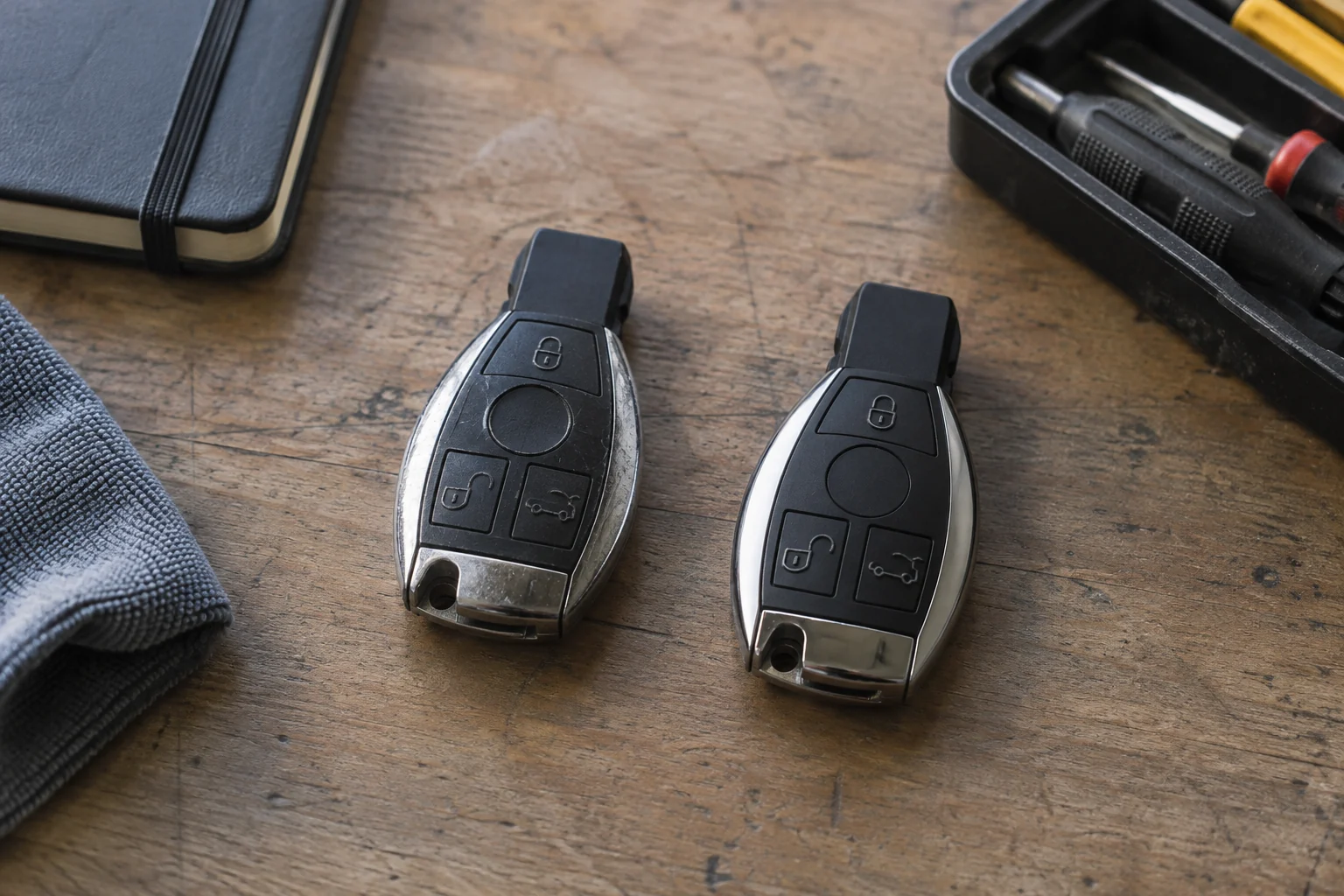
To assess a replacement Mercedes-Benz key shell, start where the emergency blade meets the housing, not with the overall outline. Compare the connection on your original blade with clear listing photos of the candidate shell. Look at the blade’s base: its width, thickness, profile, and any visible notch, shoulder or groove. Then check whether the candidate’s blade opening and retaining area appear to match. A slot that looks the right size from the front may have a different retaining feature farther inside.
Photographs are most useful when they show the blade connection from several angles: straight into the opening, from the side, and from above. Compare your original key from those same angles where the parts are visible. A side view can reveal a raised edge or offset that a front view hides. Check the position of the blade relative to the shell’s edges, too; an opening in roughly the right place is not enough if the blade approaches it at a different angle.
Next, compare the release control’s position with the blade opening and the area where the blade sits. The control must be positioned to act on the retaining connection, not merely occupy the same spot on the outside. If internal photographs are available, look for differences in the blade channel, surrounding guides and seating surfaces. These features determine how the blade is supported when it is fully seated. Do not assume that a release button with the same shape operates the same internal arrangement.
The rest of the internal layout also matters. Compare visible recesses, supports and alignment features in the original housing and the candidate. If you cannot see inside your original key without opening it, limit the comparison to what is safely visible; an exterior photograph cannot confirm a hidden match. Likewise, a listing that shows only a closed shell gives you too little evidence about its internal seating areas, however close the exterior looks.
Pay particular attention to small differences near the blade connection. For example, a notch on the blade base needs to line up with the feature intended to hold it; a similar-looking channel without that alignment is not proof of fit. These are comparison points, not a universal Mercedes-Benz connection pattern. Check the actual key and the specific listing rather than relying on an example from another key design or a broad vehicle-compatibility claim.
Matching shape, logo position or button count can help narrow the options, but none confirms that the emergency blade will fit and stay secured. If the connection or internal layout is obscured, or if two views appear to contradict each other, leave compatibility unconfirmed. Do not turn an uncertain visual match into a fit claim.
Check what the shell listing actually includes
A shell can look right in the photos yet arrive without the parts needed to hold or release the emergency blade. Before ordering, read the contents description as closely as the pictures. “Empty shell” may mean only the outer housing, while a listing that includes a metal blade may supply a blank blade rather than one you can use as-is. Neither description confirms that the release and retaining parts are included.
Look for an explicit account of the parts involved in emergency blade retention. Depending on the shell design, a seller may describe a release button, sliding control, spring, clip or other retainer. Treat those as examples to check for, not a standard parts list for every Mercedes-Benz key. If you need a particular piece because it is missing from your original key, make sure the listing says that piece is supplied. A replacement Mercedes-Benz key shell that omits it may leave you with the same problem.
Do not assume everything visible in a product image comes in the package. A photo may show a complete assembled key to illustrate the finished appearance, even when the sale is for a Mercedes-Benz key shell without blade. Check the written contents, variation selected and any note such as “blade not included” or “electronics not included.” If a photo and the description disagree, ask which one represents the item you would actually receive.
When the contents are unclear, send the seller a short, specific question rather than asking only whether the shell is “complete.” For example:
Does this exact listing include the emergency blade release control and every separate part needed to retain the blade? Is the metal blade included, and is it a blank? Could you provide a photo of all parts supplied, laid out separately?
If you plan to reuse your original blade, say so and ask whether any blade-retaining parts shown are included with the shell or must be transferred from the old one. If the seller cannot provide a contents list or a clear view of the supplied pieces, you cannot confirm that the purchase addresses a missing release or retainer. Keep that uncertainty separate from the physical-fit checks discussed above.
- Housing and release control
- Blade, if required
- Retaining parts needed for that blade
- Clear views of the connection and interior
Verify retention before relying on the replacement
Do not rely on the replacement housing until the emergency blade both releases when you operate the control and stays in place when you do not. A shell that closes neatly is not enough: the blade could still come loose in a pocket or remain stuck when you need it.
During the transfer, work over a clear surface so small original parts cannot roll away. Set aside each part as you remove it, and take a photo before moving anything whose position you may need to check later. If a small piece drops out and you cannot tell where it belongs, pause rather than closing the housing and hoping it is unnecessary. Follow instructions confirmed for your particular key design; do not assume that a transfer sequence shown for another housing applies to yours.
The blade and electronic assembly should seat without being driven into place. If the blade catches, sits at an angle, or needs pressure that feels likely to bend or crack something, stop. The same applies if the electronics do not lie where the housing allows them to sit naturally, or the housing will close only when squeezed hard. Forcing either part can create a new fault and make it harder to tell whether the replacement was suitable.
Once assembled, test the blade over a table, away from gaps where it could fall. Operate the release and check that the blade comes out without a hard pull. Reinsert it, let the release return to its resting position, then give the blade a gentle pull without operating the release. Repeat the release-and-retention check a few times. If the blade slips out, jams, or holds only intermittently, do not carry the key as though the problem is fixed.
Check the remote buttons separately after reassembly. A working remote does not prove that the blade is secure; a blade that stays put does not prove that the electronics were transferred successfully. If remote operation has changed, or if you remain unsure whether the blade is properly retained, stop using the replacement as your regular key and get hands-on help. Repeatedly forcing a doubtful fit is not a useful test.
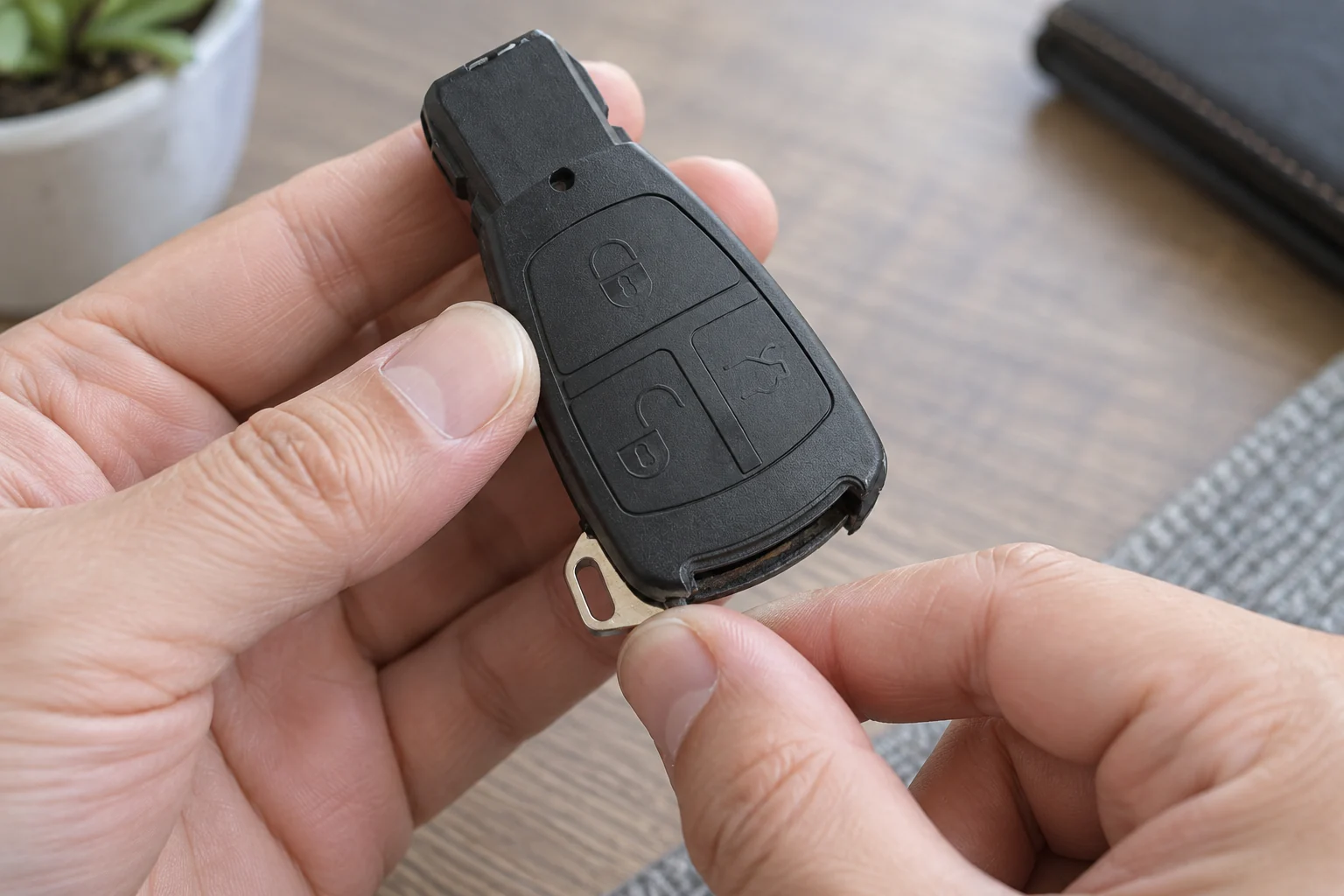
A stuck or loose emergency blade does not automatically need replacing. Before buying a new shell, check the blade, its retaining parts and the old shell together. A sound blade may be reusable, but only if the replacement shell accepts its shape and holds it securely. A bent blade, worn retaining notch or missing part can change that. Do not force the blade into a shell just because it looks similar: once fitted, it needs to seat fully, release normally and stay secure.
Choose the option that matches your vehicle and situation.
Frequently asked questions
What should I do if the emergency blade is stuck and I need access to the car?
Use a working spare if you have one. If not, seek appropriate hands-on help rather than pulling hard on the blade or prying at the release. Force can damage the blade or housing and leave you with a harder problem to resolve. Tell the person helping you that the release is stuck.
Should I add lubricant to a stuck blade release?
Not before you know what is stopping it. A sticky button, damaged retainer and misaligned blade may look much the same from outside. An unknown lubricant could spread into the housing or make the fault harder to inspect. Start with a visual check, without forcing the button or blade.
Can I glue a loose emergency blade into the shell?
Glue may hold the blade in one position, but it does not restore a working retainer. The joint could fail when you pull the blade or use it in a lock, and adhesive can make later inspection or transfer difficult. Treat a blade that will not stay secured as an unresolved fault.
What if the original emergency blade is missing?
A replacement housing does not necessarily include a usable emergency blade. You may need a suitable blade blank and have it cut for the car; buying a shell alone will not replace the missing key. If you need to ask about the blade separately from the shell, car-keys.lt is a useful place to start.
Can a bent emergency blade be reused in a new shell?
Do not force it into the new housing to see whether it fits. A bent blade may prevent the retainer from engaging properly, even if the housing is otherwise suitable. Have the blade assessed separately before reusing it, particularly if it has also become difficult to insert into or remove from the lock.
Will changing an empty key shell require remote reprogramming?
Moving the existing electronics into an empty shell is different from replacing those electronics. A housing change alone does not automatically mean reprogramming is needed, but the result depends on what is transferred and how the particular key is built. Check that the remote still works after assembly rather than assuming it will.
Will a new battery fix the emergency blade release?
A new battery may address a remote-button problem, but it will not repair a mechanical blade release. If the blade sticks, fails to latch or comes out too easily, assess that fault separately, even if the remote also needs a battery.
What if the blade appears to latch but pulls out easily?
Do not rely on a click alone. If the blade comes free with a light pull, its retention is still unreliable, and it could detach when you need it. Stop using it as though the fault is fixed and have the blade and housing connection checked before relying on the replacement.
