
- A key shell replaces the housing, not the original remote electronics or immobiliser function.
- Opening a sealed remote can damage parts you need to retain, so assess the risk before attempting a transfer.
- Compare the original key’s shape, buttons, blade end and side profile with listing photos before relying on an E46 label.
- A matching exterior cannot establish whether the original circuit board will sit securely inside a replacement shell.
- Check whether the original blade can transfer and what the listing includes; housing fit alone does not settle blade use.
- If the remote already has an electronic fault, replacing its case alone will not repair that fault.
A replacement shell can renew a worn case, but it cannot tell you whether the electronics inside your sealed original key are working—or whether they will fit a particular case. You can narrow down a BMW E46 key shell from the outside before buying, but you cannot confirm the internal fit without opening the original key.
Start with details you can see: the case shape, button layout, blade shape and the position of any seams. Compare your key with clear photographs of the shell for sale, not just a listing title or a vehicle model in a compatibility list. If you are comparing listings in Lithuania, ask for photos of the actual shell when the images leave those details unclear.
The uncertainty is inside. A sealed key may not reveal the circuit board’s shape, how it sits in the case, or whether the replacement provides the right space for every component. Opening the original merely to check can damage it, so a seller’s return terms matter when fit remains uncertain.
This introduction on car-keys.lt sets out what you can check safely before ordering, what needs inspection later, and why a new case will not fix a faulty remote.
What you can check while the original key is still sealed
Start with photographs of your own key before comparing BMW E46 key shell listings. Take a straight-on view of each face and a side view, with the key resting flat and evenly lit. Include a ruler in at least one photo so you have a size reference. Worn buttons and a dark case can hide outlines, so check that the edge of the housing and the end where the blade emerges are visible rather than lost in shadow.
Compare the overall outline first. Look at the width and length of the case, the shape of its corners and the way it narrows towards the blade end. Then check the side profile: a shell that looks similar from above may have a noticeably different thickness or edge shape. Product photos taken at an angle can distort these features, so compare like-for-like views whenever possible.
Next, check the number, position and shape of the buttons. Note their spacing, the direction the symbols face and whether any button sits within a distinct raised or recessed area. If the original buttons are badly worn, use their physical outlines rather than trying to identify them from faint symbols. A listing with the same general case shape but a different button layout should not remain on your shortlist.
Pay close attention to the blade end as an exterior shape. Compare the visible opening, the surrounding case outline and how the housing meets the blade. Do not treat a similar-looking blade in a listing photo as evidence that the whole shell matches: perspective and cropping can conceal differences at this end. If the photo does not show it clearly, mark that feature as unconfirmed.
Use the listing images, not an “E46” label, as the basis for this comparison. Names such as “BMW diamond key shell” may help you find candidates, but they do not establish that a pictured housing matches the sealed key in your hand. Check that the listing shows the actual exterior from enough angles; a single front-facing image leaves the reverse and side profile unknown. If photos appear inconsistent with one another, do not assume they all depict the same shell.
An exterior match is a way to narrow the choices, not proof of suitability. Keep candidates whose visible shape, buttons and blade-end outline agree with your original, and set aside those with a clear mismatch. Where a view is missing or ambiguous, record what you could not compare instead of treating it as a match.

What a matching exterior cannot tell you
A BMW E46 key shell can match the outside of your sealed remote and still fail to hold its contents. The unanswered question is whether the original circuit board has the right shape and position for the replacement case. With the original closed, you cannot check its outline, thickness or where it sits relative to the buttons. Treat a matching exterior as a reason to investigate a listing, not as confirmation that the board will fit.
The inside of the proposed shell matters just as much as its outline. Moulded ledges, posts and recesses may locate the board and stop it moving when the case is closed. A shell that looks identical from above could have different internal features. If those features are in the wrong places, the board may not sit flat, or the two halves may not close properly around it. A seller’s statement that a case is “for E46” does not resolve that question unless the listing also identifies the internal layout it is intended to accept.
Button alignment is a separate fit check. Each button needs to press the intended contact on the board without holding it down when the key is at rest. Even if a board fits within the cavity, differences in the height or position of the shell’s button mechanisms could leave a button unresponsive or make it press continuously. Photos of the replacement interior can show where those mechanisms sit, but they cannot prove alignment with a board you have not seen.
Look for clear photographs of both inside halves of the listed shell, taken square-on and with enough detail to distinguish the retaining features. If a listing shows only the assembled case, ask the seller for interior photos of the exact version being sold. Where dimensions are given, check what was measured: an overall case length tells you little about the space available for the board. Internal cavity measurements and the positions of any posts are more useful, provided the seller can identify them clearly.
If two listings use the same exterior photograph but show different interiors—or one does not show an interior at all—do not assume they are interchangeable. Ask the seller which interior is supplied and whether its fit claim refers to a particular board layout. A reply based only on the car model or the case’s appearance leaves the central question unanswered.
Until the original parts and replacement interior can be compared, describe the choice as a possible match, not a confirmed fit. If a seller cannot provide enough detail to distinguish the internal layout, that uncertainty belongs in your buying decision, however convincing the outside looks.
- Visible now: case shape, button layout, blade end and side profile.
- Still uncertain: board shape, internal supports and how securely the parts will sit.
Check the blade and the listing contents separately
Before buying a BMW E46 key shell, check exactly what the listing includes. “Key shell” may mean the plastic housing alone, a housing with an uncut blade, or a set of parts that still needs assembly. Look at the contents photo and the item description separately: a blade shown in a product photo is not necessarily included. If the listing does not say which parts you receive, ask the seller to identify them before ordering.
An included blade is usually a blank, not a blade ready for your lock. It would need to be cut to match your existing key before it could serve the same purpose. Check whether the seller describes it as blank or cut, and do not treat “with blade” as confirmation that it will work as supplied. Nor does a housing-only listing necessarily suit someone who wants to keep using the original blade.
The harder question, while your original case remains sealed, is how a blade would attach to the replacement housing. Listings may show a blade fixed into a case half or a separate blade piece intended to fit into a holder. Those arrangements should not be treated as interchangeable. Look for clear photos of the blade’s base and the point where it joins the case, plus any description of how it is secured. If those details are missing, you cannot tell from the listing whether your original blade could be retained.
Do not assume a BMW E46 key blade transfer is possible just because the replacement resembles your key. The original blade may not separate from its housing in the way the proposed shell requires, and a supplied blade may use a different attachment. Until the relevant parts can be compared, regard reuse of the original blade as an open question rather than a feature of the shell.
A short message to the seller can resolve some listing ambiguities. Ask: “Does the price include the blade, and is it uncut? Can this case take an existing blade, or must the supplied blade be used? Could you show the blade attachment and list any retaining parts supplied?” A specific answer with photos is more useful than a general statement that the shell is “for E46.” If the seller cannot establish what is included or how the blade is held, choose a listing with clearer evidence rather than planning around a transfer you have not confirmed.
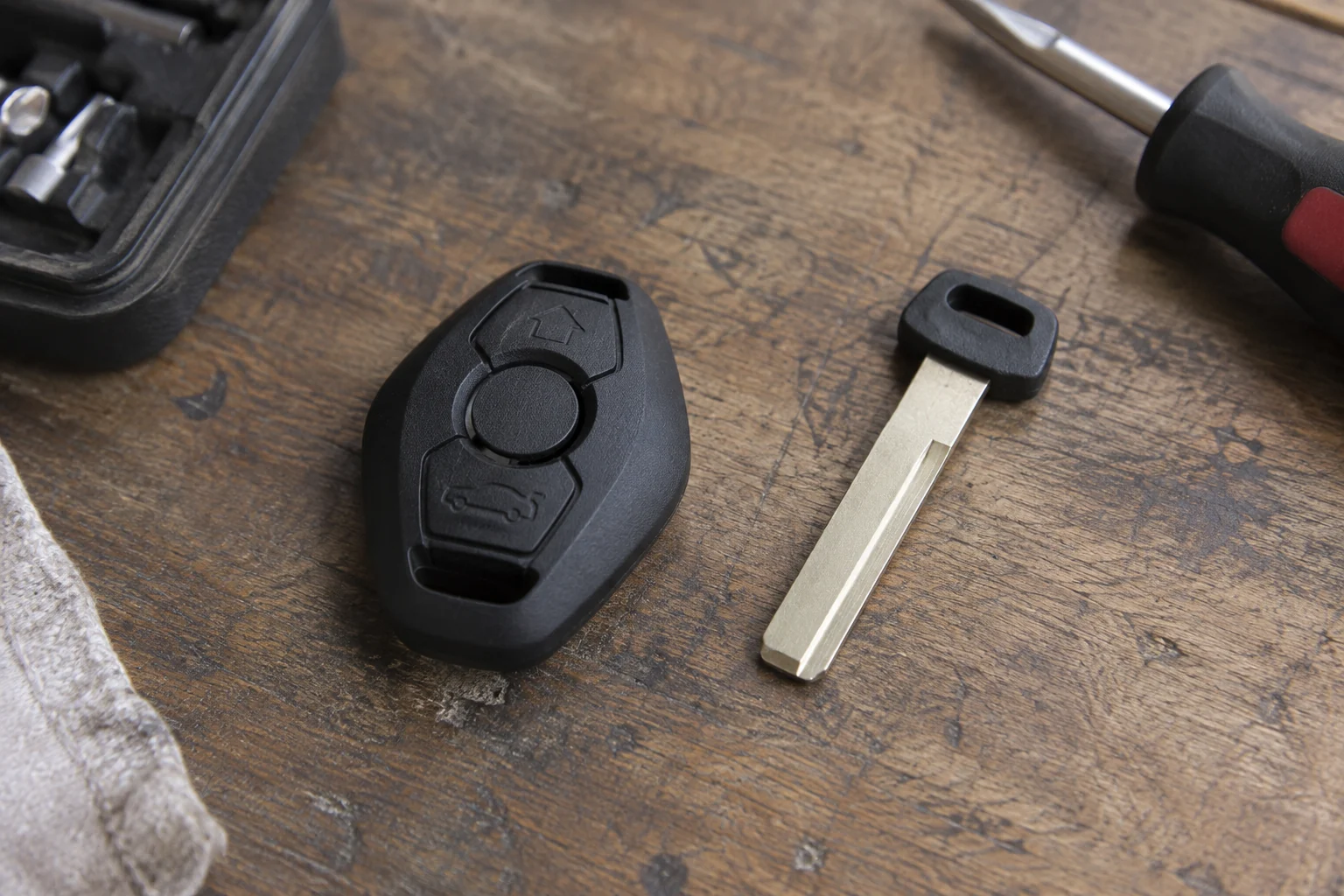
Assess the transfer risk before opening the original
If the sealed original is your only usable key, do not open it just to confirm a BMW E46 key shell purchase. Gaining a look inside may answer a fit question, but the inspection itself can damage parts you need to retain. A slipping tool, a cracked housing or a small component lost during separation could leave you worse off than an uncertain purchase. The less easily you could manage without the original, the stronger the reason to keep it intact while you gather more information.
A line around the case is not, by itself, an opening instruction. Do not assume that a visible joint is a safe place to insert a blade or that a method shown for a similar-looking key applies to yours. Prying, cutting or heating the case without a confirmed method creates risk before you have learned anything useful about the replacement. If an attempted separation needs increasing force or makes the case flex unexpectedly, stop rather than treating resistance as something to overcome.
There are two reasonable ways to handle the timing. You can keep the original sealed and buy a candidate shell only if you accept that its suitability will remain unconfirmed until transfer begins. Check the seller’s return conditions before choosing that route; opening or altering the new shell may affect your options. Alternatively, postpone the purchase until the original can be assessed. That reduces the chance of buying the wrong housing, but only if the assessment can be done at a level of risk you are willing to accept. Buying a shell first does not make opening the original safer.
Consider asking a key specialist to assess the original before anyone opens it if losing the key would be a serious problem, or if the remaining fit question cannot be resolved any other way. Ask whether they can establish anything without opening it, how they would approach a sealed case, and when they would stop if separation proves difficult. An assessment is not a promise that the case can be opened without damage; it should help you decide whether the information is worth that risk.
If you proceed with a transfer, work where any loose parts can be found and keep track of their positions as the case separates. Before closing the replacement, check whether retained parts settle into place without bending, trimming or heavy pressure. If something will not sit properly, stop. Forcing it into a BMW E46 key shell can turn a questionable fit into damage to the parts you were trying to preserve.
- Save clear photos of the sealed original.
- Check the listing's exterior and interior photos.
- Confirm the supplied parts and blade arrangement.
- Consider the risk of opening the original before relying on a transfer.
When a new case will not solve the key problem
A replacement shell changes the housing, not the electronics you already have. If the remote stopped locking or unlocking the car before the case became damaged, a new housing will not, by itself, restore that function. Likewise, an empty shell does not provide the components needed for the car to recognise the key for starting. Buy a BMW E46 key shell to address a case problem, not as a substitute for diagnosing a remote or starting fault.
The clearest case for replacement is a principally cosmetic or mechanical problem: the remote still operates as it did before, but the outer button covering is worn, split or missing, or the housing no longer feels secure. Even then, separate what you can see from what you can only suspect. A damaged outer button may make the underlying switch difficult to press; it does not prove that the switch or remote electronics are sound. A new button surface can only help if the parts beneath it still respond.
Test the key as it is, without treating one successful press as a complete diagnosis. Do the remote buttons respond consistently when pressed normally, or only after repeated attempts or unusually firm pressure? If one button has always needed extra force while the others work, the worn housing may be relevant, but an internal contact fault remains possible. If every button has stopped responding, replacing the plastic alone is a much weaker bet. Inconsistent operation can have more than one cause, including a problem outside the key, so symptoms narrow the question rather than settle it.
Starting and remote operation are also separate checks. A key that starts the car but no longer operates the remote has not demonstrated that its remote electronics work. Conversely, a remote that locks the doors does not establish why the car will not start. Neither symptom justifies assuming that a housing purchase will fix the other function.
Before ordering, ask what outcome you actually need. If it is a sounder-looking, less damaged case for an otherwise working key, a shell may be worth considering, subject to the fit questions covered above. If you need to restore a failed function, resolve or assess that fault separately first; otherwise, you may end up with the same non-working key in a new case.
Conclusion
The practical takeaway is to buy only against details you can verify without opening the sealed key. Compare its button layout, blade shape and visible case features with clear listing photos, and check any stated measurements against your key. A similar-looking shell is not proof that the internal parts will fit, so treat claims about the unseen interior as unconfirmed unless the seller can substantiate them. If the listing leaves that uncertainty unresolved, waiting for better information is safer than damaging the original case just to place an order.
Choose the option that matches your vehicle and situation.
Frequently asked questions
What if a listing shows only the front of the shell?
Ask for photos of the back, sides and inside before deciding. The front may show the right button layout while hiding differences in the case shape, blade opening or how the halves close. A single photo is not enough for a useful comparison with your sealed key.
Does a three-button layout prove a shell will fit?
No. Three buttons tell you where the controls appear, not whether the case has the same exterior shape or will hold your original parts. Compare the whole shell in photos, and treat the fit of the unseen components as a separate question until you have better evidence.
Does “shell only” include the circuit board or immobiliser component?
Do not assume it does. “Shell only” may be used differently across listings, so check the stated contents for the circuit board, immobiliser component, buttons and blade. If you’re looking at a listing on car-keys.lt, read its contents carefully and ask the seller about anything it does not name.
Is an included blank blade ready to use?
A blank blade is not prepared for your existing key simply because it comes with the shell. Check whether the listing expects you to transfer your original blade or have the supplied blank prepared separately. Confirming that distinction before ordering can prevent a suitable-looking case from being mistaken for a ready-to-use key.
What if the original metal blade is worn or bent?
Moving the old blade into a new case will not remove its wear or straighten it. If the blade is damaged, assess that issue separately before relying on a transfer. A replacement housing may address a broken case, but it does not make the metal blade sound.
Can the internal board be identified from a photo of the closed key?
No. A closed-key photo can help compare the exterior, but it cannot show the board’s outline, its position inside the case or whether the new shell will hold it securely. Interior photos of the proposed shell help, though the fit of your particular parts remains uncertain while the original is sealed.
Will changing only the housing fix a remote that already fails to operate?
No. A new housing cannot repair an existing electronic fault. If the remote stopped working before the case was damaged, treat that as a separate problem rather than assuming a shell swap will restore it. The failed function alone may not tell you which internal part is at fault.
What if the original parts do not seat in the shell after opening?
Do not force the parts into place or trim them to make them fit. Recheck the listing photos and description against what you found inside the original key, then review the seller’s return terms before making changes. A close exterior match does not justify risking parts you still need.
