
- If only the separate metal ring has opened or broken, replacing the key’s outer housing will not address that failure.
- A shell may address a broken attachment point when that point belongs to the housing and the replacement has a matching design.
- An empty shell replaces the casing, not damaged remote electronics, an immobiliser transponder or a key blade.
- Match the original key’s overall shape, buttons, closure and attachment point rather than relying on the Porsche name alone.
- The replacement also needs to accommodate any original components being retained; matching the outside does not establish internal fit.
- If the original key no longer performs its required functions, diagnose that fault separately before assuming a casing change is sufficient.
If only the metal key ring has broken, a new key shell will not fix it. If the plastic attachment point has snapped off the casing, a replacement shell may help—but only if that attachment point is part of the shell you order. A detachable clip or fitting is less clear-cut: it may not come with the outer case.
Start by looking at where the break ends. A bent or open metal ring is different from a missing piece of plastic or a crack running into the casing. If a separate fitting has come loose, check whether the fitting itself broke or the part of the case that holds it. Avoid pulling on the damaged area to test it, as that could make a small crack worse.
Here on car-keys.lt, the starting point is the failed attachment, not the assumption that every broken key-ring point calls for a whole new key. Once you know which piece failed, you can judge whether a Porsche replacement key shell would replace it. You will also need to check that the shell matches your existing key’s shape and layout, without assuming that its electronics or blade are included.
Find the part that actually broke
Start with the part that passes through your keyring. If it is a split metal ring, check whether its coils have opened, bent or pulled apart. An open gap can let the key slip free even when the plastic around the carrying point is intact. Remove the key from the rest of the bunch if that gives you a clearer view, but do not tug on the damaged area to test its strength.
Next, look for a separate fitting between the ring and the key body. Depending on the key in your hand, this might be a small metal or plastic piece that passes through an opening in the housing. Check whether it has come loose, snapped or left a piece behind. Do not assume every visible join is a break: a fitting that was designed to move may have a gap or pivot. Its shape, any matching loose piece and the marks where it sat can help you tell what has separated.
Inspect the housing where the ring or fitting attaches. Look for a missing corner, a crack running away from the opening, or plastic that has split into layers. A clean, continuous edge on the housing points to a different failure from a jagged edge with exposed fresh plastic. A moulded seam between the two halves of the key can resemble a crack, so follow the line: a seam usually continues in a regular path, while damage may branch or end at the carrying point.
Turn the key over and check both sides of that point. One face may look intact while the other has broken away, especially if the ring pulled against one side of an opening. Use good light and tilt the key rather than levering the case apart. If a fragment is still caught in place, leave it there for now; forcing it out can obscure how the parts originally fitted together or cause further damage.
Keep any ring, detached fitting and plastic fragments you find. Lay them beside the key and, if useful, take clear photos of each side before anything else comes loose. A fragment that matches a gap in the housing identifies the damaged area more reliably than the fact that the ring fell off. The parts present on Porsche keys can differ, so use what you can see on your particular key—not a picture of a similar-looking one—to identify the break.
Decide whether replacing the shell addresses the break
If only the metal ring has failed, a Porsche replacement key shell will not address the problem. The ring is the part to replace; the housing can stay in use if its attachment point is sound. Buying a casing for an opened or bent ring adds an unnecessary change to a part that has not broken.
A separate fitting calls for a different decision. If the ring was attached through a detachable piece and the key housing is intact, find out whether that fitting can be replaced on its own. Do not assume a new shell includes it: “key shell” may describe the casing, not every piece used to attach it to a keyring. Check the proposed product’s contents before treating it as the remedy.
If the carrying loop is formed by the housing itself, a broken loop is a casing problem. A matching Porsche key fob shell may provide a new attachment point where the original plastic has broken away. That depends on the loop actually being part of the housing on the key you have. If it belongs to a separate fitting, changing the casing alone may leave you with the same missing attachment.
The boundary can matter when more than one piece is damaged. For example, a metal ring may have pulled free and taken part of a plastic loop with it. Replacing just the ring would leave a weakened place to hang the key; replacing just the housing would not give you a usable ring if that too is bent or lost. Account for each damaged part rather than choosing one replacement based on where the break first caught your eye.
A casing change also has a firm limit: it replaces the casing, not a fault in the key’s working parts. If the key has another problem, a new housing should not be expected to make it work again. That remains true even when the broken key-ring attachment makes the casing look like the most obvious issue.
The practical choice is therefore based on what must be restored. Replace a failed ring if the attachment point is sound; address a detachable fitting if that is the failed part; consider a shell when the housing-integrated attachment has broken. Before ordering, confirm which of those parts the proposed replacement actually supplies. The next step is to assess whether that replacement matches the key you have—not to assume that any Porsche key housing replacement will do.
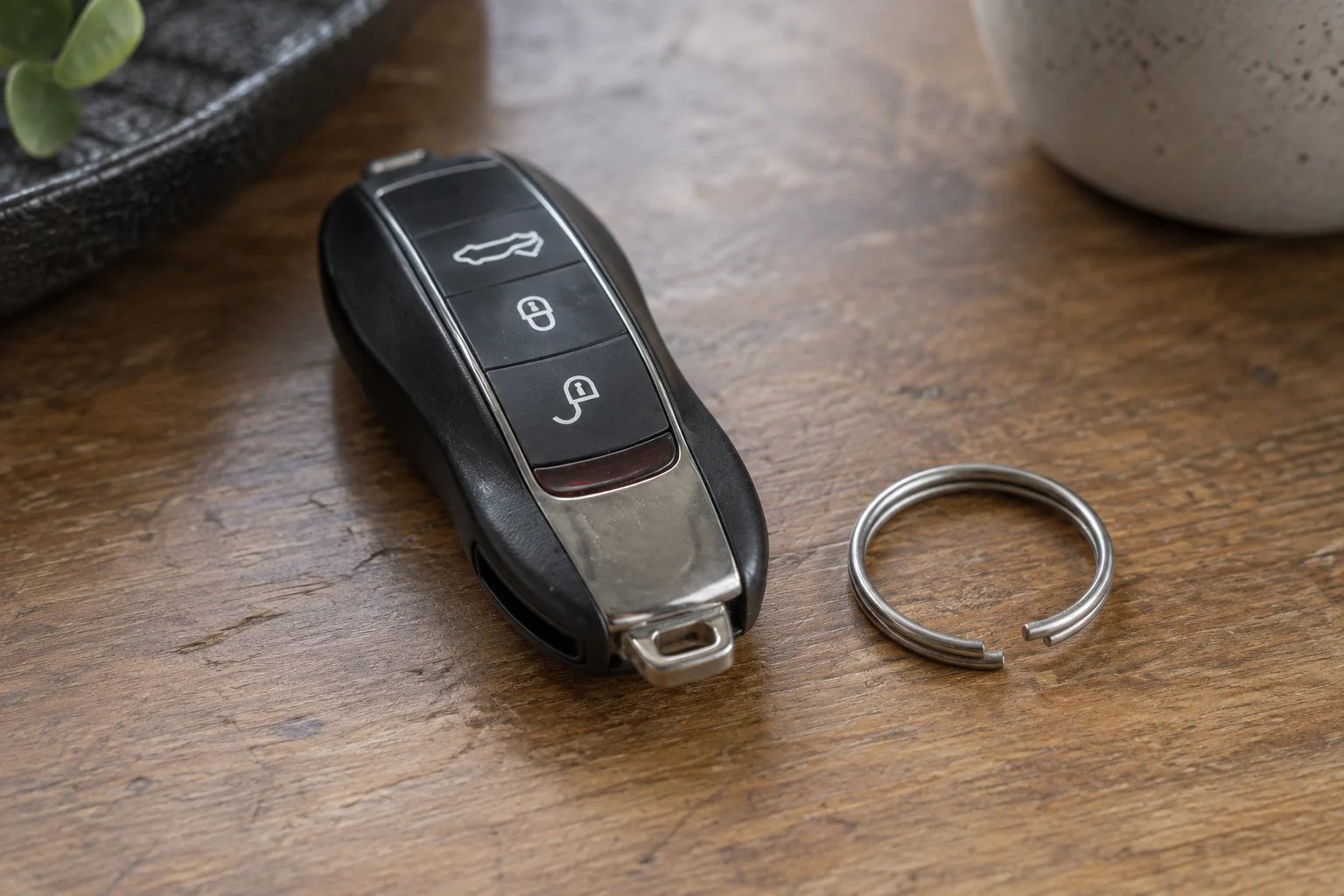
- Metal ring only: inspect or replace the ring, not the housing.
- Separate fitting: identify a matching fitting before considering a shell.
- Housing attachment point: consider a matching shell, subject to exterior and internal fit.
Compare the replacement with the key you have
Before ordering a Porsche replacement key shell, compare its exterior with the key in your hand—not just the vehicle name in the listing. Start with clear photos of your key’s front, back and edges. Lay it beside the listing images in the same orientation. If the seller shows only one face of the shell, you may not have enough evidence to judge the attachment end or the way the case closes.
Check the overall outline first. Look at the width and shape of each end, any raised sections, and where the body narrows or curves. Then compare the number, shape and position of the buttons. A shell with the same number of buttons is not necessarily the same design: one button may sit closer to the edge, or the spaces between buttons may differ. Compare the physical layout rather than relying on the symbols printed on them.
Next, follow the seam around your key. Note where the front and back halves meet and whether you can see a screw, a cover or a distinct end piece. The proposed Porsche key fob shell should show the same exterior arrangement in its photos and description. If the listing calls the casing “snap-fit” but your key visibly has a screw in the case, ask for clarification rather than assuming the two designs are interchangeable. You do not need to open your key to make this comparison.
Look closely at the carrying point, because that is the feature your replacement must provide. Compare its position on the body, the direction the ring opening faces, and the shape of the surrounding plastic. A small hole through a moulded corner is visibly different from a loop that projects from the end. If your key has a broken key-ring attachment, a listing photo taken only from the button side may hide the difference that matters most.
If your key has a blade, compare the external opening or blade end as well. Check its position and shape against the proposed housing. Do not assume a similar-looking button face means the other end matches.
Treat a model name or broad vehicle list as a starting point, not proof of fit. Check that the listing’s written description agrees with its pictures. Where an image is labelled illustrative, the attachment end is obscured, or the photos show inconsistent designs, ask the seller for images of the actual shell from both sides and the edges. Send clear views of your own key and ask them to confirm the exterior match before ordering.
Check what the new casing must hold
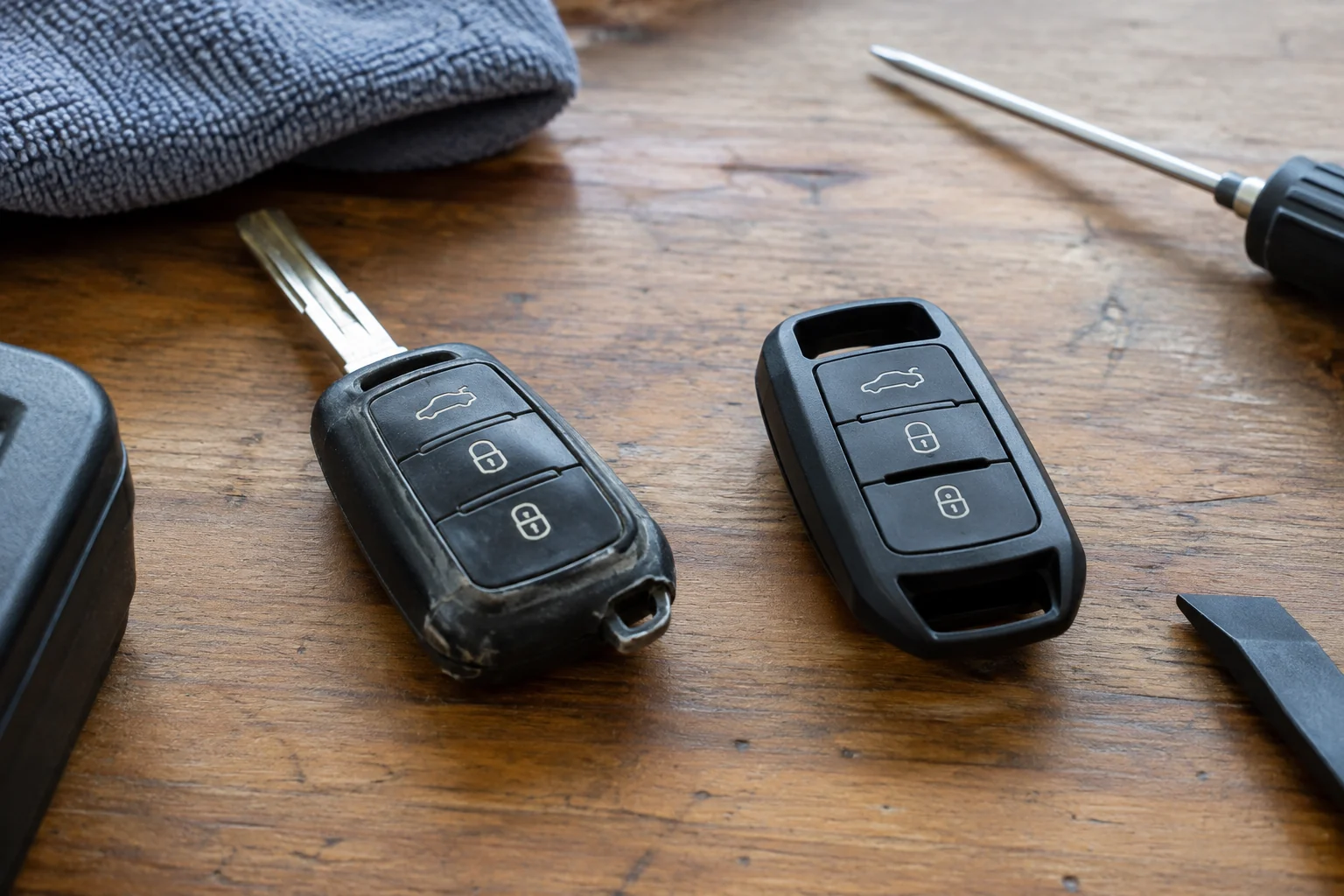
A Porsche replacement key shell is useful only if it can accommodate the parts your existing key needs. Before ordering, establish what is inside your key and what the proposed shell includes. An exterior match, even down to the number of buttons, does not establish that the internal parts will fit.
Start with the remote components. The circuit board needs a cavity of the right size, supports in the right places and a way for its buttons to meet the case buttons. Check whether the listing shows the inside of both halves. A board that is slightly different in shape, or has a switch in a different position, may not sit properly despite a familiar-looking button arrangement. If the shell includes a rubber button pad, confirm that it suits the board you intend to keep; if it does not, check whether your original pad can be accommodated.
Find out how the key’s immobiliser transponder is housed, where applicable. It may be a separate component that needs its own recess, or its function may be incorporated into another part of the key. Do not assume an empty-looking space in a product photo is a suitable transponder position. If you cannot establish which arrangement your key uses, ask for confirmation against the proposed shell’s internal layout before buying it.
Check the battery arrangement too. Some housings provide part of the battery holder or the features that keep the contacts correctly positioned. Others rely on components retained from the original key. The listing should make clear what is supplied and whether the parts you need to retain have places to sit. A shell that closes around the circuit board but leaves a contact unsupported is not a complete match.
If your key has a blade, identify how it is held. A fixed blade, a folding blade and a removable emergency blade need different provisions inside the casing. Check whether the new shell accepts the existing blade and whether it supplies any required carrier, pivot or retaining piece. A supplied blade blank is not the same as your existing cut blade, and a photo of a blade does not show that your original one can be fitted.
Finally, read “replacement shell” as a description of the casing, not a promise of a working key. Listings vary: one may contain only plastic halves, while another may include buttons, a blade blank or small fittings. Check the included-parts list against the components your key must retain. If the seller cannot confirm the internal layout and contents, matching buttons alone are not enough reason to order.
Check the working key before changing its housing
Before changing a working key’s housing, check what the key does now. With the vehicle safely parked, try the functions you normally use: remote locking and unlocking, the blade if your key has one, and starting the vehicle. Note any button that needs several presses or works only intermittently. This gives you a baseline: if a function already fails, moving the key into a new shell is not a reliable way to fix it.
Write down the results before opening anything. A short note such as “remote unlock works; lock button intermittent; vehicle starts normally” is more useful than trying to remember later whether the fault began during the transfer. If you cannot test a function—for example, the vehicle is not available—mark it as untested rather than assuming it works.
If you do proceed, keep a record of the key as you take it apart. Photograph each stage before lifting out a part, and note which way each piece faces and where it sits. Place removed parts in a clean, contained space so that a small piece cannot roll away or be mistaken for packaging. Keep the original housing pieces until the key has been reassembled and tested; they may help you check how a part was positioned.
Do not pry harder because a seam resists, or force a component into a position that merely looks close. The opening method and the parts inside can vary, so use instructions confirmed for the key you actually have. If you cannot establish how a part is retained or oriented, stop rather than risk damaging a key that still starts the vehicle. Getting help with an uncertain transfer is preferable to turning an attachment problem into a non-working key.
After a completed housing change, repeat the same checks you made beforehand. Test the buttons, blade and starting function where applicable, not just whether the case closes. If something that worked before now fails, do not assume the new shell needs “breaking in.” Stop using the changed key as your only reliable means of access or starting until the placement of the transferred parts and the cause of the fault have been checked.
If only the ring or a detachable fitting has broken, the key shell may be sound. If the plastic attachment point has cracked or broken away, a new ring alone will not hold securely. Check where the break is before buying a replacement part, and do not force a ring through damaged plastic. If you need a new shell, compare its shape, buttons and internal layout with your existing key rather than assuming a similar-looking case will fit. The practical goal is to replace the broken part, not more of the key than necessary.
- An empty shell does not replace electronics, a transponder or a blade.
- Do not force open a working key when component placement is uncertain.
- An existing functional fault needs assessment apart from casing damage.
Questions about damaged Porsche key shells
Can I keep using the key if its broken attachment piece is missing?
Keep the key somewhere secure, such as a closed pocket or a small pouch, rather than hanging it from the damaged point. Avoid pulling on any remaining plastic when removing it. The missing attachment piece alone does not establish whether the key will keep working, so check its normal functions before relying on it.
Will a new shell need programming?
An empty shell is a casing, not a new programmed key. If the existing electronic components are moved into it and remain intact, replacing the casing alone does not call for programming. That does not mean every transfer is risk-free: a damaged component or one that does not sit correctly in the new housing can leave the key unusable.
Will a replacement shell fix buttons that feel sticky?
It depends on where the problem is. If the outer button surface is worn, torn or catching on the casing, a suitable replacement shell may help. If the button beneath that surface is sticking or failing to register a press, changing the outer casing will not necessarily fix it. Check how the buttons behave before buying.
Can I reuse the blade from my current key?
Possibly, but do not judge by the blade’s visible shape alone. Its mounting point and the way it is retained must suit the replacement housing. A listing that shows only the outside may not answer that question. Check the relevant design details before assuming the existing blade can be moved across.
What if the two halves of my key casing no longer stay closed?
The closure points may be worn or broken, making the casing the part that needs attention. First check where the halves separate and whether anything inside is preventing them from sitting together. Until the closure and retained components have been inspected, do not assume a new shell alone will solve the problem.
Is glue a suitable fix for a broken plastic key-ring lug?
Glue may hold the piece in place, but that is not the same as knowing it will withstand the repeated pulls of a key ring. A bond can fail while the key is being carried, putting the whole key at risk of loss. Do not rely on a glued lug as a secure attachment point.
Should I keep the old casing after moving the components?
Yes. Keep the old casing until the new housing is fully assembled and you have checked every key function you normally use. It may also help you identify where a small retained part belongs if assembly needs another look. Once the checks are complete, you can decide whether it is still useful to keep.
What if a replacement shell looks right but its listing does not show the inside?
Ask for clear photos of the inside and confirmation of what is included before ordering. The outer shape does not show whether your existing components have the right seats or fixings. If you are comparing a listing on car-keys.lt, use those details to check the housing rather than treating a similar-looking exterior as proof of fit.
Choose the option that matches your vehicle and situation.
Frequently asked questions
Where can I find more information?
More information is available at car-keys.lt.
