
- A replacement key shell is a housing, but the pieces packaged with it vary by listing.
- Check whether buttons and any small retaining or flip-mechanism parts are explicitly included rather than inferring contents from photos.
- A supplied blade may be uncut, and its presence alone does not establish that it fits your original key.
- Do not assume a shell includes a remote circuit board or immobiliser transponder unless the listing explicitly identifies those components.
- Confirm the battery’s inclusion separately; space for a battery does not mean a battery is supplied.
- A complete contents list still cannot prove compatibility: the housing must accommodate the original components you intend to reuse.
A replacement key shell can look like a complete key in a photo without being sold as one. Before ordering, check which parts the listing explicitly says are included, which parts must come from your original key, and whether the shell physically matches what you have. The picture alone cannot settle those questions.
A shell is the outer housing. Depending on the listing, the contents may differ from what the assembled product image suggests. A button pad or metal blade visible in a photo, for example, is not necessarily part of the order. Equally, a shell that looks close to your old one may not accommodate its internal parts or close around them properly.
This guide on car-keys.lt uses a parts-by-parts check to help you read the listing against the key in your hand. It explains how to separate pictured items from confirmed contents, identify what you would need to transfer, and spot physical details worth checking before you buy. If the description leaves a part or fit unclear, treat it as unconfirmed rather than assuming the photo fills the gap.
Read the listing as a contents list, not a photograph
A replacement key shell is a housing, but the contents of a listing can vary. To work out what comes with a replacement key shell, start with the seller’s written description of the item you can actually order. A photograph may show a complete-looking key without establishing that every visible piece is supplied.
Read the product title, selected variant and contents description together. The title may name a product family, while a dropdown changes what is being sold. For example, a page titled “replacement key shell” might offer several versions under the same photos. Choose the variant first, then check whether the written contents apply to that choice or only to one of the options.
Give the most weight to an explicit “package includes,” “what’s included” or equivalent list. Such a list states what the seller says will arrive; images mainly show appearance. Key shell listing photos may include an assembled example, a view of several options, or an original key shown for comparison. Unless the description says otherwise, do not count an object as included simply because it appears beside the shell or inside it in a photo.
Check for wording that limits the offer as well as wording that adds to it. “Shell only” and “housing only” narrow what you should expect, even if the main image looks more complete. Conversely, “complete shell” is not a precise contents list: it may describe the assembled appearance rather than every item pictured. Read any notes below the main description, since exclusions are sometimes stated separately from the headline.
If the title, variant name, bullet points and images disagree, do not pick the most favourable interpretation. Look for a variant-specific contents statement. If there is none, ask the seller to confirm in writing exactly what is supplied with the option you intend to select. Include the variant name or a screenshot in the question so the answer cannot easily refer to a different option.
Before ordering, you should be able to make a simple list of what the package supplies based on explicit wording, not visual guesswork. If an item matters to your purchase but is only pictured—or covered by a vague phrase—treat its inclusion as unconfirmed. The later checks of individual parts are useful only once that basic contents list is clear.
Account for the housing, buttons, blade and small hardware
To establish what comes with a replacement key shell, check each physical part separately. “Shell” may describe the main plastic housing without telling you whether the button pieces, fasteners or blade are supplied.
Start with the housing. Does the contents description name both the front and back halves, or only a replacement cover? If the key has a separate battery door, end cap or trim piece, check whether that piece is included too. A listing for one damaged half is different from a listing for a complete outer housing, even if both use the word shell.
Next, identify the buttons. Some housings have a flexible button pad moulded into the front; others use separate rubber pads or individual plastic buttons. Check whether those pieces are supplied with the housing or expected to be reused. Also check the number and arrangement of button openings. A housing with three openings does not, by itself, establish that three button pieces are in the package.
Look for a separate mention of small hardware, especially if the housing has a flip-out blade. Depending on the design, assembly may involve a retaining pin, screw, pivot pin, spring or release-button piece. Do not assume “housing included” covers those items. If the contents list names the two housing halves but says nothing about a spring or pin, ask whether the flip mechanism is supplied assembled, supplied as loose parts, or not supplied at all. A missing small part can prevent the housing from closing properly or the blade from folding and releasing as intended.
Check the blade as its own line item. A blade shown with an assembled shell is not the same as a blade explicitly included in the order. The description may say “with blade,” “blade included,” “blade not included” or “blade sold separately.” If it says only “blade option,” check which option is selected and what that option contains.
If a blade is included, confirm its cut status. An uncut blade is a blank that has not been cut to operate your lock; it is not ready to use simply because it is attached to the shell. If the listing does not say whether the blade is uncut, do not treat its condition as settled. Likewise, the presence of a blade is not evidence that its shape or mounting matches your original key. For this parts check, record only whether a blade is supplied, whether it is attached or loose, and whether the seller identifies it as uncut.

Check electronics and battery as separate contents
Check for a remote circuit board as its own line item. This is the electronic part that sends a signal when the remote is operated; a housing with no board cannot provide remote functions by itself. Look for wording such as “circuit board included”, “remote electronics included” or “PCB included”. By contrast, “replacement case”, “empty shell” or “car key shell without electronics” gives you no reason to expect a board. If the description does not say, ask whether a circuit board is supplied with the variant you are ordering.
Check the immobiliser transponder separately, where the key uses one. It is the component the vehicle recognises for starting, and it may be a separate chip or part of the electronic assembly, depending on the key. A listing that mentions a remote circuit board does not, on its own, establish that the required transponder is included. Likewise, “transponder slot” describes space in a housing, not a supplied chip. Ask the seller to identify whether a transponder is included and, if so, whether it is separate or incorporated into another supplied component.
Treat the battery as a third item to verify. A battery compartment shows where a battery goes; it does not confirm that one is in the package. Even a listing that explicitly includes electronics may exclude the battery. Look for a statement such as “battery included” or “battery not included”. If the contents description names neither, ask before ordering rather than assuming that an assembled-looking shell arrives ready to use.
These distinctions matter because an item can look like a finished remote while being only a housing, or it can contain one electronic component but lack another. For example, “shell with battery” would confirm neither a remote circuit board nor an immobiliser transponder. “Shell with PCB” would still leave the battery and any separate transponder to be checked. Read each inclusion as narrowly as it is written.
If a listing uses the broad word “electronics”, request a breakdown: remote circuit board, immobiliser transponder where applicable, and battery. That gives you a clear answer to what comes with the replacement key shell without treating an unspecified electronic part as proof that the key is complete or functional.
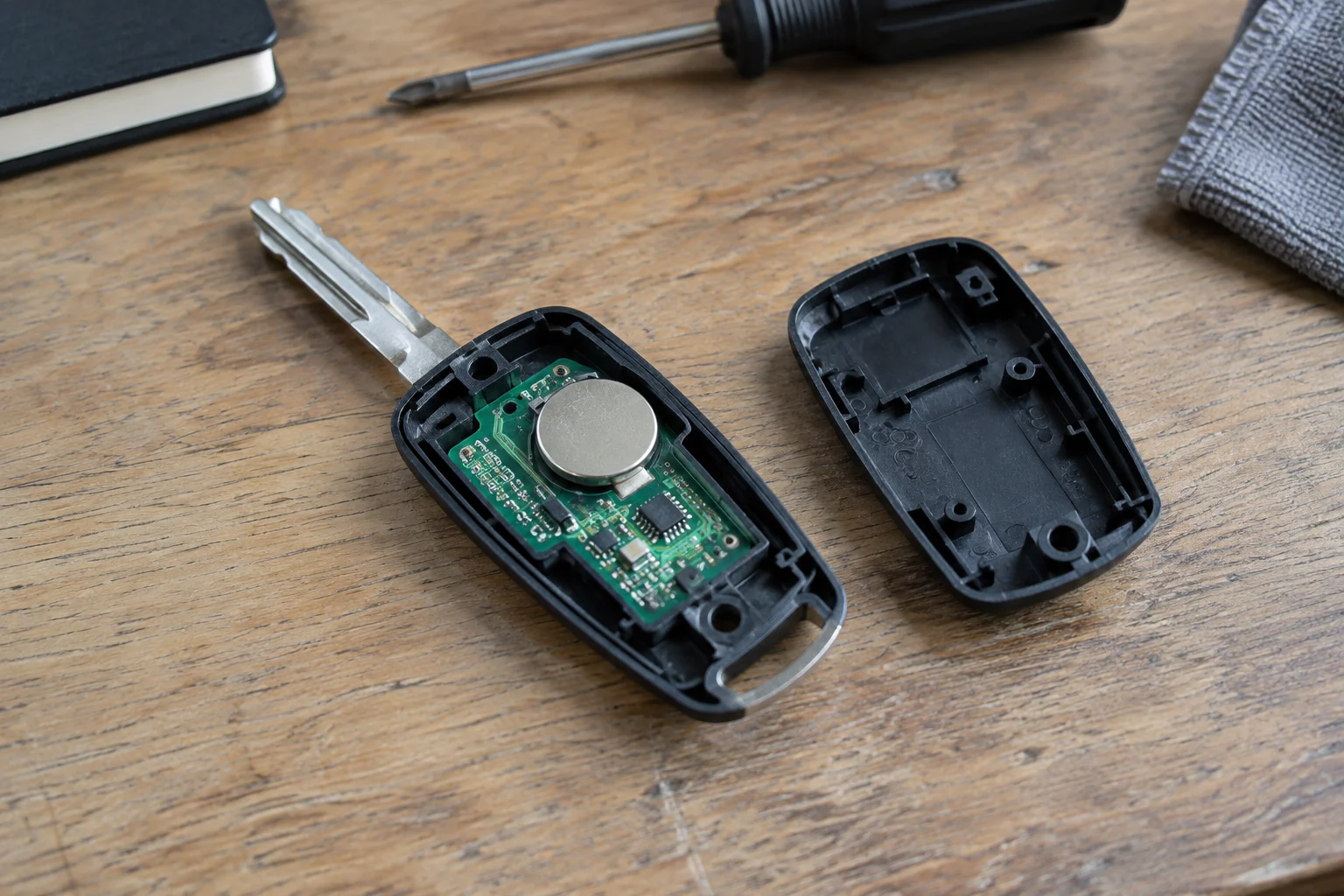
Inventory the parts you would need from your original key
Put the listing’s stated contents beside your original key and account for anything the listing does not supply. For each part, mark whether you have it, can access it and believe it is usable. A part that appears to be inside the old key is not necessarily available for transfer.
Start with any electronics the new shell does not include. Is the remote circuit board still in the original key, or has it been lost or damaged? If your key uses a separate immobiliser transponder, can you identify whether it is present? Do not assume that a key which no longer operates has a working board or transponder; the fault may be elsewhere, but the part’s condition remains uncertain.
Next, check the physical pieces you would be relying on. Look for a blade, button pieces, battery, battery contacts and any small retaining or flip-mechanism parts that your original key uses. Note anything missing or visibly damaged. A loose button, bent contact or broken spring should not be counted as a sound reusable part simply because it is still inside the housing.
Availability is a separate question from condition. A blade may be fixed into the old housing, and a transponder may be difficult to locate or remove. Damage to the case can also make it hard to reach a component without putting that component at risk. Do not treat an apparently complete original key as a guaranteed set of removable parts.
If a needed component is missing, the contents gap is unresolved. If it is damaged or cannot be removed safely, treat it as unavailable until you have a reliable way to replace or recover it. Where opening the old key could damage a board, transponder or other part you need, ask a qualified key professional to assess it rather than forcing the case apart.
This inventory gives you a practical answer to the ordering question: the listing must supply the necessary parts or you must have usable parts available from the original key. It does not, by itself, establish whether those parts will fit the new housing.
- Which exact variant and quantity are being supplied?
- Which physical parts are explicitly included?
- Are electronics and a battery included or expected from the original key?
- Will the housing accommodate the original parts you plan to reuse?
Check whether the supplied shell can house those parts
A complete contents list does not establish that the shell will hold the parts you plan to reuse. Compare the replacement with your original key from the outside and the inside. The housing should have the same overall shape, seam position and button layout. Count the buttons, but also check their order and spacing: a three-button case can still press the wrong points on a different circuit board.
Check how the housing closes around the electronics. Clear interior photos should show the supports, locating posts and recesses where the circuit board sits. Compare their positions with the board in your original key, including any protruding components that need clearance. If the original key has a separate transponder, look for a suitable space and a way to keep it in place. An empty cavity is not, by itself, evidence that the part will be held securely.
Pay particular attention to the blade connection. A blade that looks similar in a photo may have a different base or mounting hole. For a flip key, compare the way the blade attaches to the pivot, not just the exposed metal portion. For a fixed-blade key, compare the point where the blade enters the housing. If you intend to transfer your existing blade, the shell must accept that blade’s mounting end; blade inclusion or a matching outline does not answer that question.
Use key shell listing photos to test these details, rather than relying on a front-facing product image. Look for views of both sides, the open housing, the blade mount and the area beneath the buttons. Place those images beside clear photos of your original shell. Differences in post positions, screw holes or hinge design are reasons to pause, even when the outer shape appears close.
A vehicle make, model or year in a listing is a starting point, not proof of fit. Keys supplied for the same named vehicle may differ in case design or internal arrangement. Compare any part identifiers on your original shell with identifiers stated for the exact item and selected variant. If the seller provides dimensions, check what was measured and compare the same points on your key; a measurement for the whole case cannot confirm the blade mount or board supports.
If the available images or measurements do not show a critical mounting point, ask for an interior photo or a measured detail before ordering. Specify the part you need to fit—for example, the circuit board’s locating posts or the blade’s mounting end. If that point remains unverified, treat physical compatibility as uncertain, regardless of how complete the listed contents are.
A key shell can look like a complete replacement even when the listing is for an empty case. Before ordering, check what is actually included and which parts, such as the blade, electronics or immobiliser chip, would need to come from your existing key. Don’t rely on photos of an assembled key; read the contents and compatibility information in the listing. The practical takeaway is to account for every part you need before buying, especially if your original key is damaged or missing components that the new shell does not supply.
Choose the option that matches your vehicle and situation.
Frequently asked questions
If a listing offers several variants, which one will I receive?
The selected option at checkout is the one to check, not the first photo or the listing’s general description. Read any contents stated for that option. If its name, photos and description point to different parts, ask the seller to confirm what that exact variant includes before ordering.
Does a photo of multiple shells mean the price covers all of them?
Not necessarily. A photo may show the available styles or variants together. Check the quantity stated for the option you selected, including any wording such as “one piece” or “set.” If no quantity is given, ask the seller rather than treating every shell in the image as part of the order.
Is a badge or logo shown in the photo necessarily included?
No. A badge may be shown to illustrate the finished key while being supplied separately, or it may be part of only one variant. Look for an express statement that the badge is included with your selected option. If the listing does not say, ask before relying on the photo.
Does an uncut blade mean key cutting is included?
An uncut blade is a physical part; cutting is a separate service. If the listing says it includes a blank blade, that does not by itself mean it will arrive cut for your key. Look for a separate statement about cutting, and clarify it with the seller if you need a cut blade.
What if I no longer have the original remote circuit board?
A replacement housing will not restore remote functions if the needed electronics are missing. Check whether the selected product explicitly includes a circuit board; do not infer one from a photo of an assembled key. If the listing offers only a shell, you will need to resolve the missing electronics separately.
What if I cannot remove a component from the original key without damaging it?
Do not force it out just to make a transfer possible. A component that breaks during removal may leave you with a new shell but no usable part to put inside it. Ask someone qualified to assess the original key before you order a housing that depends on reusing that component.
What should I ask when the product description does not list the contents?
Ask the seller for an itemised list for the exact variant you intend to select: housing, buttons, blade, electronics, transponder and battery, where relevant. The parts checklist on car-keys.lt can help you phrase that question, but the seller’s answer should identify what is actually supplied with your chosen option.
What should I do if the delivered parts differ from the listing?
Keep a copy of the listing as it appeared when you ordered, including the selected variant and its stated contents, along with your order record. Compare those details with what arrived, then contact the seller and describe the specific discrepancy. Photos of the delivered parts can help make the question clear.
