
- An Audi Q3 model label alone cannot establish shell compatibility; compare the listing with the specific key you intend to repair.
- A shell is a housing, not necessarily a remote or complete key, so confirm exactly which components the listing includes.
- Matching button counts narrow the options, but button positions and the overall case shape must also correspond to your key.
- An exterior match cannot establish whether the original circuit board and other retained components will sit correctly inside the replacement.
- Check blade attachment separately from housing fit; an included blade may be uncut or may not accept your original blade.
- If interior photos or supplied-part details are missing, leave compatibility unconfirmed until the relevant listing information is available.
Different listings under the Audi Q3 name may show different keys because they are not necessarily selling the same thing. One may offer an empty replacement housing, another a protective cover, and another a complete key. Even among empty shells, the button layout and case shape can differ. The vehicle name alone cannot tell you which housing will take the parts from the key you own.
Start with the key you intend to repair. Compare its outline, the number and position of its buttons, and how the blade sits in the case. Look beyond the first product photo: a closed-key image may not show the inside of the housing or make clear what is included. If your original case is cracked, for example, a silicone cover will not replace it, however similar the listing photo looks.
For readers comparing listings on car-keys.lt and elsewhere, the useful question is not “Which one says Q3?” but “What exactly is being sold, and does it match my key?” The checks below will help you narrow the options and recognise when a listing does not give you enough detail to choose a shell confidently.
First, identify what the listing actually sells
Start with the supplied-parts description, not the product photo. Listings under “Audi Q3 replacement key shell” can describe different purchases: an empty housing, a remote containing electronics, or a more complete key assembly. The Audi Q3 name in a title does not tell you which of those items will arrive.
A replacement housing is the outer case intended to take parts from a key you already own. Check whether the listing includes the button pad or buttons, rather than assuming they come with the case. Also check whether it supplies a circuit board or other electronics and whether a blade is included. “Key case” and “key housing” may be used for similar-looking products, but neither label is a reliable list of contents.
A remote listing may offer electronic components rather than just a case. A complete key listing may include a housing, electronics and a blade, but “complete” does not by itself establish that the key is ready to use with your car. Read the itemised contents and any exclusions. If the description only says “key” or “replacement,” the product type remains unclear.
Treat photos as illustrations of the offer, not an inventory. A photo may show buttons and a metal blade even when the description says that only a shell is supplied. Conversely, a listing may use a plain case photo while describing additional parts. Where the photo and written contents disagree, do not count a pictured part as included without explicit confirmation in that listing.
Your starting point changes the purchase you need. If the case is damaged but you still have a working key, a housing-only listing may be the relevant category because you have the original parts. If the whole key is lost, an empty shell cannot replace the missing electronics or blade. Sort out that difference first; then assess whether a particular product matches what you own.
- Shell: confirm exactly which housing parts are supplied.
- Remote: confirm whether electronics are included.
- Complete key: confirm what is supplied; the label alone does not establish readiness for use.
Compare the listing with the key in your hand
Put the key you want to repair beside the listing photos. Use its visible features as your reference, rather than assuming every product labelled “Audi Q3” has the same shape. If you have more than one key for the car, compare the listing with the particular key that needs a new case. A photo resembling your spare key does not resolve a mismatch with the damaged one.
Start with the buttons. Count them, then compare their positions and arrangement—not just the symbols printed on them. Two Audi Q3 key housing listings might both show three buttons, yet place them in a different order or use a different shape for the button panel. Look at whether the buttons run in a line, how much space surrounds them, and where the panel sits relative to the end of the case. A different count or a clearly different layout is a reason to rule a housing out.
Next, follow the outer edge of the case. Is it narrow and rounded, broad and tapered, or nearly rectangular? Compare the proportions rather than judging size from a photo with no scale. Then look for the seam where the two halves meet. A seam running along a different edge, or a noticeably different split around the button area, can distinguish housings that look similar from the front.
Check the end where the blade emerges or folds into the case, but limit this comparison to what you can see externally. Note the shape of the surrounding plastic, any visible recess, and how that end blends into the rest of the outline. If one photo shows a broad, rounded end and your key has a narrow, angular one, matching button symbols alone should not keep that option on your shortlist.
Photographs can also exaggerate differences. A case shot at an angle may look wider than one photographed straight on; a worn key may have softened edges or faded button markings. Colour, surface finish and decorative trim can differ without changing the basic outline. Before rejecting a close-looking Audi Q3 key case, compare front, back and side views where the listing provides them. Conversely, do not assume two cases match because their front-facing photos look alike if their edges are not shown.
Use the visible comparison to narrow the options, not to declare a fit. If the button layout and case geometry agree across the available views, the listing is worth checking further. If a clear feature conflicts, set it aside—even if its title says “Audi Q3 replacement key shell.” Where the photos hide a distinguishing edge or show only one angle, leave the exterior match uncertain rather than filling in the missing view from the model name.
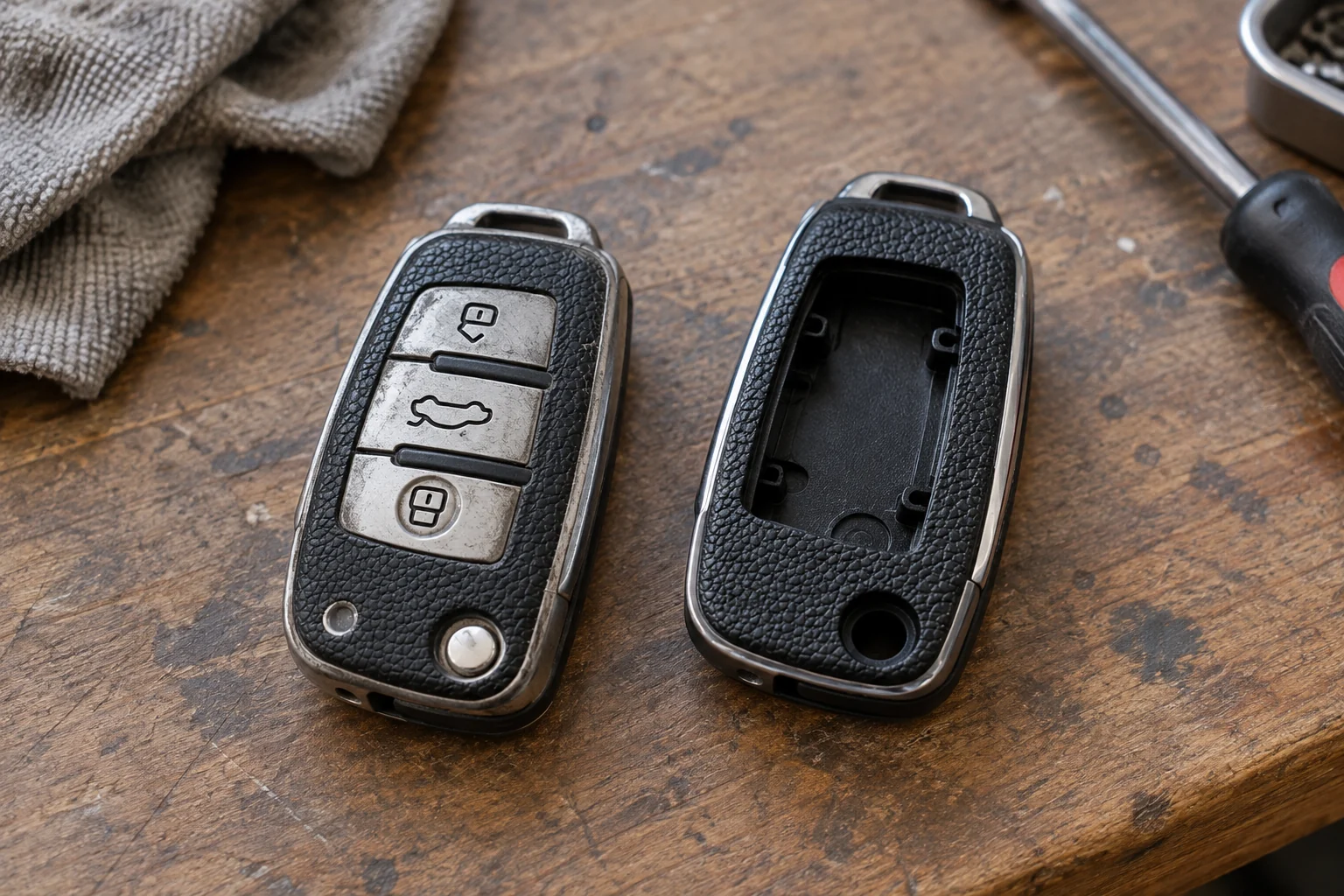
Check the inside before trusting an exterior match
An exterior match only narrows the options. For an Audi Q3 replacement key shell to be useful, the parts you intend to keep must sit in the new housing without being forced or left loose. A circuit board that is slightly too long, too wide or the wrong shape for the internal recess may prevent the case from closing, even when the outside looks right.
Compare interior photographs if the listing provides them. Look for a board-shaped recess and for posts, edges or clips that appear to hold the board in place. Note whether those supports sit where your existing board would need them. An empty-looking cavity is not automatically more adaptable: a board may depend on particular supports to stay seated when the case is closed.
Use only what you can establish about the key you own. If its case is already open and the board is visible, compare the board’s outline and the position of its larger features with the advertised interior. Pay attention to any area where the board has to clear a post or fit beneath a lip. Do not assume the board will seat simply because the closed cases look alike. Conversely, a photo taken at an angle may hide a support, so an apparent match is not proof of fit either.
Where the photographs show a battery compartment or removable cover, check how those features relate to the space for the board. A different internal arrangement could obstruct access to the battery or leave a component with nowhere to sit. Apply the same check to any separate piece you can actually see in your existing key: the new case needs a corresponding place for a part you plan to retain. Do not infer hidden compartments or additional parts from a product title alone.
If your current case is intact, avoid breaking it open just to compare it with a listing. You can use an access cover designed to be removed, if your key has one, but do not pry apart a sealed or resistant housing for an uncertain purchase. Damage to clips or internal parts would turn a straightforward case comparison into a different repair problem.
Finally, treat missing interior photographs as a real limit on what you can conclude. Exterior images can rule out some housings, but they cannot show whether the board has the right seat and supports. If two Audi Q3 key housing listings look similar outside yet show different interiors, compare each interior with the components you can verify in your own key; do not treat either exterior photo as the deciding evidence.
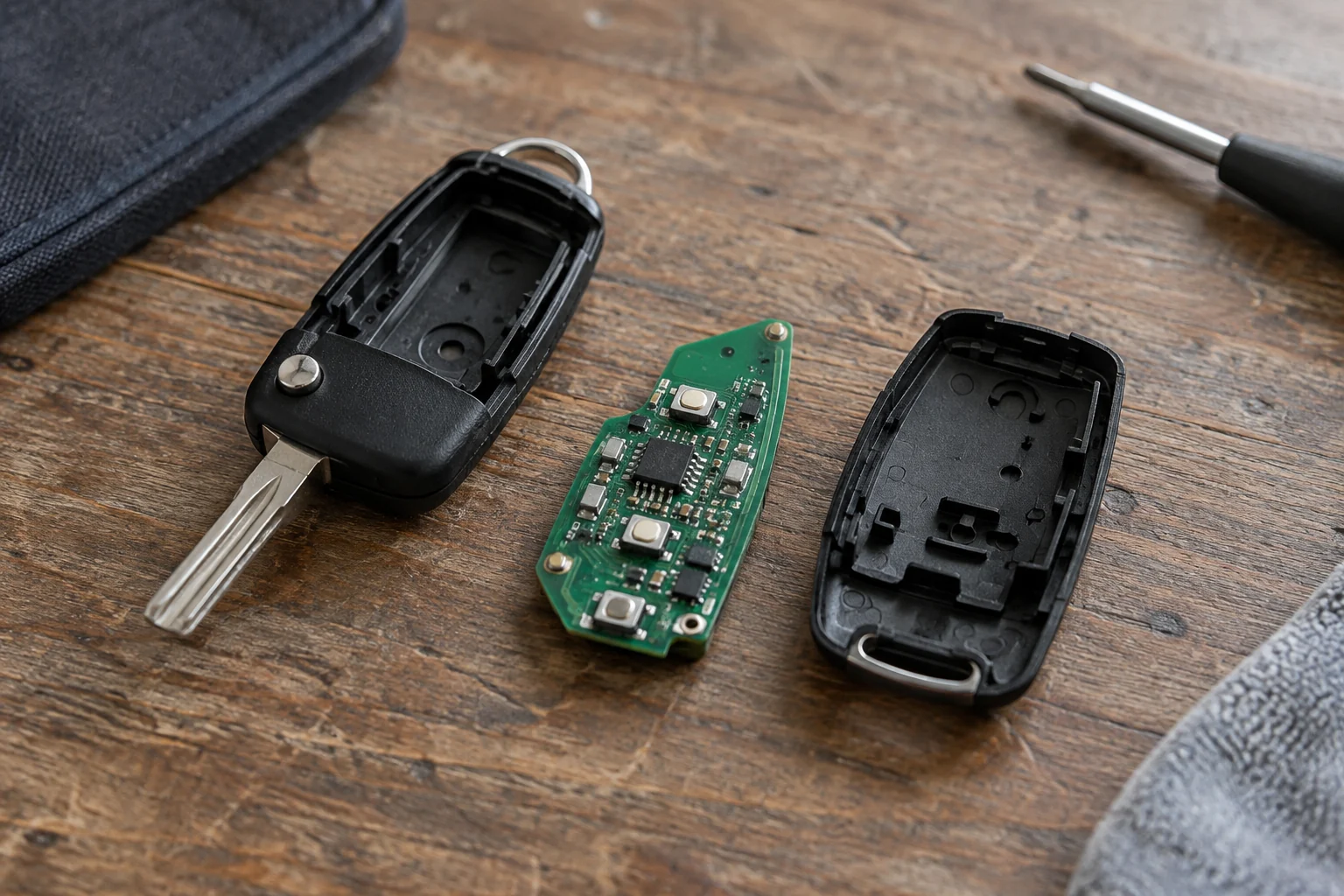
Treat the blade attachment as a separate fit check
A case can look like your key but still hold the metal blade differently. Before choosing an Audi Q3 replacement key shell, compare where the blade joins the housing on the key you own with the connection shown in the listing. Look at the base of the blade, not just the cut edge: does it fold into the case, and is its base shaped to meet the holder shown? A blade that looks similar when extended may have a different attachment at the hidden end.
If you plan to reuse your original blade, check whether the specific housing is designed to accept it. The blade may be held by a pin, a screw or another retaining feature; a close-up of the attachment area is more useful for this check than a photo of the assembled key. Do not treat “replacement case” as a promise that the old blade can be moved across. Transferability depends on the blade’s base and the housing’s holder matching, and on how the blade is secured in your existing key.
An advertised blade introduces a different question. An included uncut blade is not a ready-to-use blade: its edge has not been cut to match your existing key. It also needs the correct attachment shape for the offered housing. Check both points separately. For example, a listing may show a blade already fitted to a flip mechanism, but that photo alone does not establish that its blank is suitable for copying your original blade or that your original blade will fit the mechanism instead.
Keep the two possible routes clear when comparing listings. If you intend to retain your original blade, you need confirmation that its base can attach to the new housing. If you intend to use the supplied blade, check its attachment and whether it is uncut; cutting may then be needed before it can be used. A listing that says only “with blade” does not settle either route.
Where the listing does not show or specify the blade connection, do not infer it from the Audi Q3 label or an otherwise convincing case photo. Likewise, leave original-blade transfer and any cutting requirement unconfirmed unless the details for that particular product support them. That keeps a promising housing from being mistaken for a usable blade arrangement.
What to do when the listing leaves fit uncertain
If the listing does not show enough to confirm a match, pause before ordering. First, check what is actually on the page: which photographs show the offered product, whether its interior is pictured, and whether the specifications answer your remaining questions. Do not fill a gap with an assumption based on the title or a similar-looking listing.
Save the link and record the exact variant you are considering, including its product code or selected option if one is shown. A seller may have several Audi Q3 key housing options on one page, while a search result displays only one photo. Referring to “the Q3 shell” in a message could get you an answer about a different option.
Ask for photographs of the actual item offered in that variant, rather than another stock image. Request views of both exterior sides and the inside of each housing half. If the listing pictures a blade or other removable pieces, ask which of those parts are supplied. Ask, too, whether the blade connection is documented for that product and whether the seller has a photograph showing it. These are requests for missing evidence, not a request to infer fit from the car model.
Where appropriate, send clear photos of the existing key and say which parts you intend to retain. Show both exterior sides and the end where the blade meets the case; include an interior view only if the key is already open or can be opened without damage. Avoid sending an unnecessarily detailed image of the blade’s cut edge. This gives the seller a specific item to compare against without requiring you to dismantle a working key just to answer a listing question.
Keep the exchange tied to the precise product: “I’m considering variant [code] in this listing. Are these photos of that variant, and can you show both housing interiors? Which pictured parts are included, and do you have documentation for its blade connection?” If the reply points to another option, confirm its code before relying on the answer.
A useful reply addresses the missing points with product-specific photos or specifications. Silence, a repeated catalogue image, or “fits Audi Q3” alone does not confirm compatibility with the key you own. If the crucial detail remains unavailable, leave that Audi Q3 replacement key shell unconfirmed and look for a listing that documents it.
The Audi Q3 name on a listing is not enough to choose a replacement shell. Use the key in your hand as the reference: compare its outline, button layout, blade and key-ring attachment with the item shown and described. Listings from Lithuania or elsewhere may show different housings under the same model name, and a familiar-looking photo may miss a detail that matters. If the photos and description disagree with each other—or with your key—treat the match as unconfirmed rather than guessing from the title.
- Save the exact listing or variant under consideration.
- Obtain photographs of the supplied item's outside and inside.
- Get a clear list of supplied parts and blade details.
- Leave compatibility unconfirmed if essential information is still missing.
Choose the option that matches your vehicle and situation.
Frequently asked questions
What if my Audi Q3 key has already been put in a replacement case?
The case you see now may not match the key’s original housing. If you have the previous case, blade or any loose parts, keep them for comparison. When looking at options on car-keys.lt, use the parts you actually need to retain as your reference, rather than relying only on the current exterior.
What if my spare key looks different from the damaged one?
Use the damaged key as your reference, because that is the housing you need to replace. The spare may have been rehoused at some point, and its appearance does not establish what the damaged key needs. Keep the keys separate while comparing them so you do not mix up their parts.
How can I compare buttons if their symbols have worn away?
Count the buttons and look at their positions, outlines and spacing. Check whether any button is noticeably smaller or set apart from the others. Worn symbols are not a reason to guess what each button used to show; compare the physical layout you can still see and leave unclear details unresolved.
Should I force open a case to photograph the inside?
No. Forcing a reluctant case open can damage the housing or parts you need to keep. If you cannot inspect it safely, stop rather than prising harder for a photograph. Someone qualified to handle the key may be able to help you identify its contents without an avoidable breakage.
Will a new shell fix buttons that have stopped working?
A new shell may help if the housing is broken and the buttons no longer press properly. It will not, by itself, repair a fault in the electronics you move across. If the buttons stopped responding before the case was damaged, do not assume a housing change will restore them.
What if there is a separate small component inside my old key?
Keep it safe with the other parts from that key. Its role may not be clear from its size or appearance, so do not discard it or assume where it belongs in a replacement case. If you cannot identify it confidently, get it checked before moving the parts.
Does an OEM-style product photograph prove a shell is genuine?
No. “OEM-style” describes an appearance; a photograph alone does not verify who made the shell. Equally, a genuine-looking finish does not establish that the housing suits the parts from your key. Treat manufacturer identity and physical compatibility as separate questions, and look for clear product information rather than relying on the image.
Should I throw away the old housing after moving the parts?
Keep the old housing and any unused pieces until the reassembled key has been checked. They can help you work out whether a part was left behind or fitted incorrectly if something does not feel right. Once the key has been checked, you can decide what no longer needs keeping.
