
- A listing that names the Citroën C1 alongside other models narrows the search, but it does not establish that the shell fits your key.
- Compare both sides and the edge of your existing key with listing photos; matching button count alone cannot confirm the casing design.
- The replacement must accommodate the components you intend to retain, including the circuit board and any separate transponder where applicable.
- Blade attachment needs its own comparison because a suitable casing does not establish that the original blade can be secured in it.
- A shell replaces a housing, not faulty electronics; a casing change alone will not restore functions that already fail.
- If photos or specifications do not show the necessary interior and blade details, ask for product-specific evidence and leave fit unconfirmed.
A model list is not a fit check
A replacement shell advertised for the Citroën C1 and several other cars is not automatically a match for the key in your hand. The model list is a useful search clue, but it does not show whether your key’s parts will fit inside that casing or whether its blade will attach correctly. A shell can look right in a product photo and still differ in the places that matter.
Begin with what you can see on your existing key: its shape, button layout, seams and blade attachment. Those details can help you rule out an obvious mismatch, but they cannot confirm the fit on their own. Inside, the circuit board needs to sit in the right position, and a separate transponder chip, if your key has one, needs a suitable place too. The blade is another question, even when its shape looks familiar.
On car-keys.lt, the useful question to bring to a multi-model listing is not just “Is C1 named?” but “Does this particular shell match the parts I need to transfer?” The checks below separate what photos can reveal from what requires closer confirmation before you buy.
What a multi-model listing does—and does not—tell you
A listing that names the Citroën C1 gives you a reason to investigate the shell, not a fit confirmation. The vehicle list may group together several keys used across the advertised models. What matters is whether the particular shell offered corresponds to the key you have, rather than whether your car appears in the title or search results.
Start by checking which product the listing actually describes. Some pages offer several selectable variants under one title, while the main photo and description show only one of them. Changing a selection may update the product code, images or specifications—or leave parts of the page unchanged. If the C1 appears in a shared vehicle list but the specifications do not clearly apply to your selected variant, the listing has not established compatibility for that variant.
Read identifiers with the same care. A seller’s stock code identifies an item in that seller’s catalogue; it does not necessarily identify the original key design. A part number is more useful only when the listing makes clear what it refers to and it can be matched to reliable information about your existing key. If a page presents several numbers without linking each one to a specific option, do not assume that every number applies to every shell shown.
Model years can narrow a search, but they cannot settle it on their own. A year range is a claim about the vehicles the seller has grouped with the product, not a measurement of your key. The year you know may also be the registration year rather than the model year used in a catalogue. Use it to rule out an obvious mismatch, not to override unclear variant details.
The practical test at this stage is simple: can you identify one selectable shell whose images, specifications and identifiers all refer to the same item? If not, a multi-model listing remains a search clue. The physical fit checks come next; the vehicle list cannot stand in for them.
Compare the casing you have with every visible side of the shell
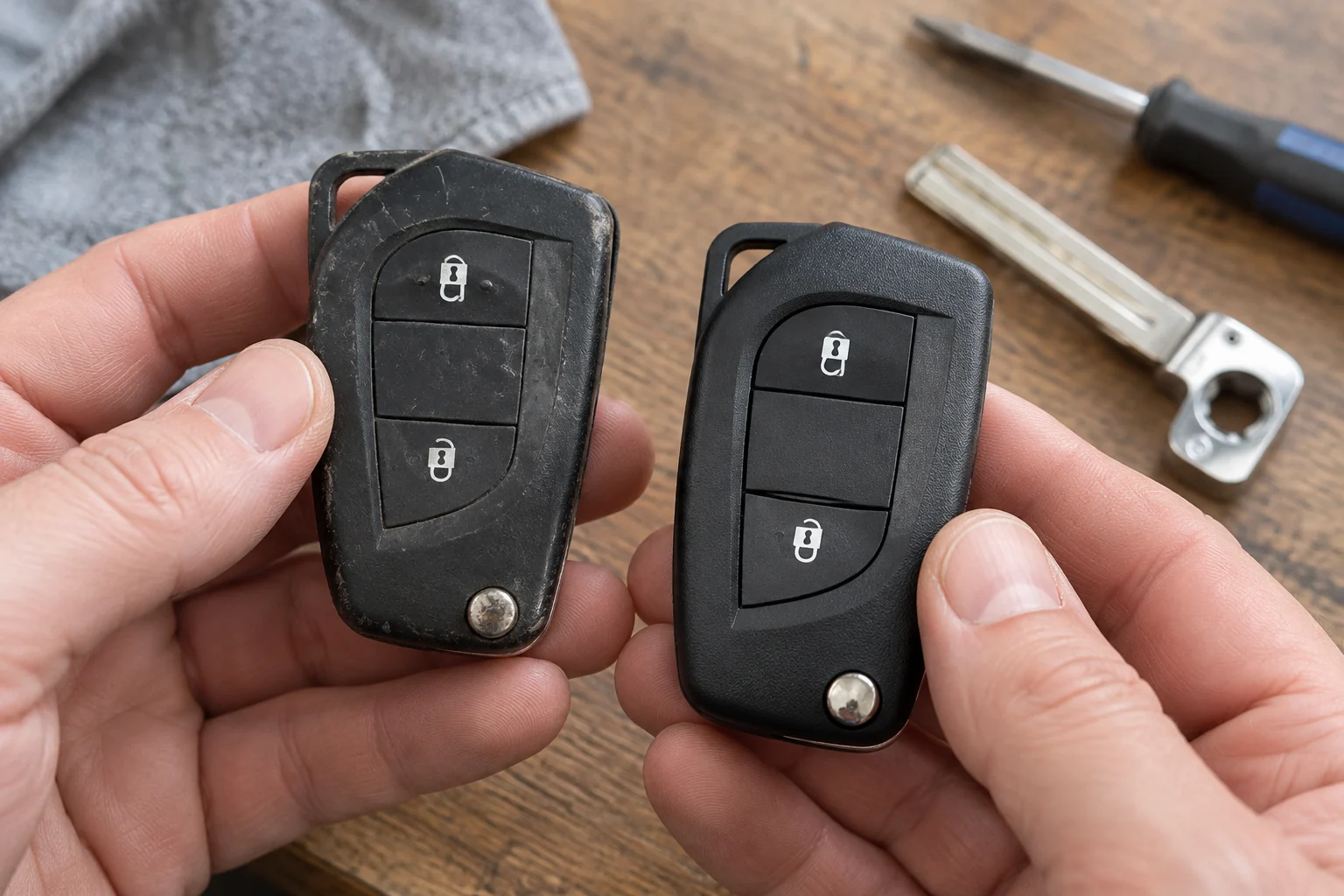
Put your existing key beside the listing photos and compare the front, back, sides and edges. A matching front view is not enough: the back may have a different contour, or the edge may be thicker or more rounded. If the seller shows only one face, you cannot complete this exterior check from the listing.
Start with the overall outline. Look at the width and shape of the top and bottom, whether the corners are rounded or squared off, and where the body narrows or widens. Then turn your key sideways. Compare its thickness and profile with any angled or edge-on photos. Product photos taken at different angles can distort proportions, so use distinctive features—such as a pronounced curve or step in the casing—rather than judging size from the image alone.
Trace the seam where the two halves of your casing meet. Does it run around the same part of the edge as the seam in the photos? Look for raised sections, shallow grooves and changes in surface texture on both faces. Check visible openings too, such as a key-ring hole or a recess for a screw. An opening in a different position, or a back cover with a noticeably different shape, is a reason to question an otherwise close-looking match.
Give the buttons a separate look. The same button count does not establish a match. Compare each button’s position, size and shape, the spacing between buttons, and the shape of the surrounding rubber or plastic. For example, two cases may both have two buttons, but one may place them in a straight column while the other uses a different layout. Also check whether the button area is flush with the case or sits inside a visible border.
Where the photos allow it, compare the key from the same viewpoint in the same orientation. A front view of your key held upright is easier to judge against a front view held upright than against a tilted product image. Do not treat a feature as absent simply because that side is hidden or in shadow; mark it as unconfirmed instead.
Write down visible differences before moving on to internal fit. A clearly different outline, seam or button layout can rule out an apparent exterior match. If the photos do not show enough angles to compare those features, the exterior match remains uncertain—even if the view you can see looks familiar.
Check what the replacement housing must hold
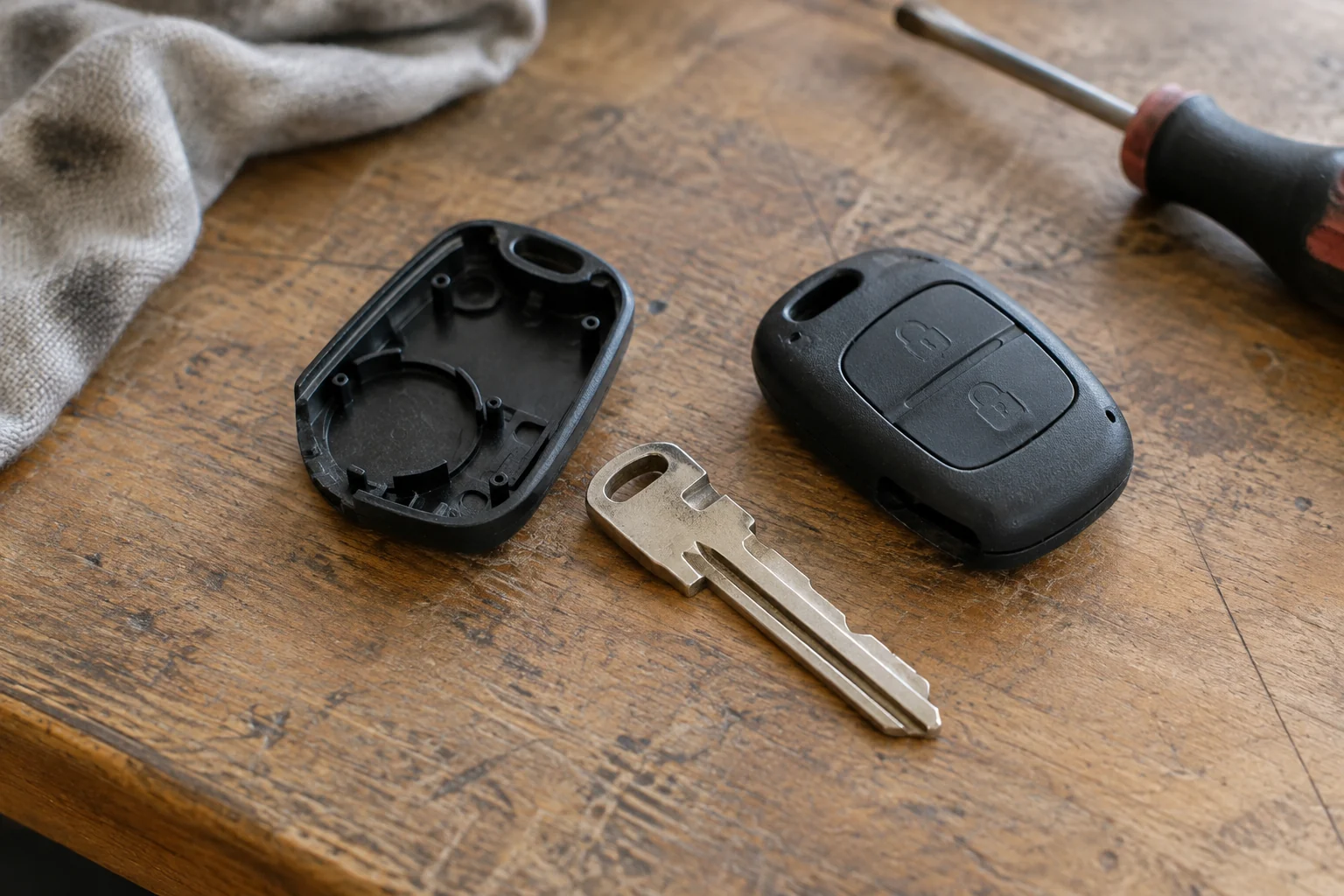
A replacement housing needs to hold the components you intend to move from your existing key. If your key has a remote-control circuit board, compare that board with the space and supports shown inside the proposed shell. Look at the board’s outline, the position of any screw holes, and the points where it rests or clips into place. A cavity that looks roughly the right size may still leave the board tilted or unable to sit flat.
Check both halves of the housing if their interiors are visible. Raised posts, ribs and battery supports can determine where the board sits when the case is closed. If one of those features meets a component on your board rather than an empty area, the halves may not close without pressure. Do not force them shut: pressure on a board or its components is not a way to correct a poor fit.
The buttons need an internal match too. Compare the position of each switch on your board with the areas pressed by the new housing’s buttons or rubber pad. A shell can have the right number of buttons yet press beside a switch, hold one down continuously or fail to reach it. If your existing key has a separate button pad, check whether that pad is intended to move across and whether it can sit flat in the replacement.
Check where the battery and its contacts sit. The new housing must leave enough room for the board, battery and any fitted battery holder without bending contacts or lifting the board out of its supports. Pay particular attention if the battery is held in one half of the casing rather than directly on the board: its position must line up with the contacts on the components you are retaining.
Your key may also contain a separate transponder, distinct from the remote-control board. If you can identify one in your existing key, account for its place in the replacement housing as well as the board’s. A loose chip should not be left to move around inside the case. Do not assume that every key has a separate chip, or that an empty-looking recess in a shell proves where yours belongs. If you cannot tell which components your key contains, that part of the fit remains unconfirmed.
Finally, separate a damaged casing from a faulty key. A shell can replace cracked plastic or worn button surfaces, but it cannot fix a failed switch, damaged circuit board, poor battery contact or another electronic fault. If the remote functions were unreliable before the casing broke, a better-fitting housing alone may leave the same problem in place. Assess what still works before deciding that transferring the existing components will solve it.
Treat blade attachment as a separate fit test
Before assuming you can move your existing blade into a replacement shell, check how the blade is held in your current key. Look at the part that enters the housing, not just the cut edge that enters the lock. Is the blade fixed in place, or does it fold out? If it folds, note where it pivots and how it is retained. If the joint is hidden, do not assume the blade can be removed without damaging the old housing.
Compare that joint with the proposed shell’s blade opening. A shell may have room for a blade yet be made to hold it in a different way. Where the details are visible, check the shape of the blade’s base, its width, the position of any hole or groove, and the space for a pin or screw. For a folding key, check the pivot arrangement as well as the point where the blade is secured. A blade that slides into an opening but cannot be locked in place is not a usable match.
Pay attention to what the listing actually supplies. “Shell only” may mean a housing without a blade, while a shell pictured with an uncut blade does not necessarily accept the blade you already own. Nor does a similar-looking blade tip establish that the part inside the housing matches. If the seller shows only the extended blade, ask for a close view of its attachment end or for the dimensions and retention method. Do not treat a shared vehicle name as an answer to that question.
There are two different plans: reuse the original blade or have a suitable new blade cut. Reuse depends on the old blade being removable and its attachment end matching the new housing. Cutting a new blade avoids transferring the old one, but it still requires a blade blank appropriate for the key and a housing that secures that blank correctly. A supplied blank does not resolve an attachment mismatch with your original blade; it changes which blade you intend to use.
If the old blade’s attachment is concealed and the listing gives no clear view or specification for the new one, leave blade reuse unconfirmed. Ask specifically whether the shell accepts the attachment style shown on your existing key, ideally with clear photos of both blade bases. That is a narrower, more useful question than asking whether a multi-model shell “fits a C1.”
- The exterior shape and openings match the key in hand.
- The housing accommodates the components being retained.
- The blade can be attached and secured as intended.
Decide when you have enough evidence to order
Order only when you can link one selectable listing variant to the shell shown in the photos and described in the specifications. Note the selected option and any product code before making your decision. If the images change when you select a variant, use the images for that variant—not the default gallery. If several options share the same photos and you cannot tell which one they show, the listing has not established what you would receive.
For a purchase decision, you need enough evidence to compare the casing, the space for the parts you intend to retain, and the key blade attachment. You do not need a perfect photograph of every surface, but you do need a clear basis for each essential comparison. A convincing exterior match does not resolve an unseen interior or an unidentified blade joint.
Ask the seller for the missing evidence before ordering. An interior photo of both housing halves, taken from the option you selected, may settle a question that exterior shots cannot. If blade reuse matters, request a close view of the blade opening and retention point. You can send a photo of the corresponding area on your existing key and ask the seller to identify the matching feature on the product they will supply.
Make the question product-specific. Instead of “Will this fit my Citroën C1?”, ask, for example, “Does the selected two-button variant have the interior shown in this photo, and can you show where the existing blade is secured?” An answer that only repeats a vehicle-compatibility claim does not resolve a physical difference you have found. Keep the reply with the listing details so you can check what was actually confirmed.
Pause if the evidence conflicts. A product description that says one thing while the selected variant’s photos show another needs clarification; do not choose whichever detail supports the purchase. The same applies if a seller supplies a close-up but cannot say which option it depicts. If you cannot safely see a feature on your own key, that comparison remains open too. Fit is unconfirmed while any essential point cannot be checked.
After the shell arrives, compare it with your original key before moving parts. Check that the supplied housing matches the variant you ordered, including areas the listing did not show clearly. If you begin a transfer, keep the original casing, blade and other removed parts together, and do not force a component into a space where it will not sit or close properly. Retaining the old parts gives you a way to reassess an apparent mismatch rather than treating the new shell as a confirmed fit simply because it arrived.
A vehicle name in a product listing is not proof that the shell will accept the parts from your key. Before choosing a replacement, compare the old casing with clear photos of the new one, paying particular attention to the blade mount, button layout and space for the circuit board and transponder, if present. If the photos do not show enough detail, ask the seller to confirm the match using photos of your key. The casing’s physical layout matters more than a long list of vehicle models.
Choose the option that matches your vehicle and situation.
Frequently asked questions
What if my current key has already been put in a replacement shell?
Treat its casing as a reference, not proof of the original design. If you know the key has been reshelled, compare the circuit board, any loose components and the blade attachment with the proposed housing. A previous owner may have used a shell that looks right externally but holds those parts differently.
Does transferring my existing electronics into a shell require reprogramming?
Moving the same working electronics into another housing does not, by itself, mean you are replacing or reprogramming them. That is different from fitting a new circuit board or transponder. The transfer still has to leave the components intact and correctly positioned, so check the key’s required functions afterwards rather than assuming it worked.
Is an empty key shell the same as a complete replacement key?
No. An empty shell is a housing; it does not supply the electronics that make a remote or immobiliser key work. Check what the listing includes, particularly if its photos show a blade or buttons. If you need more than a casing, do not assume that a shell listing covers the missing parts.
What if I cannot see a separate transponder in my key?
Not seeing a loose transponder does not establish that the key has none. Its immobiliser function may be arranged in a way that is not obvious from a quick look inside the casing. Do not discard a small part or choose a shell on that assumption; get help identifying the components if you are unsure.
Can my vehicle’s year or VIN confirm shell fit on its own?
A year or VIN may help narrow the search, but neither shows the shape of the key you hold or whether it has been reshelled before. Use vehicle details to filter possibilities, then compare the existing key and the listing’s clear photos or dimensions. If they conflict, pause rather than relying on the vehicle match.
Should I open a working key just to check the circuit board?
Not if you are unsure how the housing opens. A working key can be damaged while prying it apart, and a broken clip or displaced component may create a new problem. Start with the visible details and listing information. If an internal check is essential, ask someone qualified to handle keys rather than forcing the casing.
What if the old shell is glued or damaged around the blade?
Do not force the blade out of a glued or broken casing. Reuse depends on its attachment and what can be removed without damage. You can use car-keys.lt to compare possible shells, but if the blade mounting is still unclear, have the old assembly assessed before ordering a housing on the assumption that the blade will transfer.
When can I discard the original shell and loose parts?
Keep them until the transferred key has been checked for every function you need, including starting the vehicle and, where applicable, operating the remote buttons. Retain even pieces that appear unimportant during the transfer: they may help identify a missing component or explain why the new housing is not working as expected.
