
- A gap concentrated at one corner can point to a local closure problem, while a gap along the seam calls for a broader fit check.
- A broken retaining feature on the casing may justify a replacement shell if the new housing has the matching closure design.
- If an internal part prevents the halves from meeting, replacing the plastic alone may leave the same closing problem.
- A missing or loose fastener needs its own assessment; do not assume an empty replacement shell supplies that part.
- Compare the replacement’s fastening points and internal fit with the original key, not just its exterior shape or button count.
- Forcing the case shut can damage its retaining features or the parts inside, so stop if the halves do not meet naturally.
Introduction
A Porsche key that springs open does not necessarily need a new shell. A cracked clip or worn closure edge may be to blame, but the casing can also separate when the battery, circuit board or another internal piece sits too high. If the key’s design uses a screw, a missing screw can leave an otherwise sound casing loose.
The useful clue is where the halves first separate. Look along the seam without forcing the key shut. A gap beside a visibly damaged catch points towards a housing that can no longer hold itself closed. If the halves meet at one end but stand apart elsewhere, something inside may be stopping them from seating. A visible screw hole is worth checking, too; not every key relies on clips alone.
This car-keys.lt guide focuses on that distinction before you order a Porsche replacement key shell. You’ll learn what the gap can tell you and when a new housing is likely to address the fault. The point is to avoid replacing a sound casing when the real problem is a misplaced part or missing fastener.
Where does the Porsche key casing separate?
Start by looking at the key in good light, without trying to snap it shut. Hold it over a table so that nothing can fall far if a loose piece comes away. Turn it slowly and follow the seam around the casing. Note where the gap begins and whether it stays the same width or changes as you move along the edge.
If the gap starts at one corner, check whether the rest of the seam sits together. If it runs along most of one side, note where the halves come closest. Check the opposite side too: a casing can look closed from one angle while remaining open along the edge you cannot see. These observations give you a more useful description of the problem than “the key won’t close.”
Next, watch what happens when you bring the halves together gently. Do they meet and then separate when you let go, or does a visible space remain even while you hold them in position? A gap that appears only after release is different from one that never closes. You do not need to make either happen again by squeezing harder; one careful check is enough.
Look along the open edge for anything plainly visible in the gap, such as dirt caught between the outer surfaces or an edge that is not sitting where you expected. Change the viewing angle rather than prising the casing open for a better look. If you cannot see what is holding the halves apart, record that uncertainty instead of guessing from the gap alone.
Pay attention to how much effort closing takes. If the halves do not move together with light, even pressure, stop. Do not pinch one corner shut, press the casing against a table or keep trying to produce a click. Pressure could shift what you are trying to observe or make the casing harder to assess.
Before considering a Porsche replacement key shell, note three things: the first place the gap appears, how far it extends, and whether the halves meet briefly or remain apart. That short description will help you investigate the reason for the opening without assuming the housing itself needs replacing.
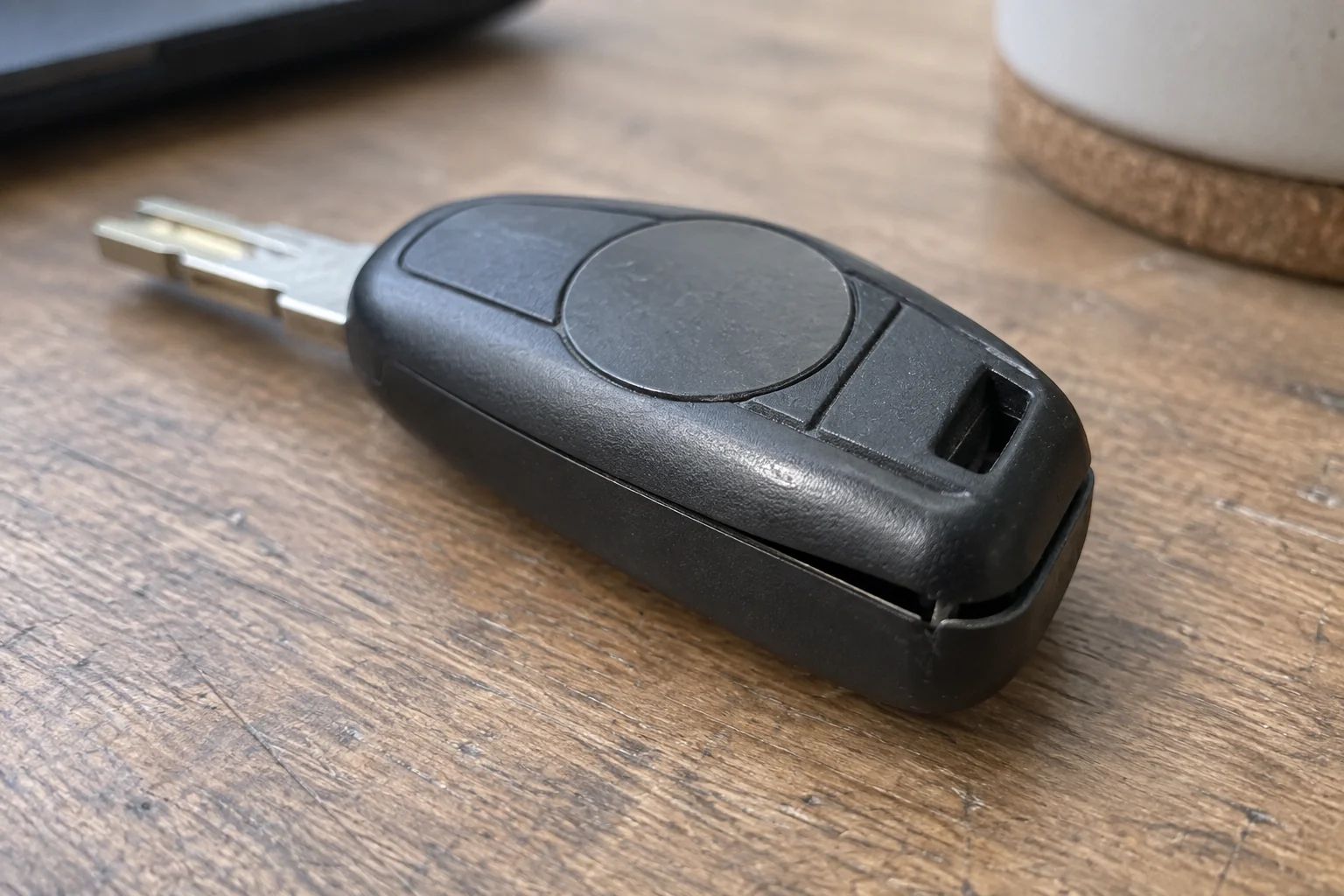
- Stop if the edges will not meet naturally.
- Extra pressure can damage retaining points or parts inside.
When the casing’s closure features have failed
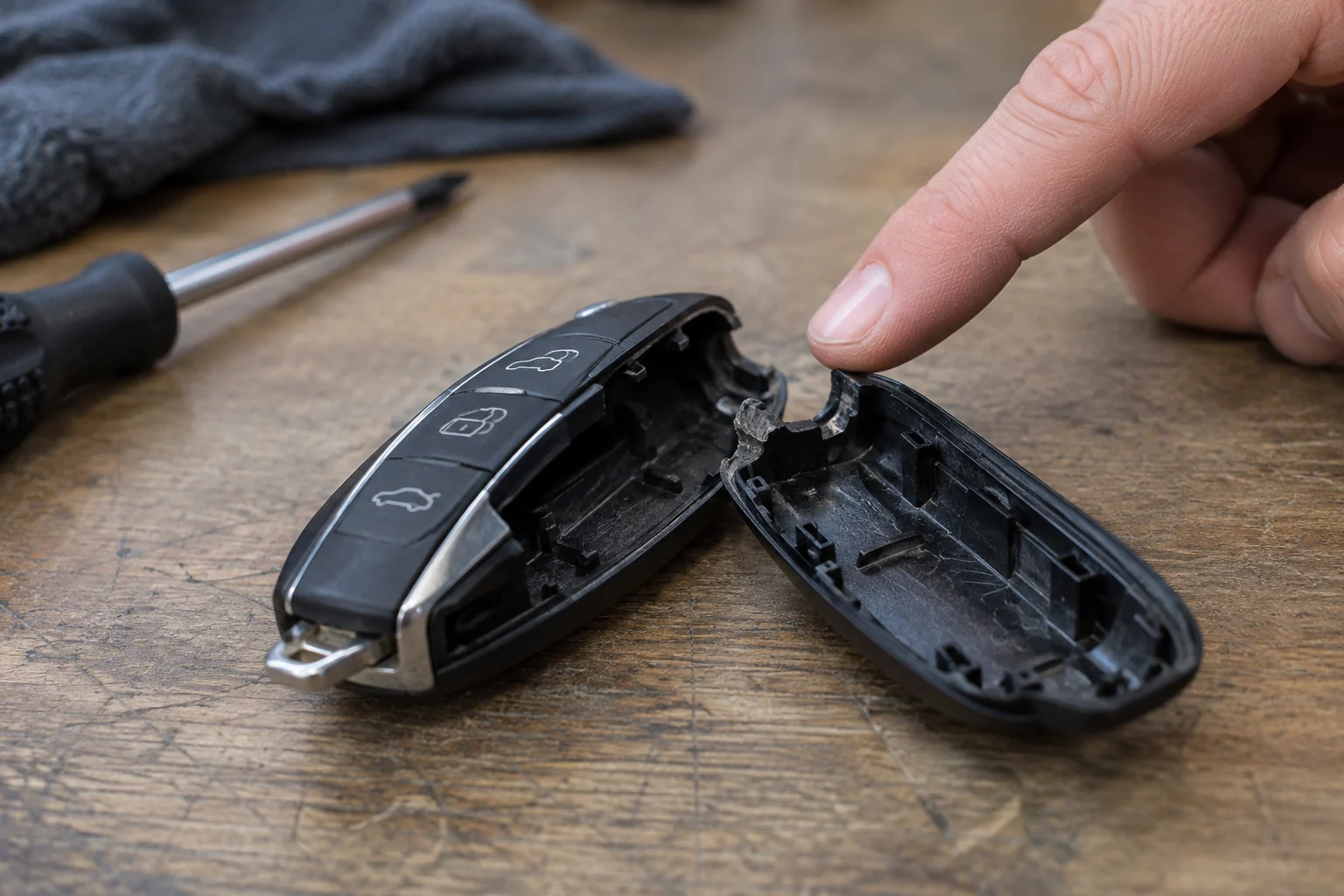
A casing that closes and then springs open may have lost one of the small retaining features that holds its halves together. The design varies by key, so look at the mating edges of your own casing rather than assuming it has a particular clip or tab. If the key is already open, inspect the edges in good light. Look for a chipped projection, a cracked lip, or a recess with a broken edge where another part would normally catch.
Compare the suspect area with an intact part of the same case. A sound retaining point usually has a defined edge; a damaged one may look shortened, uneven or bent out of shape. This comparison is most useful where the casing has similar features on both sides. The features need not be identical, though, so do not treat every difference as proof of breakage. A clean-looking recess on one side, for example, may have a different job from a projecting tab on the other.
Pay particular attention to the corner that will not hold. A tiny missing piece at a contact point can matter more than a long crack elsewhere: it may leave too little material for the halves to catch. Conversely, a surface crack on an outer panel does not, by itself, show that the closure has failed. Trace the crack to its end. If it reaches a retaining point or has allowed the mating edge to flex or spread, it is more likely to affect how securely the case closes.
Distortion can be less obvious than a chip. A retaining lip may still be present but no longer sit in its original position. Look for a bent edge, stress whitening in the plastic, or a point that moves independently when touched lightly. Do not bend it back to test it; a weakened point may break off. If the relevant edges look intact, keep an open mind about the cause rather than diagnosing a failed housing from the fact that the key reopens.
Repeatedly snapping the halves together is not a useful test once a retaining point appears damaged. Each attempt can put force on the same thin piece of plastic, widen a crack or shear off what remains of a tab. Clear damage at the point that should hold the casing shut is evidence that the housing itself can no longer do that job reliably. That is the fault a Porsche replacement key shell may address; a cosmetic crack alone is not the same finding.
When something inside prevents the halves from meeting
If the Porsche key casing keeps opening, look at what sits inside before assuming the housing is at fault. An intact casing may resist closing because a battery or another component has shifted into the space the halves need to occupy. Open it only as far as it already opens easily, and check the contents in good light. You are looking for something visibly tilted, raised or caught between surfaces that should meet—not trying to make every part look like a picture of a different key.
Start with the battery, if you can see it. Does it appear to sit level in its holder, or is one edge standing higher than the other? Also look for a loose piece resting across the edge of a recess. Either could stop the casing from closing fully. Do not push the battery down simply because it looks high: the arrangement depends on the key, and a part that seems out of place may be seated correctly.
Next, look at the two halves separately while holding them open. A component that sits proud of the surrounding plastic may be the first thing the opposite half touches. For example, if a button insert has lifted at one edge, that edge may get caught as the casing comes together. Check only what is plainly visible. If you cannot tell where an insert belongs, avoid lifting it out to investigate; you may lose the orientation that would help you put it back.
If you can see an obvious obstruction, such as a loose piece caught across the closing surfaces, move it only if its proper place is clear and it can be repositioned without touching or bending the electronics. Keep track of which way it was facing. If repositioning it changes how readily the halves meet, that is useful evidence that the contents, rather than the outer casing, were preventing closure. It does not mean the key should be forced through the last bit of resistance.
Never press on the circuit board or other electronic parts to make the casing shut. Pressure applied through the plastic can reach those parts even when your fingers are on the outside. If a component still stands proud, will not stay in place, or has no obvious seated position, leave the key open rather than trapping it under the cover. The layout of your actual key matters more than a generic diagram; when you cannot verify that layout, pause before moving anything else. A Porsche replacement key shell would not, by itself, correct contents that remain misplaced.
Could a fastener be loose or missing?
First check whether your original key casing uses a separate fastener at all. Porsche key designs vary, and a small hole or recess is not, by itself, proof that a screw belongs there. Look for an accessible screw head or a clearly threaded fastening point on the key you have. If you cannot identify one, do not try to add a fastener to make the casing stay closed.
Where a screw is visible, check whether its head sits flush and whether the casing moves around that fastening point. A screw that has backed out may let the halves separate even though the housing is otherwise sound. If you can reach it without taking the key further apart, use a driver that fits the head properly and turn it gently. Stop if it resists, spins without tightening, or the driver slips; more force could damage the fastening point.
An empty position needs a little more care. Compare it with any matching fastening point on the same key, if there is one, and check whether you have a screw that recently fell out. Do not infer the required size from a photograph of a similar-looking key. A screw that is too long may bottom out before it holds the casing; one with the wrong thread may damage the point it is meant to secure. If you are unsure whether the position originally held a fastener, leave it empty until you can confirm.
Before ordering a Porsche replacement key shell to address a suspected missing screw, check exactly what the proposed item includes. Listings may show an assembled casing without making clear whether screws or other separate hardware come with it. Ask for confirmation if the contents are unclear, and keep any original fastener safe. An empty shell should not be treated as a source of replacement hardware unless that hardware is expressly included.
Will a replacement shell fix the fault you found?
A Porsche replacement key shell is a sensible option when the fault is in the housing itself: a broken retaining point or damaged mating edge that can no longer hold the halves together. If the casing cannot close because something inside is out of place, a new shell may leave you with the same problem. Use the fault you found to choose the next step, rather than treating every case that opens as a shell failure.
| What you found | Next step |
|---|---|
| A retaining feature or mating edge is broken | Look for a replacement housing with the same closure arrangement and internal layout. |
| The halves are blocked by the contents | Resolve the obstruction before deciding whether the housing also needs replacement. |
| A separate fastener is loose or missing | Confirm the original fastening arrangement and whether the required hardware is included or available. |
| You cannot tell how the original case closes | Pause the order and ask for clear product details or confirmation against your original key. |
For a likely housing failure, compare fastening and retaining points first. An exterior that looks right in a product photo does not show whether the two halves join in the same way as yours. Check images or documentation of both the outside and inside of the proposed shell. The positions and shapes of its catches, mating edges and any fastening points need to correspond to the original; a small difference at the point that holds the case shut matters more than a close match in overall outline.
Next, check the space the shell provides for the parts you need to transfer. Compare the internal compartments and supports with your original casing, along with the number and position of the button openings. A shell can resemble your key from above yet leave a button in the wrong position or fail to accommodate an internal part. If the listing shows only exterior views, request interior images rather than inferring the layout from the model name or shape.
Read the included-parts description separately from the compatibility description. “Shell” does not necessarily mean that buttons, fasteners or every small housing piece are supplied. Establish what must be moved from your existing key and whether any damaged or missing piece is provided with the replacement. If the part that prevents closure is not part of the new housing, buying the shell alone will not address it. Likewise, a new casing cannot be assumed to correct contents that still sit incorrectly inside it.
Before ordering, compare the proposed shell with your exact original key, not only with a vehicle description or a similar-looking listing. If the closure design, internal layout or supplied components remain unclear, send the seller clear photos of your casing and ask them to confirm those points. A confirmation based only on the exterior shape is not enough when the fault concerns how the casing stays shut. If you cannot establish a physical match, keep the existing parts together and resolve that uncertainty before buying.
A Porsche key that will not stay closed does not automatically need a new shell. Before ordering one, open the case carefully and check whether the battery or another internal piece is preventing the halves from meeting evenly. Do not force them together; that can damage parts that are still sound. If everything sits properly but the case still springs open, look for a broken clip or a warped edge. The practical takeaway is to identify what is stopping the case from closing before choosing a replacement housing.
- Broken housing closure: assess a shell with matching retaining points.
- Internal obstruction: resolve the interference before considering a shell.
- Missing fastener: confirm the required hardware and whether it is supplied.
Questions about a Porsche key casing that won’t close
Can tape or glue be used while the casing keeps opening?
Tape can temporarily keep the halves together while you avoid carrying the key loose, but it does not fix what is holding them apart. Be careful not to cover the buttons or trap tape in the seam. Avoid glue: it can bond moving or internal parts and make the casing harder to inspect later.
Can a spare key help identify what looks wrong?
Yes, if the spare has the same housing design. Compare where the halves meet, how the buttons sit and whether any visible piece appears out of place. A different-looking spare may be assembled differently, so it is not a reliable guide to what your open casing should look like.
What if the battery looks damaged or swollen?
Do not force the casing closed around a battery that appears swollen, leaking or otherwise damaged, and do not put that battery back into use. Keep it separate from the closure question: even if the plastic parts look sound, a visibly damaged battery needs attention before you try to use the key again.
Will changing the outer casing restore a key that has stopped working?
Not necessarily. A replacement housing addresses the physical casing; it does not establish why the key stopped working or repair an electronic fault. If you are considering a new casing, car-keys.lt is a useful place to start looking, but check the housing design and treat the loss of function as a separate problem.
What if the metal key blade is loose but the casing stays closed?
A loose blade is a different fault from a casing seam that opens. Check whether the movement is at the blade or its holder rather than between the housing halves. Replacing the outer shell solely because the blade moves may miss the part that needs attention, especially when the casing itself still closes securely.
What if the buttons stop working after the casing has been closed?
Stop repeatedly pressing them. Look for an obvious sign that a button is trapped, sits unevenly or cannot move freely, without prying or forcing the casing. If nothing visible explains it, reopening and closing the shell again may not help; the button problem needs to be considered separately from whether the halves stay together.
What should I do if the key got wet while the casing was open?
Do not assume a new casing will put the key right. Moisture may have reached parts inside while the shell was open, even if the halves now close normally. Avoid pressing the buttons to test it repeatedly, and seek appropriate help with the wet key rather than treating this as only a housing problem.
Does a visible crack mean the shell must be replaced if it still stays closed?
Not always. A crack can be cosmetic if the halves still meet and remain closed, but it is worth watching: it may spread with use or begin to affect the seam. Avoid squeezing the crack to test its strength. If the casing starts to separate, reassess it as a closure fault.
Choose the option that matches your vehicle and situation.
Frequently asked questions
Where can I find more information?
More information is available at car-keys.lt.
