
- A replacement shell addresses the key’s housing and button surfaces, not a failed switch on its circuit board.
- If the remote still responds normally despite worn button coverings, a matching shell may address the visible wear.
- An unresponsive button does not prove the casing is at fault; its switch and other electronic components may need assessment.
- Three buttons are not proof of fit because housings can differ in shape, button placement and internal layout.
- Check the original key’s blade arrangement and internal parts separately from the appearance of the replacement casing.
- Confirm what a listing includes before ordering; a shell should not be assumed to contain electronics, a transponder or a blade.
A worn-looking Porsche key button does not necessarily mean the switch underneath has failed. If the button surface is split, shiny or missing but the key still responds consistently, the casing may be the problem. If the button feels normal yet works only occasionally, a new shell alone may not put things right.
The distinction matters because the casing and the electronic switch do different jobs. A Porsche three-button replacement key shell replaces worn exterior parts; it does not repair a damaged switch on the circuit board. The reverse can happen, too: a button cover that has shifted or collapsed can make a working switch difficult to press. What you can see and feel offers useful clues, but it cannot confirm the condition of the parts inside.
For readers of car-keys.lt, the practical starting point is to notice whether the button is physically hard to press or presses normally without a reliable response. This article explains how to use those clues without treating every missed press as proof of switch damage. If the casing does appear to be the issue, finding a suitable replacement still requires more than matching the number of buttons.
Check what still works before judging the worn buttons
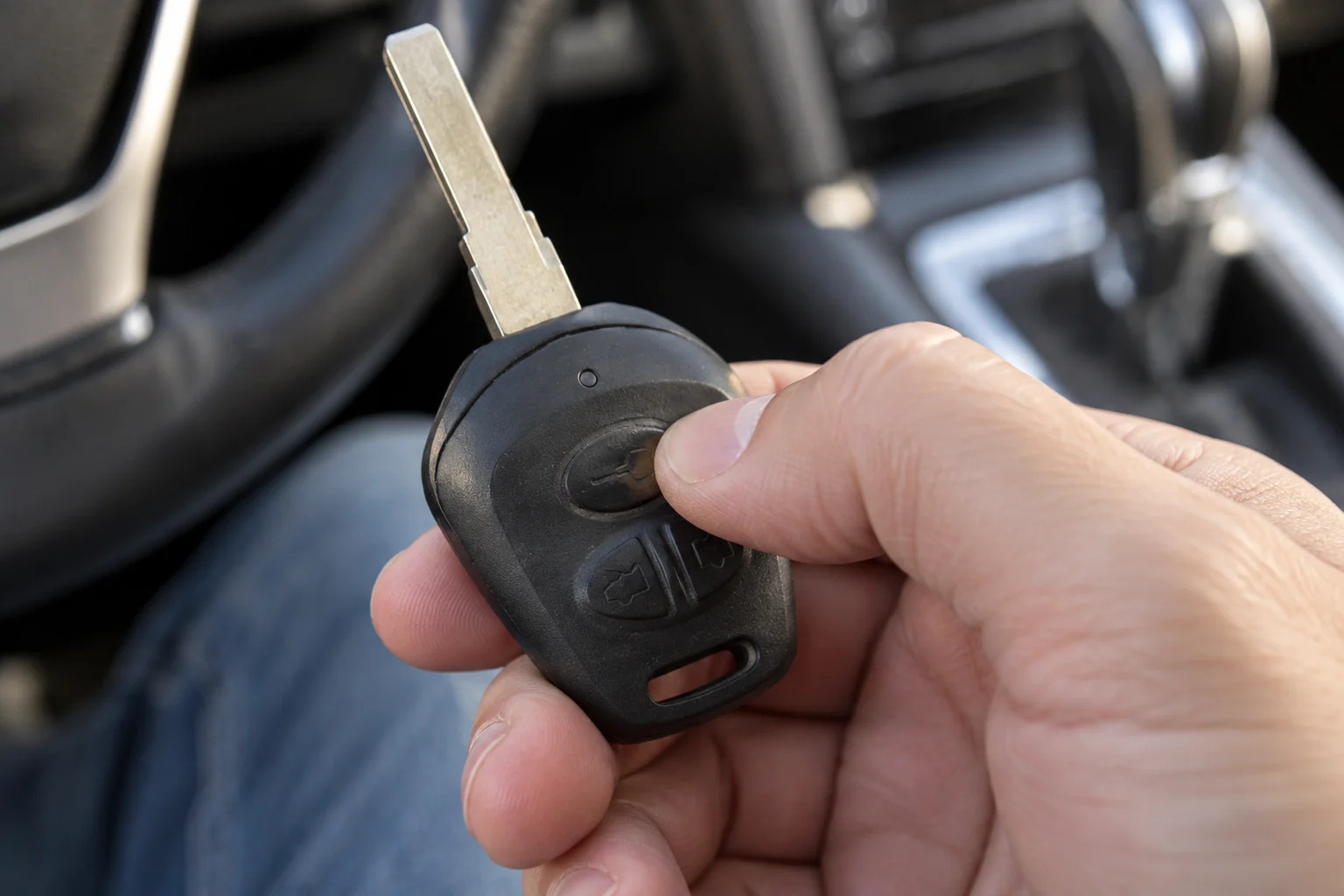
Start with what you can see. Faded symbols and a polished surface show that a button has been used, but they do not tell you whether it still operates reliably. Look more closely for cracks, a missing section of the button surface or an edge that has lifted. Then press each button once with your usual pressure. Note whether one feels flatter, sticks, or moves differently from the others.
Check operation separately, under ordinary conditions. Stand where you would normally use the key, with the vehicle parked and in view. Press lock and unlock one at a time, leaving a moment between presses, and watch for the response you normally expect from the vehicle. If you know what the third button does, test it only where that action is safe and easy to observe. Do not rely on a beep alone if your vehicle does not always make one.
Try each button more than once without changing how hard you press. The useful distinction is between a worn-looking button that responds every time and one that responds only occasionally. Note whether a missed response happens with one button or several, and whether it occurs on the first press or after repeated use. If you have to change your grip or press at an unusual angle to get a response, record that too; it is a more useful observation than simply saying the key “sometimes works”.
Keep the test conditions as steady as you can. Moving farther from the vehicle between presses makes the results harder to compare. A single missed response in an unfamiliar spot is less informative than the same button failing repeatedly at your usual distance. Equally, a successful press does not prove that an intermittent problem has gone away. You are looking for a pattern, not trying to force the key to pass a test.
If you have a working spare, try it from the same place and compare the vehicle’s response. If the spare works consistently while the worn key does not, that helps narrow down what you observed. It is not a definitive test: the two keys may be in different condition, and a difference on one occasion does not identify the cause.
Avoid pressing harder to make an unreliable button work. Extra force can make a damaged surface worse and hides the pressure at which the problem occurs. Instead, note which button is affected, how it feels, and how often a normal press gets a response. Those observations provide a clearer starting point than appearance alone.
Why a new outer case may not restore button operation
The part your thumb presses is not necessarily the part that registers the command. In a key with separate outer buttons and a circuit board, pressure passes through the button cover to a small switch on the board. A replacement shell changes the housing and its button surfaces; it does not replace a failed electronic switch. The exact construction varies, so the visible button alone cannot show how a particular key works inside.
Worn Porsche key buttons can still make a working switch difficult to press. A split or distorted cover may no longer transfer pressure cleanly, or it may catch against the surrounding case. That can make a press feel vague or awkward even when the switch beneath it remains functional. In this situation, the cover affects how force reaches the switch; it does not establish that the electronics have failed.
The reverse is possible too: a button can look sound and move normally while the switch beneath it fails to register a press. A switch may also work inconsistently rather than stop altogether. Replacing the outer case would give your thumb a fresh surface, but it would leave that internal fault in place. Button feel and electronic response are related, not interchangeable, clues.
An intermittent response does not identify the switch as the culprit either. A weak battery, poor electrical contact or damage elsewhere on the circuit board could produce an unreliable remote. The car may also fail to receive or act on a signal for reasons outside the button assembly. These possibilities matter because a new housing cannot correct an electrical fault simply by covering it.
Patterns can suggest where a problem lies without proving it. If one command is unreliable while others still respond, the affected button’s cover or switch may deserve attention, but the symptom does not distinguish between them. If every command fails, a fault shared by the buttons—such as the battery or another part of the electronics—becomes plausible. Neither pattern pinpoints a component on its own.
That is the limit of a Porsche three-button replacement key shell as a fix for unreliable operation: it can address damaged housing parts, but it cannot be assumed to restore a command the electronics are not registering or transmitting. A worn cover and an internal fault can also exist at the same time. Treat the appearance and feel of the buttons as evidence about the outer case, not as a definitive diagnosis of the key’s internal parts.
- A button that does not respond may have an internal fault.
- Do not use the appearance of the cover alone to diagnose the switch.
When to consider a shell—and when to seek a key assessment
If every button still responds consistently but the outer surfaces are worn, a replacement shell is worth considering. If a button has stopped responding, do not buy a shell on the assumption that it will restore operation. A Porsche three-button replacement key shell may address damaged housing, but an unreliable key needs assessment before you can choose a remedy with confidence.
| What you notice | Sensible next step |
|---|---|
| Symbols are worn, or a button cover is cracked, but responses remain consistent | Consider a matching shell to address the physical wear. |
| One button does not respond, even though its surface looks intact | Seek a key assessment rather than assuming the casing is the cause. |
| A button cover is damaged and response is intermittent | Allow for both housing attention and fault assessment; a shell alone may not resolve the problem. |
| A gap or missing piece leaves internal parts exposed | Treat protection of the key as the priority and seek advice promptly. |
The deciding question is whether the problem is confined to the part you touch. For example, worn Porsche key buttons that still operate normally present a different choice from a tidy-looking button that does nothing. In the first case, the reason to consider a shell is the condition of the casing. In the second, appearance gives you no sound basis for ordering a casing as a fix.
Mixed symptoms deserve the most caution. A split or loose button cover may make the key unpleasant to use, while an occasional missed response raises a separate question about operation. It is reasonable to want the damaged housing put right, but do not treat that as proof that the unreliable response will disappear. Describe both symptoms when seeking an assessment, including which button is affected and whether the problem is constant or occasional.
Likewise, a Porsche key button not working does not automatically mean every part of the key needs replacing. The useful next step is to establish what requires attention before committing to a shell or another repair. This avoids paying for a new-looking housing while the original complaint remains, without ruling out a shell if the casing also needs one.
Visible openings change the priority. If a button is missing or the case has separated enough to expose parts inside, avoid pressing directly on the exposed area or letting the key get wet. Arrange an assessment rather than continuing to use the damaged casing as though it were only cosmetic wear.
Once you have a clear reason to replace the housing, check its compatibility separately. “Three-button” describes the layout, not a confirmed match for your key.
If a shell makes sense, will a three-button housing fit?
Three buttons are a starting point, not proof of fit. A Porsche three-button replacement key shell needs to match the construction of the key you already have. Two housings can show the same number of buttons while differing in shape, blade arrangement or the space provided for the internal parts.
Compare the proposed shell with your original from the front, back and side. Look at the overall outline, thickness, corners and position of the seam where the housing halves meet. Then check the buttons: are they in the same order, similarly spaced and set in the same part of the casing? A listing that shows only a straight-on front view may hide differences that matter when the key is assembled.
Check openings as well as the button faces. If your original has a visible indicator opening, release button or other cut-out, find its equivalent on the proposed housing. Do not rely on similar-looking symbols alone. A button surface may appear right in a photograph even when its shape or position does not line up with the part underneath.
Treat the blade as a separate fit check. Note whether your original has a folding blade, a fixed blade or a removable arrangement, and compare how the blade meets the housing. For a folding key, the pivot area and release-button position matter; a similar-looking outer case is not enough. Check the shape of the blade mounting point rather than assuming that a matching button layout means the existing blade can be transferred.
The inside must match too. If clear interior photographs are available, compare the space and locating features for the original circuit board, battery holder and any other parts you need to move across. Look for differences in supports, recesses and the way the housing closes around those parts. A board that has to be bent, pressed into place or left loose is not a suitable fit, even if the outside looks convincing. If you have not opened the original key, do not guess its internal layout from the exterior.
When photographs cannot establish these details, ask for clear front, back and interior images, relevant dimensions and confirmation of the blade arrangement. Any identifiers visible on your existing housing may help narrow the comparison, but they should not replace a physical layout check. If the seller cannot confirm how your original parts fit, treat compatibility as unverified rather than choosing by button count or a broad vehicle description.
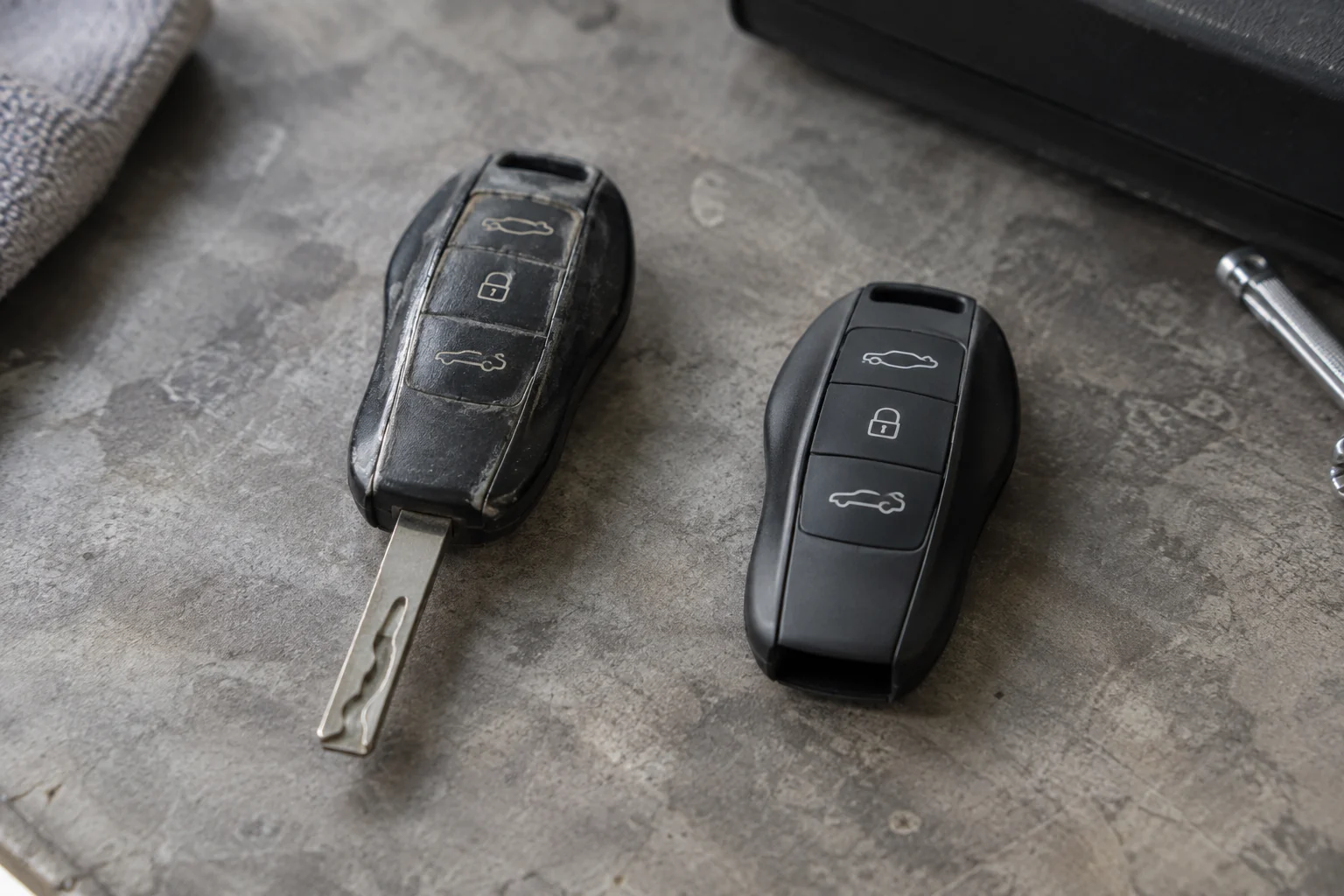
- Compare the original housing’s shape and button positions.
- Check the blade arrangement.
- Verify how the original internal parts fit.
- Read the listing for exactly what is included.
Check what the shell listing actually includes
Before ordering a Porsche three-button replacement key shell for worn buttons, read the item description as carefully as the photographs. “Key shell” often means an empty housing with outer buttons, but the term alone does not establish what is in the package. A listing for a complete replacement key is different: do not treat a photo of an assembled key as proof that working internals are included.
Check whether the listing expressly includes a circuit board, battery, transponder and key blade. If any of these are absent or unspecified, do not assume they will arrive with the housing. This matters even if you need only a new button cover: the parts that make your original key work may still have to be retained.
Identify exactly what you would need to move from the original key into the new housing. The circuit board and transponder may be separate parts, and a pictured blade may be a blank rather than a copy of your existing one. If the listing does not clearly distinguish the supplied parts from those shown for illustration, ask the seller before ordering.
Finally, check whether any help with transferring parts is actually offered. A product listing does not, by itself, include a transfer service or instructions for opening the original key. If those details are missing, plan on confirming them separately rather than assuming the shell purchase covers the whole job.
Conclusion
Worn Porsche key buttons do not, by themselves, tell you whether the outer cover or the switch beneath it is at fault. The practical takeaway is to check which part is actually failing before replacing anything. A new casing will not fix a damaged switch, while worn lettering or a split cover does not prove the electronics have failed. If the key responds inconsistently, avoid judging it by appearance alone: the switch may be the problem, but the cause needs checking before you choose a repair.
Choose the option that matches your vehicle and situation.
Frequently asked questions
Will changing the casing erase the key’s programming?
Changing an empty outer housing does not, by itself, change the programming stored in the original electronics. What matters is which components are kept and what work is done during the change. Before buying a shell or arranging a transfer, confirm that the plan is to retain the parts your key needs.
What if the rubber button pad is loose but the remote still responds?
A loose pad is a physical problem even if every press still works. Check whether a matching button pad is available separately before assuming you need a complete shell. Avoid relying on a pad that slips out of place: it may make the button harder to press consistently or leave the key less protected.
Does a shell repair a bent or damaged metal blade?
No. A new housing cannot straighten or repair the metal blade. If the replacement shell includes a blade, do not assume it is ready to use; the blade and its fit need separate verification. If you hope to reuse the original blade, confirm that the new housing accepts it.
What should I do if a button has worn through and the inside is exposed?
Try to prevent further wear and keep the exposed area away from moisture and dirt. Have the key assessed before deciding that a shell alone will solve the problem. An opening in the cover shows that protection has been lost, but it does not establish whether the internal switch or electronics are damaged.
Could moisture inside the key change what needs fixing?
Yes. If you suspect moisture has entered the key, treat it as more than a cosmetic housing issue. Internal components may need assessment even if the casing is visibly worn. A fresh shell can cover the outside, but it cannot establish whether moisture has already affected the key’s operation.
Should I check every function after a casing change?
Yes. Test each button, then check that the key still performs its normal locking and starting functions. Do this before putting the old housing aside. If something has changed, note exactly which function fails and whether it worked before the casing change; that detail will help whoever assesses the key.
Can I keep the original blade when replacing the housing?
Possibly, but confirm it before purchase. Blade reuse depends on how the original key is assembled and how the replacement housing holds the blade. Photos showing a similar-looking blade are not enough to establish that yours can be transferred; check the housing details or ask the seller about that specific arrangement.
Can someone else transfer the original key parts into a new shell?
You can ask a suitable key specialist whether they offer that work and which parts they would transfer. Use car-keys.lt as a starting point when considering a replacement housing, but confirm the work directly with the provider before buying parts. Describe the key’s condition, including any loose buttons or exposed components.
