
- A replacement key shell is a housing; it cannot repair a loose or damaged metal blade simply by enclosing the existing key.
- Blade movement at the housing connection points to a different fault than movement within the blade itself.
- If the original housing’s blade mount is damaged, a matching replacement shell may help, provided its blade-retention arrangement also matches.
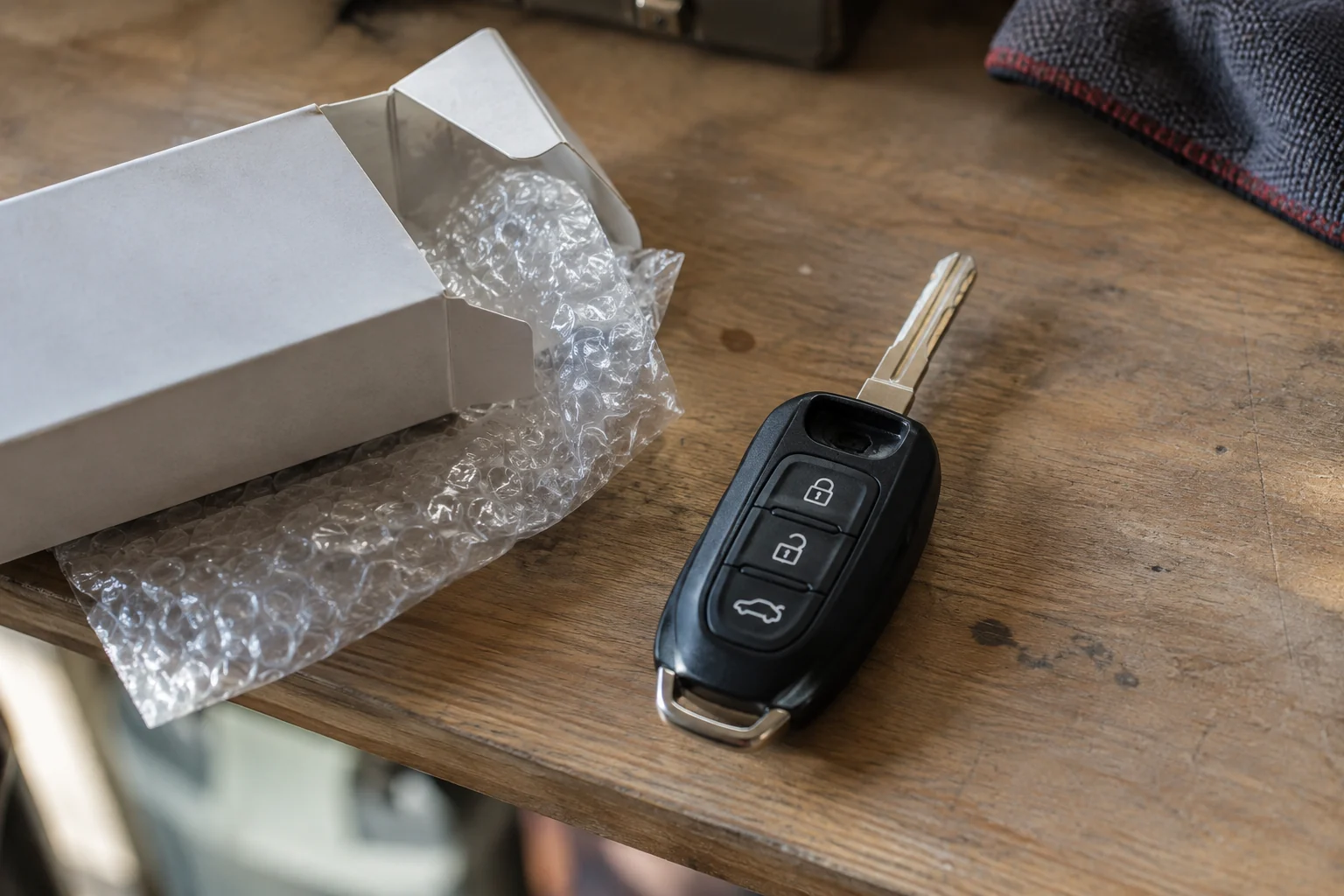
- Three buttons and a Porsche badge do not establish fit; compare the original casing and blade connection with the listing.
- Check whether a listing includes a blade or only an empty housing, and whether the existing blade can be transferred.
- A shell does not replace failed remote electronics or a transponder, so other key faults need separate assessment.
A loose Porsche key blade does not automatically mean you need a new shell. If the blade and its fitting move together inside the plastic housing, the housing may be at fault. If the blade moves within its fitting, replacing the outer case alone may leave the looseness unchanged. Start by watching where the movement occurs as you gently move the blade, rather than judging the key by how much its tip wobbles.
That distinction matters when you shop for a Porsche three-button key shell. A listing may show the right number of buttons and a familiar shape without confirming that its blade mount matches your key—or even that the part you need is included. Photos can help narrow the choice, but they cannot tell you what has failed in the key you already have.
This guide on car-keys.lt explains what to look for at the blade-to-housing connection and what to check in a shell listing before ordering. The goal is to make the purchase follow the fault you can actually see, not to assume that every loose blade calls for a replacement case.
Find the point where the blade moves
Examine the key away from the vehicle, where you can see and feel it without putting pressure on the lock. Hold it over a table so that a small part will not be lost if it is already loose. If the blade folds, open it using the normal button or release. Do not prise the case apart or try to straighten the blade for this check.
Grip the housing firmly in one hand and use a fingertip to move the exposed blade gently with the other. Watch the point where the metal enters the key, not just the blade tip. A small movement at the tip is easier to see than movement at its base, so note exactly which part shifts first. Stop if testing it would require force or if the blade feels close to coming free.
Check the direction of movement, too. Does the blade rock from side to side, lift away from the housing, twist, or slide in and out? If the key folds, does movement appear only at the folding point, or does the blade move relative to the part that carries it? These observations describe a loose Porsche key blade more usefully than “the key wobbles”, because they identify where the movement begins.
Next, keep the blade still and apply light finger pressure to the housing near its seam. Look for the two halves separating or shifting against each other. If the gap opens and closes while the blade stays in the same position relative to one half, the movement is at the housing joint. If the housing remains steady but the blade shifts where it is held, the movement is in the blade assembly. Both can happen at once, so check each area separately rather than assuming there is only one loose point.
Look closely under good light for a crack running from the blade opening, a widened or uneven case seam, or a chipped edge around the moving part. Check for an empty hole or another place where a retaining part appears to be missing, but do not assume every visible hole should contain one. Dirt can hide a fine crack; wipe the outside with a dry cloth rather than probing inside it.
If the movement is hard to locate, place the key on a plain surface and take a close-up photo or short video while moving it lightly. Record which part stays still and which moves. That gives you something concrete to compare later, without dismantling the key or making an already loose connection worse.

- Inspect the key away from the vehicle.
- Avoid twisting, pulling or gluing parts to test the connection.
When a replacement shell could help
A replacement shell can help when the housing is the part that has failed. If the blade connection sits in a cracked or worn part of the case, replacing that housing may remove the source of the looseness. A Porsche three-button key shell is not, however, a repair for damaged metal or a loose blade assembly. The decision rests on which part has failed, not on how much the blade moves at its tip.
| Where the fault appears to be | Sensible next step |
|---|---|
| The housing around the blade connection is cracked or no longer holds the assembly firmly | Consider a matching replacement shell. |
| The blade itself is bent, cracked or worn where it is held | Have the blade assessed separately; a new case will not restore damaged metal. |
| A retaining part is loose, broken or missing | Establish whether that part, rather than the housing, needs attention before ordering. |
| More than one part seems to move, or the source is unclear | Do not buy a shell on the assumption that it will tighten the whole key. |
Housing damage is the clearest reason to consider a replacement key casing. For example, a broken section that supports the blade connection cannot hold it firmly simply because the remaining case closes around it. Replacing the damaged housing may address that fault, provided the replacement has the appropriate connection. By contrast, a cosmetic crack elsewhere on the case does not establish that the shell is responsible for a loose blade. Judge the purchase against the damaged area that matters, not the case’s overall appearance.
Blade damage calls for a different decision. A new housing cannot straighten a bent blade, rebuild a worn section of metal or make a cracked blade sound. Even if that blade can be placed in another case, the original weakness may remain. If the metal is visibly damaged, treat the blade as a separate issue rather than ordering a shell as a trial fix.
A retaining part makes the choice less clear-cut. It may be difficult to tell whether the part has failed, whether the housing that holds it has failed, or whether both have. In that situation, “loose Porsche key blade” describes the symptom but not the item to buy. Get the failed part identified before committing to a shell.
Where the signs are mixed, pause rather than expecting a new case to clamp everything into place. A housing-only purchase is justified when the housing fault is reasonably clear; uncertainty about the blade or its retention is a reason for further assessment. Once the shell is the likely answer, the next question is whether its blade connection matches the original key.
Compare the original key with the shell’s blade connection
Start with the point where the blade meets the housing, not with the badge on the front. Put your original key beside the listing photographs and look for a clear view of that connection on both. A Porsche three-button key shell is a candidate only if the housing shape and the way it holds the blade correspond to your key. A similar outline from the front is not enough.
Compare the outer shape from the front, back and side. Check the thickness around the blade end, the position of the case seam and where that seam meets the blade opening. If one housing has a pronounced joint around the blade neck while the other has a smooth, continuous edge, do not assume the internal connection is the same. Photographs taken at different angles can disguise these differences, so compare the same views where possible rather than relying on one attractive product image.
Look more closely at the blade seat: the recess or opening that supports the blade where it enters the case. Compare its shape, width and orientation with the original. If the blade folds, check the position of its pivot and release relative to the housing. If it does not fold, compare the entry point and the surrounding moulded shape instead. An opening that appears close in size may still place the blade at the wrong angle or leave it without proper support.
The retention arrangement matters just as much as the visible opening. Look for how the original connection is held in place and whether the listing shows a corresponding feature in the shell. Depending on the design, a visible pin hole, screw position, clip point or moulded recess may be relevant; do not assume any one of these is present on your key. The question is whether the same connection points are in the same places. A photograph that shows only the outside cannot establish that the Porsche key blade mount matches.
Next, compare the three button positions, their shapes and the openings in the housing. Check any release button or other opening near the blade as well. A different spacing or an opening on the opposite edge is a reason to stop, even if the listing calls the item a three-button shell. These details help distinguish housings that look alike at a glance but are not physically interchangeable.
Treat the badge and button count as ways to narrow a search, not as proof of fit. They say little about the case seam or key blade retention. Model names or broad compatibility lists in a listing are no substitute for views of the actual connection.
If the listing hides the blade end, shows only a closed key, or uses photographs too small to judge the retention points, pause before ordering. Ask the seller for clear photographs of that area and confirmation of how the blade is retained, then compare the reply with your original key. If the connection still cannot be checked, treat compatibility as unresolved rather than guessing from the badge.
Check what the listing includes and what must transfer
Before ordering, read the parts list as carefully as the photographs. “Shell”, “case” and “housing” do not always mean the same bundle: one listing may offer an empty housing, while another may include a blade, pivot, spring or retaining pin. A blade pictured beside a case is not proof that it is supplied; an assembled key may simply illustrate the housing. If the description and images leave different impressions, ask what will arrive.
Where a blade is supplied, establish whether it is uncut, already cut or described only as a blank. An uncut blade needs to be cut before it can replace your existing cut blade; do not assume a pre-cut blade will match your key. If the listing says only “blade included”, ask for clarification. Check, too, whether the blade comes fitted to a carrier or as a separate piece. That determines whether you can use the supplied assembly as offered or need to transfer parts from your old key.
Make a separate inventory of what you intend to reuse. If you want to keep your original blade, confirm that it can be transferred to this shell; the presence of a new blade does not answer that question. Ask whether the original blade comes out of its carrier, whether the carrier transfers as one piece, and which pin, clip, spring or other retaining parts must move with it. Do not assume those small parts are included with an empty housing or that they can all be recovered from your loose key. If one is missing, ask whether it is supplied.
Finally, check what the listing leaves unspecified. Does it identify every included blade and retaining part? Does it say which parts you must provide? If the contents are unclear, request an itemised answer or a photograph of the parts supplied. Tell the seller which original parts you plan to transfer and ask whether the offered Porsche three-button key shell allows that transfer. If the answer remains unclear, hold off on ordering rather than assuming the replacement key casing will arrive with everything you need.
- Confirm which part is loose.
- Compare the original blade connection with the listing.
- Check what parts are included.
- Resolve any uncertainty about blade transfer.
Keep remote and starting faults separate
A loose blade and unresponsive buttons can occur at the same time without having the same cause. Before treating a Porsche three-button key shell as the answer to both, note what happens when you press each button. If the blade moves but the buttons still lock and unlock the car, the remote is working despite the physical fault. If a button works only intermittently, a replacement housing might help if the existing case prevents it from being pressed properly. It will not, by itself, repair a faulty circuit board, contact or battery.
Starting is a separate check. The metal blade’s security in the key does not tell you whether the vehicle recognises the key for starting. Depending on the key design, that function may rely on a transponder or other electronics. An empty replacement casing does not supply a correctly configured replacement for those components. If the car fails to recognise the key, or starting has become intermittent, do not assume that securing the blade will resolve it.
Keep the symptoms separate when deciding what to buy: a housing-only purchase addresses a physical casing problem, not an unexplained remote or starting fault. If the buttons and starting worked normally before the blade became loose, that is useful context, but it is not a guarantee that they will continue to work after the key is handled or reassembled. If either function already fails, assess it independently rather than using a new shell as a test of the electronics.
Before buying a replacement shell, hold the key body steady and gently check where the movement starts: at the blade, its mount, or the casing around it. A shell may not fix a blade that is loose in its mount, and forcing the key apart could make the problem harder to assess. If you cannot tell what is moving, have the key inspected before ordering parts. Identify the loose part first, then confirm that any replacement shell is compatible with your key.
Choose the option that matches your vehicle and situation.
Frequently asked questions
Should I keep using a key whose blade wobbles?
A slight wobble does not establish when a key might fail, but worsening movement is a reason to stop treating it as normal wear. Avoid forcing the key into a lock or ignition. If the blade seems close to coming free, use a spare key if you have one and have the loose key checked.
What if the blade-retaining piece is missing?
First identify which piece is missing: a separate retainer, a part of the blade assembly, or a broken section of the housing may call for different parts. Before ordering, ask car-keys.lt whether the particular piece is included with the shell you are considering. Do not assume it comes with the outer casing.
Can I glue a loose blade into the case?
Glue can hide the point of movement without repairing the failed connection. It may also make the blade or internal parts harder to remove if the key needs work later. Keep the parts together, but avoid bonding them until the cause of the looseness is clear.
How can I compare shells if part of my original casing is missing?
Use the pieces you still have, along with clear photographs showing the blade connection and any surviving housing details. Compare those against the candidate shell rather than relying on its overall shape. If the missing section held the blade in place, photographs may not be enough to confirm a match.
What if someone has previously modified the key?
A replaced blade, altered retaining piece or repaired casing can make the key’s appearance a poor guide to its original design. Look for signs of cutting, glue or parts that do not sit flush. Where a modification affects the blade connection, confirm the parts themselves before choosing a shell.
Can I replace just one half of the casing?
Possibly, but only if the housing is designed to separate that way and the supplied part matches the half you intend to keep. Listings may show a complete case even when your key needs only one side. Check the joining points and what is included before assuming the halves can be mixed.
What if the blade still moves after the casing is changed?
The new casing may not have addressed the connection that was loose. Check whether movement is at the blade, its retaining piece or the point where it meets the housing. Avoid forcing the key to compensate for the movement; the blade assembly or connection may need separate attention.
Should I keep the old casing after a transfer?
Yes, at least until you have checked that the replacement closes properly and the blade sits securely. The old casing can help identify where a small part came from or show how the original pieces were arranged. Once you are satisfied with the transfer, you can decide whether it is still useful.
