
What to verify when the original blade cannot be reused.
- A shell sold with a blade may contain an uncut blank, which still needs cutting before it can operate the vehicle’s lock.
- The replacement blade’s profile must match the required key type; a C1 label or similar-looking metal tip cannot establish that match.
- A blade also needs the correct attachment for the chosen housing, even if its metal profile is otherwise suitable.
- Case shape and button layout help narrow shell options, but internal supports must also accommodate any components you intend to transfer.
- A new shell and blade do not replace missing or faulty remote electronics or an immobiliser transponder.
- If the original blade is too worn or damaged to serve as a cutting reference, confirm another reliable cutting reference before ordering a blank.
Introduction
If the blade from your Citroën C1 key is broken, missing or too worn to reuse, a replacement shell pictured with a blade may seem to solve the problem. An included blade is not necessarily a ready-cut key. It must be suitable for the key and cut to work in the vehicle’s lock.
Before ordering, compare more than the outside of the case. The supplied blade needs to attach properly to the new housing, while the housing needs room for the parts you plan to transfer from your old key. Similar-looking shells can differ in ways that are hard to judge from a product photo, especially around the blade fitting and the space for the electronics.
For readers browsing car-keys.lt, the useful question is not simply whether a listing shows a blade, but what the blade and shell are supplied to do. A clear listing should help you tell what is included; it cannot make an uncut blade usable in your car.
The checks below will help you compare a shell with your existing key and spot details worth confirming before you buy.
What can you still use from the original key?
Before choosing a replacement shell with a blade, put the original key and every detached piece in one place. Check what is actually damaged: the metal blade, the outer case, the buttons, or more than one part. A snapped blade and a missing blade leave you with different things to assess, even though neither can simply be moved into a new case.
A broken blade is not necessarily an unusable cutting reference. If both pieces are present and the cut edges are clear, keep them together for assessment. If part of the blade is missing, badly bent or heavily worn, its shape may no longer be reliable. Do not throw away a short fragment because it looks too small to use as a key; it may still help someone identify what was originally fitted. Equally, do not assume that a complete-looking fragment is accurate enough to work from.
Record what the existing key still does. Does its blade turn in the door lock? Do the buttons lock and unlock the car? Does the key start the engine? Try to separate those observations rather than calling the whole key “working” or “broken”. For example, remote locking may still work when the blade has snapped, while a blade that turns in a lock tells you nothing by itself about whether the buttons work.
Next, inventory the parts you may need to retain from inside the original key. These may include a circuit board and, depending on the key’s construction, a separate transponder chip. Note whether a battery or loose buttons are present too. Do not prise out a component just to check it if you cannot see how it is held: small parts can be lost or damaged. Any instructions for moving parts must be confirmed against the particular key and product, not assumed from a photograph.
Keep cracked case halves, screws, loose buttons and blade fragments together until you have finished comparing the original with a potential replacement. A damaged part can still show how the key was assembled. If the original key is entirely missing, record that plainly: there is no blade or internal component available to reuse or inspect, so a new outer shell alone does not resolve what is missing.
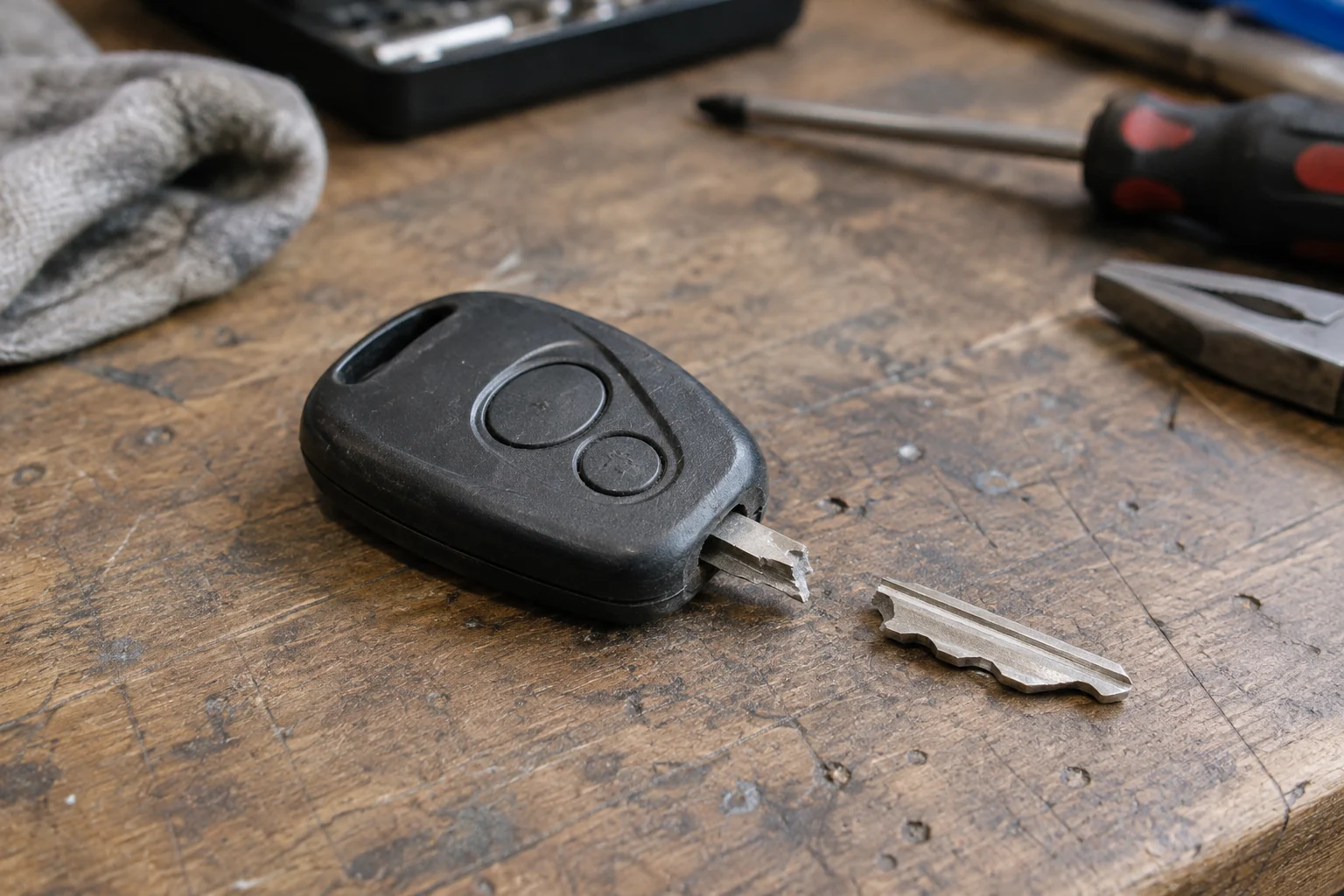
Does the listing include a blade—and is it a blank?
A Citroën C1 replacement key shell with a blade pictured beside it may be sold with that blade, but the photograph alone does not establish what arrives. Check the written contents for the exact option you are buying. A listing may show several versions in one set of photos, while the selected option supplies only the housing. Look for an explicit statement that a metal blade is included, not just a picture of one.
Then check whether the supplied blade is uncut. An uncut car key blade is a blank: it has not been cut to operate your vehicle’s lock. It may be the part you need when the old blade cannot be reused, but it is not a ready-to-use replacement key. It still needs cutting before it can serve as a working blade. “New blade” and “blade included” describe what is supplied; neither phrase tells you that the blade has been cut.
Read the description, option name and contents list together. If one says “shell with blade” but another says “case only”, do not guess which is correct from the images. Ask the seller to confirm, in writing, whether the option you intend to order includes a metal blade and whether that blade is uncut. This matters especially where a listing offers multiple colours, button layouts or blade options under the same title: confirmation needs to refer to the selected option, not merely the product range.
Treat “cut” with care, too. A listing that describes a blade as cut should say what that means for the item being supplied; the word alone does not establish that it has been cut for your car. If the description does not make the blade’s condition clear, settle that question before ordering rather than assuming a pictured blade is usable.
Finally, a “C1” label is a search aid, not a fitment guarantee. A listing can clearly include an uncut blade and still leave compatibility unanswered. First establish what is in the package and whether the blade is blank; the separate checks against the lock and shell come next.
- Confirm that the blade is included, not merely pictured.
- An included uncut blank still needs a suitable cutting reference and cutting.
Check the blade against both the lock and the shell
A replacement blade has to pass two separate physical checks: its working portion must match the vehicle’s lock, and its attachment end must fit the chosen housing. A blade can pass one check and fail the other. Treat a listing headed “Citroën C1 key shell with blade” as a starting point for comparison, not evidence that both parts will fit.
First, compare the blade profile, not just the shape of its tip. Look at the blade’s cross-section, width, thickness, and the position and shape of its lengthwise grooves. Two blades can have similar outlines in a photograph but different grooves along their sides. Those differences matter where the blade enters the lock; the familiar-looking tip does not settle the question. A photo taken only from above may hide the feature you most need to see.
If you still have the original blade or a detached piece of it, compare an undamaged section with the proposed replacement from the same angle. Check both faces and the edge, rather than relying on a silhouette. If the original is missing or too damaged to show its profile, ask the seller for a clear blade-profile designation or close-up photographs of both faces and the edge. Do not assume that a blade offered under the vehicle name matches your lock: a listing title may cover more than one key arrangement, and the precise blade in an option may be unclear.
Next, check the blade attachment where the metal meets the shell. The root may need a particular width, thickness, shoulder, notch, hole or retaining-pin position to sit in the housing. For a folding shell, the root also has to suit the hinge or blade holder; a blade with the right working profile can still have the wrong mounting end. Conversely, a blade that attaches neatly to a shell tells you nothing by itself about its fit in the vehicle’s lock.
Compare the seller’s images of the blade root and housing mount with the parts in hand, if available. Look for matching shapes and fixing points, not merely a statement that the shell and blade are “for C1”. If the blade and housing are offered as a pairing, ask the seller to confirm that exact pairing when the attachment is not clearly shown. If choosing a separate blade for a shell, request the housing’s attachment specifications as well as the blade’s; sharing a vehicle label is not a substitute for a matching mount.
If either profile or attachment remains uncertain after checking the specifications, leave that option unresolved rather than treating a plausible photograph as confirmation. A suitable purchase requires a blade that matches the lock and can be secured in the selected shell.
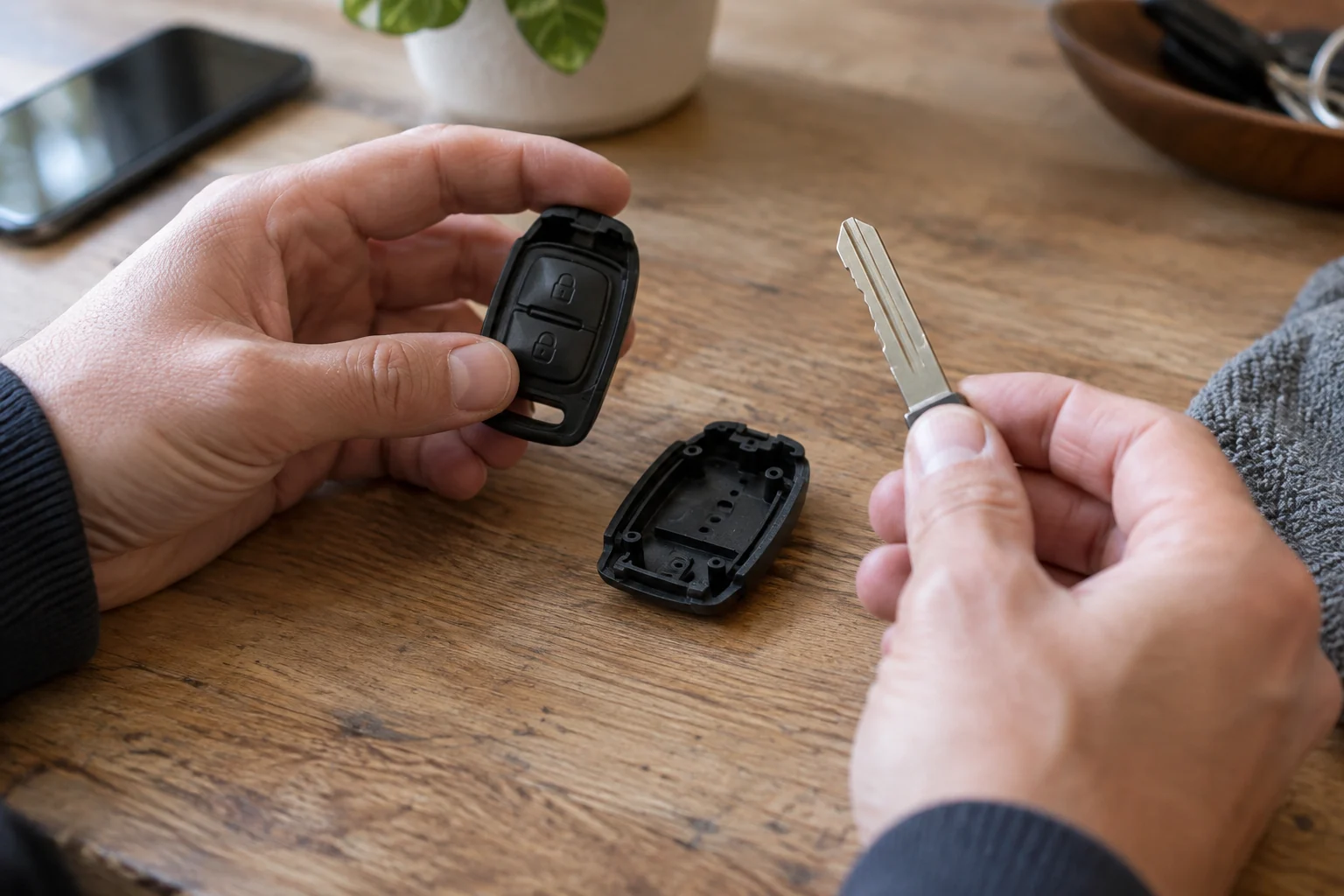
Will the housing hold the parts you need to transfer?
A replacement shell is useful only if it can hold the parts your original key needs. Compare the overall case shape and button arrangement with your existing key, including the number and positions of the buttons. A similar-looking case with a different button layout may close around the electronics but leave the switches impossible to press.
Look beyond the outside photographs. Check the seller’s images for the inside of both case halves, and compare them with your original housing before removing anything. The circuit board needs to sit securely, with its switches beneath the buttons. Check for supports or retaining points in the right places, as well as room for the battery and its contacts where applicable. If the board has to bend, rattle or sit at an angle to make the case close, the housing is not a sound match.
Remote electronics and the immobiliser transponder are not necessarily the same component. The remote electronics operate the lock and unlock buttons; the transponder is involved in starting the vehicle. Depending on the original key’s construction, the transponder may be a separate small chip or incorporated into the electronics. Inspect what your key actually contains rather than assuming that moving the circuit board moves everything needed.
If the transponder is separate, look for a suitable space or holder inside the proposed shell. A case can accommodate the remote board yet provide no secure place for a loose chip. Do not discard the old housing until you have checked for a component tucked into a recess or retained by a small insert. If you cannot identify where a necessary part will sit in the new case, ask for clear internal photographs or dimensions before ordering.
A bare shell does not replace missing or faulty electronics. Moving a non-working remote board into a new housing will not repair the remote function, and an absent or damaged transponder will not appear with a case advertised simply as a shell. This matters even if the new housing looks identical to the old one: physical fit and working components are separate requirements.
Finally, check the contents of the exact option you intend to buy. Photographs may show button pads, screws, a battery holder or internal inserts that are not supplied with every version. If a fitting from the old case is broken or lost, confirm that its replacement is included rather than counting on a bare housing to provide it. When internal photographs or contents are unclear, treat case compatibility as unconfirmed until the seller supplies enough detail to compare.
If the old blade cannot be copied, what must be settled before ordering?
Do not order an uncut blade until you know what it can be cut from and who will cut it. First, ask whether the old blade is a reliable reference. A worn blade may have rounded cuts, while a bent or incomplete one may no longer show its original shape accurately. Do not assume that a cutter can recover the correct cuts from what remains; ask them to assess it.
If the old blade is unsuitable, find out whether you have another authorised cutting reference. A working spare key may be one possibility. A key code, if you have one, may be another, but do not assume it is available for your car or accepted by a particular cutter. Ask what reference the cutter can use and what they need to verify before agreeing to the work.
Next, connect that answer to the product you plan to buy. Give the cutter the chosen blank’s specifications or listing details and ask whether that blank can be cut from that reference. A seller confirming that a blade is supplied does not answer this question. Likewise, a cutter’s ability to copy an existing key does not establish that they can work from a code or another proposed reference. Check the cutting arrangement before paying for a shell that may leave you with an unusable blank.
Use the remaining uncertainties as a final order check:
| Unresolved question | What to confirm before ordering | If it cannot be confirmed |
|---|---|---|
| Cutting reference or blade | Is there an accepted reference, and can the chosen blank be cut from it? | Pause the order; a supplied blade alone does not solve the problem. |
| Housing or blade attachment | Has the seller confirmed the chosen blade and housing combination? | Ask for the exact option’s specifications rather than relying on the listing title. |
| Parts to transfer | Has the seller confirmed the housing can take the components you need to reuse? | Do not assume a similar-looking shell will work. |
A Citroën C1 replacement key shell with blade is a sensible purchase only when the required fit checks are settled and you have a confirmed route to getting its blade cut. If the old key is too damaged to serve as a reference and no alternative has been accepted, hold off on the order. Confirming that route first is less risky than buying a blank and hoping someone can cut it later.
Treat a Citroën C1 shell pictured with a blade as a potential replacement part, not a ready-to-use key. Before ordering, check whether the blade profile and mounting point match your original key and whether the shell can hold its electronics. A supplied blank blade needs cutting to match the lock; the remote and immobiliser functions depend on the correct electronics, not the metal alone. If the listing does not establish those details, the photograph is not enough to confirm that the shell or blade will work with your car.
- Is the supplied blade profile the required type?
- Does its attachment fit this housing?
- Will the case accommodate the parts being transferred?
- Is there a reliable reference for cutting the blank?
Choose the option that matches your vehicle and situation.
Frequently asked questions
Are Citroën C1 key shells interchangeable across model years?
Do not assume they are. Keys from different years may look similar while their blades, fittings or internal layouts differ. Compare the complete key assembly with the verified details of the particular shell. If you are comparing options on car-keys.lt, use the individual listing rather than the model year alone to judge what needs checking.
Is the immobiliser transponder the same part as the remote battery?
No. The battery powers the remote functions, while the transponder is involved in authorising the key to start the car. Replacing one does not replace the other. A shell listing may include neither part, so check its stated contents and identify what can be transferred from your existing key.
Why might a newly cut blade turn a lock but not start the car?
Cutting gives the blade the mechanical shape needed to operate a lock; it does not provide immobiliser authorisation. If the blade turns but the car will not start, check whether the required transponder is present and recognised. Do not assume the cutting is wrong solely because the engine does not start.
Could a new case fix buttons that no longer respond?
It may help if the plastic button cover is damaged and no longer presses the switches properly. It will not repair a faulty circuit board, worn switch or other problem inside the remote. Check whether the buttons still work when pressed directly before treating the outer case as the cause.
Does a replacement shell necessarily include screws, a pin or other small fittings?
No. Photos may show an assembled case without making clear which loose fittings are supplied. Read the contents of the individual listing and check for every small part your key needs. If a fitting is missing from your old key, do not plan on transferring it unless you have confirmed where a replacement will come from.
Can I use a blade from a used key shell?
An already-cut blade carries the pattern of another key, so do not treat it as an uncut replacement for yours. Even if it attaches to the case, that does not mean it will operate your locks. Check whether the blade is genuinely blank or whether a suitable new blade is needed.
What if the vehicle’s locks have been changed?
The vehicle’s model and year may no longer identify the blade pattern used by its current locks. An existing key that operates those locks is more relevant than a blade selected from vehicle details alone. If you have no working key, establish a reliable cutting reference before ordering a blade.
Should I publish a clear photo of my existing key to check compatibility?
Avoid posting a clear view of the cut blade or other key details publicly. Share only the details needed to assess compatibility, and send sensitive photos privately to a relevant supplier if they request them. A photo of the case shape may be enough for an initial question; the blade can be checked separately.
