
- Compare a replacement shell with the exact key you intend to repair, not merely with the other key supplied with the car.
- Two keys working with the same vehicle does not establish that their housings, blades or internal components interchange.
- Matching button counts are insufficient if button positions, case contours or the way the circuit board sits inside differ.
- Check blade shape and attachment separately because an apparently matching case may use a different blade fitting.
- A shell replaces the housing; it does not, by itself, replace faulty electronics or create a working immobiliser transponder.
- If the listing does not show the relevant interior or supplied parts, compatibility remains uncertain until those details are confirmed.
If the two keys supplied with your car look different, compare replacement shells with the key you need to repair, not with the spare. Both keys may operate the car while using different housings and internal parts. Either could have been replaced or rehoused before it reached you, so neither key’s appearance proves what the other one needs.
Keep the damaged key at hand as you look at possible shells. Its overall shape and button positions are useful starting points, but a close visual match does not confirm that the blade attachment or any electronics inside will fit. The second key explains why you may be seeing two designs for the same car; it does not establish that their parts interchange.
This car-keys.lt guide focuses on the comparisons you can make with the key in front of you, rather than guessing which of the pair is factory-original. You’ll learn which details deserve a closer look, why product photos alone can be misleading, and when the car’s model and year leave too much uncertainty to choose a housing confidently.
Start with the key that needs a new shell
Before looking for a replacement, put the damaged key in front of you and set the other one aside. The shell needs to suit the key you intend to repair, not whichever key looks newer or more familiar. If one key has a cracked housing and the other is intact, the cracked key is your reference even if the intact one is the one you usually carry.
Keep the two keys separate while you work. A simple photo of them side by side, with a note identifying the damaged one, can prevent a mix-up later. This matters if you put both keys down, ask someone else to help, or return to the search after a few days. If both need new housings, treat them as two separate jobs rather than assuming one shell choice will cover both.
Use the other key as context, not as a template. It may show that two different-looking keys were supplied with the car, but it does not establish that their housings are interchangeable. Nor does the fact that both keys operate the car settle which design the damaged key should be housed in. For that question, the key being repaired remains the starting point.
Do not assume either key is factory-original. Without a reliable record of the car’s key history, appearance alone cannot tell you whether a housing was changed, a key was added later, or the two keys came from different sources. A tidy-looking spare is not necessarily the original; a worn key is not necessarily older. Avoid using either guess to override what you can observe on the damaged key.
Write down any visible branding, numbers or other markings on each key, keeping clear which marking belongs to which one. These details can help you keep track of information as you compare options, but they are not proof that a shell will fit. If a mark is worn or partly hidden, record only the characters you can read rather than filling in the rest from the other key.
The practical rule is to keep your evidence tied to the key you are repairing. When the two keys disagree, do not quietly substitute a feature or marking from the intact key. Note the difference and leave it unresolved until you can assess the damaged key itself.
Compare the case beyond its button count
Two cases can have the same number of buttons and still be different shells. Compare the positions, shapes and spacing of the buttons on the housing you are repairing with those in a replacement listing. Check their order from top to bottom and whether any button sits off to one side. A three-button case with a long central button, for example, is not an obvious match for one with three equally sized buttons.
Look at the button surround as well as the symbols printed on it. Is each button separate, or are several areas formed in one rubber pad? Does the pad sit flush with the case or inside a raised border? Symbols can wear away, and listing photos may show a different print style, so the moulded layout is usually more useful than the artwork alone.
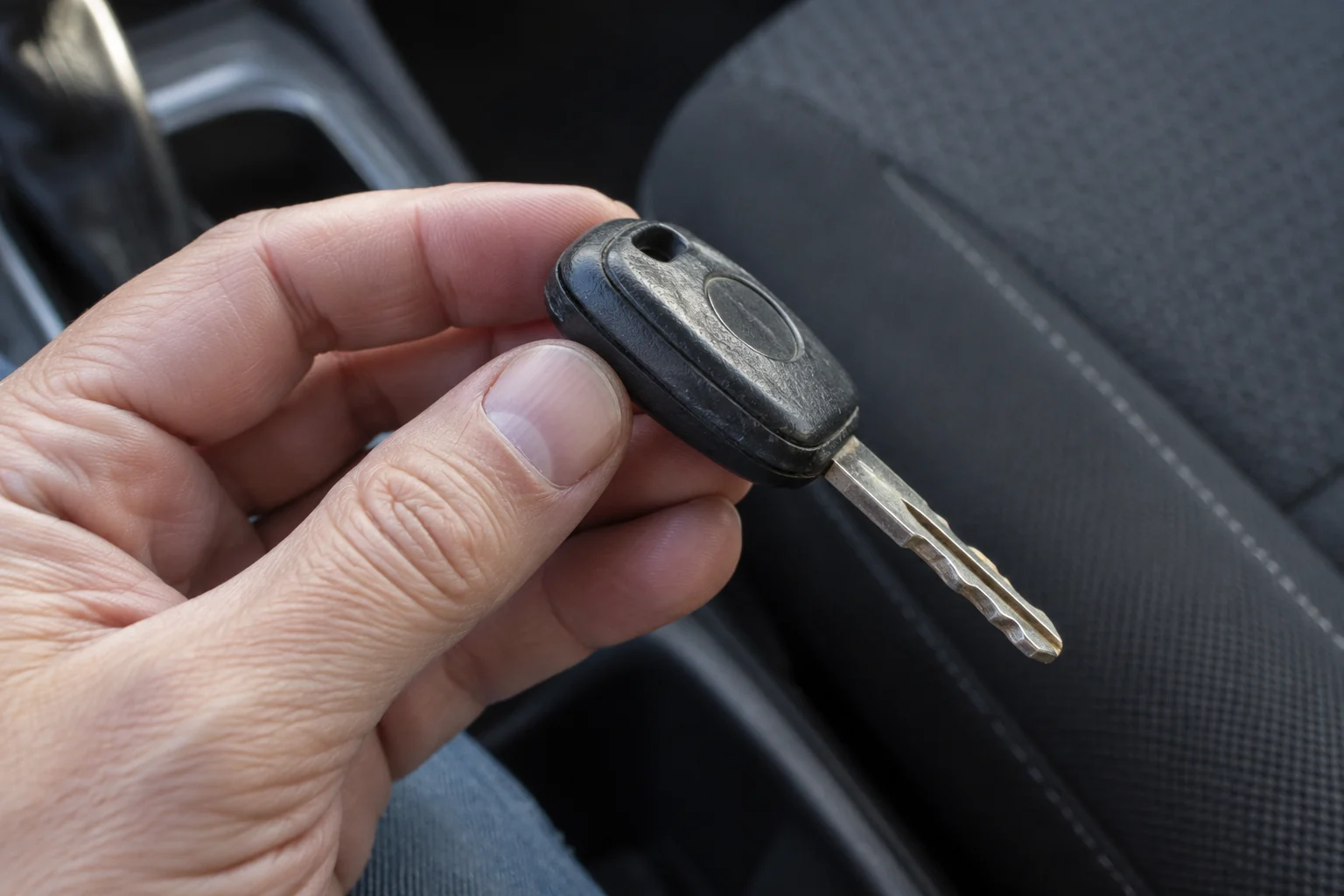
Next, compare the case outline from more than one angle. Note whether the sides are straight or curved, where the case widens, and whether the corners are rounded or sharply cut. Check the thickness if a side view is available. Similar front views can hide a tapered back or a bulge near one end that changes how the two halves meet.
Follow the seam around the edge. Its position may differ even between cases with a similar face: one may split along the middle of its thickness, while another has a shallow rear cover. Where visible, compare the hinge or pivot area, any sliding cover, and the position of clips or closure notches. A visible difference in these features is a good reason to pause rather than assume the cases are interchangeable.
Use listing photos of the front, back, sides and ends. Rotate the key you are repairing to match each view instead of comparing a front photo with an angled product shot. Be careful with mirrored images and camera perspective: a close-up taken from one corner can make a curve or button spacing look different. If a listing shows only the front, it may help rule a shell out, but it cannot establish a close exterior match.
Treat visual similarity as a screening step, not proof of car key shell compatibility. If the button layout or case shape clearly differs, keep looking. If the exterior appears to match, check the listing’s product details for the exact key design it claims to replace; photos alone cannot confirm every fit detail. That matters particularly when comparing different car keys supplied with the same vehicle: a familiar-looking outline is useful evidence, but it is not a compatibility claim.
Check what the shell must hold inside
For a replacement key shell, the question is whether it can hold the components from the key you are repairing in the right positions. Two cases may look alike from the outside yet have different spaces, supports or clearances inside. Do not use the other key’s internals as a substitute for checking the damaged one; different-looking car keys supplied with the same vehicle may be built differently.
If the damaged case can be opened without further damage, note how its circuit board sits before moving anything. Look for posts, ledges, clips or a shaped recess that keeps the board level and stops it shifting. Compare those features with clear interior views of the proposed shell. A board that seems to fit the cavity may still sit too high, tilt against a post or move when the case is closed. If opening the key risks breaking a working part, do not pry it apart simply to make a comparison.
Check how the case’s buttons act on the existing electronics. The flexible button pad or the inside of the case must press the intended switches on the board. Contact points that miss the switches can leave a button unresponsive; parts that hold a switch down can make it stick. When comparing interiors, look at the position and height of the contact points, not just whether there is room for the board. A small difference matters if it changes where pressure lands.
Also account for any transponder in the key you are repairing. Depending on the key’s design, it may be a separate small component housed in the case or incorporated into the electronics. Do not assume its location from the other key, and take care not to lose a loose component during inspection. If the existing key has a separate transponder, the new case needs a suitable place to hold it securely without crushing it or leaving it free to rattle.
Before closing a case around transferred parts, make sure the board rests on its supports and the halves meet without pressure. Do not trim supports, bend the board or force the case shut to overcome a mismatch. Pressure can damage components or prevent a button from working, even when the assembled key looks fine.
Finally, note what worked before the housing was damaged. A cracked case with electronics that still responded is a different problem from a key whose buttons had already stopped working. A new housing can protect and position existing components; it does not repair an electronic fault.
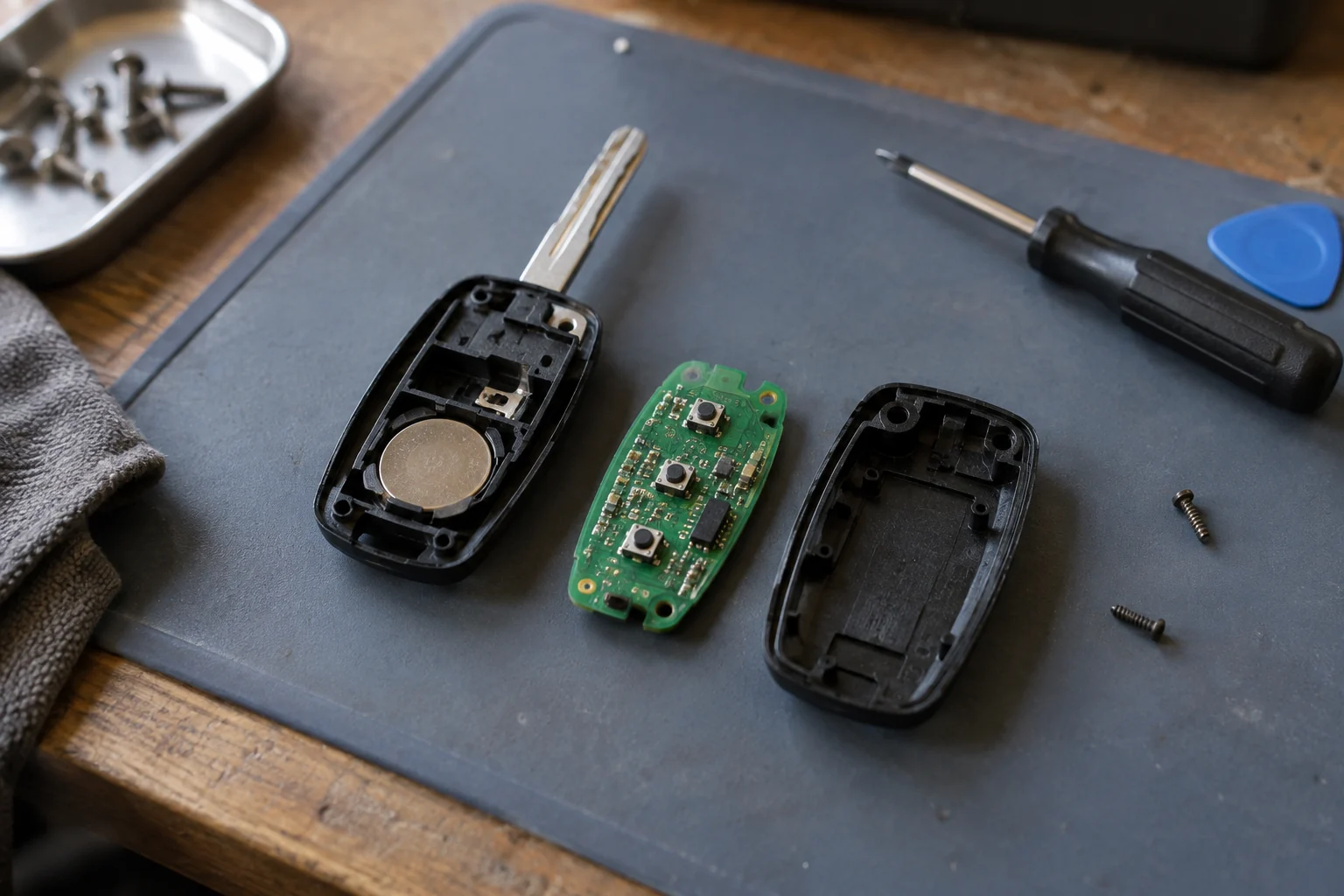
- A replacement housing does not itself fix a faulty circuit board.
- Do not assume the transponder is built into the board or supplied with the shell.
Check the blade and how it attaches
Compare the metal blade on the key you are repairing with the blade shown or described for a replacement shell. Treat this as a separate check from the housing: a shell can appear suitable but still leave you without a usable blade. Do not use the other key supplied with the car as the blade template merely because it works in the same vehicle.
Start with the blade’s form. Is it straight or does it have a milled track along its face? Are its grooves on one face or both? Compare its overall length, width and tip with the blade pictured for the shell. These details can rule out an obvious mismatch, but a similar-looking blank is not proof that it has the correct profile or will operate the lock. A different blade style on the second key does not establish which style the damaged key’s housing can accept.
Next, look at how the blade joins the damaged key. A folding blade may be secured to a pivot by a small pin or other retainer. A fixed blade may fit into a particular mount or be embedded in the housing. The replacement must accommodate the attachment used by the blade you intend to keep, not just provide a place for a blade of similar shape. If the joint is hidden or damaged, do not assume the old blade can be removed intact.
Check what the replacement actually supplies. A shell offered with a metal blank does not come with a ready-to-use blade: the blank still needs to be the appropriate type and cut to operate the car’s lock. A shell offered without a blade depends on your existing blade being both usable and transferable. Even when a listing shows the same general blade shape, its mounting end may differ from yours. “Blade included” and “old blade transfers” are therefore different claims.
Finally, inspect the blade itself before planning to reuse it. A bent, cracked or badly worn blade is a separate problem from a broken housing; moving it into a new shell will not repair the metal. If it sticks in a lock, needs unusual force or has a damaged mounting end, address that condition rather than treating a shell change as the fix. The practical decision is whether you have a sound blade that can attach to the new shell, or whether obtaining a correctly cut blade is also part of the job.
Resolve gaps in the listing before choosing a shell
Choose a shell only when the listing gives enough evidence to match the key you are repairing, not merely the other key that came with the car. If both keys look different, a listing that shows only a vehicle model or a familiar-looking front cover does not establish which housing it replaces.
Check whether the listing shows the inside of both case halves and identifies exactly what comes in the package. “Key shell” can describe a housing supplied with buttons and a blade, or just some of those parts. Look for a clear contents list and photos of the actual parts offered, rather than treating an example photo as a promise of what is included. If a pictured circuit board appears in an illustration, do not assume it is supplied unless the description says so.
Read the blade and component details as carefully as the photos. Does the listing state whether its blade is a blank, whether a blade is included at all, and whether it expects you to transfer parts from your existing key? If it names a particular board or component type, check that information against the key being repaired. A claim such as “fits this car” is less useful than a description that makes clear which key design and supplied parts the claim refers to.
When a detail is missing, ask the seller a narrow question before ordering. You could send photos of the damaged key, clearly labelled as the one being repaired, and ask: “Can you provide photos of both inside halves of the shell supplied?” or “What parts are included, and is the pictured blade blank?” If the listing relies on a code or reference number, ask where that number should appear on the key and whether the seller can confirm it applies to the shell offered. Keep the other key out of the photos unless it helps explain why the two must not be confused.
An unanswered question, a generic reply or a photo that never shows the relevant part leaves car key shell compatibility unconfirmed. That does not prove the shell is wrong; it means the listing has not resolved the risk. Look for a better-documented option rather than filling the gap with an assumption.
Finally, decide whether a housing is what you need. A replacement key fob case addresses a damaged case; it does not, by itself, fix a key whose buttons, electronics or starting function have stopped working. If the fault is unclear, identify it before choosing between a shell-only repair and help with the key itself.
The two keys that came with your car may look different, and neither appearance proves which one is original. For a replacement housing, match the shell to the key you are repairing—not to the other key or to a listing based only on the car model. Compare the button layout, blade arrangement, case shape and, where you can see them, the internal mounting points. If those details do not match, do not assume the blade or electronics will transfer just because both keys work with the same car.
- Use the damaged key as the reference.
- Check exterior and interior views.
- Confirm blade form and attachment.
- Check exactly which parts are included.
- Ask about any detail the listing does not show.
Choose the option that matches your vehicle and situation.
Frequently asked questions
What if pieces of the damaged shell are missing?
Photograph everything you still have, including both sides of the housing, the blade attachment and any loose pieces. Mark which features are missing rather than trying to reconstruct them from memory. If a listing does not show the area you need to check, ask for a clear photo or confirmation before choosing a shell.
Should I open the working spare to identify the damaged key’s parts?
Usually not. The spare may have a different housing or internal layout, even though it works with the same car. Opening it would not establish what fits the damaged key, and it adds a risk of breaking clips or misplacing a small component. Compare the damaged key’s own parts wherever possible.
Can I move the button pad from my old shell into a new one?
Possibly, but check what the replacement includes first. Some shells have a separate rubber pad; others use buttons built into the housing. The old pad must sit correctly and press the board’s contacts in the right places. Do not assume it will transfer just because the button symbols match.
Does changing a shell require the key to be programmed again?
Moving the same, undamaged electronic components into a suitable housing does not by itself change their programmed identity. That is different from replacing a board or losing a transponder during the transfer. If a component is missing, damaged or replaced, the key may need further work; the shell alone cannot settle that question.
What if the remote works but the car does not start?
Working remote buttons do not establish that the car recognises the key for starting. A missing or damaged transponder, an immobiliser-related fault, or a separate starting problem may need investigation. Replacing the housing can protect components that still work, but an empty shell cannot fix a fault in the starting function.
What if the blade is bent or cracked?
Treat blade damage separately from a broken case. A new shell does not straighten a bent blade or make a cracked one sound. Avoid forcing the key in a lock or ignition. Have the blade assessed before deciding whether it can be reused or whether a suitable replacement must be cut.
How can I choose a shell if the damaged key has been lost?
You cannot directly compare a shell with a key you no longer have. Look for earlier photos or records that show the missing key, and make clear which details you cannot verify. The remaining working key may be a different design, so its appearance alone is not enough to establish the lost key’s housing.
What should I send when asking about a shell with incomplete photos?
Send clear photos of the key you intend to repair: front, back, blade attachment and any visible interior. Point out exactly what the listing fails to show. If you ask car-keys.lt about a shell listing, request photos of the inside and confirmation of which parts are included, particularly the button pad.
