
- Replacement shells may be sold with an uncut blade or without a blade, so the individual listing must identify the supplied parts.
- “With blade” does not mean the blade is already cut to operate your vehicle’s lock.
- An included blade must match the original key’s blade type and attachment method; a similar-looking shell alone cannot establish that fit.
- Reusing an existing blade depends on whether it can be removed and secured in the replacement shell’s blade fitting.
- A supplied blade does not establish that the shell includes a remote circuit board or immobiliser transponder.
- If a listing leaves the blade or its condition unclear, confirm the actual contents before ordering rather than relying on the product photo.
A replacement car key shell may come with a blade, but “with blade” does not mean the blade is cut or ready to use. Some listings include an uncut metal blank; others show a blade in the photos but sell only the casing. Even when a blade is included, its shape and the way it attaches to the shell must match your original key.
That makes the product description more useful than the headline. Check what the listing says is included, then compare clear photos of the parts with your existing key, especially where the blade meets the case. If the blade is described as “uncut,” it still needs cutting to match your key before it can operate a lock. Your original blade may be reusable in a replacement shell, but that depends on how it is mounted; a similar-looking casing does not establish a match.
For readers browsing car-keys.lt, the useful question is not simply whether a shell has a blade, but whether the supplied parts suit the key you already have. The distinctions below will help you tell what is included, what fits and what still needs to be done.
Does the replacement shell actually include a blade?
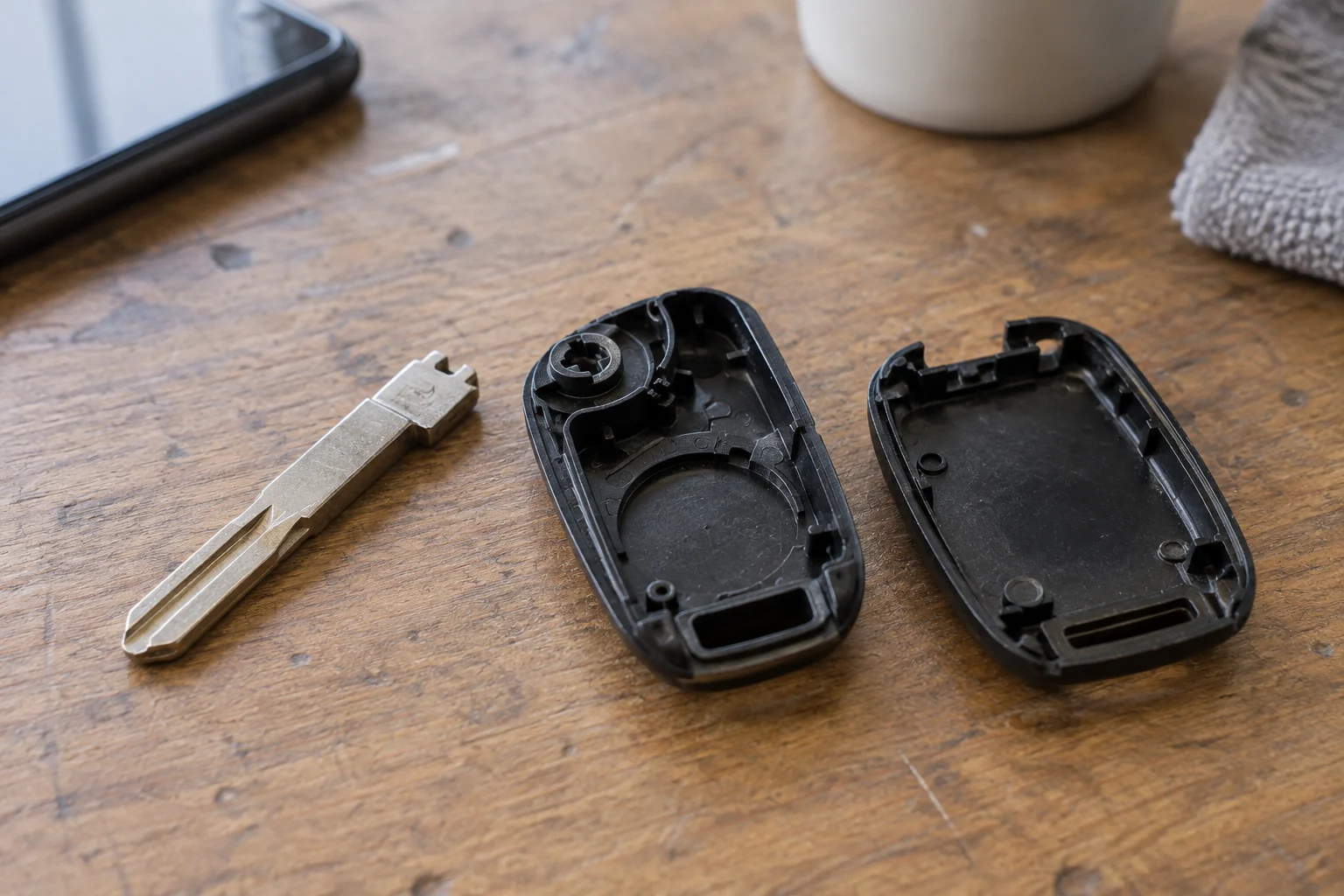
There is no universal rule: a replacement car key shell may come with no blade, a separate blade, or a blade already attached to the shell. “Shell” describes the outer casing, not a fixed set of included parts. To tell which version you are buying, check the selected variant and the written contents of the listing.
A car key shell without a blade provides the casing but no metal key piece. Some listings make this clear with phrases such as “case only” or “blade not included”. Others use “key shell” in the title without spelling out what is in the package. In that situation, the title alone does not answer the question.
Where a blade is included, it may be loose in the package or attached to the shell. That difference matters when checking what will arrive: a photo of a complete-looking key does not establish how its parts are supplied. Look for wording such as “blade included”, “separate blade” or “blade fitted”. If a listing offers several options, check the description of the option you have actually selected; the main photo may be shared across all variants.
Treat product photos as illustrations of the item, not as a complete contents list. A blade shown beside a shell might be included, might represent an optional variant, or might simply show how the finished key looks. Conversely, a photo focused on the casing may not show every supplied part. The most useful evidence is an explicit package-contents list that matches the selected variant. If the title, photos and contents list disagree, the inclusion of a blade remains unclear.
A supplied blade also says nothing, by itself, about the electronic parts of the key. The shell may include plastic buttons or a battery cover while excluding the circuit board, transponder chip or battery. Read those items separately in the contents list rather than assuming that “key with blade” means a complete working remote.
The direct answer to “does a car key shell come with a blade?” is therefore sometimes. Confirm whether the selected listing supplies no blade, a loose blade or an attached one. Whether an included blade can work with your existing key is a separate question from whether it is in the package.
- Supplied: Is a blade actually included?
- Compatible: Does its type and fitting match the original?
- Usable: Is it already cut for the lock, or is it an uncut blank?
Will an included blade fit the original key arrangement?
An included blade will fit your key arrangement only if both its metal profile and its connection to the shell match. A shell that looks like the original does not establish either point. Compare the blade and its mounting with your existing key, then check the specifications for the exact listing variant you have selected.
Start with the metal section that enters the lock. Compare its overall shape, width and length, as well as the position of any grooves or channels. Two blades can look alike in a small product photo yet have different profiles. A broad description such as “flip key blade” does not identify the profile: it describes how the blade is carried by the case, not whether its metal section matches your original.
Next, look at the end of the blade that sits inside the shell. Depending on the design, the blade may be part of a flip mechanism or held in a fixed position. The portion inside the case must match the shell’s fitting: its shape, thickness and position of any retaining hole or notch can matter. A blade with the right profile for the lock can still be unsuitable if its mounting end cannot be secured in the shell. Equally, a blade that sits neatly in the replacement case is not necessarily the right profile for your key.
Treat the listing’s selected variant as part of the compatibility check. A seller may use the same outer-case photos for variants with different blade profiles or mountings. Read the variant name and specifications rather than relying on the main image or a vehicle model mentioned in the title. If a profile code is given, compare it with a reliable identification of your original blade; do not assume a similar-looking code means the same fitting. Where the listing gives only a vehicle range or a photograph, it may not provide enough detail to establish a match.
Outer-case similarity is especially weak evidence. Two housings may share the same button layout and silhouette while accepting different blades or using different internal mountings. Even a close visual match between shells says little about the grooves on the metal blade, which may be hard to see in a listing image. Conversely, a shell that differs slightly in appearance is not automatically incompatible; the relevant question here is whether the blade profile and its mounting match the original arrangement.
If you cannot establish both matches from clear specifications and comparable views of your existing key, regard the blade’s fit as unconfirmed, not probable. A listing that names only the shell style leaves an important gap: it does not tell you whether the included blade is the right metal type or whether it attaches in the way your key arrangement requires.
If a blade is included, is it ready to use?
Not necessarily. A replacement car key shell with a blade may include an uncut key blade: a blank that has not been cut to match your vehicle’s lock. It can have grooves or channels along its length and still be uncut. Those features are part of the blade’s basic shape; the cuts that operate a particular lock are a separate matter. “With blade” therefore tells you what is supplied, not whether the blade will turn your lock.
A blade cut for a particular vehicle has a pattern that matches its lock. An uncut blank does not acquire that pattern simply by being fitted to a shell. For example, if the supplied metal blade has a smooth cutting edge where your original has a series of notches, you should expect it to need cutting before it can operate the lock. The visible difference may be less obvious on other blade designs, so appearance alone is not a reliable way to establish cutting status.
Check the wording for the exact option you plan to order. “Uncut blade”, “blank blade” and “requires cutting” indicate that further work is needed. If a listing says “cut blade” or “pre-cut”, look for what it has been cut to. A blade cut to a generic example pattern, or shown cut in a product photo, is not evidence that the supplied blade matches your car. If the description does not say whether the blade is cut, ask the seller directly rather than treating “with blade” as “ready to use”.
Where cutting is required, the relevant question is whether the blank can be cut to the pattern needed for your lock. That may involve working from an existing key or from a key code where one is available. Do not assume a service can cut it from a photograph or a vehicle model name alone; ask what information or original key they would need before relying on that option.
For mechanical use, “ready to use” means the blade is correctly cut for the lock you intend to operate—not merely included or already shaped as a blank. Even if a correctly cut blade turns an ignition lock, that alone does not establish that the vehicle will start: any required electronic authorisation is a separate question.
Can the original blade be moved into a new shell?
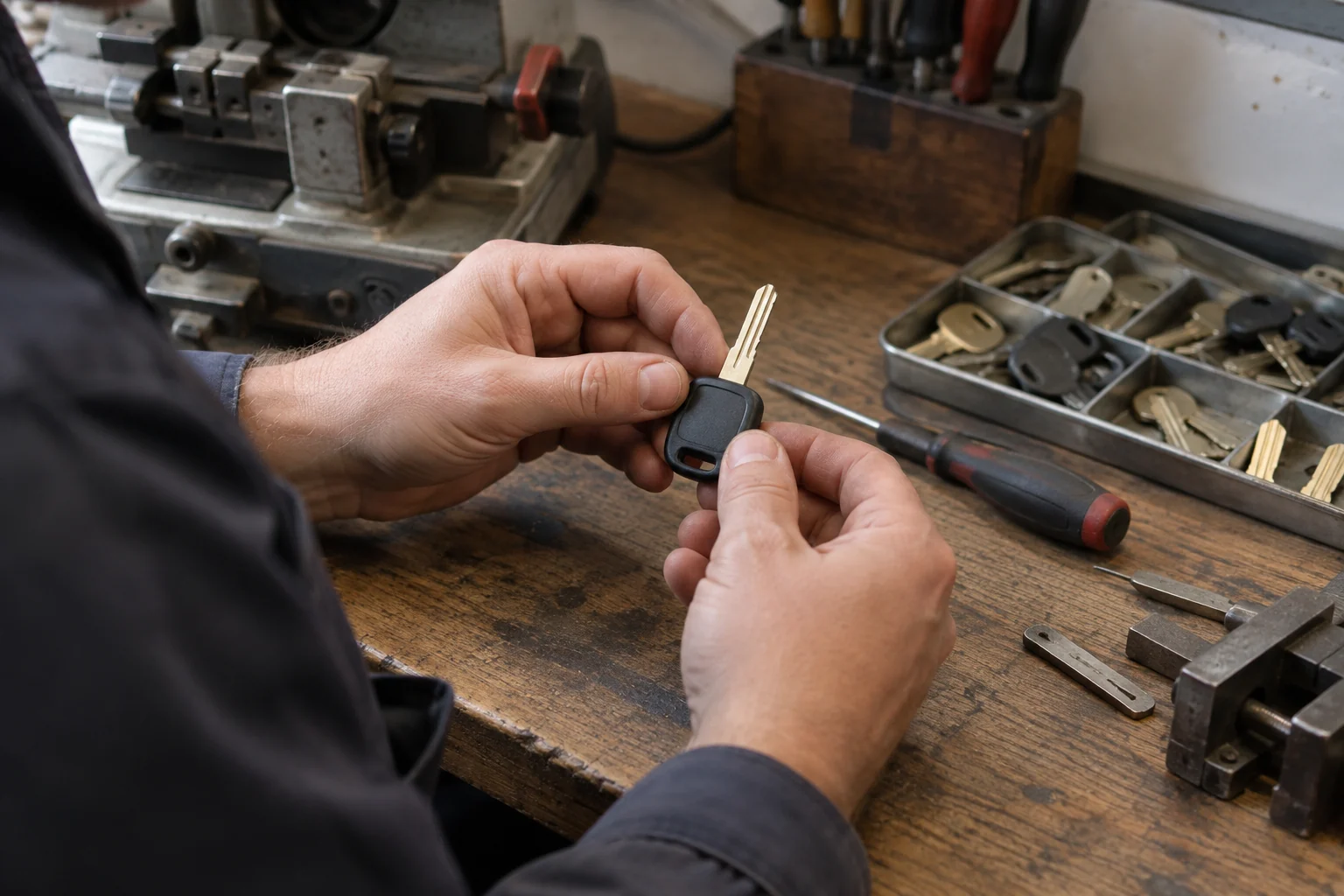
Sometimes, if the existing blade can be removed without damage and secured in the replacement shell. Keeping the blade you already use avoids changing the metal piece that operates the lock, but a similar-looking casing does not mean its blade fitting will accept a transfer.
First, inspect how the blade is held in your current key. Depending on the design, it may be retained by a screw, pin or fitting inside the casing. In other keys, the blade may be fixed in a way that does not allow straightforward removal. Look for the point where the metal enters the casing and check for an accessible fastener or the manufacturer’s instructions for that key design. Do not assume that a visible seam means the blade will come out intact.
If removal requires prying hard against the blade or breaking its mounting, stop. Damage at the base of the blade can prevent it from sitting securely in another shell, even if the part that enters the lock is unaffected. On a folding key, take particular care around the hinge: the blade must be retained firmly and able to move as the new fitting is designed to move.
Next, check the base of the old blade, not just the part that enters the lock. Its shape, thickness and fixing point must suit the replacement fitting. A blade that fits into an opening but cannot be held by the intended pin, screw or other retainer is not a successful transfer. It may shift when you turn the key or come loose when you fold or carry it. Do not file down the base, wedge it in place or force it into an incompatible mount merely to make it fit.
Finally, consider whether the existing blade is worth reusing. Check for bends, cracks, looseness at its base and obvious wear on the working edges. If the key has already been difficult to insert or turn, moving that blade into a fresh casing will not fix the underlying problem. A straight, sound blade that operates smoothly is a better candidate than one that needs extra pressure or careful positioning to work.
Only treat the transfer as complete when the blade sits in the intended position, its retainer holds it securely and any folding action works without binding. If you cannot establish those points without forcing the parts, leave the blade in its original mounting rather than risk an insecure key.
What should you confirm before ordering?
Before ordering, get answers for the exact variant in your basket, not just the product title. Colour, button layout or blade options may be grouped on one page, while the description or photos refer to a different selection. Check the selected variant’s written contents, then ask the seller these questions if anything remains unclear:
- What is supplied with this variant? Ask whether it includes no blade, a loose blade or one already fitted to the shell. If the photo shows a blade but the contents do not mention it, do not treat the photo as confirmation.
- If a blade is supplied, is it cut or uncut? Ask the seller to state its cutting status explicitly. If the listing says only “with blade”, that does not answer whether you can use the supplied blade with your lock.
- Does the blade and its fitting match my original key? Ask the seller to confirm the blade type and the way it attaches to the shell against your existing key. A matching button layout or similar-looking case is not enough to settle either point.
- Can I keep my original blade instead? If that is your plan, ask whether the selected shell accepts a transferred blade from your key. Confirm this even when the new shell comes with a blade; inclusion and the ability to retain your original are separate questions.
Give the seller enough information to answer about your key, rather than a general model range. Send the product link and selected variant, along with clear photos of your original key’s blade and where it meets the casing. A photo of the case and button layout can help identify the version you have. If a part number is visible on the old shell, include it too, but do not assume it proves the blade fitting matches. Avoid sending key codes or other sensitive details unless there is a clear reason to do so through an appropriate channel.
Keep the reply in writing, tied to the variant you intend to buy. For example, “This option includes an uncut blade, but we cannot confirm that your existing blade fits” resolves the contents question while leaving the transfer question open. If the seller cannot confirm a point that matters to your purchase, treat it as unverified rather than filling the gap from a photo or a broad compatibility claim. You can then look for a listing with clearer specifications or choose a different variant whose contents and fitting are confirmed.
The practical takeaway is to check exactly what the listing includes before ordering. A replacement shell may come with no blade, an uncut blade or a blade intended to be swapped with your existing one. A blade shown in a photo is not necessarily included, and an included blade is not necessarily cut or compatible with your key. Check the written description for those details and for compatibility with your original key. If either point is unclear, ask the seller rather than relying on the product title alone.
- Exact parts supplied
- Blade type and attachment
- Cut or uncut condition
- Whether the existing blade can be retained
Choose the option that matches your vehicle and situation.
Frequently asked questions
What does “uncut” mean if the blade already has grooves?
The grooves along an uncut blade can be part of its basic profile. “Uncut” means it has not been cut to operate your particular lock. A blade can therefore look detailed in a product photo and still need cutting before it will work in your car.
Is a flip-key blade always attached when the shell arrives?
No. Depending on the selected variant, the blade may be fitted to the flip mechanism, supplied separately, or not included. Check the contents stated for the variant you are buying; a photo of an assembled key does not, by itself, confirm how the parts will arrive.
Can I move the blade without dismantling my only working key?
Moving the existing blade requires removing it from the old key, so do not assume you can make the transfer without temporarily disrupting your only working key. If you need to keep using it, establish how the blade is held in place and how the replacement accepts it before taking anything apart.
Should I reuse a blade that is bent or badly worn?
Avoid forcing a bent blade into a new shell or relying on one that is badly worn. A fresh housing will not repair damage to the metal. Have the blade’s condition assessed before deciding whether to transfer it or use a suitable replacement blade.
Will changing the shell affect the immobiliser transponder?
The mechanical blade and immobiliser transponder do different jobs. Changing the shell does not automatically change the transponder, but the result depends on where that component sits in your key and what happens to it during the swap. Do not treat a blade that turns the lock as proof that the car will start.
What if the listing shows several different blade shapes?
Those images may show alternative variants, not everything supplied in one order. Identify the exact option you are selecting and check its blade shape and stated contents. If you are comparing options on car-keys.lt, use the selected variant—not the group photo—as the starting point for that check.
Can I keep using my old key while an included blank is uncut?
Yes, if your original key remains intact and working, an unused blank supplied with a shell does not prevent you from using it. Keep the original key separate while you confirm whether the blank is suitable and arrange any cutting it needs.
What if the delivered shell is missing a blade the listing said was included?
First check the variant on your order against the listing as it appeared when you bought it; different options may have different contents. Keep the order details and relevant listing text or screenshots, then contact the seller to explain what arrived. The appropriate resolution depends on those details.
