
- Shell compatibility depends on housing dimensions, button placement, internal supports, battery arrangement, blade mount, and closure points—not the Porsche badge alone.
- A three-button layout is a useful visual clue, but it cannot prove that the circuit board, battery holder, or mounting posts will fit.
- Replacing only the shell usually reuses the original electronics and may preserve existing programming, while a complete key can require cutting or programming.
- Compare the original shell’s front and back, button symbols, seam, clips, screw points, blade attachment, and battery position with the listing photographs.
- If the circuit board, transponder, battery contacts, or buttons are damaged, an empty shell alone will not restore the key’s electronic functions.
- Vehicle model, production year, key generation, market, and original key shape can all affect compatibility when Porsche housings look similar.
A Porsche 3-button replacement key shell is compatible only when its physical design and internal layout match your original key—not simply because both shells have three buttons or carry a Porsche badge. Similar-looking housings can differ in their shape, button arrangement, circuit-board fit, transponder position, battery compartment, or blade connection. Ordering by vehicle model name alone can therefore lead to a shell that cannot be assembled correctly or reused with your existing electronics.
The safest approach is to treat your current key as the reference. Compare its overall outline, button layout, rear cover, internal supports, blade fitting, and electronic components with the replacement shell before ordering. Vehicle details, including the model, year, and key type, can help narrow the options, but they do not replace a physical comparison. This guide explains how to identify the features that matter, which photographs and measurements are useful, and where compatibility can remain uncertain. It also clarifies the difference between replacing the outer housing and replacing the complete key, since a shell normally does not automatically include the electronics, immobiliser data, or a ready-to-use blade. When any key feature differs or cannot be confirmed, the safer decision is to pause and verify the match rather than rely on appearance.
Why Three Buttons Are Not Enough to Confirm Fit
A three-button layout is useful as an initial clue, not as proof of compatibility. It can help narrow the search to a Porsche 3-button replacement key shell, but it does not confirm that the housing has the same internal shape as the original. Two shells may both have lock, unlock and boot buttons while using different dimensions, mounting points or closure details.
Porsche key housings can look remarkably similar across vehicle generations and markets. The Porsche badge, button symbols and general oval or rounded profile may remain familiar even when the inside has changed. A replacement key housing can therefore appear correct from the front but still fail to accept the original electronics or close securely around them. Visual similarity is evidence to investigate, not evidence that the shell fits.
The important differences are often hidden inside the casing. The circuit board needs the correct space and locating supports; otherwise it may sit too high, move when a button is pressed or prevent the two halves from closing. The battery area also has to align with the shell design, and the clips, screw points or other closure features must meet in the right positions. These details explain why button count alone cannot establish Porsche key shell compatibility.
The model name can mislead as well. A listing described only as a shell for a broad Porsche model family may cover several key generations or regional versions. The same vehicle name may appear alongside different key designs, while a similar shell may be listed for another model because the exterior is alike. Before treating a listing as a match, check whether it identifies a precise key or shell version, rather than relying on the vehicle name alone.
The Porsche badge should be treated in the same way. It may confirm the intended brand styling, but it does not confirm the board supports, battery space or closure geometry. If the listing gives only a three-button count, a model name and a product photo, compatibility remains unconfirmed. A reliable decision requires evidence that the specific shell design corresponds to the original key; the physical comparison itself should be carried out before ordering.
- Three buttons are only an initial visual clue.
- Check the housing shape, internal supports, blade mount and battery arrangement.
- Treat an unverified model-name match as uncertain.
How to Compare the Original Shell With the Replacement
Before ordering a Porsche 3-button replacement key shell, compare the original housing with the product photographs and dimensions point by point. Do not rely on the Porsche badge or a general model description. Place both shells in the same orientation and check the outside first, then the inside.
Compare the exterior and closure geometry
Start with the front and rear housing shape. Check the overall length, width and thickness, but also look at details that are easy to overlook: rounded corners, raised edges, the profile around the key ring, and any change in thickness near the button area. A shell can have similar outside dimensions yet still fail to close if its rear cover has a different contour.
Next, compare the button symbols, spacing and recesses. The lock, unlock and boot symbols should be positioned in the same order and at the same distances from one another. Check whether the buttons sit in separate openings or in one shared recess, and whether each opening is square, rounded or slightly angled. Also compare the depth of the recesses. If the original buttons project through individual apertures but the replacement uses a single wide opening, the parts may not sit or move correctly.
Examine the seam around the housing. It should follow a similar route and meet at comparable points around the ends and sides. Then look for clips, screw locations, hinge points and other closure features. Count visible screws and compare their positions rather than assuming that a similar rear cover uses the same fasteners. Clips may also differ in location or shape; a replacement can look correct from the front while having no matching points to hold the two halves together.
Inspect the inside before deciding
If the original shell can be opened without damaging it, photograph the interior before removing anything. Compare the replacement listing with those photographs, not just with the outside of the key. The internal supports should appear in corresponding positions and have similar height, width and orientation. Pay particular attention to posts, rails, retaining walls and ledges that keep the original circuit board seated. A support that is a few millimetres out of position can prevent the housing from closing or place pressure on the board.
Check the circuit-board clearance by comparing the empty spaces around the original board with the replacement shell. Look for differences near the button contacts, corners and cover. The board should have room to sit flat without being bent, pinched or held away from the button plungers. This is a physical shell comparison only; it does not confirm that the electronics or vehicle-specific components are suitable.
Finally, compare the battery compartment’s position and shape. Check its location relative to the board, the cover and the edge of the shell. Note the battery outline, retaining lip, contact openings and clearance above it. A compartment that accepts the same battery type may still be positioned differently, leaving the cover unable to close.
Before relying on a listing, manually confirm its stated dimensions, fastening details and internal layout. Also confirm that its photographs show the inside of the housing, rather than only the exterior. If the interior is not shown and these details cannot be verified, treat Porsche key shell compatibility as unconfirmed rather than assuming the replacement key housing matches.
- Front and rear photos of the original key
- Button symbols and spacing
- Seam, clips, screws and closure points
- Blade attachment and battery position
- Vehicle details and original key generation
Check the Blade, Electronics and Vehicle Details Separately
A shell can match the outside of your key and still fail at the blade end. Check how the blade attaches before ordering: it may use a hinge pin, a fixed mount, a spring-loaded mechanism or another housing-specific arrangement. Compare the pivot point, retaining features and available space inside the shell. Also confirm whether the Porsche 3-button replacement key shell includes a blade. If it does not, verify that your existing blade can be transferred without altering the mount.
Blade and electronic compatibility
The blade is not the only part that must transfer. Open the original key only if you can do so safely, then compare the replacement housing’s internal layout with the circuit board. The board must sit flat in its supports, and its button contacts must line up with the shell’s rubber or plastic button surfaces. Even a small difference in contact position can leave one or more buttons difficult to press or non-functional.
Check the board outline, locating posts, clips and clearance around the battery area. A Porsche replacement key housing may have room for a similar-looking board but lack the supports needed to hold it securely. Do not assume that the same three-button arrangement means the electronics are interchangeable. The relevant key generation can use a different board shape, button-contact pattern or battery-contact arrangement.
The transponder also needs separate attention. Confirm how the original key’s transponder is housed and whether the replacement shell provides the required space or retaining feature. The battery contacts must likewise meet the correct terminals in the board and remain clear of the housing after assembly. If the listing gives no useful information about board, transponder or battery compatibility, treat that as missing evidence rather than confirmation.
An empty shell cannot solve an electronic fault. If the original key has a damaged circuit board, failed button contacts, a missing transponder or a battery-contact problem, moving those parts into a new Porsche remote key shell may leave the fault unchanged. A housing replacement addresses physical damage or wear; it does not automatically repair the electronics.
Vehicle and key-generation cross-check
Finally, compare the vehicle details with the original key, not only with a model name in the listing. Confirm the vehicle model, model year, market and key generation where this information is available. A three-button Porsche key used for one market or generation may not correspond to a visually similar key supplied for another. Any vehicle-compatibility statement should therefore apply to your specific market and original key.
Before treating the shell as a match, you should be able to confirm three separate links: the blade can be mounted or transferred, the original electronics and transponder fit the internal arrangement, and the vehicle information matches the stated key generation. If one link remains uncertain, the shell is only a visual possibility, not a confirmed fit.
When a Replacement Shell Is Enough—and When It Is Not
A Porsche 3-button replacement key shell is usually intended for a shell swap: you keep the working parts from the original key and move them into a new housing. This can solve cracked plastic, worn button surfaces, broken clips or a loose blade mount without changing the vehicle’s existing key setup. The replacement housing does not, by itself, create a new coded key.
A shell-only option is more likely to be suitable when the original remote still responds, the circuit board is undamaged, and the rubber or plastic buttons are the main problem. Check that the board has no visible cracks, corrosion or detached components, and that the button contacts are present and positioned correctly. Battery contacts should also be intact. If the original transponder part is separate from the board, confirm that it can be retained and transferred; do not assume every Porsche remote key shell accommodates it in the same way.
An empty Porsche replacement key housing will not repair an electronic fault. A remote that stopped working because of a damaged board, failed contacts or water damage may need electronic diagnosis or a different replacement solution. The same applies if the transponder is missing, damaged or not transferable. In those cases, changing the casing may improve the appearance but will not make the key start or unlock the vehicle.
A complete replacement key is a different product. It may include electronics, a transponder and a blade, but the exact contents vary by listing. The blade may require cutting to match the vehicle, while the electronics or transponder may require programming or other vehicle-specific work. Confirm these requirements before ordering; a complete key is not automatically ready to use.
Before choosing, verify whether the listing includes only the casing, or also buttons, blade, board, battery parts and transponder. Then confirm what cutting, programming or vehicle-specific work—if any—is required. This keeps a Porsche key shell compatibility decision separate from the need for a fully functioning replacement key.
- A shell normally concerns the housing and may reuse the original parts.
- Damaged electronics or transponder components are not repaired by an empty shell.
- A complete key may involve additional cutting or programming requirements that must be confirmed.
A Safe Pre-Order Check for a Porsche Three-Button Shell
Use a simple evidence-first process before ordering a Porsche 3-button replacement key shell. The aim is not to find a listing that looks close, but to confirm that the replacement housing agrees with your original key in every feature that affects the swap.
Follow the checklist before paying
-
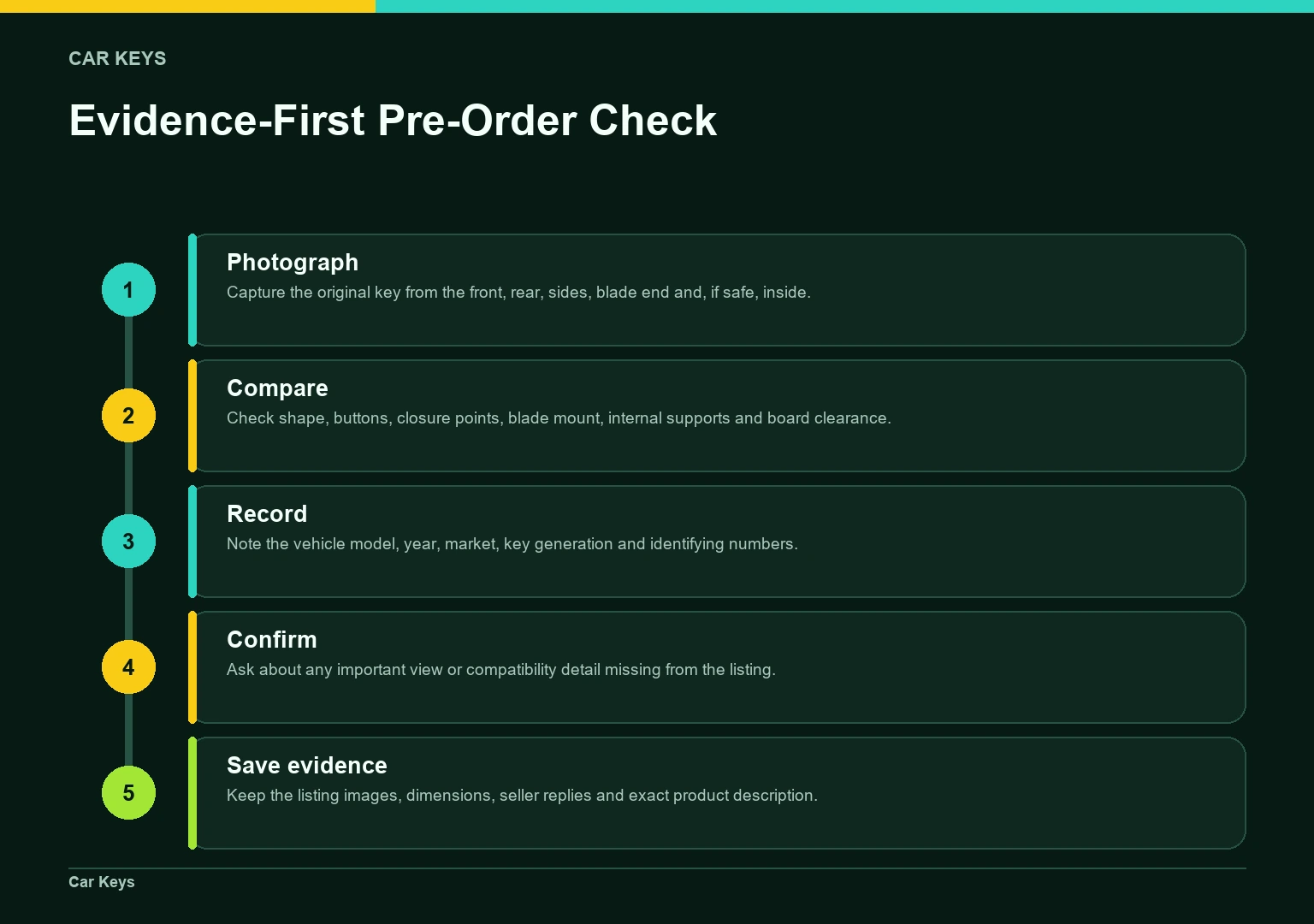
Photograph the original key from several angles. Take clear images of the front, rear, sides, button area, seam, blade attachment and opened housing. Include the inside if you can open it without damaging the clips. A ruler in one image can help show scale, but it does not replace a direct dimensional comparison.
-
Compare the listing with your photographs feature by feature. Check the outside shape, button layout, closure points, blade mount, internal supports, battery area and circuit-board clearance. Mark each item as matches, does not match or not visible. Do not treat an unshown feature as a match.
-
Record the identifying details of your key and vehicle. Note the vehicle model, model year, market, key generation and any number printed on the original housing or electronics. Record whether the blade is hinged, fixed or attached through a separate mount. These details give the seller something more useful than “three-button Porsche key.”
-
Ask for confirmation when an important view is missing. Request the rear, interior, blade-end or electronics-side photograph that the listing does not show. Also ask which identification details the seller accepts for a compatibility check and how their support process works. A clear answer should address the specific feature in question, not merely repeat the product title.
-
Keep the evidence before ordering. Save the listing photographs, dimensions, written replies and the exact product description. This creates a record of what was represented at the time of purchase and makes a later comparison easier if the delivered Porsche replacement key housing differs from the listing.
-
Stop if a critical feature conflicts. Do not order because several minor details match when the blade mount, internal support, board clearance or closure method is different. If evidence remains incomplete, treat the shell as unconfirmed rather than assuming it will fit.
Before completing the purchase, read the seller’s current compatibility, return and exchange terms. Confirm what happens if the housing does not match your documented key, since policies and accepted evidence can differ between sellers. A cautious pause is safer than forcing a replacement key casing onto an incompatible original.
A three-button layout alone does not confirm that a Porsche replacement shell will fit your key. Before buying, compare the shell with your original housing in every relevant detail: button arrangement, shape, internal mounting points, transponder or electronics space, and the blade or emergency-key design. Check the seller’s compatibility information against your exact key version rather than relying on a similar vehicle image or model name. If any essential detail remains unclear, treat the match as unverified; a close-looking housing can still be the wrong replacement.
Choose the option that matches your vehicle and situation.
Frequently asked questions
Can two Porsche keys with three buttons use different replacement shells?
Yes. Three buttons describe only the control layout, not the complete housing design. Two keys may use different shell shapes, button positions, clips, screw points, battery covers or internal supports despite having the same button count. Compare the original key’s exterior and interior structure before treating a three-button listing as compatible.
Should I compare the front or the back of my original Porsche key?
Compare both sides. Check the front shape, button openings, badge area and seam, then inspect the rear contour, clips, screw points and battery-cover arrangement. Small differences on the back can prevent the shell from closing correctly, even when the front appears identical.
Do I need to open the original key before buying a replacement shell?
Opening the key can reveal useful details, including board supports, battery placement and the blade-mount arrangement. However, do not force clips, seams or screws, since the housing or electronics may be damaged. If you are unsure how the key opens safely, obtain appropriate assistance or rely on clear internal photos from the seller.
Will a replacement shell fix buttons that no longer work?
Only if the problem is limited to worn, damaged or poorly positioned physical button parts. A new housing will not repair a damaged circuit board, faulty contacts, broken solder joints or other electronic problems. If the buttons fail because the electronics are defective, a shell-only replacement is unlikely to solve the issue.
Can I move my existing Porsche blade into a new shell?
That depends on how the original blade is mounted and how the replacement shell retains it. Compare the hinge, pin, screw, slot or other retaining arrangement rather than assuming the blade will transfer. A shell may look correct externally but still use a different blade mount, making direct transfer unsuitable.
Does the Porsche model and production year identify the correct shell?
The model and production year can narrow the possibilities, but they do not always identify one exact shell design. Keys can vary by generation or equipment, and listings may use broad vehicle descriptions. Use those details together with photographs and a comparison of your original key’s shape, buttons and blade arrangement.
What if the product listing shows only the outside of the shell?
Treat the missing information as unresolved compatibility evidence. Exterior photographs cannot confirm the internal supports, battery space, blade mount or closure design. Ask for clear interior, blade-area and battery-cover details, or compare the listing with your opened original key before ordering. Do not assume a match based only on the badge and button layout.
What details should I provide when asking whether a shell fits?
Provide clear photographs of the front and back, including the seam, buttons and rear contour. If appropriate, add photographs of the opened shell, showing the board supports, battery area and blade mount. Include the vehicle model and production year, plus the original key’s button count and blade configuration.
