
- A key shell replaces the outer casing, so a shell listing should not automatically be treated as a complete programmed replacement key.
- Button count alone cannot prove compatibility because the casing shape, blade arrangement, internal layout, and vehicle version may also differ.
- Before ordering, compare the existing key’s front, rear, side profile, button positions, blade connection, and internal component arrangement.
- A replacement shell may require transferring usable electronics and other original components, but the exact transferability depends on the shell design.
- If the physical casing matches but the vehicle still fails to recognise the key, the problem may involve electronics, programming, or another component.
- Vehicle model and production year should be treated as starting points rather than final proof of fit unless the specific listing confirms compatibility.
Replacing a damaged Iveco Daily key shell is not the same as replacing the vehicle’s complete key. A shell is the outer housing: it may protect the existing buttons, circuit board, transponder and key blade, but it does not normally add a new programmed immobiliser key. If the original electronics still work and only the casing, button area or blade housing is damaged, transferring the original components into a compatible shell may solve the problem. If the electronics are missing, faulty or unsuitable, a shell alone will not restore starting or remote-locking functions.
The main challenge is choosing the correct Iveco Daily key shell before opening the old key. One-button appearance is only a starting point. You should compare the shell’s shape, button position, blade arrangement, case joint, internal supports and space for the original electronics. Model year and vehicle version can help narrow the options, but they should not replace a physical comparison.
This guide explains how to inspect the existing key, distinguish a replacement casing from a complete programmed key, assess whether the internal parts can be transferred and recognise situations where a locksmith or specialist should confirm compatibility before you buy or modify anything.
What an Iveco Daily Key Shell Actually Replaces
An Iveco Daily key shell is the outer casing of the key, not usually a complete replacement key. It provides the plastic housing, button area and, in some listings, a new or separate blade. The vehicle does not recognise the casing itself. Recognition depends on the original key’s electronic components and, where applicable, the programmed transponder.
A complete programmed key is a different product. It may include the casing, a cut blade, electronic board, transponder and programming. However, the exact contents vary, so do not assume that a listing called an “Iveco Daily replacement key case” includes everything needed to start the vehicle. Check whether the product is described as a shell, case, housing or complete key, then confirm each included part.
A one-button car key shell listing may exclude several items:
- the electronic circuit board;
- the transponder or immobiliser chip;
- the key blade;
- a blade insert that still needs cutting;
- programming or any service connected with programming.
Some shells are supplied without a blade, while others include an uncut blade or a blade insert. Those options are not interchangeable in practical terms. Before ordering, verify the listing contents rather than relying on the product photograph or the number of buttons shown.
The casing is more likely to be the only damaged part when the key still locks and unlocks the vehicle, starts it normally, and responds consistently, but the plastic is cracked, the button supports are worn, or the key blade is loose because the housing no longer holds it securely. A broken button cover does not automatically mean that the electronics have failed. Conversely, intermittent operation, failure to start, or a key that is not detected points to a problem that an Iveco key case replacement may not solve.
An intact original key is therefore important. It preserves the known-working key components and gives a reliable reference for the replacement casing. If the original key is still functional, replacing only the damaged housing may be appropriate; if it is lost, non-functional or already missing internal parts, a shell alone may not provide a usable solution. The product listing and the condition of the original key must be assessed together.
- A shell changes the outer casing.
- A complete replacement key may involve additional components or programming.
- The exact contents must be confirmed from the individual listing.
How to Check an Iveco Daily One-Button Shell for Physical Fit
A one-button layout is only a starting clue. Several Iveco Daily keys may have one button while using different housing dimensions, blade connections or internal layouts. Compare the replacement listing with your existing key from several angles before treating it as a suitable Iveco Daily one-button key shell.
Compare the outside shape
Place the original key and the proposed shell next to each other and check the following points:
- Front face: Compare the overall outline, button position, button shape and the distance between the button and the casing edge. A round button is not equivalent to an oval or recessed button if the opening in the shell is different.
- Rear face: Look for matching contours, screw locations, clips, seams and recesses. The back cover may appear similar in a product photograph while using different fixing points.
- Side profile: Check the thickness, curved edges and height of the button area. A shell that matches from the front may still be too shallow or too thick when viewed from the side.
- End and blade area: Compare the shape around the blade base, hinge or connection point. The blade may fold into the casing, pivot on a pin or connect through a different retaining arrangement. These designs should not be assumed interchangeable.
Use clear photographs of the original key, including its front, back and side. If a listing shows only the front, physical compatibility remains unconfirmed. Ask the seller or supplier to confirm the shell’s stated vehicle compatibility and the blade style or connection design rather than relying on the product title alone.
Check the inside, not just the button count
If the casing can be opened without damaging it, compare the internal cavity with the replacement shell’s photographs or stated dimensions. Check the length and width of the main compartment, the position of locating posts, clips, screw towers and any separate recesses. The cavity must have the same general layout; a similar external shape does not prove that the original internal arrangement will be accommodated.
Pay particular attention to the button mechanism and the space around it. The replacement should show a matching opening, support or contact position, not merely a single button symbol. Also compare the available space near the blade hinge or connection point, because a different pivot location can prevent the casing from closing correctly.
Treat the vehicle model and year as useful starting clues, not as final proof of Iveco Daily key compatibility. Production changes, regional variants and different key designs can occur within a model range. A listing that says “Iveco Daily” may still require a particular blade arrangement, housing shape or internal dimension.
Before ordering an Iveco key case replacement, record the original key’s measurements and photograph its identifying features. Then match those details against the listing and obtain confirmation when any feature is unclear. If the front matches but the side profile, blade connection or internal cavity does not, do not assume that car key shell installation will be straightforward.
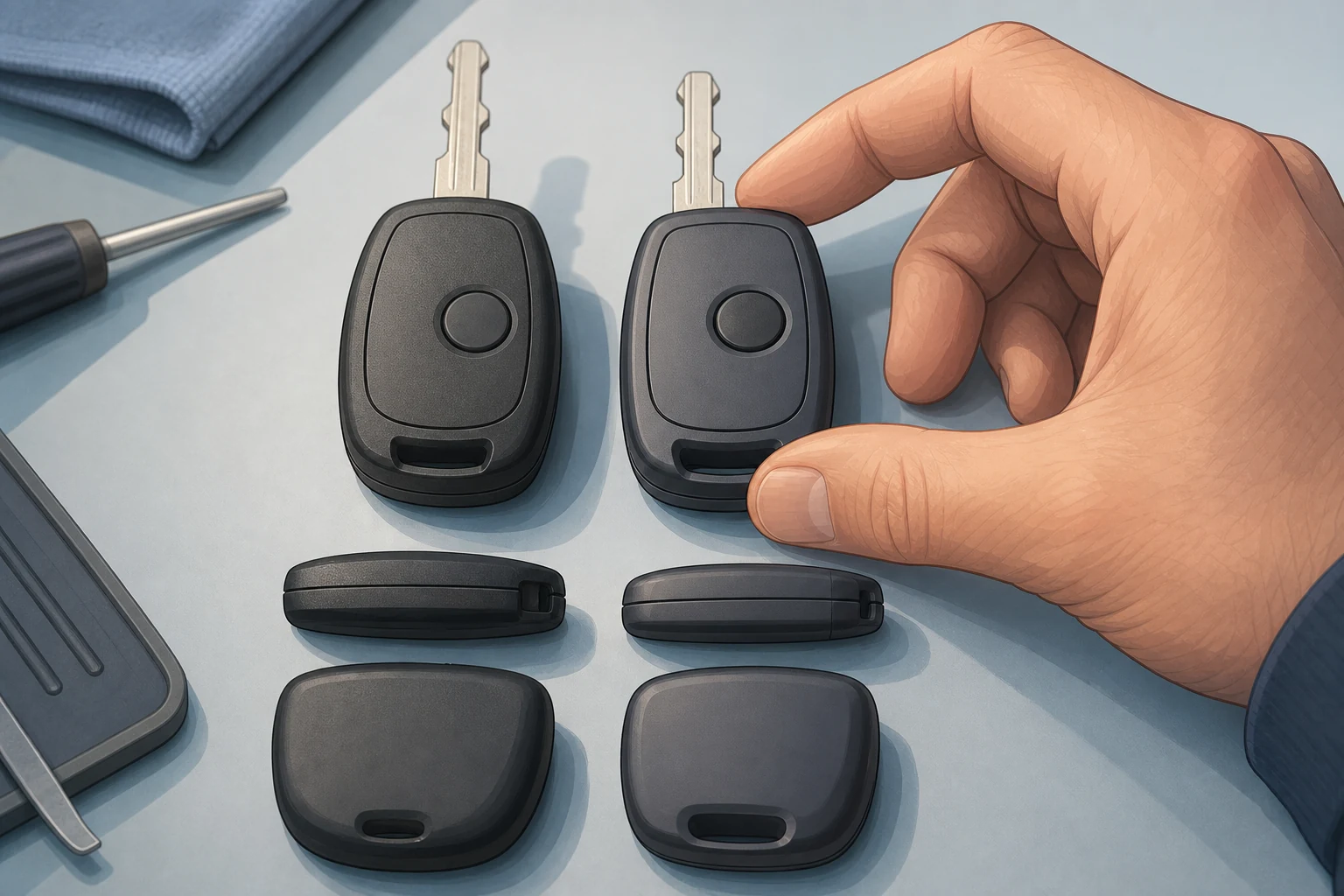
- Compare the casing shape, blade connection, button layout and internal cavity before ordering.
- Treat vehicle model and production year as starting clues, not final confirmation.
What You May Need to Transfer Into the Replacement Casing
A replacement casing normally works by reusing the usable parts from the original key. Before opening it, gather the original key, the new Iveco Daily key shell, and a clean, well-lit work surface. Take a photo of the original layout first. This provides a reference if a small part, spring or rubber button moves during the transfer.
Electronic components
The original circuit board and its buttons are usually the first parts to inspect. Check whether the board is intact and whether the button contacts, rubber membrane and battery contacts are still seated correctly. If the new housing is designed for that board, transfer it without bending or scraping it. A cracked board, loose component or corroded contact should not be treated as a casing problem simply because the plastic is damaged.
Some keys also contain a separate transponder or another original electronic component. Its position may be inside the main housing, in a dedicated pocket or near the blade area, depending on the key design. Do not assume that every one-button car key shell uses the same arrangement. Confirm which components the specific product accepts and whether it provides a secure place for each original part.
The internal shape can prevent a straightforward transfer. A cavity may be too shallow for the circuit board, a locating post may sit in a different position, or a retaining clip may not hold the original component firmly. A shell that looks similar from the outside can therefore be unsuitable internally. Never force the board, battery holder or transponder into place: pressure can break solder joints, deform contacts or damage a component that was otherwise usable.
Blade and fitting details
The original blade may be reusable when the replacement casing has the same blade connection and enough space for the original fitting. In other cases, the shell includes a replacement blade insert that must be cut to match the vehicle’s lock. Some products include only the housing, while others include an uncut insert, pin, spring or hinge parts. Confirm exactly what is included before starting the Iveco key case replacement.
If the original blade is removable, keep its pin, spring and small retaining parts together during disassembly. Their position matters when the blade folds or returns to its stored position. Do not transfer a blade merely because it appears to fit the slot; the pivot, stop and retention method must also match the casing design.
Work slowly and compare each component with the replacement’s internal supports before closing it. The two halves should meet without gaps or pressure. If the circuit board, transponder or blade cannot sit securely, stop rather than modifying the casing or trimming plastic. Ask the product supplier or a qualified key professional to confirm the correct transfer parts, whether the original blade can be reused, and whether an additional insert is required.
When a New Shell Will Not Solve the Key Problem
A new Iveco Daily key shell can correct a cracked housing, loose button cover or damaged hinge, but it cannot repair every key fault. Before replacing the casing, separate visible physical damage from a failure of the key’s electronic functions. If the original key still operates normally apart from its broken housing, a casing-only repair may be appropriate. If its functions have stopped, the cause may lie elsewhere.
Remote-button symptoms and engine-recognition symptoms should be assessed separately. A remote that no longer locks or unlocks the vehicle may have a flat battery, damaged button contacts, a faulty circuit board or a problem with the vehicle’s receiving system. Replacing the outer case will only help if the fault was caused by the damaged button area or housing. Test the original key’s remote functions before dismantling it, and note whether the fault affects one button action or all available functions.
A key that turns the ignition or enters the lock but does not allow the engine to start raises a different question. Depending on the vehicle’s system, engine authorisation may involve a transponder or other immobiliser-related component, not just the remote circuit board. That component may be damaged, missing, incorrectly positioned or no longer accepted by the vehicle. A one-button car key shell does not normally restore immobiliser recognition, and moving parts into a new case does not automatically create a programmed key.
A visually identical casing can therefore produce the wrong conclusion. It may match the original externally while failing to hold the existing electronics correctly, or it may be compatible with the housing but not with the vehicle’s key system. “The case fits” and “the key works” are separate outcomes. Before treating an Iveco Daily replacement key case as the solution, confirm the vehicle’s key-system requirements and establish whether the original electronic components still function.
Professional confirmation is sensible when the key has never started the vehicle, the immobiliser warning remains active, the remote fault persists with a known-good battery, or the original electronics are damaged. It is also advisable when the vehicle requires programming or diagnostic work after a component change. A locksmith or other qualified automotive key professional can determine whether the problem is limited to the casing or whether an electronic repair, replacement and programming service is required. The exact requirement must be confirmed for the vehicle rather than inferred from the shell’s appearance alone.
A Practical Check Before Ordering an Iveco Daily Key Shell
Use the original key as your main reference, not the product title alone. Before ordering an Iveco Daily key shell, collect enough evidence to show that the proposed casing matches the key you already have. A one-button layout may look correct while other details differ.
Pre-order evidence checklist
-
Photograph the original key clearly. Take separate front, rear, side and open-case photographs in good light. Include the blade connection, hinge or pivot area, button position and any markings on the casing. These images make it easier to compare the listing and give the seller usable information if the description is incomplete.
-
Save the complete listing. Check every product photograph, written specification and compatibility table. Confirm whether the item is a casing only, whether a blade is included, and whether the listing says anything about transferring the original internal parts. Do not rely on “Iveco Daily” or “one-button” appearing in the title as proof of Iveco Daily key compatibility.
-
Record identifying details before contacting the seller. Note the vehicle’s model year and the key’s visible markings, then describe the blade’s shape and how it connects to the housing. If you have opened the key safely, record the broad internal layout and the position of the board and retaining points. Do not force the case open merely to obtain this information.
-
Ask for evidence when the match is uncertain. Send the photographs and ask the seller to confirm the specific casing design, blade arrangement and internal layout. Request confirmation of what is included and whether your original parts are expected to transfer. Written confirmation is more useful than a general statement that the shell is “universal”.
-
Check the return or exchange terms first. Confirm the deadline, condition requirements and whether an opened or partly fitted Iveco Daily replacement key case can be returned. This matters because a casing may appear correct externally but fail to accommodate the original parts.
-
Ask whether professional fitting is available. A seller or local specialist may be able to assess the match or offer car key shell installation, but availability depends on the provider. Confirm this before purchasing rather than assuming the service is included.
Keep the original key intact until the replacement has been checked against it. If the evidence remains incomplete, postponing the order—or obtaining an in-person assessment—is safer than treating a similar-looking one-button car key shell as a confirmed match.
The practical takeaway is simple: treat an Iveco Daily one-button key shell as a housing replacement, not as a complete key. Before ordering, compare the original shell’s button layout, blade arrangement, transponder space and internal fixing points with the replacement listing. If the wording or photos leave any doubt, do not rely on the vehicle model alone; have the shell and original key checked by a qualified key specialist. A suitable shell should let you transfer the necessary working components without damage. When that cannot be confirmed, professional advice is the safer choice.
- Clear front, rear and side photos
- Button and blade arrangement
- Internal component layout, if safely visible
- Vehicle model and production year
- Description of whether the original key still works
Choose the option that matches your vehicle and situation.
Frequently asked questions
Does a one-button Iveco Daily key shell include the electronics?
Usually, a key shell is a casing-only replacement. It may not include the remote circuit board, battery holder, transponder or blade. Do not assume these parts are supplied because the listing shows a complete-looking key. Check the product description carefully and confirm exactly what is included before ordering.
Can the original blade be moved into a replacement key shell?
Sometimes, but it depends on how the blade attaches and how the replacement shell is designed. Compare the blade shape, fixing point and internal support before attempting the transfer. If the blade is permanently moulded into the old casing or the new shell uses a different arrangement, another solution may be needed.
Is one button enough to confirm that an Iveco Daily shell will fit?
No. Button count is only one identifying detail. Also compare the casing profile, button position, blade arrangement, internal cavity, circuit-board shape and any locating points or fasteners. A shell with one button can still be incompatible if its internal layout or blade connection differs from the original key.
Can the same Iveco Daily key shell fit every production year?
Not necessarily. The vehicle model and production year can help narrow the search, but they do not confirm the casing design. Different versions may use different housings, blades or internal layouts. Compare the actual key with the listing photographs and measurements rather than relying on the year range alone.
What should I do if the old key casing is damaged but the vehicle still starts?
That can indicate a shell-replacement situation, provided the working internal parts are intact. Keep the original circuit board, transponder and blade safe, and avoid discarding the damaged casing until the replacement has been compared. The aim is to move usable components without changing the parts that allow the vehicle to operate.
What if the replacement casing fits but the vehicle does not recognise the key?
A physical fit does not prove that the key’s electronics or transponder are working correctly. Check that the original components were transferred properly and were not damaged during fitting. If the vehicle still does not recognise the key, the issue may involve the electronics, transponder or programming rather than the casing itself.
Should I open the original Iveco Daily key before ordering a shell?
Opening it may reveal useful details, such as the circuit-board shape, battery position, blade connection and internal supports. However, do not open a working key merely to inspect it if doing so could damage the electronics or lose small parts. Use clear photographs and the listing details first, then inspect cautiously if necessary.
When is professional confirmation necessary for a key-shell replacement?
Ask for professional confirmation when the internal layout is unclear, the blade connection is unusual, the electronics are damaged, or the vehicle does not recognise the key. It is also sensible when photographs and measurements do not provide a confident match. A casing should not be treated as a fix for an unconfirmed electronic fault.
