
Use the original key’s buttons, blade, casing and internal layout as your compatibility reference.
- A replacement key housing normally changes the outer casing, while the original circuit board, transponder, battery and usable blade may need to be transferred.
- Matching three buttons narrows the options but cannot confirm compatibility because button spacing, housing shape and internal supports may differ.
- The original key’s blade profile and attachment method must match the replacement housing independently of the vehicle model name.
- A shell transfer can preserve existing key electronics only when the replacement casing securely accommodates the board, battery and transponder.
- A complete replacement key is a different solution from a housing and may involve separate blade, electronics or programming requirements.
- If the original electronics or blade are damaged, missing or unsuitable for transfer, a housing-only purchase may not solve the key problem.
A Mini Cooper replacement key housing should be matched to the parts inside your original key, not chosen from the R55–R60 model label alone. Even when two keys have the same three-button layout, their casing shape, blade fitting, circuit board, battery position or internal supports may differ. A housing that looks right may therefore fail to accept the parts you need to transfer.
First, identify what you are actually replacing. A housing or shell is the outer casing only: it is intended for reusing compatible parts from your existing key. It is not automatically a complete replacement key, and it does not by itself provide a new blade, working electronics or vehicle programming. Those are separate requirements.
Your original key is the most useful compatibility reference. Its button arrangement, blade style and mounting point, internal layout, battery location and casing details should be compared with the replacement housing before ordering. The vehicle’s generation and registration details may help narrow the options, but they do not confirm a match on their own.
This guide explains how to inspect those features, recognise the limits of housing-only replacement and avoid confusing a shell transfer with blade cutting, electronic replacement or key programming. That distinction helps you select the correct part—or recognise when a housing is not the appropriate solution.
Start With the Original Key, Not Only the R55–R60 Label
The R55–R60 range identifies the vehicle family, but it does not identify one universal key casing. Mini Cooper models within this range can use different key versions depending on production period, market, equipment and the key generation supplied with the vehicle. Treat the model label as background information, not as proof that a particular Mini Cooper replacement key housing will accept your parts.
Start by recording what you can see on the original key. Note the number of buttons, their arrangement and their symbols. A three-button layout is useful, but it is only one matching clue. Also record the overall key shape, whether the casing is rounded or sharply contoured, the location of any visible seam, and whether the key has a folding or fixed appearance. These details help distinguish similar-looking BMW MINI key shell versions that may not share the same internal construction.
Take clear photographs of the front, back, side and key end before ordering a shell. Include the buttons and any markings or part references visible on the casing. If the original key has been repaired before, photograph the replacement casing as well as the parts that appear original. A previously changed shell can make the vehicle’s model and the current key look like they belong to different versions.
Do not rely on button count alone when comparing listings. For example, two R55 key housing or R56 key housing listings may both show three buttons while differing in their casing outline, button positions or internal layout. The same caution applies to listings described broadly as an R57 key housing or R60 key housing. Those labels may describe the intended vehicle range without confirming the exact key generation.
Before buying, compare the seller’s photographs and description with your original key, then look for a specific key-generation reference, part number or clearly stated casing version. If the listing only says “fits R55–R60” and provides no further identification, treat compatibility as unconfirmed. Ask for clarification rather than assuming that a similar exterior guarantees a usable transfer.
Keep two records separate: identification clues and verified compatibility. Your model, button count and photographs identify what you have; an exact product reference or supplier confirmation determines whether the proposed replacement car key shell is suitable. This approach reduces the risk of ordering a housing that looks right but cannot accept the original key assembly.
- R55–R60 and three-button descriptions narrow the search but do not prove a housing match.
- Do not order solely from the vehicle badge or button count.
- Confirm the exact product contents and compatibility before purchase.
Check the Blade, Hinge and Internal Housing Geometry
Match the blade separately
A matching three-button layout does not confirm that the original blade will transfer. Compare the blade profile itself: its length, width, shoulder shape, tip, groove pattern and the way it enters the front of the housing. A blade that looks similar at a glance may still sit too high, bind in the opening or fail to reach the correct folded position.
Check the blade against the replacement housing’s product photographs and specifications, not only against the vehicle description. Confirm whether the item includes a complete blade, a cuttable blank blade or no blade at all. A supplied blank may require cutting, while a housing without a blade may be intended only for transferring the original one. Do not assume that a blade listed for an R55 key housing will also match every R56, R57 or R60 variant.
Inspect the hinge and shell structure
With a folding key, the attachment method is as important as the blade shape. Examine how the original blade connects to its casing: it may use a pivot pin, hinge barrel, retaining pin or another moulded arrangement. Compare the diameter and position of the pivot points, the available space around the folded blade and the location of any spring or stop surfaces. If these details differ, the blade may not open fully, may wobble or may not stay closed.
Place the original and replacement housings side by side, ideally with both shell halves separated only as far as necessary for inspection. Compare the outer outline, blade exit, screw locations, seam shape and the position of the physical button openings. Button cut-outs that are slightly offset can leave the rubber buttons pressed continuously or make them difficult to reach. A BMW MINI key shell with a similar silhouette can still be unsuitable if its front section or shell halves use different dimensions.
Before transferring anything, inspect the inside of the new casing for posts, guide channels, locating ribs and clearance around the blade mechanism. These supports must hold the relevant parts in the same position without forcing them against the shell. Look for closed-off channels, extra ribs, missing screw bosses or a hinge cavity that is too shallow. Compare the inside of both housings rather than relying on the outside appearance; internal geometry often determines whether the transfer is practical.
Use a ruler or the original parts as a direct reference for close comparisons, and treat unclear photographs as a reason to request better specifications or avoid ordering. This physical check establishes key housing compatibility only; the separate fit of the original electronics and battery must be assessed before the transfer is considered complete.
Confirm That the Original Electronics Can Be Reused
A Mini Cooper replacement key housing is suitable only if it can physically support the circuit board from the original key. Remove the existing shell carefully and compare the board with the replacement housing’s interior, rather than relying on the vehicle model or button layout. Look at the board’s outline, thickness, screw points, clips, locating rails and any moulded supports. The board should sit flat and in the correct orientation without being bent, pinched or left loose.
Check the board and battery arrangement
Check whether the proposed Mini Cooper key shell is designed around the same board shape and mounting arrangement. Some housings may use posts or clips in different positions, even when the outside shape appears similar. A board that is slightly different can prevent the shell halves from closing properly or leave the buttons misaligned with the switches. Do not trim internal supports or press the board into place by force; that can damage components or create unreliable button operation.
The battery arrangement also requires a direct comparison. Note the battery type, its position, the contact layout and the way the battery is retained. Depending on the key variant, the battery may sit in a holder, against spring contacts or in another dedicated section. The replacement housing must leave enough room for the battery and maintain pressure on the contacts when the shell is closed. A BMW MINI key shell with a different battery compartment may look compatible but still fail to hold the battery securely.
Check the battery contacts for bending, corrosion, looseness or broken solder joints before transferring anything. If the original key works only when squeezed, or loses power when moved, the fault may not be limited to the casing. A new R55 key housing, R56 key housing, R57 key housing or R60 key housing cannot correct a damaged circuit board or defective contact by itself.
Allow for the transponder component
The transponder must also have a secure, correctly positioned place inside the new housing. Its construction can vary by key version: it may be integrated with the electronics or provided as a separate component. Do not assume that a vacant-looking recess is intended for it. Compare the original interior with the replacement housing and confirm that the component is retained without rattling, crushing or obstructing the shell.
If the board is cracked, components are missing, contacts are damaged, or the transponder cannot be securely accommodated, a replacement car key shell is unlikely to solve the problem. Before ordering, manually verify the housing’s internal layout against the original electronics; product photos and model labels alone are not enough.
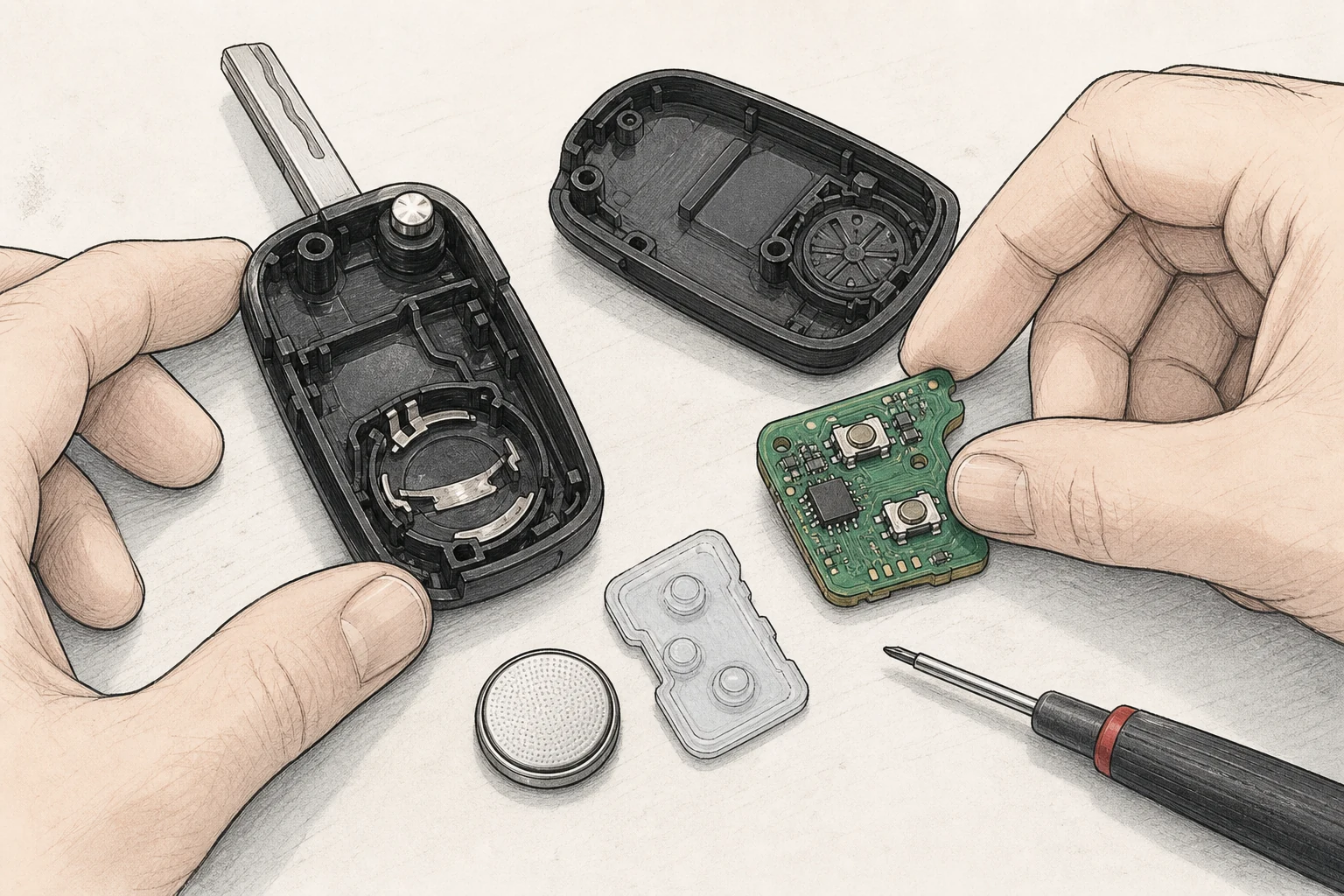
- Compare the original key’s outer shape and buttons.
- Check the blade profile and attachment point.
- Inspect the board, battery and transponder position.
- Confirm that the replacement housing supports every reusable component.
Decide Whether a Shell Transfer Is the Right Repair Path
Use a staged decision before ordering a Mini Cooper replacement key housing. First, confirm that the replacement is intended for the same key version as the original. Then compare the blade attachment, internal supports, circuit-board seating and battery arrangement using the checks above. Do not place an order while one of these points remains uncertain: a shell that matches the button count may still prevent the blade from folding or leave the electronics loose.
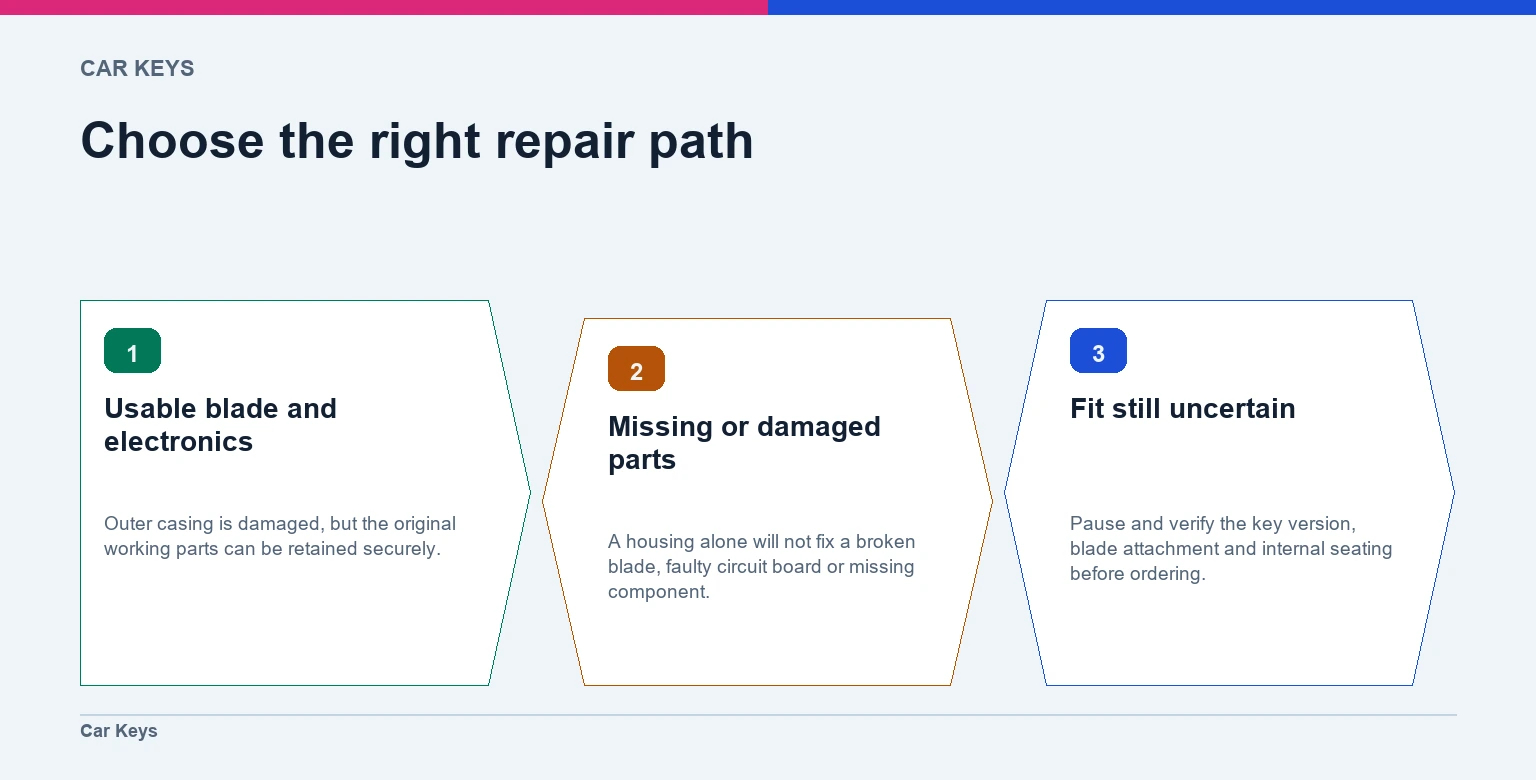
Next, assess the condition of the parts you plan to transfer. A housing-only repair is sensible when the original blade and electronics are usable, while the outer casing is cracked, worn, or no longer holds together properly. The new shell must close fully and stay closed during normal handling. Buttons, the blade and any internal components must remain correctly positioned after both halves are fitted. If the case needs pressure, adhesive or improvised packing to retain its contents, the transfer is not a reliable repair.
A shell will not solve every key problem. Stop and reassess if the blade is damaged or unsuitable, the circuit board has a fault, the battery contacts are damaged, or a required internal component is missing. The same applies when the original housing has broken in a way that has damaged the parts inside it. In these situations, buying a replacement car key shell may leave the main fault unchanged. The appropriate route may instead involve a blade solution, electronics work, or a complete replacement key; those are different requirements from changing the casing.
| What you still have | Most suitable direction | Why |
|---|---|---|
| Usable blade and working electronics, but damaged outer casing | Shell transfer | The existing parts may be reused if the new housing retains them securely. |
| Electronics usable, but the blade is bent, worn or incompatible | Blade replacement or cutting route | A new casing alone does not create a usable blade. Confirm what the supplier actually provides. |
| Damaged or unreliable circuit board, battery contacts or other internal parts | Electronics repair or replacement assessment | A new shell cannot correct an electrical or retention fault inside the key. |
| Missing essential parts or no dependable original key to transfer | Complete-key assessment | A housing transfer depends on having suitable original components available. |
Before buying a BMW MINI key shell or another R55 key housing, R56 key housing, R57 key housing or R60 key housing, read the specific listing rather than relying on the model label. Confirm what the product includes, which compatibility notes apply, and whether cutting, transfer or programming is offered at all. Also verify whether customers are expected to move the parts themselves or seek professional assistance. If the listing does not answer those questions, ask Car Keys before ordering; do not assume that a shell transfer, key cutting or programming service is included.
When a Complete Replacement Key Is a Different Solution
A Mini Cooper replacement key housing normally means the outer casing or shell only. It is intended to replace a cracked, worn or damaged body while the owner keeps the usable parts from the original key. A Mini Cooper key shell may therefore be supplied without the blade, circuit board, battery, transponder component or any other working internals. Check the listing carefully rather than treating a photograph as a complete-key specification.
A complete replacement key is a different product. It may involve a new housing, a blade, electronic components and, depending on the key variant and vehicle, programming or pairing. Those parts create separate questions: whether the supplied blade is the correct type, whether the electronics are suitable, and whether the key must be cut or programmed before it can operate the vehicle. A three-button layout alone does not answer any of them.
The condition of the original key determines which route remains practical. If the original blade and electronics are present and usable, a housing-only transfer may address damage to the casing. If the blade is missing, broken beyond reuse or permanently attached in a way the new shell cannot accept, a replacement car key shell will not solve the problem. The same applies when the electronic assembly is missing or damaged rather than merely loose inside a worn case.
Use the product description to establish what is actually included. Terms such as “housing”, “shell” or “case” generally point to the casing, while “complete key” should still be checked for its exact contents and whether cutting or programming is included. This matters when comparing a BMW MINI key shell with a complete key offered for an R55, R56, R57 or R60 variant.
Before ordering, ask for confirmation based on the original key and vehicle variant, not only the model name. Confirm whether the available product includes the parts you lack and whether blade cutting or programming is available for that specific version. If those details cannot be verified, do not assume a complete key and a housing are interchangeable.
For Mini Cooper R55–R60 keys, the practical takeaway is simple: do not choose a replacement housing from the model label and three-button layout alone. Compare the original key’s blade, electronics, battery arrangement and internal supports with the housing details before ordering. If any of these differ, the shell may not transfer correctly, even when the key looks similar. Car Keys provides information for customers considering car key shells, replacement keys and related options, but compatibility still needs to be verified against the specific original key rather than assumed from the vehicle series.
- Housing: outer casing transfer, if the original parts remain usable.
- Blade solution: needed when the blade is missing, damaged or incompatible.
- Complete key: a separate solution when electronics or programming requirements exceed a casing transfer.
Choose the option that matches your vehicle and situation.
Frequently asked questions
Can three buttons confirm that a Mini Cooper R55–R60 key housing will fit?
No. Button count is only one identification clue. The replacement housing must also match the shell’s shape, blade profile, folding or attachment method, circuit-board supports, battery area and transponder location. Two keys with the same number of buttons may still use different internal layouts, so the original key remains the main reference.
Can I move my original Mini Cooper blade into a replacement housing?
Only if both the blade profile and the attachment method match. Some housings may accept a transferable original blade, while others require a supplied blade or use a different hinge arrangement. Check the specific product description and compare the blade base, pin or pivot area before treating the job as a simple casing swap.
Does a replacement housing include the circuit board and transponder?
Not necessarily. A housing-only product normally refers to the physical casing and its related parts, but the exact contents must be verified for that listing. Do not assume that the circuit board, transponder, battery or blade is included. If your original electronics are reusable, confirm that the new shell is designed to hold them.
What should I do if the original key circuit board is damaged?
A new casing will not normally correct a fault on the circuit board. First separate cosmetic or structural damage from an electronic problem, because transferring damaged electronics may leave the key unusable. If the board is faulty, a different repair or replacement-key route may be needed rather than a housing-only purchase.
Can a replacement shell use the original battery?
It may, but compatibility depends on more than battery size. Check the battery position, contact arrangement, clearance and retention inside the replacement housing. The original battery must sit securely and make reliable contact without stressing the circuit board. Confirm these details for the exact housing instead of assuming that a similar-looking shell will work.
What happens if the original blade is missing?
A missing blade changes the job from transferring parts into a new casing. You may need a housing supplied with a compatible blade, or a suitable blade that can be cut for the lock. The blade profile and attachment still need to match the housing, and a casing alone will not replace the missing mechanical key.
Is changing a key housing the same as programming a replacement key?
No. Changing a housing is a physical transfer of compatible parts, such as the original circuit board, battery and possibly blade. Creating or programming a complete replacement key is a separate matter involving replacement components and any required vehicle-related procedures. A housing purchase should not be treated as a complete programmed-key service.
What photos or details should I provide before ordering a Mini Cooper key housing?
Provide clear photos of the complete original key, each button side, the blade and its attachment area, plus the opened housing and internal components if possible. Also note the vehicle generation, button count and whether the blade or electronics are damaged. Photos help with identification, but they cannot replace product-specific compatibility confirmation.
