
Compare the housing, buttons, blade and reusable electronics before ordering a casing-only replacement.
- A replacement shell changes the outer housing, while the original circuit board, battery, transponder and usable blade may need to be transferred.
- Button count narrows the options, but button positions, symbols, spacing and housing shape provide stronger physical compatibility clues.
- The replacement casing must provide suitable space and supports for every original component without bending, squeezing or leaving parts unsecured.
- Blade compatibility is a separate check involving the blade profile, folding or fixed arrangement, pivot and how the blade attaches.
- A shell-only repair makes sense when the existing internals remain usable and the replacement listing provides matching fit evidence.
- If the electronics or blade are missing, damaged or incompatible, a complete replacement-key route may be more suitable than a casing transfer.
A worn Honda key does not automatically mean that you need a complete replacement key. In many cases, a Honda replacement key shell is intended to reuse parts from the original: the outer housing, rubber buttons, key blade and internal remote electronics. The important distinction is that a shell can solve a damaged casing without replacing or programming the components that make the key work, but only if those components can be transferred safely.
Start with the original key rather than relying on a vehicle model name alone. Small differences in housing shape, button layout, blade mounting and internal supports can prevent a seemingly similar casing from being suitable. The old key also shows which parts you actually need to preserve and whether damage has affected more than the outside.
This checklist explains how to compare the replacement housing with your existing key, what to inspect before removing any components, and which compatibility questions cannot be answered from appearance alone. It also clarifies when a casing-only purchase is reasonable and when the condition or design of the original key points towards a different replacement route. If you are comparing options listed on car-keys.lt, use the original key’s details and photographs as your main reference before ordering.
Decide Whether a Shell Transfer Is the Right Repair
Start by identifying what has actually failed. A Honda replacement key shell is intended to replace the outer housing, not automatically the remote electronics, battery contacts, transponder components or blade. If the original casing is cracked, worn, or no longer holds its buttons securely while the key still works, a shell transfer may be the relevant repair path. If the remote has stopped responding, the circuit board is damaged, or important internal parts are missing, a casing-only purchase may not solve the problem.
Test the original key before ordering whenever possible. Confirm that it still performs its normal functions and that the buttons respond consistently. Then inspect the circuit board for visible breaks, heavy contamination, corrosion or signs of liquid damage. The battery area deserves separate attention: damaged contacts, a loose holder or leakage can make the original electronics unsuitable for transfer even when the outside of the Honda key fob shell looks repairable.
Also establish whether the usable Honda key blade is still present and physically serviceable. A damaged or missing blade changes the purchase decision because a new housing may not include the correct blade, and a remote casing replacement does not by itself create a replacement for the mechanical key. Leave detailed blade-profile and attachment checks for the later blade assessment, but do not place an order while assuming that the blade problem will be resolved by changing the housing.
A complete replacement key may be the more appropriate route when the original electronics cannot be reused, the blade is missing, or more than the outer casing is damaged. That does not mean a complete key is automatically compatible or ready to use. Any alternative listed by the business still needs separate confirmation of its included components, compatibility and any required preparation.
Do not use the vehicle model alone as proof of Honda key shell compatibility. The same model name can be associated with different key designs, button arrangements or internal layouts. Before choosing a Honda key housing, confirm that the intended shell is designed to accept the specific original parts you still have: the electronics, battery-related components, buttons and blade arrangement. If that information is not clear in the listing, treat the transfer as unconfirmed and ask for manual confirmation rather than relying on a generic model reference.
The initial decision is therefore simple: choose a shell-only path only when the original key’s essential components are present, reusable and confirmed as accepted by the intended housing. Otherwise, investigate a complete-key alternative instead.
- A shell transfer may suit a usable original key with damaged outer housing
- A complete-key route may need consideration when electronics or the blade are missing or unusable
- Neither route should be selected from the Honda model name alone
- Compatibility claims require confirmation against the exact original key
Use the Original Honda Key as the Compatibility Reference
The safest starting point is the remote you already own, not the vehicle model name. Place the original key beside the product photos for the Honda replacement key shell and compare the visible features one by one. A listing may describe several Honda applications, but that does not prove that every key revision uses the same Honda key fob shell.
Compare the visible layout
Count the buttons and check their positions. A three-button remote is not automatically interchangeable with another three-button version if the buttons are arranged differently or have different spacing. Compare the symbols as well: lock, unlock, trunk, panic and other markings should appear in the same order, orientation and relative size.
Then compare the overall housing shape. Look at the length-to-width ratio, rounded or squared corners, raised areas around the buttons and the thickness visible along the edge. A Honda remote casing replacement can look similar in a small listing image while having a different contour or button spacing. Enlarge the photographs where possible, but treat image similarity as an initial comparison rather than confirmation.
Check whether both keys use the same configuration: folding or fixed. For a folding design, compare the position and shape of the hinge area and the way the two housing halves meet when closed. For a fixed-key design, compare the straight housing outline and the visible end section. Do not assume that a fixed Honda key housing can substitute for a folding version merely because the button layout appears close.
Visible seams and attachment points provide further clues. Compare the seam line around the casing, screw or clip locations that can be seen from the outside, button openings and any recesses for a badge or decorative insert. Differences in these areas often indicate another housing revision, even when the remote has the same number of buttons.
Treat listing details as evidence to confirm
Use the product listing’s stated Honda application, photographs and dimensions together. The dimensions should be compared with the original housing in the same orientation, since measuring a folded remote against an opened one can produce a misleading result. Product photos should also be checked for the exact version shown in the description; a generic image may not represent every variant offered under one listing.
Before ordering, confirm the shell’s stated application and physical dimensions with the seller or product information, and ask whether the pictured version matches your original key revision. Record the button count, layout, housing style and visible seam pattern rather than relying on a model-year match alone. If any of those details conflict, pause the order until Honda key shell compatibility is confirmed. This visual check does not replace the separate internal, blade and transfer checks covered later.
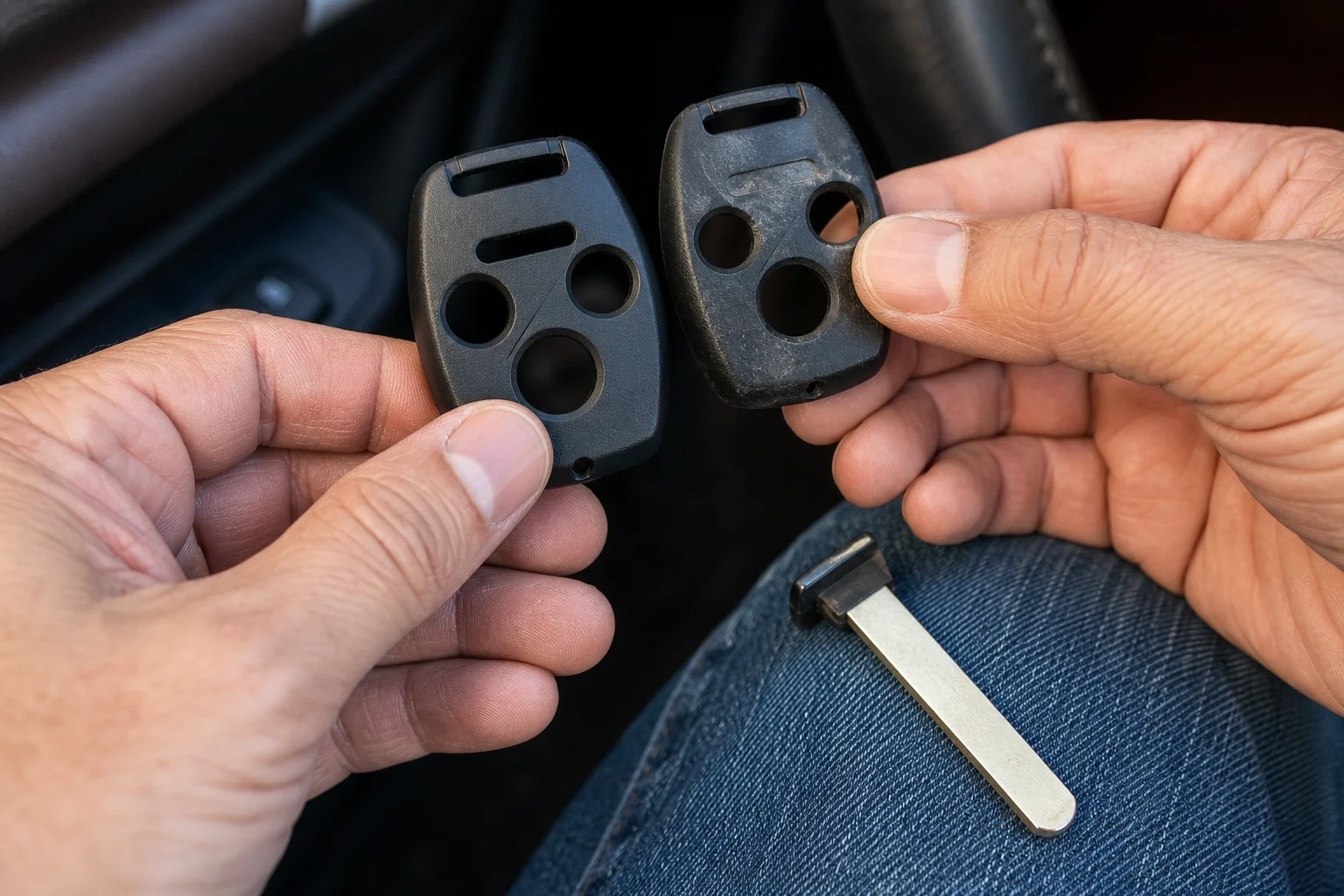
Check Whether Every Original Internal Part Can Transfer
Open the original remote carefully and identify every part that must move into the new housing: the circuit board, battery, battery contacts or holder, rubber button pad, and any separate transponder component. Photograph the arrangement before removing anything. Note which side of the board faces the buttons, how the battery is oriented, and whether any small piece sits in a dedicated recess. These details are part of the fit, not just assembly preferences.
Check the housing’s internal structure
Compare the inside of the Honda replacement key shell with the original casing, not only its outside shape. The replacement should provide the right supports for the circuit board, such as ledges, locating posts, channels, clips, or other retaining features. These structures keep the board aligned with the buttons and stop it from moving when the casing is closed.
A board can appear to fit while still being unsuitable. For example, the replacement may have enough room for the board but lack a guide that holds one edge in position. It may also use a different battery holder, contact arrangement, or internal separator. Before ordering, manually confirm from clear product photographs, dimensions, or the seller’s answer that the intended board and battery arrangement is supported. Do not treat a general “Honda key fob shell” description as proof that the internal moulding matches your key revision.
Check clearance around the circuit board and battery on all sides. The battery should sit fully in its holder without pressing against the board, cover, or buttons. The board should not touch the casing where closing pressure could damage components or interrupt contacts. Pay particular attention to the cover seam: if it closes only when pressed firmly, or leaves a gap after the transfer, something may be misaligned or too large.
Do not bend the board, battery contacts, or retaining clips to make an apparently close fit work. Avoid adding pressure from tape, foam, or improvised packing unless the design specifically calls for a retaining insert. A loose board can shift away from the buttons; a compressed board can suffer damaged solder joints or unreliable battery contact. The Honda remote casing replacement should hold the original electronics securely when the housing is closed, without forcing either half together.
Confirm the transponder separately
The immobiliser transponder requires its own compatibility check. Depending on the key design, it may be integrated with the electronics or located separately in a dedicated cavity. Its position and retention method must match the replacement Honda key housing. Confirm manually whether the shell includes the necessary recess or holder and whether the original transponder can be placed there in the required orientation. A circuit-board fit alone does not confirm transponder compatibility, so leave this point unresolved until the listing or seller provides clear evidence.
Verify the Blade Separately From the Remote Housing
A matching remote housing does not prove that the Honda key blade will transfer. Compare the original blade with the replacement listing separately, including its overall profile, width, shoulder shape and visible cut pattern where the photographs allow a meaningful comparison. The cut pattern alone is not enough if the blade’s base or profile differs. If the listing does not show the blade clearly, ask the seller to confirm compatibility against the original key rather than relying on the vehicle model name.
Identify whether your key uses a folding blade or a fixed blade. A folding design needs more than an opening in the Honda key shell: the blade must sit at the correct angle, fold into the housing and lock in the open position. A fixed-blade housing may use a different mounting arrangement and cannot automatically accept folding hardware. Treat these as different configurations even when the button layout appears identical.
Inspect the blade’s pivot area before ordering. Compare the location and size of the pivot hole, pin or screw, and check whether the original design uses a spring, retaining clip or another visible part. The replacement Honda key housing must provide compatible support for these parts; otherwise the blade may wobble, fail to remain open or place stress on the casing. Do not force a pin or enlarge an opening to make an uncertain match fit.
Also establish exactly what the product includes. Some listings provide only the remote key casing, while others may include a blank blade, a transferable blade or separate attachment hardware. A blank blade is not a usable replacement until it has been cut to match the original key, and some designs may require additional assembly or pinning. Confirm whether your original blade is intended to move across, whether a new blade is supplied, and whether cutting or fitting is your responsibility.
Before buying, request manual confirmation of three points: the blade profile matches your original, the folding or fixed mechanism uses compatible pivot and retaining hardware, and every required blade component is included or transferable. If any answer remains unclear, treat the shell as unverified. A visually matching Honda replacement key shell can still leave you with a housing that accepts the electronics but cannot securely hold a usable blade.
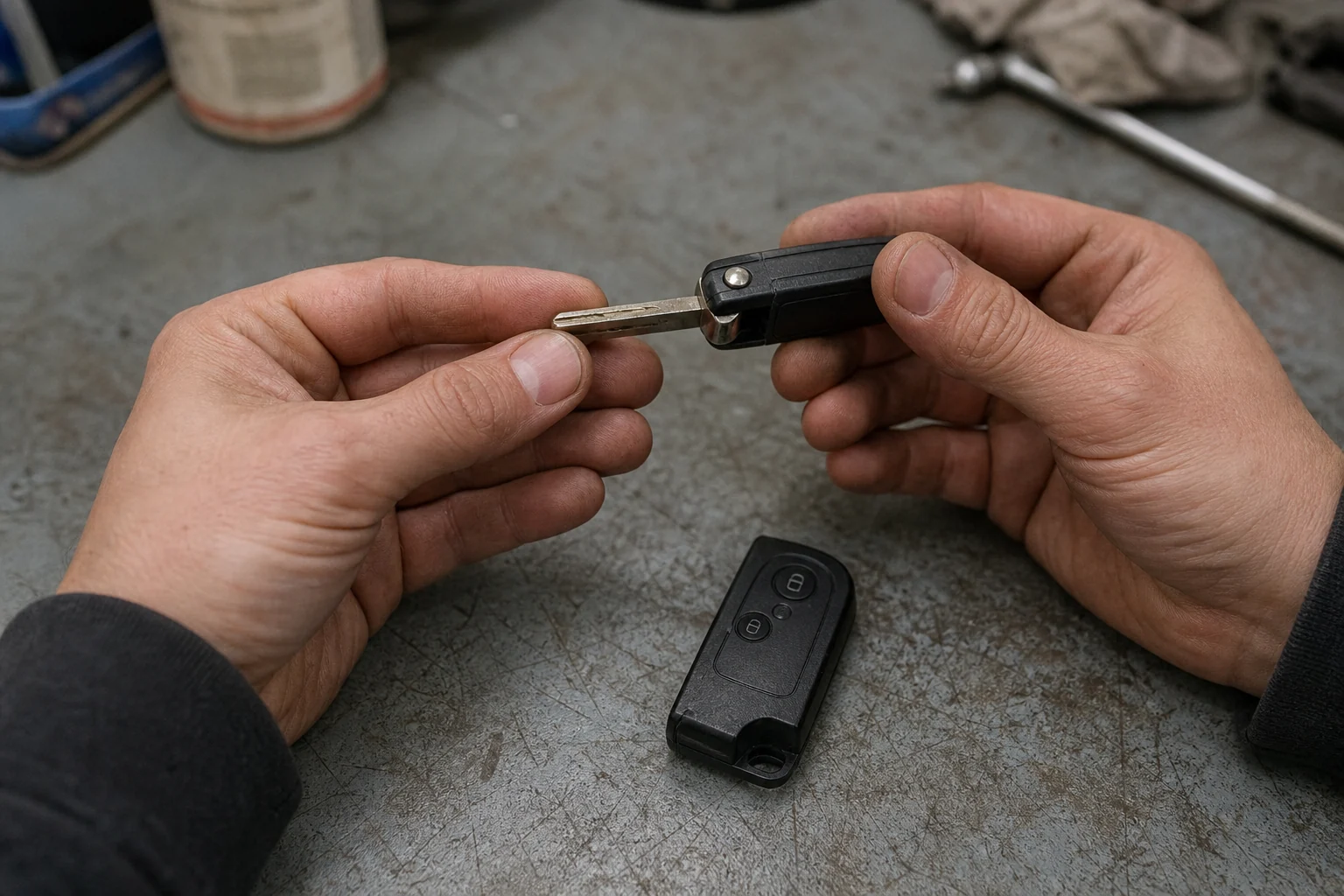
Complete the Transfer Checklist Before Ordering
Before ordering a Honda replacement key shell, make a short record of the original key. Photograph both sides, the open housing, the circuit board position, the battery arrangement, the rubber button pad and any separate small components. Note whether the key folds or remains fixed, and keep the original blade beside the remote for comparison. These records give you evidence to use if the listing photographs are incomplete or the casing changes during handling.
Review the product listing against that record rather than relying on the vehicle model alone. Check every visible and internal reference point that the previous checks identified:
- button positions, symbols and spacing;
- housing shape, seams, clips and screw locations;
- folding or fixed-key construction;
- circuit-board supports, guides and retaining points;
- battery space, contacts and cover arrangement;
- the blade opening, pivot area and retaining hardware;
- the position and clearance of any separate transponder component.
A close-looking Honda key fob shell can still be unsuitable if one locating post, battery contact or internal support is different. Do not treat listing dimensions or photographs as final proof when an important feature cannot be seen. Compare the original part with several product images, and mark each feature as matched, different or unconfirmed.
Next, read the contents description carefully. Confirm whether the order includes only the Honda key housing, or also a button pad, battery cover, blade, screws, hinge parts or other hardware. Check whether your original electronics and usable blade are expected to transfer. Do not assume that a pictured blade or complete-looking remote key casing is included unless the written contents confirm it.
Resolve service-related details before paying. Ask the seller to confirm the exact shell revision and compatibility evidence for your original key, based on photographs or identifying details rather than only the car model. Also ask whether installation, key-blade cutting, programming or any other work is included or excluded. A shell may accept the original parts while still requiring separate work before the key can be used.
Pause the order if the seller cannot clarify a critical difference, the internal fit is not shown, the contents are ambiguous, or the blade and electronics transfer remain unconfirmed. The sensible go/no-go decision is not “the shape looks close”; it is “every essential transfer point is matched or explicitly confirmed.”
Use the product page to make that final comparison, and reserve the single enquiry for one unresolved fit or contents question. That gives the seller a clear basis for answering before you commit to a Honda remote casing replacement.
The safest Honda key-shell transfer starts with one rule: match the replacement housing to your existing key before moving any parts. Compare the shell shape, button layout, blade arrangement and space for the original electronics, then check that the circuit board, transponder and battery can remain undamaged and correctly positioned. A shell that looks similar may still be unsuitable if these details differ. If the fit, internal support or blade arrangement is uncertain, do not force the transfer; confirm compatibility first so the original key remains usable and secure.
- Photograph the original key from multiple angles
- Record button count, symbols and positions
- Note folding or fixed-blade construction
- Compare internal supports and component space
- Confirm what the listing includes
Choose the option that matches your vehicle and situation.
Frequently asked questions
Can I reuse the original Honda key electronics in a replacement shell?
Possibly, but the Honda badge or vehicle model does not confirm compatibility. The replacement housing must support the original circuit board, battery arrangement, transponder, buttons and retaining points. If any part is damaged, unusually shaped or unsupported by the new shell, a complete replacement key may be more suitable than a casing-only transfer.
Does the same Honda model always use the same key shell?
No. The exact shell can vary by model year, trim level, remote revision or key design. Compare the original key’s button arrangement, housing shape, blade style and internal layout instead of relying only on the vehicle name. A listing that names your Honda model is a useful lead, not proof of fit.
Is matching the number of buttons enough to choose a shell?
No. Button count is only an initial clue. Check the position, symbols, spacing and shape of the buttons, along with the housing’s outline and openings. Two remotes may have the same number of buttons but use different internal supports or a different case design that prevents the original parts from seating correctly.
Will a replacement Honda shell include a new blade?
Not necessarily. A listing may include the housing only, a blank blade, a cut blade, transfer hardware or no blade at all. Read the included-parts description carefully and confirm how the blade is attached. If the product information is unclear, ask the seller before ordering rather than assuming the pictured blade is included.
Can a fixed-blade key use a folding-key replacement shell?
Only if the construction has been specifically confirmed. Fixed-blade and folding-key designs use different blade arrangements, attachment points and moving parts. A shell with the right button layout may still be unsuitable if the original blade cannot be secured or the folding mechanism does not match the internal housing.
What if the original circuit board is damaged but the casing is worn?
A shell transfer may not solve the problem because the damaged board can still prevent the key from operating. First separate the casing issue from the electronics issue. Depending on the damage, you may need to evaluate board repair, a replacement electronic assembly or a complete replacement key rather than ordering a shell alone.
Should I remove the electronics before ordering a replacement shell?
Usually, document and compare the original key first. Photograph both sides, note the button and blade arrangement, and inspect the visible seams without forcing them open. Unnecessary disassembly can damage clips, buttons or delicate components, and small parts can be misplaced before you have confirmed that the proposed shell is suitable.
What information should I send when asking whether a Honda shell fits?
Provide clear photographs of the original key from both sides, the button layout, the blade arrangement and, if safely accessible, the internal components. Include the vehicle model and year as supporting information, not as the sole identification. For an additional fit assessment, car-keys.lt may be a useful next step, but photographs alone cannot guarantee compatibility.
