
- A key shell replaces the outer housing, while the original circuit board, battery, transponder and blade may need to be retained.
- Button count narrows the options, but button symbols, spacing, housing shape and folding arrangement provide stronger comparison evidence.
- The shell must have suitable internal space and supports for the original electronics without forcing or damaging the components.
- Blade compatibility is a separate check because a matching casing may have a different blade format, pivot or supplied contents.
- A shell is most relevant when the existing electronics and blade remain usable but the outer housing is damaged or worn.
- Vehicle model and Seat branding alone cannot prove fit, so the original remote and the specific listing details must be compared together.
A Seat remote key shell will fit your key only if its physical design matches the original remote—not simply because the listing shows a Seat badge or the same number of buttons. The replacement must have the right outer shape, button layout, internal cavity and mounting points for your existing electronics. Its blade arrangement is a separate question: a shell may accept the circuit board but still require a different blade, an interchangeable blade fitting or a blade that cannot be reused.
Readers in Lithuania often compare English-language listings on car-keys.lt and other sites without being able to inspect the replacement in person, so the original remote is the most useful compatibility reference. Before ordering, compare it with the listing photos and description from several angles, paying attention to details that are easy to overlook, such as the blade’s position, the keyring opening, screw or clip locations and the shape of the button pad.
This guide explains how to separate shell compatibility from electronics transfer and blade suitability. It also covers which details can confirm a likely match, which similarities are misleading, and when a listing does not provide enough information to order safely. If the original remote is available, its markings and internal parts are more reliable evidence than the vehicle badge alone.
What a Seat Key Shell Replaces — and What It Does Not
A Seat remote key shell is the outer housing of the key, not normally a complete working replacement key. It protects and holds the remote’s internal parts, while the vehicle-related functions remain with the original components. A shell may include exterior button pads, a logo insert, or other small housing parts, but this depends on the listing.
The parts commonly transferred from the original key are the electronic circuit board, battery and, where fitted separately, the immobiliser transponder. The original mechanical blade may also need to be retained or moved, although some products supply a blank or replacement blade instead. Do not assume that any of these parts are included: confirm exactly what the listing supplies before ordering a Seat replacement key shell.
A shell is relevant when the remote still contains usable working parts but the housing is cracked, badly worn, missing buttons or no longer holds those parts securely. For example, if the buttons have become difficult to press because the casing is damaged, replacing the housing may solve the physical problem. It will not, by itself, repair a failed circuit board, dead remote electronics or a lost programming function.
Start by separating visible housing damage from a broader key fault. If the remote stopped working at the same time as the casing broke, the damage may have affected an internal component, but that cannot be established from the shell’s appearance alone. If the electronics are already faulty or the key has been lost, a casing is unlikely to be the complete solution.
The product description must also be read as a supply list, not as proof of Seat key shell compatibility. A listing for a Seat key fob shell may show the brand and the same number of buttons as your remote while supplying a different housing or no blade at all. Conversely, a two-button Seat key shell or three-button Seat key shell may still require you to transfer the correct original parts.
This distinction matters when comparing online listings in Lithuania, where you may need to decide from photographs and written details without inspecting the replacement in person. The Seat badge, button count or phrase “remote key casing” is only an initial clue. The listing must identify the shell type and supplied components, while compatibility with your existing key remains a separate question.
Compare the Original Remote With the Listing Before Ordering
Start with the original remote, not the Seat badge in the product title. Count the buttons, but use that only as an initial filter. A two-button Seat key shell may look promising for a two-button remote, yet the buttons can sit in different positions or use a different housing shape. The same applies to a three-button Seat key shell: matching the number of buttons does not confirm that the casing is the same version.
Compare the button symbols, spacing and orientation. Check whether the lock, unlock and other symbols are arranged in the same order as on the original. Note whether the buttons are in a straight row, offset vertically, separated by a central gap or surrounded by a raised frame. Also compare their size and shape. A listing showing only the correct button count, without clear symbols or spacing, provides too little evidence for a reliable comparison.
Next, compare the housing outline. Look at the taper toward the key end, the width of the shoulders, the rounded corners and any changes in thickness along the sides. Examine the seam around the original remote and compare its position with the Seat replacement key shell in the listing. A different seam, screw position or end profile can indicate another casing design, even when the front appears similar.
The folding arrangement must also match. Confirm whether the original is a folding remote or a non-folding design, and check where the pivot or fixed key section sits. A Seat folding key shell is not a visual match for a fixed housing simply because both have the same number of buttons. Compare the remote in its closed and open positions where possible, including the direction in which the folding section moves.
Do not rely on a single product image. Request or locate clear front, rear and side photographs, and, if available, a photograph of the open shell. The rear view can reveal a different cover profile; side views show thickness and the position of the seam. An open-shell image may show a different exterior layout around the component area, although the internal cavity needs its own check before any transfer is considered.
Check the seller’s stated dimensions against the original with a ruler or caliper. Record the length, widest point and thickness, then ask which points the listing measurements refer to. Also check the stated key type, folding status and any vehicle-generation or part-number reference. Treat those references as clues rather than proof: manually compare the reference with the original remote and, where necessary, ask the seller to confirm the exact version.
This process is especially useful in Lithuania, where an online listing may be the only practical option and you may not be able to inspect a Seat remote key casing in person before ordering. Save the listing photographs, dimensions and description, then compare them systematically with your remote. If essential views or details are missing, the uncertainty remains—regardless of the product title or button count.
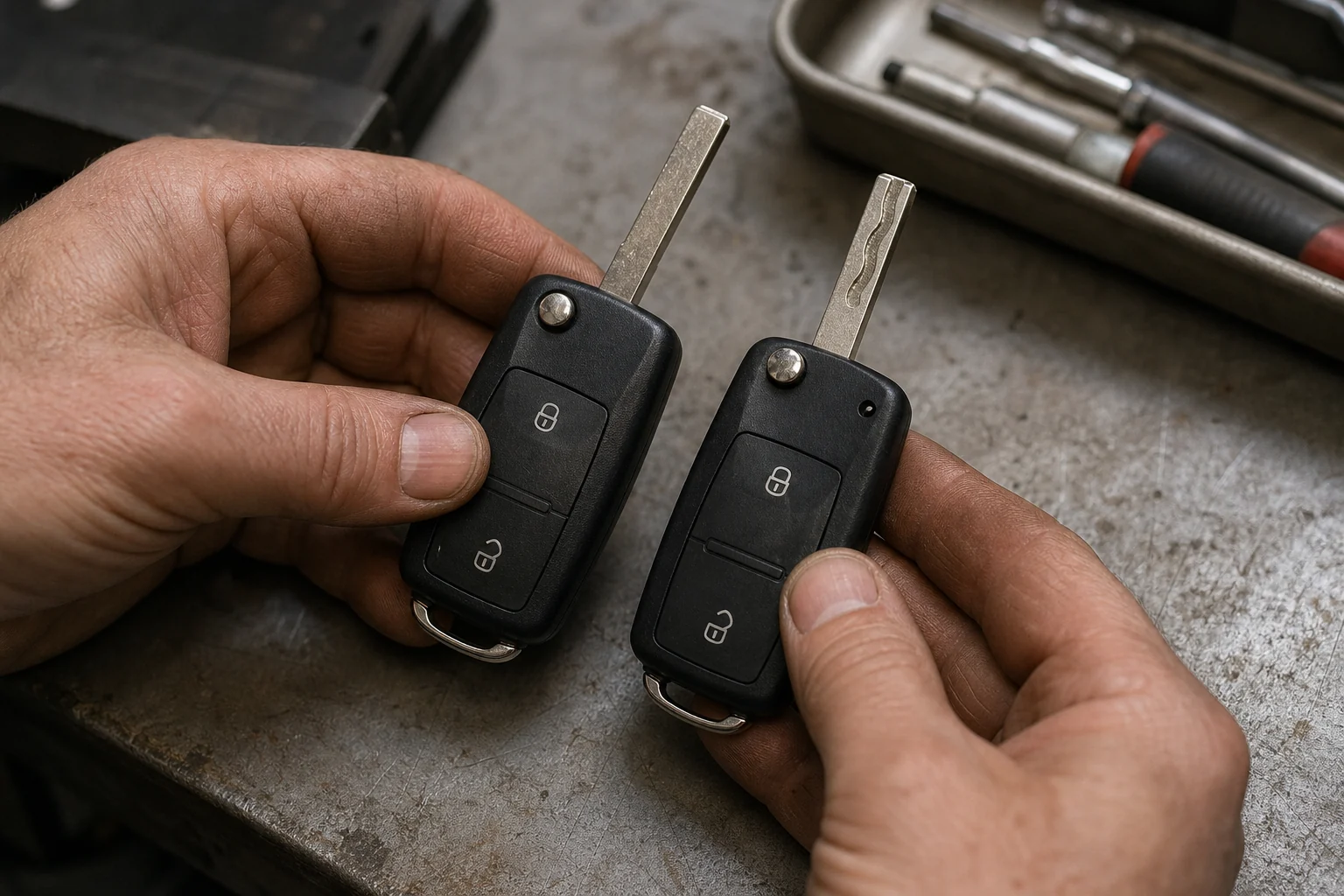
- Compare the original remote with the complete listing, not just the Seat badge.
- Match button symbols, spacing, housing shape and folding arrangement.
- Check internal supports and component clearance.
- Confirm whether a blade is included and which format it uses.
- Resolve uncertain dimensions or part references before ordering.
Check the Internal Cavity Before Moving the Electronics
A Seat remote key shell can match the original from the outside and still fail internally. The decisive question is whether the original circuit board, battery and transponder can be placed in the new housing without pressure, movement or obstruction. Product photos showing only the closed casing cannot answer that. Look for open-shell images, internal measurements, moulded supports and a description of the parts the shell is designed to accept.
Check the circuit board and battery arrangement
Compare the circuit-board footprint, not just the remote’s button count. The board must sit in the correct orientation, with its buttons aligned beneath the shell’s button pads and its edges supported by the internal guides. A board that is slightly longer, wider or shaped differently may prevent the casing from closing, even if the visible buttons appear to line up.
The battery compartment is another common failure point. Check the battery type and position in the original remote, then compare the replacement’s holder, contacts and access opening. A shell may have space for the battery but place it on the opposite side, use a different retaining arrangement or press against the board when closed. The battery should remain secure and accessible without forcing the two halves of the casing apart.
Do not assume that every remote has the same transponder arrangement. The immobiliser transponder may be separate from the circuit board or integrated into it, depending on the original key design. Confirm which arrangement your key uses and whether the shell has a dedicated recess or retainer for that part. If the listing does not show this area clearly, treat the Seat key shell compatibility as unconfirmed rather than assuming the component will fit.
Inspect supports, clips and clearances
Internal posts, clips and rails keep the electronics in position. They also determine whether the shell can close fully. Compare their location with the original housing and check for clearance around the board, battery, button contacts and any separate transponder. Small differences can cause a button to remain pressed, interrupt electrical contact or leave the board loose inside the casing.
The shell should close through its intended clips or screws with only normal hand pressure. Do not trim posts, bend contacts or force the halves together to make an apparently similar Seat replacement key shell work. Pressure can crack the circuit board, damage switches or create intermittent faults that are difficult to diagnose later. Loose components are also a warning sign: movement inside the casing can wear contacts and allow the buttons to shift out of alignment.
For online listings in Lithuania, where you may not be able to inspect the replacement in person, request clear photographs of the opened casing and compare them with your original housing. Ask the seller to confirm the exact internal component fit, but treat any unverified claim as provisional. A Seat remote key casing is suitable only when the internal layout—not merely the brand, shape or button count—accepts your existing parts securely.
Treat Blade Compatibility as a Separate Check
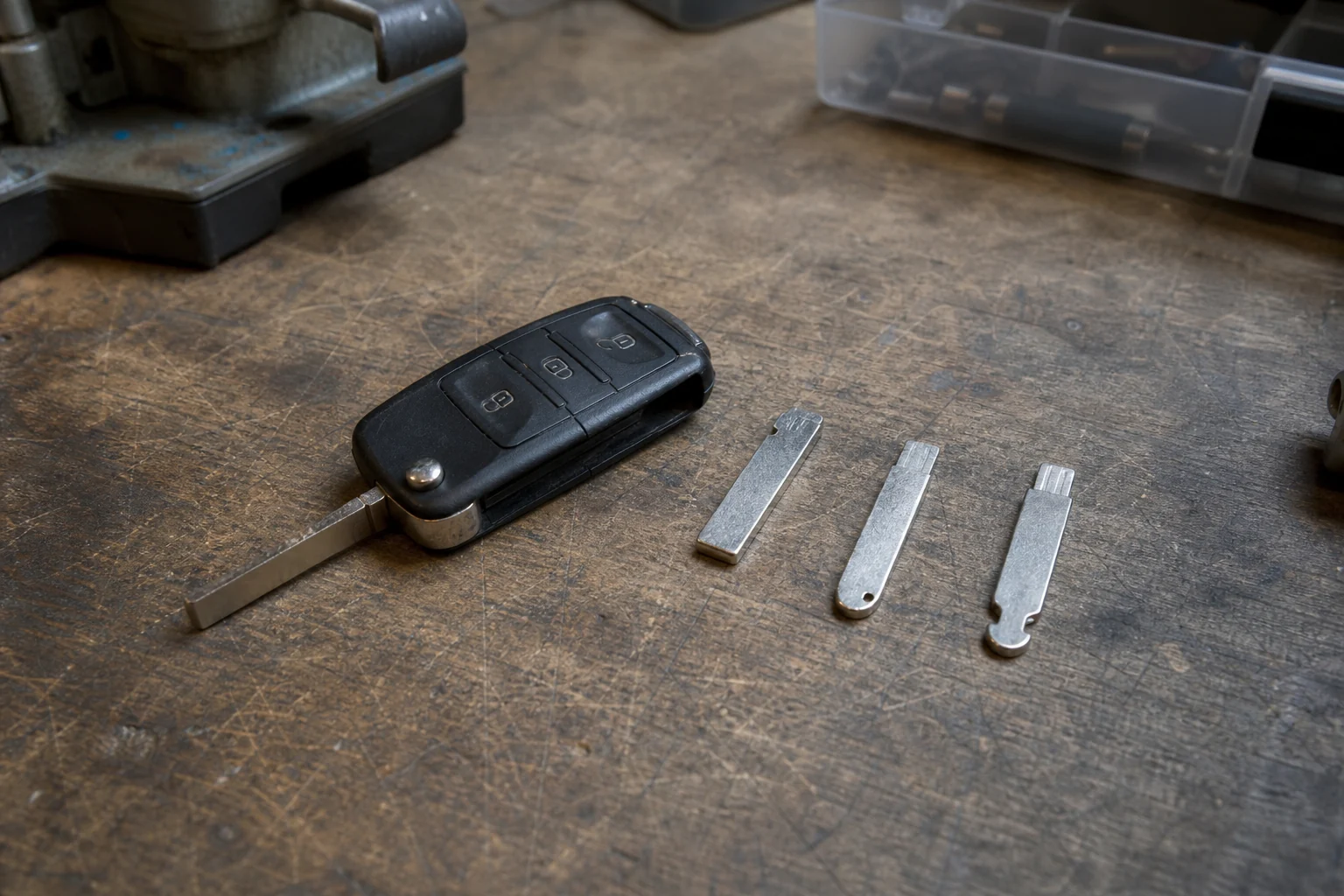
A matching remote casing does not automatically give you a usable mechanical key. The blade has its own compatibility requirements: its profile must match the lock, and its mounting method must match the housing. A listing may show a Seat folding key shell with the right number of buttons, but the blade area can still use a different insert, pivot arrangement or retaining system.
First identify how the original blade is fitted. Is it a fixed blade, a folding blade, or a removable blade insert? On a folding key, check the pivot position, the shape of the blade base and the hardware that holds it in place. Depending on the design, this may involve a pivot pin, screw, clip or another retaining piece. Do not assume that a visually similar Seat key fob shell uses the same hardware. Compare the open and side views of your original key with detailed photos of the replacement.
Also confirm what the listing actually includes. A Seat replacement key shell may be supplied as:
- the shell only;
- a shell with a blank, uncut blade;
- a shell with a blade insert;
- a shell intended for transferring the original blade and its retaining parts.
These descriptions are not interchangeable. An uncut blade still needs to be cut to the original key profile before it can operate the relevant lock. A blade insert may have to be removed from the old housing and fitted into the new one. If the product page does not clearly state whether a blade is included, treat that detail as unresolved rather than assuming the photographs show the full contents.
Before ordering, photograph the original blade from both sides and from the base where it enters the housing. Note whether it folds, which side the cut pattern is on, and whether the blade base has a hole, notch or other visible fixing feature. If the listing provides measurements, a blade profile, a pivot description or a part number, compare each item manually with the original. A part number that appears in a title is not, by itself, proof of key blade compatibility.
This check is especially important when comparing online listings in Lithuania, where you may be choosing from photographs without handling the replacement first. Ask for a clear image of the blade mount or the open shell if the listing does not show it. Avoid relying only on the Seat badge, button count or an identical-looking front cover.
Remote fit and blade fit can therefore produce different answers. A housing may accept the original remote casing components yet fail to hold the original blade securely. Conversely, a supplied blank blade may suit the mechanical arrangement but still require cutting, while the remote housing itself may not match. Consider the shell compatible only when the remote housing and the blade arrangement have both been checked separately.
When a Shell Is Enough — and When It Is Not
A Seat remote key shell is usually enough when the original remote still works and the damage is limited to the housing: cracked plastic, worn button areas, a broken case seam or a loose folding cover. In that situation, transferring the working parts into a compatible Seat replacement key shell may solve the physical problem without replacing the key’s electronic components.
A shell is unlikely to solve the problem if the remote no longer works because its circuit board is damaged, or if the original transponder is missing. The same applies when the key blade is unusable and cannot be transferred to the replacement casing. A replacement housing does not replace damaged electronics or automatically provide a compatible mechanical key.
Treat the decision as a short comparison:
| Your situation | More suitable direction |
|---|---|
| Housing is damaged, but the original remote works | Shell only |
| Circuit board or transponder is missing or damaged | A broader replacement option |
| Blade cannot be reused | Confirm the complete product contents and compatibility |
| Listing does not show the relevant internal or blade details | Ask questions before ordering |
Before paying, ask the seller to confirm that the Seat remote key casing accepts your original electronics, whether the advertised button layout and folding arrangement match your key, and exactly what parts are supplied. Also clarify whether the listed blade is included, transferable or supplied separately. Do not rely on the Seat badge or button count alone.
This matters when comparing Lithuanian online listings without seeing the item in person. If the seller cannot provide clear photos, measurements or a compatible part reference, the safer decision may be to postpone the order rather than assume that a similar-looking shell will work.
Treat the button count and SEAT badge as starting clues, not proof of compatibility. A replacement shell must match the key’s outer shape, blade fitting and internal cavity so your original electronics and other reusable parts can be transferred correctly. Before ordering, compare the listing with the complete old key, including its side profile, blade attachment and circuit-board layout where shown. This matters particularly in Lithuania, where an online listing may be the only thing you can inspect. If one detail is unclear or differs, treat the shell as unverified rather than relying on the brand name or button count.
- A shell is most relevant when the outer housing is damaged but the original working parts remain usable.
- A shell does not repair a damaged circuit board, missing transponder or unsuitable blade.
- A complete replacement route may be needed when several key components are unusable.
- Do not treat a matching casing as proof that the entire key will work.
Choose the option that matches your vehicle and situation.
Frequently asked questions
Can I reuse the original circuit board in a Seat key shell?
Often, but only if the replacement shell is designed for that board. Check the internal supports, locating posts, button mechanisms, battery space and clearance around the components. Two shells can look identical outside yet hold different electronics. Do not assume transferability from the Seat badge, colour or number of buttons alone.
Is the number of buttons enough to identify the correct shell?
No. Button count is only a useful first filter. Compare the symbols, button spacing, overall housing shape, key arrangement and the position of any indicator or opening. A three-button shell, for example, may still differ in its internal layout or button shape. Use the original remote as the main reference.
How can I compare a shell listing if its internal photos are missing?
Ask the seller for clear photos of the open shell, including the inner supports and button area. If that is not possible, request exact dimensions or confirmation against your key’s reference and internal layout. An exterior photograph alone cannot reliably show whether the original circuit board and battery compartment will fit.
Does a replacement shell normally include a blade?
The contents depend on the listing. “Shell only” usually refers to the housing and buttons, while an “uncut blade” includes a blade that still needs cutting. Some products supply a separate blade insert instead. Read the supplied-parts description carefully and confirm whether the blade shown in the photograph is actually included.
Can a shell fit the remote but not the blade?
Yes. Remote-housing compatibility and blade compatibility are separate checks. The shell may hold the electronics correctly while using a different blade type, mounting point or profile. Even a physically suitable uncut blade is not ready for use until it has been cut to match the vehicle’s mechanical key.
What if the original electronics are damaged as well as the housing?
A shell replaces the casing, not the circuit board, battery contacts or other damaged electronics. If the remote is also faulty, first establish which components still work and which replacement route is appropriate. A compatible shell alone will not restore functions that depend on damaged electronic parts.
Should I open my original remote before ordering?
Inspecting the original can reveal the board shape, battery position, supports and transponder location, which may prevent a wrong order. Open it carefully and use the correct method for the clips or screws. Do not force the housing, bend battery contacts or handle the circuit board and transponder unnecessarily.
What should a buyer in Lithuania check when ordering online?
Compare photos of your original key with the listing, including the rear, side, buttons, blade arrangement and internal cavity. Check measurements and supplied parts, then ask the seller to confirm the reference if anything differs. When the listing remains unclear, car-keys.lt can be a useful next step for discussing the correct replacement route.
