
Button count narrows the search, but the original housing and internal layout provide stronger compatibility evidence.
- A remote key shell replaces the outer housing and does not automatically replace the circuit board, transponder, battery or blade.
- The Lexus model name alone cannot prove compatibility because different key designs may exist across generations or vehicle versions.
- Matching button count is only an initial clue; symbols, spacing, button position and surrounding housing shape matter too.
- The replacement must provide suitable internal space and supports for the original circuit board, battery and other retained components.
- Blade compatibility is separate from casing fit, so compare the blade mount, folding arrangement and whether a blade is supplied or transferable.
- A shell is relevant only when the original internal components remain usable and can be transferred securely into the matching housing.
Choosing a Lexus remote key shell by vehicle model or button count alone is risky. Several remotes can look similar while using different housings, circuit-board layouts, or blade arrangements. The original remote in your hand is the most useful reference: compare its physical shape and mounting points first, then check whether the replacement shell is designed around the same internal components.
A suitable Lexus remote key shell should correspond to more than the number of buttons. Look at the button positions and symbols, the edge profile, screw or clip locations, battery access, transponder space, and the way the key blade folds or attaches. A listing written in English, including one found on car-keys.lt, may use a familiar Lexus model name without showing all the details needed to confirm compatibility.
This guide explains how to make that comparison before ordering. It separates the visible housing from the buttons, internal electronics, and blade, because a shell may match one of these elements but not the others. It also highlights which evidence is dependable, which listing details require caution, and what to do when your original remote or the seller’s photographs do not provide enough information for a confident match.
What a Lexus Remote Key Shell Actually Replaces
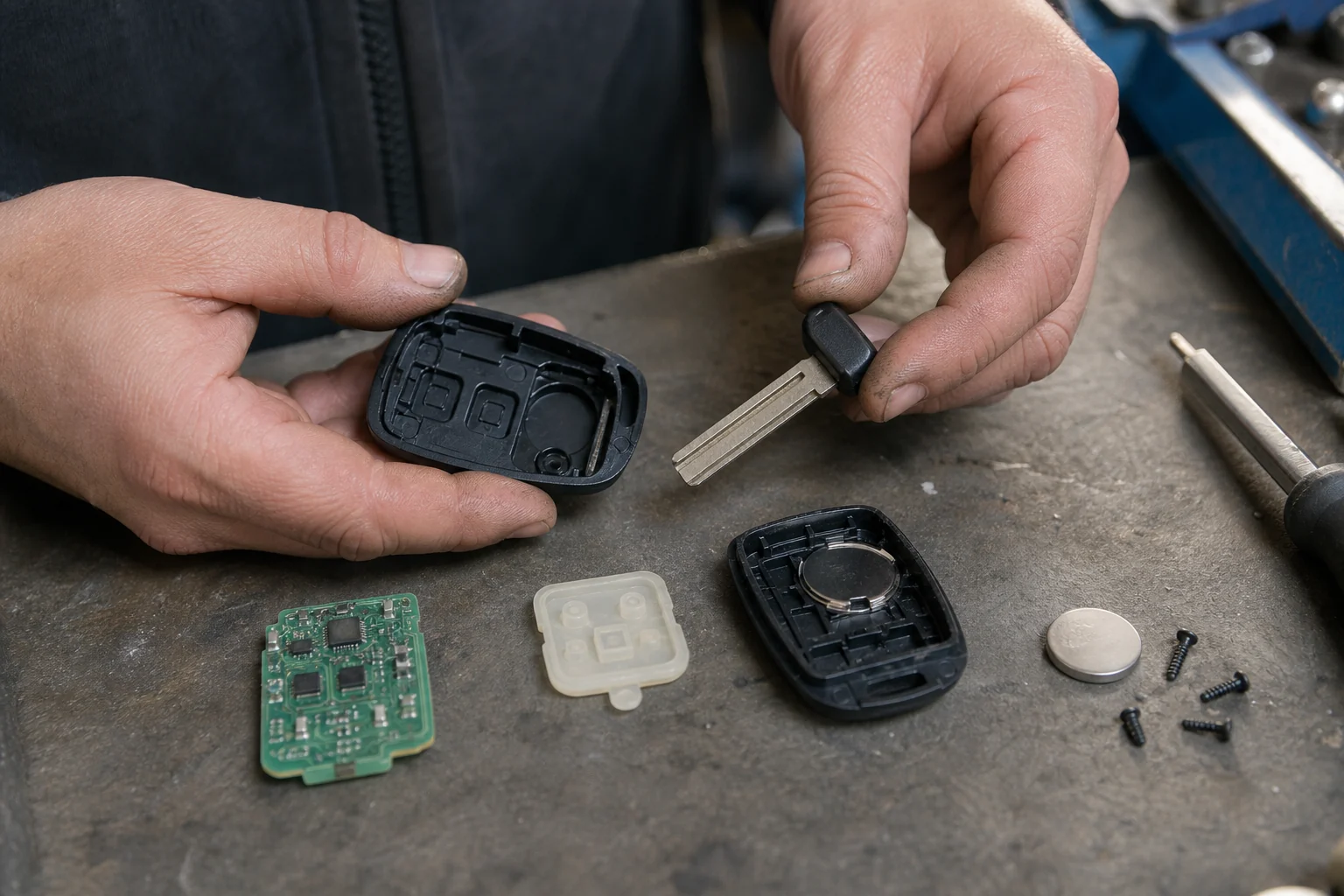
A Lexus remote key shell is the outer housing of the key, not the complete key assembly. It normally replaces damaged or worn plastic parts such as the front and rear case sections, button pad, clips and, in some designs, the visible emblem or trim. The exact contents vary by listing, so check whether you are buying a housing only or a package that also includes buttons, a blank blade or other parts.
The original circuit board, battery and transponder are usually separate components that must be moved into the replacement casing. Their position and form depend on the original remote. A transponder may be integrated with the electronics or supplied as a separate insert, so do not assume that every Lexus key fob shell uses the same arrangement. The product instructions should state which original parts are expected to be transferred.
This means a shell can only restore your key if the original internal components are still usable. Before ordering, confirm that the remote still has its circuit board, battery contacts and any transponder component, and that the electronics have not been damaged by water, impact or corrosion. If the original board is faulty, a new casing will improve the appearance but will not restore remote functions. Manual confirmation is important when a listing does not clearly explain what must be reused.
A shell replacement is therefore different from a complete Lexus remote key replacement. Replacing the shell changes the physical enclosure while retaining the programmed electronics and, where applicable, the original key blade. A complete replacement key may involve new electronics, programming and a blade, but those elements should not be assumed to be included in a shell listing.
Read the item description for terms such as “case,” “housing,” “shell” or “casing,” and check the product photographs against your original parts. “Remote key replacement shell” can describe only the plastic housing, even when the listing headline uses the broader word “key.” Treat Lexus key shell compatibility as unconfirmed until the seller’s instructions and the condition of your original internals support the transfer.
Use the Original Lexus Remote to Compare Exterior Details
Start with the markings on your original remote, but treat the Lexus model and generation only as preliminary clues. A listing may describe a shell as suitable for a particular model while covering several production years or versions with different remote housings. Note the model name, generation, part number or other visible marking, then compare the photographs with the actual remote in your hand. This is especially important when an English-language listing comes from Lithuania or another market.
Next, compare the Lexus key button layout, not just the number of buttons. Check each symbol, its shape, and its order from top to bottom or left to right. Two remotes may both have three or four buttons, yet differ in whether the buttons control the boot, panic function, lock or unlock function. Also compare the spacing between buttons and the distance from the button group to the edge of the housing. A button pad with the same count but different spacing may not sit correctly in the replacement case.
Button position provides another useful clue. Look at whether the buttons sit in a straight row, an offset arrangement or separate recessed areas. Compare the depth and outline of the recesses around them: a long shared recess is not equivalent to several individual wells, even if the symbols appear similar. Photograph your original remote from directly above and compare it with the listing’s front view rather than relying on a cropped product title or stock image.
Inspect the overall Lexus key casing shape as well. Compare the housing’s length, width, corners and changes in thickness from front to rear. Then check the visible seam: its position, curve and relation to the buttons can reveal a different case design. At the narrow end, compare the key-ring opening, loop or other attachment feature. A shell with a similar front face may still have a differently shaped rear section or ring feature, so request clear front, back and side photos when the listing does not show them.
These details matter because Lexus remotes that look nearly identical in a catalogue can belong to different generations, regional versions or equipment configurations. A model name, colour, logo and button count therefore cannot confirm Lexus key shell compatibility on their own. Treat a listing as a likely match only when its markings and exterior photographs agree with your original; otherwise, obtain manual confirmation for the specific Lexus generation and version before ordering a Lexus remote key replacement shell. Even a close visual match remains provisional if the seller cannot show the same front, rear and side housing details.
- Lexus model names can cover different key designs.
- Button count is only an initial clue.
- The original remote should remain the primary comparison reference.
Check the Internal Cavity Before Assuming the Shell Fits
An apparently identical exterior does not prove that a Lexus remote key shell can accept your original internals. Open the original remote carefully and compare its cavity with the listing photos or stated internal design. The shell must provide the right shape and support points for the circuit board, not merely enough empty space around it. Small differences in raised guides, grooves or locating supports can leave the board misaligned, prevent the buttons from contacting it correctly, or stop the case from closing.
Check the circuit board’s outline and orientation first. Compare its length, width, corners and any notches with the shell’s internal recess. Then look for moulded supports that hold the board in place. A board that appears to fit may still move sideways or sit at the wrong height if one support is missing or positioned differently. Treat unclear internal photographs as unresolved Lexus key shell compatibility, rather than assuming that an external match is sufficient.
Battery placement is a separate test. Confirm whether the original battery sits in a dedicated holder, against contacts on the circuit board, or in another retained position. The replacement cavity must leave room for the same battery arrangement and provide any clips, ledges or pressure points that keep it secure. If the battery can shift, the cover may press on the wrong area, or the contacts may not meet reliably. Verify this arrangement on the original remote before transferring anything.
Also inspect components that are not part of the main circuit board. A transponder or another retained component may sit in a separate pocket, channel or clip. Compare its dimensions and support points manually with the new shell’s internal features. Do not assume that an empty-looking cavity is suitable: a component can fit physically but remain loose, sit too deep, or lack the positioning needed inside the housing.
Finally, compare the screw posts, clips and closure points. They should align with the original assembly and allow the two shell halves to close evenly without pressure on the board or battery. Never force the halves together or tighten a screw to pull misaligned parts into place. Forcing can crack posts, damage clips or press against electronics; a loose interior can allow movement and intermittent operation. If the internal photos do not show these features clearly, ask the seller for cavity images or dimensions before ordering. A listing described as a Lexus remote key replacement shell remains unconfirmed until the original board, battery arrangement and retained components have matching support geometry.
Treat Blade Compatibility as a Separate Check
A matching housing can still fail if the blade arrangement is different. First identify whether your original Lexus remote has a fixed blade extending from the casing or a folding blade that swings into it. Compare the blade’s position, length, direction and the space it occupies when closed. A listing that shows the same outer shape may be designed for the other arrangement.
For a folding design, inspect the pivot area rather than the blade alone. Check the pivot hole, hinge or pin position, blade mount, retaining clip and any spring-related hardware visible in the original remote and listing photographs. Even a small difference in the mount can prevent the original blade from transferring securely. This is a separate part of Lexus key blade compatibility, not an extension of the exterior or cavity comparison.
Read the listing carefully to establish what is supplied: a complete blade, a removable blade insert, an uncut blank, or no blade at all. English-language listings may use terms such as “blade,” “key insert” or “blank” inconsistently, so do not infer the contents from the product title or photographs. If the seller does not show the blade end or describe the mount, treat that point as unresolved before ordering.
If the existing blade is meant to transfer, confirm manually that its pivot and retaining hardware match the replacement housing. Do not assume that a blade from a similar Lexus key can be reused. If the shell includes an uncut blade, it will normally require cutting to match the original physical key pattern; a supplied blank is not ready to use simply because the casing fits.
Record the blade arrangement separately when assessing Lexus remote key shell compatibility. You may have a suitable Lexus key fob shell for the original internals but still need a transferable blade, a matching insert or a correctly cut replacement blade. That is why the housing and blade solution must be verified as two related, but distinct, checks.
- Does the outer housing match?
- Do the buttons and openings align?
- Can the original internals sit securely inside?
- Does the blade arrangement transfer or require another solution?
A Practical Lexus Shell Compatibility Check Before Ordering
Use a fixed review sequence rather than deciding from the Lexus model name or button count. Your aim is to establish whether the listing matches your original remote closely enough in four areas: exterior shape, button arrangement, internal fit and blade design. If one of these remains unclear, treat the shell as unconfirmed rather than assuming the missing detail is standard.
1. Create a reference record
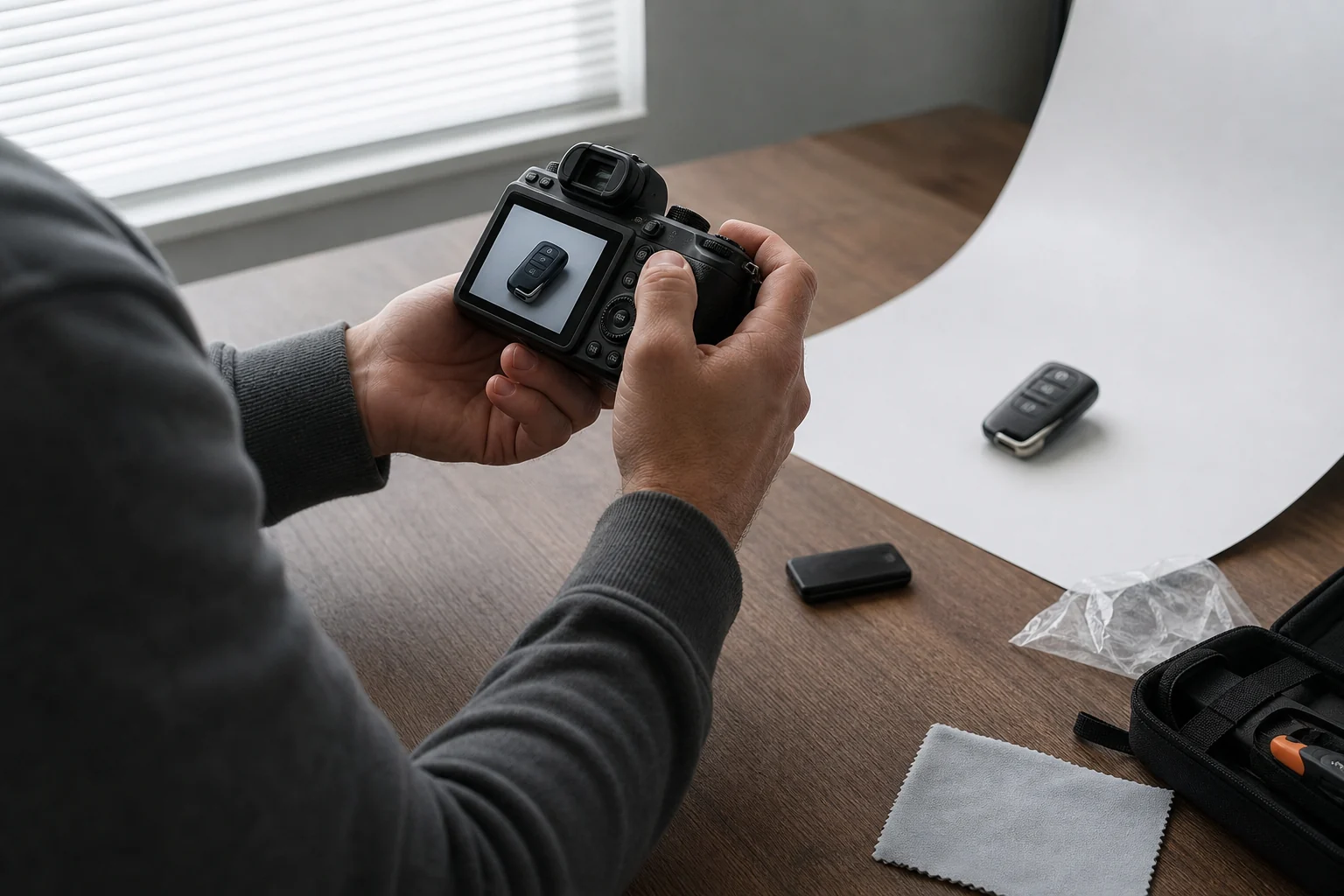
Photograph your original remote before opening it or comparing it with a listing. Take clear images of the front, back, sides, top and key-ring end, using enough light to show seams, recesses, clips and any visible markings. For a folding remote, include a photograph with the blade open and another with it closed.
Write down the number of buttons, their symbols and their positions. Note details that may be easy to overlook, such as a panic button, a different symbol, an offset button, or a button pad that sits in a shaped recess. Also record whether the blade is fixed or folding and which end or side it occupies. This gives you a checklist to use against every product page instead of relying on memory.
If the original remote has a part number, frequency marking or other identification, record it as supporting evidence. It can help narrow the search, but it does not replace a physical comparison. A broad description such as “for Lexus” or a matching vehicle model is still only a preliminary clue.
2. Review the listing in the same order
Start with the product photographs. Compare the complete outline, front and rear shape, seams, key-ring feature and visible button positions with your reference images. Do not stop after finding the same number of buttons: two Lexus key fob shells can have equal button counts but different symbols, spacing or housing contours.
Next, check the internal photographs, if provided. Look for the same general cavity arrangement and support geometry shown in your original remote, including the areas that locate and retain the original internals. You do not need to infer a fit from a single exterior image. If the seller provides only a front view, the internal match remains unverified.
Then check the blade arrangement separately. Confirm that the listing shows the same fixed or folding design and a compatible position for the blade. A product may include a blank blade, accept your existing blade, or provide no blade at all. These are different purchase conditions, so do not treat a matching Lexus key casing as proof that the blade solution is covered.
Read the product description and stated contents word for word. Confirm whether the package includes the housing sections, button pad, screws, blank blade, pivot hardware or other parts shown in the photographs. Images can be illustrative, and a description may exclude an item that appears in the product photo. If you need a Lexus remote key replacement shell only, make sure the listing does not imply that electronics, programming or a complete key are included.
Finally, compare your notes with the listing’s exact claims and mark each point as “matched,” “different” or “not shown.” Ask the seller or manufacturer to verify unresolved differences, sending your photographs and the relevant listing link. Manual confirmation is especially important when the listing uses broad model labels or covers several years. Pause before ordering if the internal layout, button design, blade arrangement or package contents cannot be confirmed. A lower-risk decision is to wait for evidence than to force an apparently similar shell to fit.
The safest way to choose a Lexus remote key shell is to match the original key’s physical design, not just its model name or number of buttons. Compare the shell’s shape, button layout, seam, internal retaining points, transponder or circuit-board position, and blade arrangement with clear photos of the replacement. If any of these details differ, treat the listing as unconfirmed, even when the wording sounds specific. A careful visual match helps prevent buying a shell that cannot accept your original internals or blade.
- Button symbols and positions
- Housing shape and rear features
- Circuit-board and battery cavity
- Blade mount or folding arrangement
- Included parts and unresolved differences
Choose the option that matches your vehicle and situation.
Frequently asked questions
Can a Lexus model name and year prove that a remote shell will fit?
No. The model and year are useful starting clues, but production changes and different remote designs can create exceptions. Compare your original remote’s outline, button arrangement, rear cover, blade area and internal shape with the listing. The physical design of your existing key is stronger evidence than the vehicle description alone.
Is matching the number of buttons enough to choose a Lexus key shell?
No. Two shells may have the same number of buttons but use different symbols, spacing, button positions or housing dimensions. Check the order and shape of the buttons, the surrounding bezel, the shell outline and the location of the key-ring loop. Button count should support a match, not decide it by itself.
Can I move my original circuit board into any shell with the same exterior shape?
Not necessarily. The replacement cavity must hold the original circuit board, battery and any retained components in the correct positions. Internal posts, clips, channels and clearances can differ even when the outside looks identical. If the board is loose, pressed against the cover or blocked by a support, the shell is not a suitable match.
What should I do if the listing does not show the inside of the shell?
Treat internal compatibility as unresolved. Ask the seller for clear photos of the cavity, retaining posts and battery area, or compare the shell with a reliable internal reference. Do not assume that an identical-looking exterior has the same supports. If the necessary internal evidence is unavailable, choosing another listing may reduce the risk of a failed transfer.
Does a Lexus remote shell usually include a usable key blade?
Do not assume that it does. A listing may include a cut or uncut blade, a separate blade insert, no blade, or a housing designed for transferring your existing blade arrangement. Check the product description and photos for the blade, hinge or mounting point. A shell can fit the electronics while still being unsuitable for your blade.
Will replacing the shell fix buttons or electronics that no longer work?
Usually not. A shell can replace worn plastic, a damaged cover or broken external button surfaces, but it does not repair a faulty circuit board, depleted battery, damaged transponder or failed switches. Before transferring the parts, identify whether the problem is physical housing damage or an electronic fault that will remain in the original components.
What photos should I compare before ordering a Lexus key shell?
Compare front and rear views, both side edges, the key-ring end, the blade or hinge area, and the opened original remote. For the listing, look for the same exterior views plus the internal cavity, battery position and support posts. Keep the photos side by side and check proportions, not just the overall colour or button count.
What if my original Lexus key looks slightly different from the listing but the buttons match?
Do not treat matching buttons as sufficient. Compare the complete housing outline, side profile, rear cover, blade arrangement and internal supports. A minor cosmetic difference may be harmless, but a different cavity or blade mount can prevent a proper transfer. If you need another compatibility check, car-keys.lt can be a useful next step.
