
Use the original housing as your reference and verify the buttons, blade, internal supports and transferable electronics before ordering.
- A replacement case changes the outer housing, while the original circuit board, transponder, battery and usable blade may need to be transferred.
- Matching the number of Kia key buttons is only an initial filter because their positions, shapes, spacing and functions may differ.
- Compare the original case from front, back and side to identify its outline, seam, thickness, clips and closure points.
- Blade compatibility requires a separate check of the profile, folding or fixed arrangement, pivot and attachment method.
- Internal supports and clearances must hold the transferred board, battery and transponder securely without pressure or misalignment.
- If the original electronics or blade are damaged, missing or incompatible, a case-only purchase may not solve the key problem.
A Kia replacement key fob case will fit your original key only when its external shape and internal layout match—not simply because the listing names the same Kia model or shows the same number of buttons. Two cases can look nearly identical while using different button positions, blade attachments or supports for the circuit board and battery.
The original housing is the safest reference. Compare the replacement with it from the front, back and sides, then check whether the buttons, key blade and internal components are arranged in the same way. The blade may be reusable even when the shell is not, and the electronics may transfer only if the new housing holds them securely and lines up with the buttons.
This guide separates those checks so you can judge a case before ordering rather than relying on a vehicle name alone. It also explains which visible differences matter, how to assess the blade independently, and what to inspect inside the shell. If you are comparing listings on car-keys.lt or elsewhere, use the original fob as the reference and treat every compatibility statement as something to verify against the actual housing in your hand.
What a Replacement Kia Key Case Actually Changes
A replacement Kia key fob case changes the outside of the key, not necessarily the key’s working electronics. A case, shell or housing-only product normally provides the plastic body, button covers and closure pieces. It is intended for transferring usable parts from your existing key. A complete replacement key is a different purchase: it may include the housing, electronics and key blade, but it still needs to be described clearly as a complete key rather than a Kia replacement key fob case.
Before ordering, confirm exactly what the product includes and what it expects you to reuse. The listing should state whether it is a Kia key shell, a Kia key fob housing or a complete key, and identify the original components it is designed to accept. Do not assume that a similar-looking case includes a circuit board, battery, transponder or blade. In many case-only purchases, those parts must come from the original key.
The condition of your existing key determines whether a shell transfer is sensible. Check that the original circuit board is present, that the battery compartment and battery contacts are usable, and that the transponder component has not been lost or damaged. Also confirm that the original blade or emergency-key component is still available if the replacement housing is intended to reuse it. A new outer case cannot replace a missing electronic part or a damaged metal key.
A case-only purchase may therefore solve a cracked, worn or broken housing while leaving an electronic fault untouched. If the key has intermittent operation, no response after a fresh battery, water damage or a missing internal component, transferring parts into a new Kia replacement key shell may not restore it. The fault may be inside the original electronics rather than in the housing.
Treat the original key as the reference part before you buy. Record its complete condition and keep every reusable component together; a key circuit board transfer is only possible when the relevant parts are present and suitable for reuse. The product description must match that situation. If it does not say which original components the case accepts, pause before ordering rather than relying on the Kia model name alone. Further checks can then establish physical Kia key case compatibility.
Compare the Original Key Case From Every Side
Place the original key next to the listing photographs, rather than judging the product from its Kia model name alone. Compare the front, back and side profile at the same orientation. A case may be listed for the correct vehicle but still belong to another key generation, with a different housing outline or closure design. If the seller provides dimensions, compare the length, width and thickness of the original case with those measurements. Small differences can be significant where the two halves meet or where the case must close around the transferred parts.
Start with the front face. Check the key fob button layout, not just the number of buttons. Note each button’s position, shape, size and spacing from the others. For example, two keys may both have four buttons, while one places the lock and unlock buttons in a vertical row and the other uses a different arrangement. A rounded button opening can also differ from a square or elongated one. If the listing photograph uses a different button sequence or orientation, treat the Kia key shell as a mismatch unless the seller clearly identifies both versions.
Turn both cases over and compare the back surface. Look for the same raised areas, recesses, logo position, battery-cover outline and visible fastener location. The rear shape can reveal a different mould even when the front appears similar. Compare the corners as well: a flatter lower edge, sharper shoulder or deeper curve may prevent the replacement housing from matching the original halves.
Next, inspect the side profile and seam. Hold the original case at eye level and compare its thickness with the product images or stated dimensions. Follow the seam around the entire housing, checking whether it runs in the same place and has the same shape near the buttons, corners and bottom edge. A Kia key fob housing that looks close from above may still be too thick, too narrow or shaped differently along the sides. Those differences can leave a gap, create pressure when the case is closed or stop the halves from sitting flush.
Finally, compare the external closure features. Check the number and position of visible screws, screw recesses, clips, latch points and joining tabs. Their location should correspond with the original case, not merely appear somewhere on a similar-looking shell. Photograph both keys from the front, back and side, then mark the matching dimensions before ordering. If any outline, button opening or closure point differs, do not rely on button count alone; request clearer photographs or confirmation of the exact key generation and version.
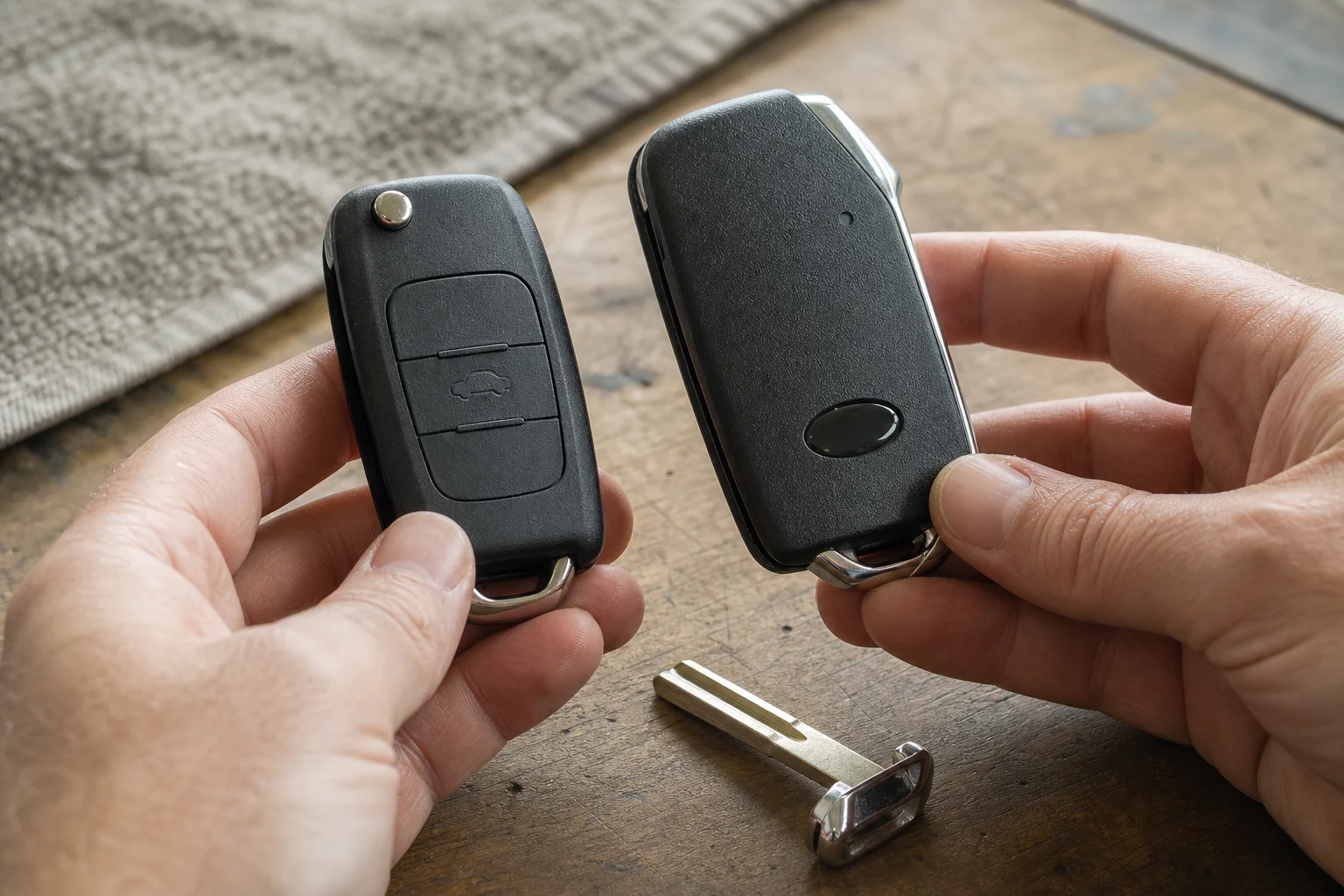
- Photograph the original key from front, back and side
- Record the button arrangement and housing shape
- Check the board, battery and transponder condition
- Identify the blade type and attachment
- Confirm exactly what the replacement product includes
Check the Circuit Board, Battery and Internal Supports
A replacement shell is suitable only if the original electronics can sit in the new cavity without force. If you can open the original case safely, photograph the inside before removing anything. If not, use clear listing photographs of both interiors, not only the outside. The comparison should show the circuit board’s outline, screw holes, locating tabs and any points where the board rests against the housing.
Match the board and battery space
Compare the replacement interior with the original board at the same orientation. The mounting points should correspond closely: a board that is held by the wrong clips or only one support may move inside the case. Check the board’s length, width and corner shape as well. Even a small difference can leave a button switch off-centre or prevent the housing from closing evenly.
The battery position needs its own check. Identify whether the battery sits in a recess, against contacts on the board or under a separate retaining feature. The replacement Kia key fob case must leave enough room for the battery and its contacts; a shallow cavity can press on the battery, while a misplaced recess can stop the back cover from closing. Do not assume that keys with the same number of buttons use the same internal layout.
Also locate the transponder and compare the space around it. Depending on the key design, it may be a separate small component or positioned on or near the circuit board. The new Kia key fob housing should hold it in the same relative position, with no loose space that allows it to rattle or fall out during transfer. If the listing does not show this part of the interior, treat compatibility as unconfirmed rather than inferring it from the vehicle name.
Look for supports, clearance and movement
Inspect every internal rib, clip and support post against the original. These features can guide the board, separate it from the battery area and keep the button mechanisms aligned. A replacement Kia key shell may have a similar exterior but use different ribs, leaving a post directly under a component or a clip across the board edge. Compare the interior photographs carefully, including the lid as well as the base.
After a test transfer, the board should lie flat, remain seated when the case is gently moved and allow the housing to close without unusual resistance. The buttons should meet their switches at the intended points, not require excessive pressure or remain partly depressed. Gaps along the seam, a bulging cover, rattling parts or marks where plastic presses against the board indicate poor Kia key case compatibility.
Do not force the halves together to prove a match. Pressure can damage a switch, battery contact or circuit board even when the case appears to close. If the seller cannot provide useful interior images or dimensions, ask for them before ordering; otherwise, the key circuit board transfer remains uncertain.
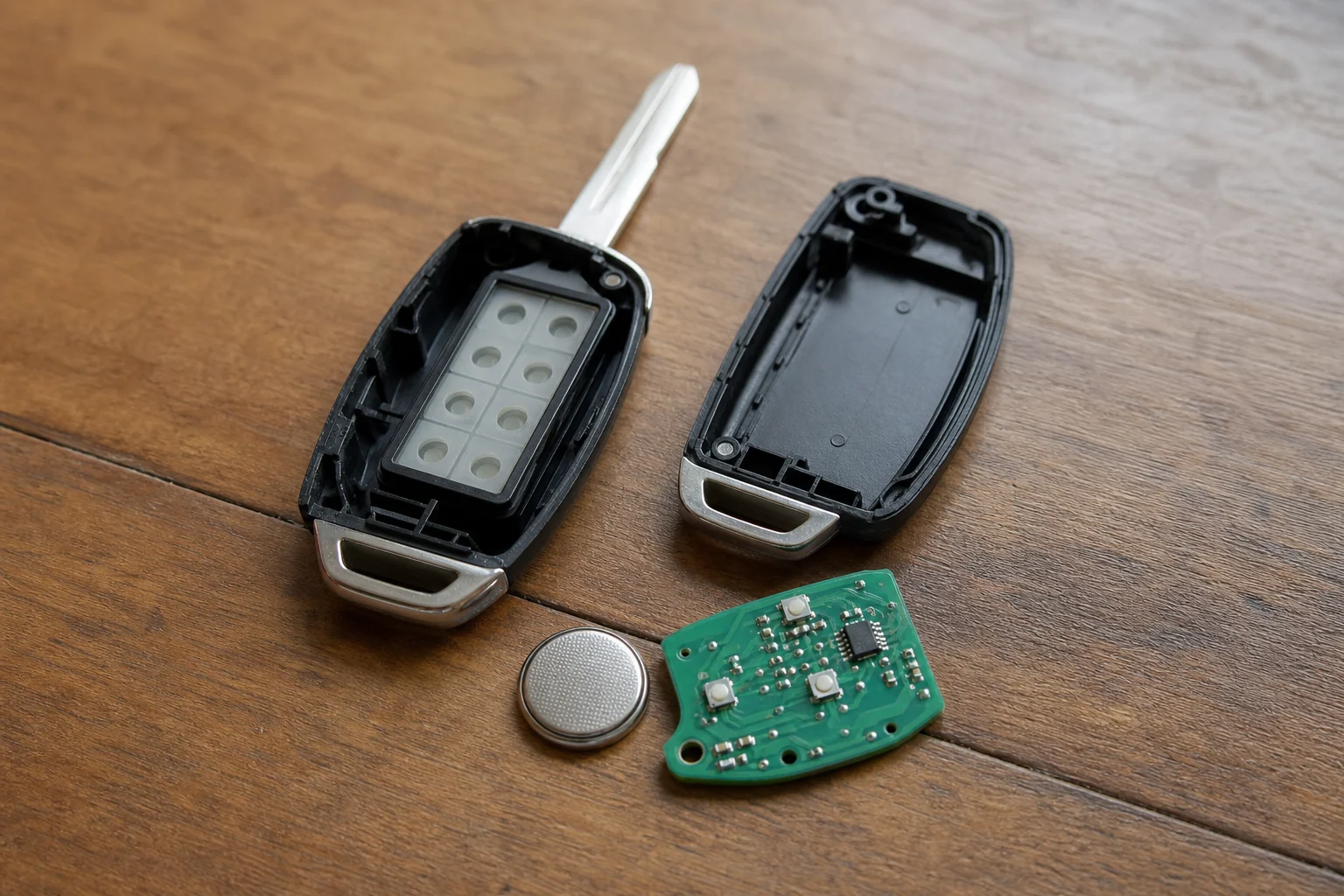
- Kia model name alone is insufficient
- Button count is only an initial filter
- Do not assume the internal supports match
- Do not assume the blade will transfer
- Seek confirmation when critical details are hidden
Assess the Blade as a Separate Compatibility Test
A replacement housing can match the outside of your Kia key and still be unusable if the blade does not transfer. Treat the metal blade or emergency key as a separate compatibility test. First identify whether the original key has a fixed blade or a folding blade stored inside the fob. A fixed blade usually passes through an opening at the end of the case, while a folding design needs room for the blade, pivot and release mechanism to move inside the housing.
Compare the blade itself
Compare the original blade with the replacement case’s blade cavity, not just with the product photograph. Check the blade’s overall length, width, thickness and profile from the shoulder to the tip. The shoulder is especially important: it determines how far the blade enters the housing and where it stops. A similar-looking blade with a different shoulder or groove profile may not sit at the correct depth.
The cutting pattern also matters. If the product includes a blank, uncut blade, it is not ready to use as a direct substitute; the original cutting pattern would need to be reproduced on that blank. If it includes no blade, the listing must provide a suitable way to transfer the original one. Do not assume that an included blank has the same profile as your existing blade simply because the Kia key shell has the same button count or general shape.
For a folding key, compare the attachment point in detail. The original blade may use a pivot pin, screw, clip or another fixed mounting arrangement. The replacement Kia key fob housing must provide the same pivot position and enough material to retain the blade securely. A different hole diameter, pin location or blade angle can prevent the key from folding fully or leave it misaligned when opened. A fixed blade also needs the correct retaining slot or attachment point; it cannot necessarily be converted to a folding arrangement.
Check movement and clearance
Move the original blade through its full travel before ordering, noting how far it folds into the handle and where the tip rests. The replacement case needs clearance around the blade’s cutting edges, shoulder and release area. Internal ribs or a shallow cavity can stop the blade early, cause rubbing or prevent the housing from closing. If the listing shows only the outside, ask for an interior photograph or exact blade dimensions rather than relying on appearance.
An existing blade may not transfer when it is permanently moulded into the old housing, damaged at the shoulder, attached by a non-matching pivot or made in a profile the replacement case does not accept. In that situation, a case-only purchase may leave you with a housing that holds the electronics but no workable key blade. Check whether the listing supplies a blank blade, a compatible cut blade or no blade at all before ordering.
Case Only or Complete Replacement Key?
Choose a case-only product when the reusable parts in your original key are confirmed to be sound and compatible with the offered housing. That means the electronics are working, the battery arrangement is usable, and the blade can be retained in the new case. A Kia replacement key fob case is then a practical option for cracked plastic, worn buttons or a broken cover, provided the replacement includes every small part needed for the transfer.
Do not choose a shell simply because the outside looks similar. A case-only purchase will not correct a damaged circuit board, a missing transponder, a broken folding mechanism or a blade that cannot attach securely. If one of these components is missing or incompatible, look for a product that supplies the required part or consider a complete replacement key instead. Check the description carefully: “complete” can mean different things, so confirm whether it includes the electronics, battery, blade and any attachment hardware.
| Your situation | More suitable choice |
|---|---|
| Original components work and the transfer points match | Case-only housing or Kia key shell |
| The housing is damaged but the key components are usable | Case-only housing |
| Electronics, blade or attachment parts are damaged or missing | Product supplying the affected component, or a complete replacement key |
| Compatibility remains uncertain | Pause the order and request confirmation |
Before ordering, ask the seller to confirm the exact key version, button arrangement, included parts and compatibility of the key blade fit. Send clear photographs of the front, back and opened original key if the listing does not show enough detail. If the seller cannot verify the Kia key case compatibility from photographs or dimensions, a specialist should confirm it before you buy.
The final decision should be based on evidence, not the vehicle name alone: reusable original parts plus a verified match support a shell transfer; missing, damaged or unverified parts point to another solution.
An aftermarket Kia key fob case is only a safe choice when it matches your original key in every detail that affects assembly: button layout, housing shape, blade attachment and internal supports. A similar-looking photo is not enough, and the vehicle model alone may not identify the correct shell. Compare the original fob directly with the seller’s measurements and images, and confirm any uncertain feature before ordering. If the details do not match, keep looking rather than forcing the old electronics into a case that may not close or function properly.
- Use a case when the original components are present, reusable and confirmed compatible
- Consider another solution when electronics, transponder or blade are damaged or missing
- Treat uncertain compatibility as a reason to verify before purchase
Choose the option that matches your vehicle and situation.
Frequently asked questions
Does matching the Kia model year prove that a replacement key case will fit?
No. The model and year can narrow the search, but Kia may use different key designs within the same vehicle range or production period. Compare the original housing’s shape, button layout, electronics cavity and blade arrangement directly with the replacement. A listing that names your model is useful evidence, not conclusive proof of compatibility.
Is matching the number of buttons enough to choose a Kia key shell?
No. Button count is only an initial filter. Two three-button cases may have different button positions, spacing, shapes or functions, and the internal switch locations may not align with the replacement buttons. Check the complete button layout and the case dimensions before ordering, especially if the original key has a separate lock, boot or panic button.
Can I move my original circuit board into any Kia replacement case?
No. The board must match the replacement case’s outline, mounting points, battery position and internal supports. It also needs enough clearance for components and must sit directly beneath the buttons. A case can look correct outside yet press against the board or leave it loose inside. Transfer is reasonable only when the internal construction matches.
How can I check whether my existing blade will transfer?
First identify whether the key uses a folding blade, a fixed blade or a separate emergency key. Compare the blade profile, length, pivot position and attachment method, including any retaining pin or clip. A housing match does not guarantee blade compatibility. If the blade is cut into a different profile, it may need separate replacement or cutting.
What should I do if the replacement case looks right but the inside is different?
Treat it as unverified rather than assuming the electronics will transfer. Ask for clear interior photographs or dimensions showing the board cavity, battery space, supports and blade attachment. If those details are unavailable, compare the product with the opened original or obtain confirmation from the seller before ordering.
Will a replacement key case fix a damaged transponder or circuit board?
No. A case can replace damaged plastic, buttons or covers, but it cannot repair a faulty circuit board, transponder or battery contact. If the key still fails after the housing is changed, the problem may be electronic or related to programming. Test the original key’s functions before treating the shell as the complete solution.
What if my original Kia key has a missing or broken blade?
A case-only purchase may not be enough. Confirm whether the replacement includes a blade, whether it is the correct type and whether it arrives uncut or already matched to your vehicle. If the original blade’s pivot or attachment part is missing, you may need a complete replacement key or a separately supplied compatible blade.
What photos should I take before ordering a Kia key case?
Take clear photos of the front, back, sides, button layout and blade. If possible, photograph the opened key as well, showing the circuit board, battery compartment, supports and blade attachment. Keep the camera parallel to the case and include close-ups of unusual clips, pins or folding mechanisms. These images can help car-keys.lt assess the next step.
