
Use the original key’s layout and transferable components—not the Q3 badge alone—to assess compatibility.
- A key shell usually refers to the outer housing, so it may not include the circuit board, transponder, battery parts or emergency blade.
- Matching button counts are useful evidence, but button positions and control layout must also correspond to the original Q3 key.
- The housing outline, seam, battery-cover arrangement and internal supports determine whether existing components can sit correctly in the replacement shell.
- Keyless Go functionality depends on compatible internal electronics and vehicle pairing, not merely on a housing that fits physically.
- The emergency blade requires separate checking because its profile, pivot or mounting arrangement may differ between otherwise similar Audi keys.
- When photographs or identifiers leave uncertainty, obtain product-specific confirmation before ordering rather than relying on the Audi Q3 name alone.
An Audi Q3 keyless go shell should be judged against the key in your hand, not against the Q3 name printed in a listing. The vehicle model may cover several key designs, while a replacement housing can differ in button layout, case shape, blade position and the internal supports that hold the electronics. If those details do not match, the shell may look suitable yet fail to accept the original parts or close correctly.
This guide explains how to compare your existing key with a replacement shell before ordering. It separates the physical housing question from the components that may need to be moved into it: the circuit board, battery arrangement, transponder and mechanical blade are not interchangeable simply because the remote is associated with an Audi Q3. The original key provides the strongest practical evidence, although product-specific confirmation may still be needed where photos or descriptions leave room for doubt. Readers comparing listings on car-keys.lt can use the same approach by identifying the exact layout first and then checking whether the shell is designed around it. The decisive question is whether the housing and transferable components correspond closely enough for a proper physical transfer.
Audi Q3 Key Housing or Complete Key: Know the Difference
An Audi Q3 key shell is usually the outer casing only. It may include the front and rear housing pieces, button covers, clips or a blank area for the emergency blade, but it does not automatically include the working electronics. The purpose of this type of replacement is generally to move usable parts from your existing key into another housing.
A complete key is a different product category. Depending on the listing, it may include a circuit board, transponder, battery components, buttons, an emergency blade or other parts. “Complete” does not have one universal contents list, however. Before relying on the description, check whether the product is called a shell, housing, case, remote key, complete key or something else, then read exactly which internal components are supplied.
For a shell replacement, your original circuit board may need to be transferred. The same applies to the transponder, if it is a separate part, because a new outer case does not by itself become a programmed or recognised Audi Q3 Keyless Go key. A shell that accepts the circuit board can therefore still leave you with a non-working key if an essential electronic component is damaged, missing or unsuitable for transfer.
The battery also needs separate attention. Some housings retain the existing battery holder or contacts; others may require parts from the original key, while a complete product may list a battery assembly as included. Do not assume that a visible battery compartment means the required battery parts are supplied. Compare the product contents with the parts inside your current key.
The emergency blade is another separate issue. A replacement housing may be designed to receive your original blade, may include a blank blade, or may not provide the relevant blade parts at all. Physical space for a blade does not confirm that your existing blade can be moved across or that a supplied blade is ready for use.
Most importantly, physical shell fit proves only that the casing may close or hold certain parts. It does not prove that the buttons line up with the circuit board, that the electronics are supported correctly, that the transponder is present, or that the finished key will operate the vehicle. For reliable Audi Q3 key shell compatibility, treat the housing and the working key components as separate questions.
- Housing compatibility concerns shape, buttons, covers, supports, and blade mounting.
- Functional compatibility concerns the circuit board, transponder, Keyless Go system, and vehicle pairing.
- A product can satisfy one of these tests without satisfying the other.
Start With the Original Audi Q3 Key
Before comparing an Audi Q3 keyless go shell, document the key you already have. The original key is the most useful reference because “Q3” alone does not identify its exact housing design. Keys described for the same model name may differ in button layout, cover shape, blade arrangement or visible markings.
Start with the button layout. Record the total number of buttons and their positions, then compare the shape and spacing of each button. Note whether the controls are arranged in a straight row, grouped together or separated by different gaps. Also check details such as a larger central button, a dedicated boot-release button or a differently shaped panic button. A listing that mentions the right number of buttons can still show a different control layout.
Inspect the outside of the original key from every side. Look at the profile, the join between the front and rear covers, the corners and any removable cover or trim. Note whether the key has a smooth or stepped edge, a separate end section, or a particular shape around the blade area. These features provide stronger evidence for Audi Q3 key shell compatibility than a generic title such as “Q3 smart key shell.”
Look for visible identifiers on the key and, where accessible without damaging it, on its existing components. These might include a part number, stamped code, manufacturer marking or other printed reference. Record the text exactly, including letters, numbers and hyphens. A partial or misread identifier can lead to the wrong comparison, so photograph it rather than relying on memory. The identifier should be treated as supporting evidence; it does not replace checking the physical design.
Take clear photographs before searching for an Audi key shell replacement. Include the front with the buttons visible, the back, both sides, the top and bottom edges, and the blade or blade opening area. Use even lighting and keep the camera square to the key for the front and back images. Place a ruler beside it only if scale is relevant, and avoid covering seams or markings with your fingers.
When reviewing a product listing, compare its supplied photographs with these records rather than matching the vehicle name. Give priority to the button arrangement, outer profile, covers, seams and blade-area shape. Treat a listing that shows only a generic image or says “fits Audi Q3” as unconfirmed until its design matches your original key. This evidence-led comparison is the safest starting point for checking an Audi Q3 key housing.
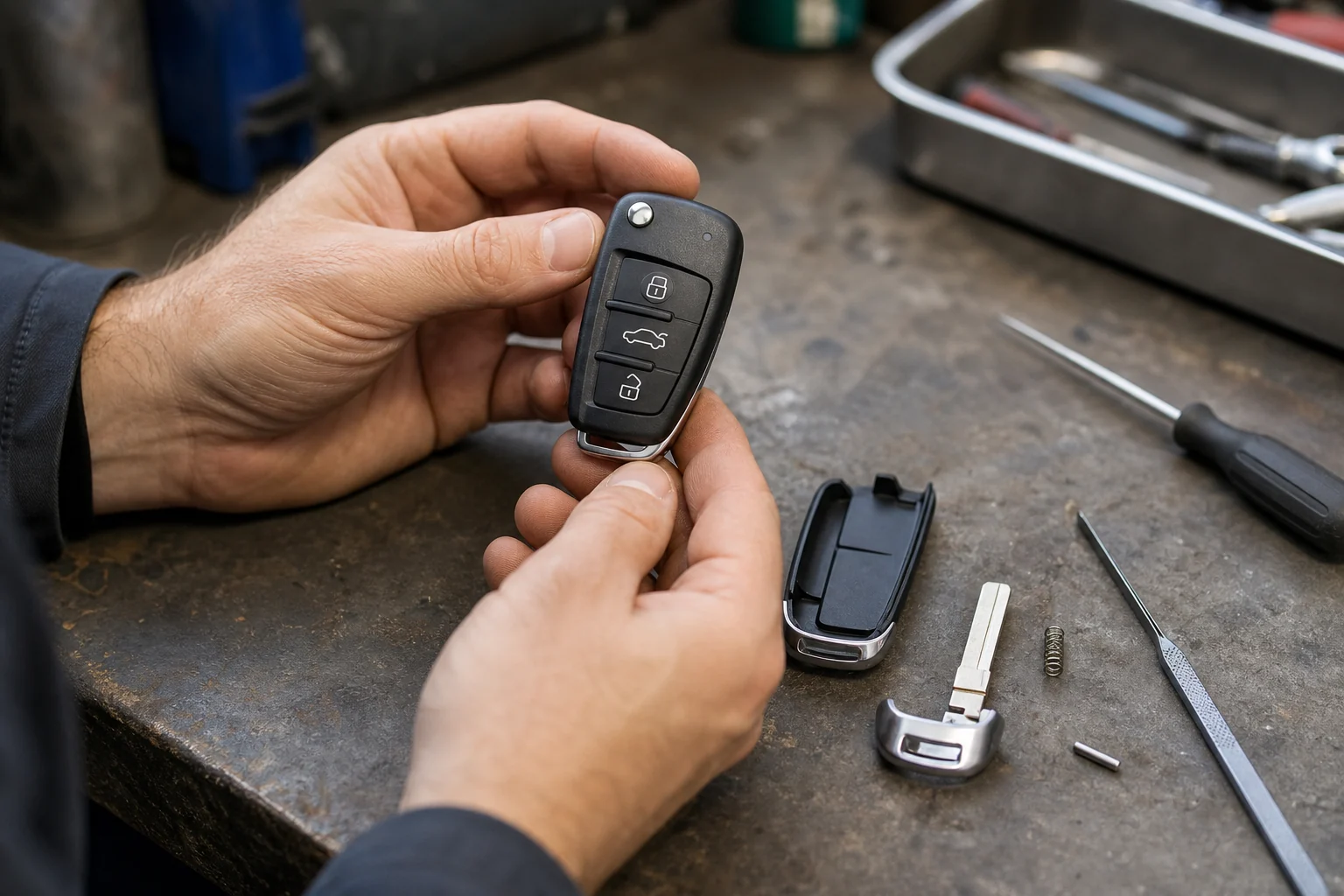
Check the Housing Before You Check the Electronics
A replacement can have the right Q3 label and still fail as an Audi Q3 key housing if its physical shape differs from your original. Compare the replacement photographs directly with your key, not with a generic image of an Audi Q3 key. Look at the overall outline, the thickness of the front and rear halves, and the position of the seam. A different curve, raised edge or clip location can stop the two halves from closing evenly or leave gaps along one side.
Compare the visible housing features
Check the button layout as a physical feature, not just as a number. Two shells may both have four buttons, while the buttons sit at different heights, use different shapes or have different spacing. Compare each opening from left to right and from top to bottom. The button covers must line up with the openings in the housing; otherwise, a control may rub against the casing, sit permanently pressed or be difficult to press.
Also compare the front and rear covers. Some designs use a separate battery cover, while others place the battery access in one of the main housing halves. The cover’s shape, latch position and surrounding rim need to match the replacement design. A shell with a differently arranged battery compartment may not leave the same clearance for the parts transferred from the original housing, even when its exterior looks similar.
Use clear photographs of your own key from the front, back and side when comparing listings. A front-facing product photo can hide differences in thickness, side rails or the rear cover. If the listing does not show the relevant angle, check whether it describes the housing arrangement clearly or ask the seller for an image of the actual shell design. Do not assume that a stock photograph represents every version sold under the same listing.
Inspect the inside, not only the outside
Internal supports determine whether the original parts can sit in the correct position. Look for moulded posts, guides, clips, ribs and locating points, and compare their positions with the inside of your existing housing. These features can prevent movement, keep covers seated and maintain clearance around the transferred components. A missing post or differently placed rib may cause pressure, rocking or an uneven seam.
Pay particular attention to the emergency-blade area. The shell should have the correct pivot or mounting space, retaining feature and surrounding clearance for the blade assembly. Compare whether the blade sits in a hinge, slot or fixed mounting area, and whether the cover closes around it without obstruction.
For Audi Q3 key shell compatibility, treat an unshown interior as missing evidence rather than proof of a match. Confirm the internal supports and battery arrangement from the product listing or directly with the seller before relying on the shell’s appearance.

Separate Shell Fit From Keyless Go and Blade Compatibility
A replacement shell can match the shape of your original key and still fail as a working Audi Q3 Keyless Go key. The housing must not only close around the transferred parts; it must also hold the circuit board, battery contacts and other components in the correct positions. If the board sits too high, shifts inside the case or cannot reach the buttons and contacts properly, the key may not respond even when the outer housing looks right.
Check whether the replacement supports your original circuit board rather than assuming that all Q3 electronics use the same internal layout. Locating posts, retaining clips, guides and clearances can differ between housings. A board that is slightly different in shape may not sit securely, and pressure from the case can damage it or prevent the buttons from operating. Product descriptions should therefore state which electronics the Audi Q3 smart key shell is designed to accept, not just list the vehicle model.
The transponder requires a separate check. Depending on the original key design, it may be part of the circuit-board assembly or a separate component that must be transferred. A shell can accommodate the board but have no suitable place for a separate transponder, or the replacement may be intended for a different transponder arrangement. Confirm how your original key stores this component and whether the new housing provides the required space and retention.
Keyless Go functionality depends on more than the casing. It requires compatible electronics and the vehicle’s recognised key data. Moving a working board into a new Audi key shell replacement may preserve the existing electronic identity if all parts remain intact, but the shell itself does not create that identity. A housing cannot make incompatible electronics communicate with the vehicle, and it cannot replace any required pairing or programming procedure.
The emergency blade has its own compatibility requirements. Compare the blade profile, length, thickness and cutting arrangement, but also check how it attaches to the housing. Some designs use a pivot and retaining pin; others may use a different mounting arrangement or require a separate blank blade. Even a correctly cut blade is unsuitable if its pivot hole, shoulder or mounting point does not match the Audi Q3 key housing.
A shell may therefore be suitable for the electronics but unsuitable for the blade, or the reverse. For example, the original circuit board may fit the replacement while the original blade cannot fold, lock in place or align with the opening. In that situation, the housing transfer is incomplete unless a compatible blade solution is available.
Finally, transferring components into an Audi keyless entry shell does not program or pair the key with the vehicle. Treat claims about included electronics, transponder support, blade supply and vehicle pairing as separate product-specific statements. A successful physical transfer proves only that the parts can be housed; it does not by itself prove that Keyless Go, remote functions or the emergency blade will work.
What to Confirm Before Ordering an Audi Q3 Shell
Before ordering an Audi Q3 keyless go shell, match the exact product variant with your existing key. Do not rely on the Q3 name in the title: a listing may cover several button layouts, housing designs or blade arrangements. If several versions are shown, identify the one that matches your key rather than choosing the closest-looking image.
Compare the original key with the exact listing photographs, including the front, back, side profile and blade area. Check the number and position of the buttons, the housing outline, seam shape, battery-cover design and any visible markings. A photograph that shows only the front may not reveal a different rear cover, blade mount or internal arrangement. If the listing uses a generic image, treat that as incomplete evidence.
Ask the seller about any feature you cannot confirm yourself. Useful questions include:
- Is this the correct variant for my button layout and housing shape?
- Does the internal structure support the components from my original key?
- Is the emergency-blade mount or pivot the same?
- Are there different versions under this Audi Q3 key housing listing?
- Which identifier, part reference or photograph should I use to select the correct option?
Send clear photographs of your own key with the enquiry: front, rear, side, blade area and any visible identifier. State the button count and arrangement, whether the blade is fixed or folding, and which parts you intend to transfer. This gives the seller evidence to assess Audi Q3 key shell compatibility against the original key, rather than making a broad assumption from the vehicle model.
Do not place the order while an important difference remains unresolved. Uncertainty about the board position, battery arrangement, blade mount or internal supports is a reason to request confirmation, not a reason to assume that the shell can be modified successfully. The same applies when a product is described as an Audi Q3 smart key shell but provides no variant details.
Proceed only when the exact housing is identified and the transfer path is clear: the listing matches your photographs, the seller has addressed the unresolved features, and you know which original parts will move into the replacement. If those points cannot be confirmed, delaying the purchase is safer than treating Q3 branding alone as proof of fit.
The practical takeaway is simple: an “Audi Q3” label is only a starting point, not proof that a keyless-go shell will fit your key. Before choosing one, compare the button layout, housing shape, blade arrangement, circuit-board position and internal supports with your existing key. The shell should match the key’s physical construction, not just the vehicle’s model name or year. If any detail differs, treat compatibility as unconfirmed until it has been checked against the exact key version. This prevents buying a housing that cannot be assembled or used correctly.
- Compare the original key with the exact product photographs.
- Match button positions, housing outline, seam, and battery-cover design.
- Check internal supports and emergency-blade arrangement.
- Confirm what the listing includes.
- Request product-specific confirmation when any detail remains uncertain.
Choose the option that matches your vehicle and situation.
Frequently asked questions
Does an Audi Q3 key shell include the original circuit board?
Usually, “shell” means the outer housing only: the case, buttons, and sometimes related plastic parts. It does not automatically include your original circuit board, battery contacts, transponder, or other electronics. Read the exact listing carefully and confirm what is supplied before ordering, especially if the product photos show only an empty housing.
Can I identify the correct shell by matching only the number of buttons?
No. Button count is a useful first check, but it is not enough on its own. Compare the button positions, shapes, spacing, housing outline, seam, side profile, and internal layout. Two keys may have the same number of buttons while using different supports or clearances that prevent the original components from transferring correctly.
Will any Audi Q3 Keyless Go shell work with my existing key?
No. The Q3 name alone does not confirm compatibility. The shell must match the physical housing, button layout, internal supports, battery arrangement, and any transponder or emergency-blade requirements. Different key versions can exist under the same vehicle model name, so compare the replacement with your exact original key rather than relying on the title.
Can the original Audi Q3 emergency blade be moved into a replacement shell?
Possibly, but only if the blade profile, pivot point, mounting arrangement, and surrounding clearance match. Some shells are designed for a transferable blade, while others use a different fitting or include a separate blade component. Compare the blade area of both keys and do not assume transfer is possible from exterior similarity alone.
If the shell fits, will Keyless Go work automatically?
A matching shell does not make Keyless Go work by itself. A shell replacement normally involves moving compatible electronics into the new housing; the vehicle’s existing key electronics and transponder still need to be suitable and correctly positioned. If the electronics are not compatible or the key requires pairing, physical fit alone cannot confirm operation.
What photographs should I take before asking about compatibility?
Take clear, well-lit photographs of the front, rear, both sides, the housing seam, the button layout, and the emergency-blade area. If possible, photograph the opened key and any visible identifiers without obscuring details. A straight-on image and a side view are especially useful because shape and thickness can be difficult to judge from one angle.
Can a replacement shell have the right buttons but the wrong internal supports?
Yes. Internal posts, locating points, clips, battery clearances, and circuit-board supports may differ even when the outside and button count appear correct. These parts keep the electronics aligned and secure. If they do not match, buttons may press poorly, the battery may not sit correctly, or the original board may not transfer into the housing.
What should I do if the product listing does not show the inside of the shell?
Ask the seller for product-specific confirmation and request internal photographs or a clear compatibility description. Do not treat an exterior image or the “Audi Q3” label as proof. If you need another opinion, car-keys.lt may be a useful next step when you can provide photographs of both your original key and the proposed shell.
