
Model names and button counts narrow the search, but the physical design of your original key provides stronger compatibility evidence.
- A key shell replaces the outer casing, while the original circuit board, battery, transponder and blade may need to remain usable.
- Matching Porsche model names does not prove compatibility because different key housings can vary in shape, supports, buttons and internal layout.
- Button count helps narrow options, but button symbols, spacing and physical placement provide stronger evidence when comparing two remote keys.
- Blade compatibility is a separate question from casing fit because the shell may use a different blade mount, pivot or supplied arrangement.
- A shell is generally relevant when the housing is damaged or worn but the existing electronic and mechanical components still function.
- Before ordering, compare the original key and listing from several angles, including the rear, side profile, button area, blade end and interior cavity.
A Porsche remote key shell is not automatically compatible just because it is listed for a Cayenne, 911 or Boxster. Porsche used different key designs across model generations, equipment levels and production periods, and even the same number of buttons can appear on housings with different shapes or internal layouts. The most reliable starting point is your existing key: compare its overall casing, button arrangement, folding or fixed blade design, and the way the internal parts are held in place.
That distinction matters because a shell can look correct yet fail to accept your circuit board, transponder, battery holder or blade. Conversely, a housing with a different button count may simply be the wrong version, even if the vehicle model appears in the listing. When comparing a Porsche remote key shell on car-keys.lt or elsewhere in Lithuania, use the original key as the reference rather than relying on the vehicle name alone.
This guide explains what to compare before ordering and separates the main compatibility questions: whether the casing matches, whether the buttons and electronics can transfer, whether the blade arrangement is suitable, and whether replacing only the shell is the right choice instead of buying a complete key.
What a Porsche Key Shell Replaces—and What It Does Not
A Porsche remote key shell is usually an empty outer casing, not a complete replacement key. It replaces the worn, cracked or damaged housing around your existing key components. Before ordering, check the product description carefully: terms such as “shell,” “case” or “housing” normally indicate that no circuit board, transponder, battery or programmed electronics are included.
The intended process is to transfer usable parts from your original key into the replacement key shell. Depending on the specific design, these parts may include the circuit board, battery holder, rubber button membrane, transponder and other internal pieces. Do not assume that every shell accepts every original component. The listing should identify which parts the shell is designed to retain, and the internal layout must still correspond to your key.
A shell is usually the relevant replacement when the remote still works but the outside casing is damaged. For example, cracked plastic, broken button areas or a loose cover may affect daily use without indicating a fault in the electronics. In that situation, transferring the original board and other compatible parts into a new housing can preserve the key’s existing functions. The same principle applies whether you are considering a Porsche Cayenne key shell, Porsche 911 key shell or Porsche Boxster key shell: the model name alone does not confirm that the internal parts will transfer.
A replacement key shell may not solve the problem when the remote no longer communicates with the vehicle, the circuit board is damaged, the transponder is missing, or important internal pieces cannot be moved into the new casing. A new outer housing does not repair failed electronics or create a programmed key. It also does not automatically resolve a blade problem; the blade and its mounting arrangement require a separate compatibility check.
Treat the shell as a housing replacement, not as a complete key. If the product is described as an empty Porsche remote key casing, expect to reuse your original components unless the seller states otherwise. If the listing is unclear about included parts or retained components, pause before ordering. The correct replacement key shell is one that matches both the outer housing and the specific original parts you need to transfer.
Use the Original Remote as Your Main Compatibility Reference
The most reliable starting point for Porsche key shell compatibility is the remote you already have, not the vehicle badge. A Porsche Cayenne key, Porsche 911 key or Porsche Boxster key may look similar across different production periods, while a replacement shell can be shaped for only one remote design. Use the original key as the physical reference and treat the listing’s vehicle model information as supporting evidence.
Compare the overall housing shape first. Check the length, width, thickness, rounded corners and taper toward the key-blade end. A shell may appear suitable in a small product image but differ in a noticeable way when placed beside your remote. Pay attention to the transition between the front and rear halves, as well as any raised or recessed sections around the buttons.
Next, compare the button layout rather than counting buttons alone. Look at the symbols, their order, spacing and distance from the housing edges. The shape of each button opening also matters: two remotes may both have three buttons but use different rectangular, oval or closely grouped openings. A replacement key shell should reproduce the same visible arrangement as the original, not merely advertise the same button count.
Inspect the rear surface and side profile from several directions. Compare the location and outline of any badge recess, seam, slot, screw opening or other visible feature shown in the product photos. Then view both keys from the side to check their thickness and edge shape. A front-facing photograph can hide a deeper or narrower casing that does not match your remote’s profile.
The blade end deserves a separate visual check. Compare the shape of the housing around the blade, including its width, angle, end contour and the position of the pivot or retaining area visible from outside. This does not prove that the blade will transfer or work; that requires the separate blade and internal checks covered later. It does, however, help identify an obviously different Porsche remote key casing before you order.
Build the comparison from clear evidence
Ask whether the candidate listing provides clear photographs of the front, back, side and blade-end areas. If the shape is difficult to judge, look for stated dimensions and compare them with measurements of your original remote. Product photos should show the actual design clearly enough to assess proportions, not just a generic image labelled for several Porsche models.
For a purchase in Lithuania, save the listing photos and compare them with well-lit photos of your own key before placing an order. Photograph the original from matching angles, with a ruler beside it if dimensions are available. Confirm any model-year or remote-generation information in the relevant listing, but do not let a broad “Cayenne,” “911” or “Boxster” label override a visible mismatch. If the exterior evidence is incomplete or differs in more than one area, pause and request clarification or choose a listing with better documentation.
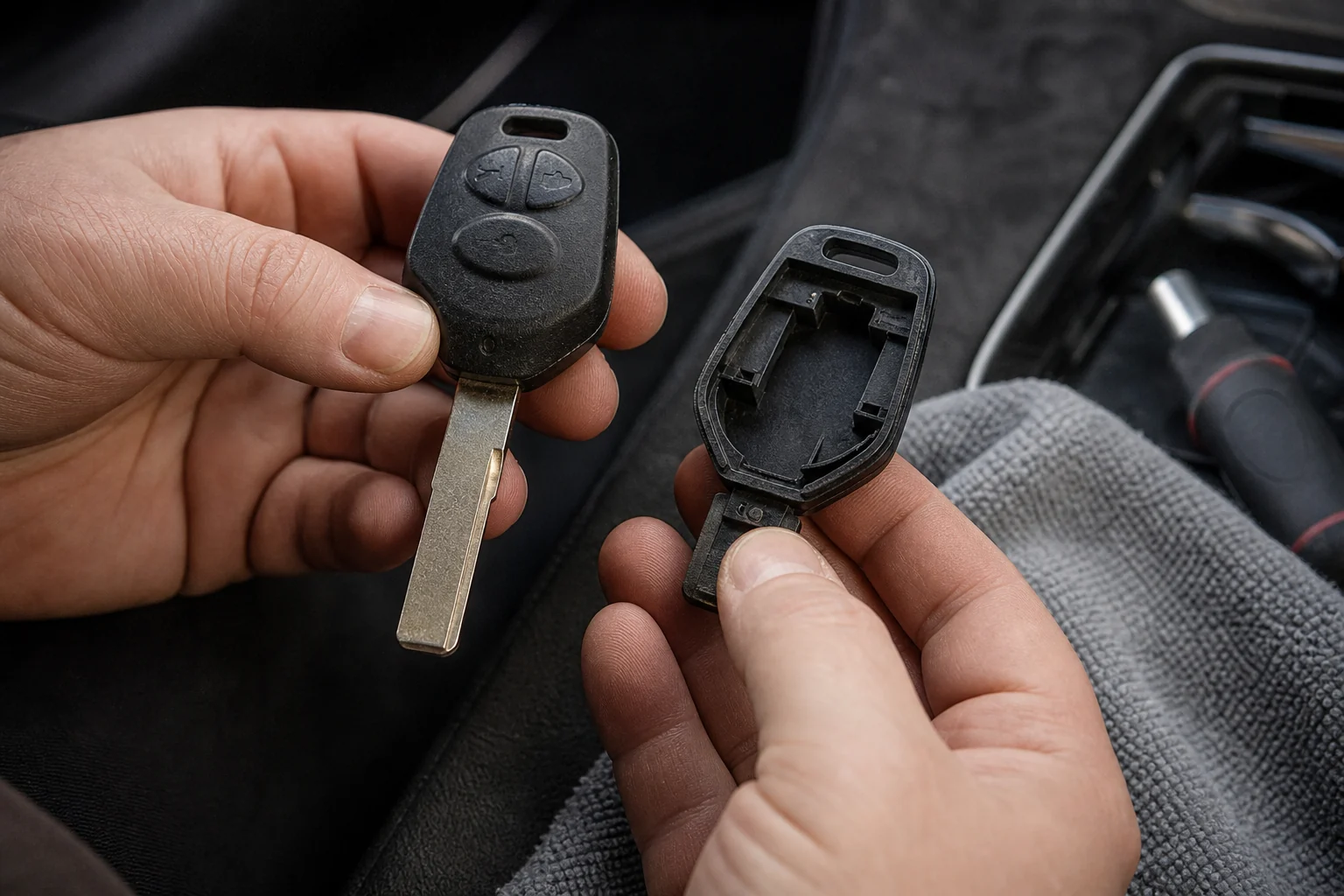
- Photograph the original remote from several angles
- Compare button symbols, spacing and housing shape
- Check the rear, side profile and blade end
- Verify the internal cavity and retained components
- Pause if the listing does not show enough evidence
Check the Buttons, Circuit Board and Internal Cavity Separately
A replacement Porsche remote key shell can look correct from the outside and still fail during transfer. The decisive question is whether the shell’s interior accepts your original components in the correct positions. This is why Porsche key shell compatibility cannot be confirmed from the model name, button count or exterior resemblance alone.
Check how the buttons work
Compare the button mechanism, not just the printed symbols. The replacement Porsche key casing must place each button over the matching contact on the original circuit board. Check the number, order and spacing of the buttons, then look at their underside: some shells use separate rubber pads, while others use moulded plastic plungers that press the board directly.
Misalignment can cause a button to press beside its contact, remain permanently pressed or require excessive force. A shell with three visible Porsche key buttons is therefore not necessarily suitable for every three-button remote. Product photos should show the inside of the shell or the button pad clearly enough to compare it with your original remote. If they do not, ask the supplier for internal photographs or a component-layout confirmation.
Confirm the internal layout before ordering
Remove the battery cover, if possible, and inspect the board’s outline, notches and mounting points. The shell should provide matching supports, guides or clips so the circuit board cannot shift when the buttons are pressed. Even a small difference in board shape may prevent the housing from closing or leave the board unsupported.
Check the battery position and access separately. The replacement should hold the same battery type and orientation, with enough clearance for the contacts and a practical way to reach the battery compartment. A cavity that looks spacious may still place the battery against a wall or cover the contact points.
Also identify where the transponder sits in your original key and whether the replacement cavity has a matching recess or retaining feature. Do not assume that the transponder can simply be placed anywhere inside the Porsche Cayenne key shell, Porsche 911 key shell or Porsche Boxster key shell. If it moves, presses against the board or cannot be secured, the transfer may not be reliable.
Before ordering, compare the cavity, posts, clips and other retaining points with the original interior and the supplier’s information. Confirm specifically that your original circuit board, battery holder and transponder can be retained. If only exterior photographs are available, treat compatibility as unverified rather than inferred.
This check is especially important when ordering a replacement key shell in Lithuania or from an overseas listing, where returning an incorrectly matched part may be inconvenient. A suitable listing should provide enough evidence to compare the internal layout; otherwise, pause and request that information before placing the order.
Treat Blade Fit as a Separate Compatibility Check
A matching Porsche remote key shell does not automatically mean that its blade will work with your vehicle. Treat the blade as a separate mechanical check. First identify whether your original key uses a fixed blade that remains extended or a folding blade that pivots into the housing. A shell designed for one arrangement is not a suitable substitute for the other, even if the outer casing and Porsche key buttons appear similar.
Next, compare how the blade is attached to the housing. On a folding design, check the blade’s mounting width, pivot location and the shape of the hinge area. The replacement Porsche remote key casing must leave enough room for the blade to fold and extend without binding. It also needs the same retaining method, such as a pin, screw or another specified fastener. A small difference in the pivot position can leave the blade misaligned, loose or unable to lock in its operating position.
For a fixed-blade design, inspect the blade’s base and the slot or channel that holds it in the shell. The base may have a particular profile or retaining point rather than simply sliding into an open cavity. Do not assume that a Porsche Cayenne key shell, Porsche 911 key shell or Porsche Boxster key shell uses the same blade mount across all versions. Confirm the candidate shell’s arrangement from clear product images and its written specifications.
Also establish what the listing actually supplies. Some shells include a blank blade, while others are intended for transfer of the original blade. A supplied blank is not automatically cut for your vehicle; it may require cutting by a suitable key professional, and the listing may not state whether cutting is available. Conversely, an original folding blade may not transfer if its pivot or retaining pin differs.
The practical test is therefore two separate questions: does the housing accept the blade mechanically, and is there a usable cut blade for the vehicle? A “yes” to the first does not answer the second. If the blade mount, pivot or fastening method cannot be verified against your original key, pause before ordering, regardless of the model name or apparent Porsche key shell compatibility.
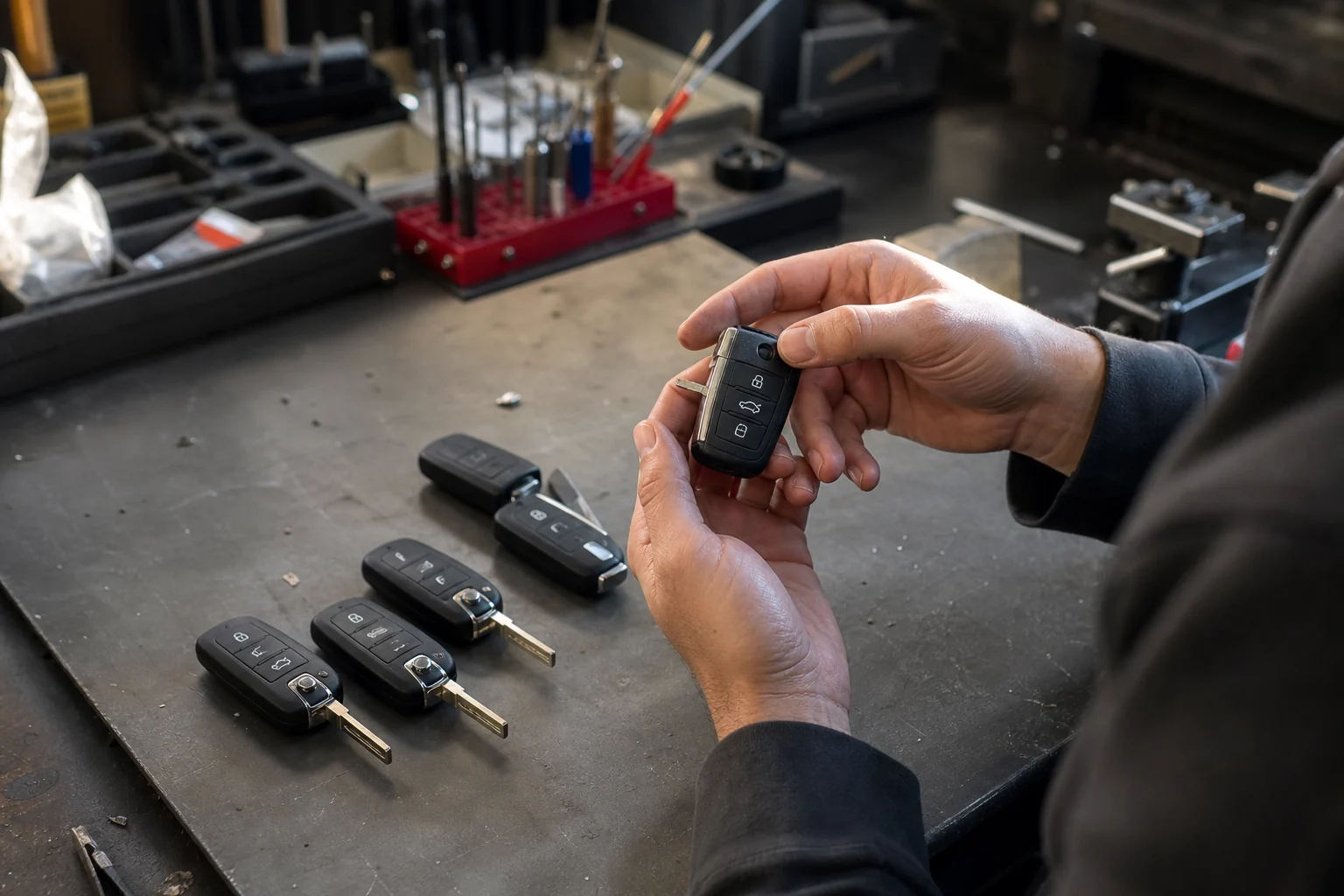
A Practical Porsche Shell Compatibility Decision
Use a short evidence check before ordering a Porsche remote key shell. The aim is not to find a listing that mentions “Cayenne,” “911” or “Boxster,” but to establish that the offered housing is a plausible physical match for the key you already have.
Record the original key first
Write down the features that must remain compatible:
- number and arrangement of Porsche key buttons;
- overall housing shape, including the rear and side profile;
- fixed or folding blade arrangement;
- the shape of the circuit board and battery area;
- visible retaining points, clips or screw locations;
- whether the original blade, transponder and other internal parts are present and reusable.
This record prevents a common mistake: treating a model name or button count as conclusive evidence. A Porsche Cayenne key shell, Porsche 911 key shell or Porsche Boxster key shell may still require different internal parts or a different blade arrangement.
Compare the listing, then identify the gaps
Review the candidate Porsche remote key casing from the front, rear, side and blade end. Compare its photographs with your original key, not with a generic image found elsewhere. Check whether the listing shows the inside of the housing and clearly states which parts are included. “Shell,” “case” and “housing” can describe different replacement packages, so confirm this point rather than assuming that buttons, a blade, electronics or a transponder are supplied.
Before ordering, separate confirmed evidence from unanswered questions:
- Is the exact housing design shown, or only a similar-looking key?
- Are the internal supports and component positions visible?
- Does the listing explain the blade arrangement and what transfers?
- Are the included parts identified clearly?
- Is compatibility stated for the relevant key design, rather than only for a broad Porsche model range?
If an answer depends on a photograph that is missing, unclear or taken from only one angle, treat compatibility as unconfirmed. The same applies when your original key has an unusual layout, damaged electronics or missing components. In that situation, ordering a replacement key shell may create an additional part that still cannot be assembled into a usable key.
Choose the shell only when the retained parts and blade arrangement are plausible matches, and the listing provides enough evidence to support that conclusion. If a critical component is broken, absent or impossible to identify, pause and make a complete-key enquiry instead of guessing. This is particularly important when comparing listings for the Lithuanian market: verify the specific replacement type and included parts with the seller, without assuming that every advertised option is locally available or supported.
The practical takeaway is simple: do not choose a Porsche remote key shell from the model name or button count alone. Before ordering, compare the shell’s exact shape and button layout with your current housing, then confirm that your electronics, transponder-related parts, blade and internal components can transfer. If any detail differs—or the listing does not provide enough information—treat compatibility as unconfirmed rather than assuming it will fit. This applies whether you are sourcing a replacement in Lithuania or elsewhere: the correct shell is identified by the complete key assembly, not the badge on the boot lid.
Choose the option that matches your vehicle and situation.
Frequently asked questions
Can the same Porsche model use more than one remote key shell design?
Yes. A model name alone may not identify the correct shell, because the same Porsche model can be associated with different remote designs or internal layouts. Compare the original remote’s shape, button arrangement, opening method and internal cavity with the replacement listing before treating it as compatible.
Is matching the number of buttons enough to identify a Porsche shell?
No. Button count is only an initial clue. The symbols, spacing, button position, housing contours and overall proportions can reveal differences between otherwise similar remotes. A shell with the same number of buttons may still have a different circuit-board position or button mechanism.
Can I move my original circuit board into a replacement shell?
That depends on the shell’s internal cavity, locating supports, retaining features and button mechanism, as well as the exact design of your original board. The board must sit securely and align with every button. Check interior photos or technical details rather than assuming that a similar outer shape will accept it.
What if the buttons and electronics work but the Porsche housing is cracked?
An empty replacement shell may be the relevant option when the original circuit board, buttons and other reusable parts still function and can be transferred. The replacement must still match those parts physically. If the damage affects retained components or their mounting points, a shell alone may not solve the problem.
Does a matching shell automatically accept my original blade?
No. Casing compatibility and blade compatibility are separate questions. Check the blade’s mounting point, pivot arrangement, end shape and whether the original blade is designed to transfer. A shell can match the remote electronics yet use a different mechanical blade arrangement.
What should I do if a listing only says it fits Cayenne, 911 or Boxster?
Treat the model reference as a starting point, not proof of fit. Compare the listing’s photographs and internal details with your original remote, or ask for clearer information about the cavity, buttons and blade mount. If the evidence remains unclear, choosing another listing is safer than relying on the badge alone.
Which photos should I take of my original Porsche remote?
Take clear photos of the front, rear and side profile, including the full button area and the end of the blade. If the remote can be opened safely, photograph the interior, circuit-board position and retaining points as well. Avoid forcing a sealed housing, since opening it may cause damage.
When is a complete replacement key more relevant than a shell?
A shell is not the right category if essential electronics, transponder-related parts or mechanical components are missing, damaged or unusable. In that situation, you may need to investigate a complete replacement-key option, subject to the vehicle and key requirements. For a next step, car-keys.lt may help you identify the relevant category.
