
Compare the housing, button layout, blade mount and internal supports before ordering.
- A BMW E39 key shell replaces the outer housing, not automatically the circuit board, transponder, battery or key blade.
- Button count helps identify a possible match, but button position and the surrounding casing shape must also agree.
- Compare the original key’s front, rear and side profiles, including the seam, clips, blade opening and any screw points.
- The blade mount is a separate compatibility question because a matching housing may use a different blade arrangement.
- Internal supports, battery placement and circuit-board clearance determine whether the existing electronics can transfer into the replacement shell.
- A shell swap does not by itself cut a blade or program a key, so mechanical and electronic requirements must be assessed separately.
A BMW E39 key shell may look right and still be the wrong replacement for your key. The model name and number of buttons are useful starting points, but they do not confirm that the housing will accept your blade, circuit board, battery arrangement, or internal supports.
Use your existing key as the main reference before ordering. Compare its overall shape, button positions, seam lines, blade attachment and the way the electronics are held inside the case. These details can differ between keys that appear similar in listings, including versions with the same general E39 application.
This guide explains how to check those points and how to separate four issues that are often confused: whether the shell physically matches, whether the blade can be reused or fitted, whether the original electronics can be transferred, and whether the completed key will work with the vehicle. A compatible shell is only the outer housing; it does not automatically provide a suitable blade or replace the need for vehicle programming. If the original key and the replacement shell differ in a critical mounting detail, forcing the parts together can damage the housing or the electronics. Compare photographs and measurements carefully rather than relying on the listing title alone.
What a BMW E39 Key Shell Replacement Actually Changes
A BMW E39 key shell replacement normally changes only the outer housing: the plastic case that holds and protects the key’s existing components. It may also be described as a BMW E39 key housing, key case or remote key housing. That wording does not automatically mean you are buying a complete working key. A shell can be an empty casing intended for parts transfer, while a complete replacement key may include additional components and may require separate cutting or programming.
Treat the following as separate parts unless the product listing clearly says otherwise:
- the outer housing or casing;
- the BMW E39 key blade;
- the remote electronics and buttons;
- the battery and any internal supports;
- the transponder or other immobiliser-related component;
- key cutting and vehicle programming.
The exact contents depend on the intended product. Before ordering, confirm that it is sold as a housing rather than a complete key, then check the product description or photographs to see which parts are included. Do not assume that a blade, circuit board, battery, transponder or programmed function comes with the shell simply because the listing uses the vehicle model name.
“BMW E39” is useful as a starting point, but it is not enough to establish BMW E39 key compatibility. Keys supplied for the same model range can differ in housing design, internal arrangement, blade setup or remote configuration. Button count is also only one clue: two keys with the same number of buttons can still use different cases or internal parts, while a visually similar case may be intended for another key version.
Use your original key as the primary reference before transferring anything. Identify the exact type of key you have, note any markings or part information, and compare it with the intended BMW E39 replacement key shell. If the listing does not show enough information to establish that match, treat compatibility as unconfirmed rather than relying on the model name alone.
This distinction prevents a common purchasing error: buying a shell when the actual requirement is a complete replacement key, or buying a complete-looking product without confirming that its housing matches the original. The shell assessment comes first; blade, electronics and programming must then be considered as separate fit or service questions.
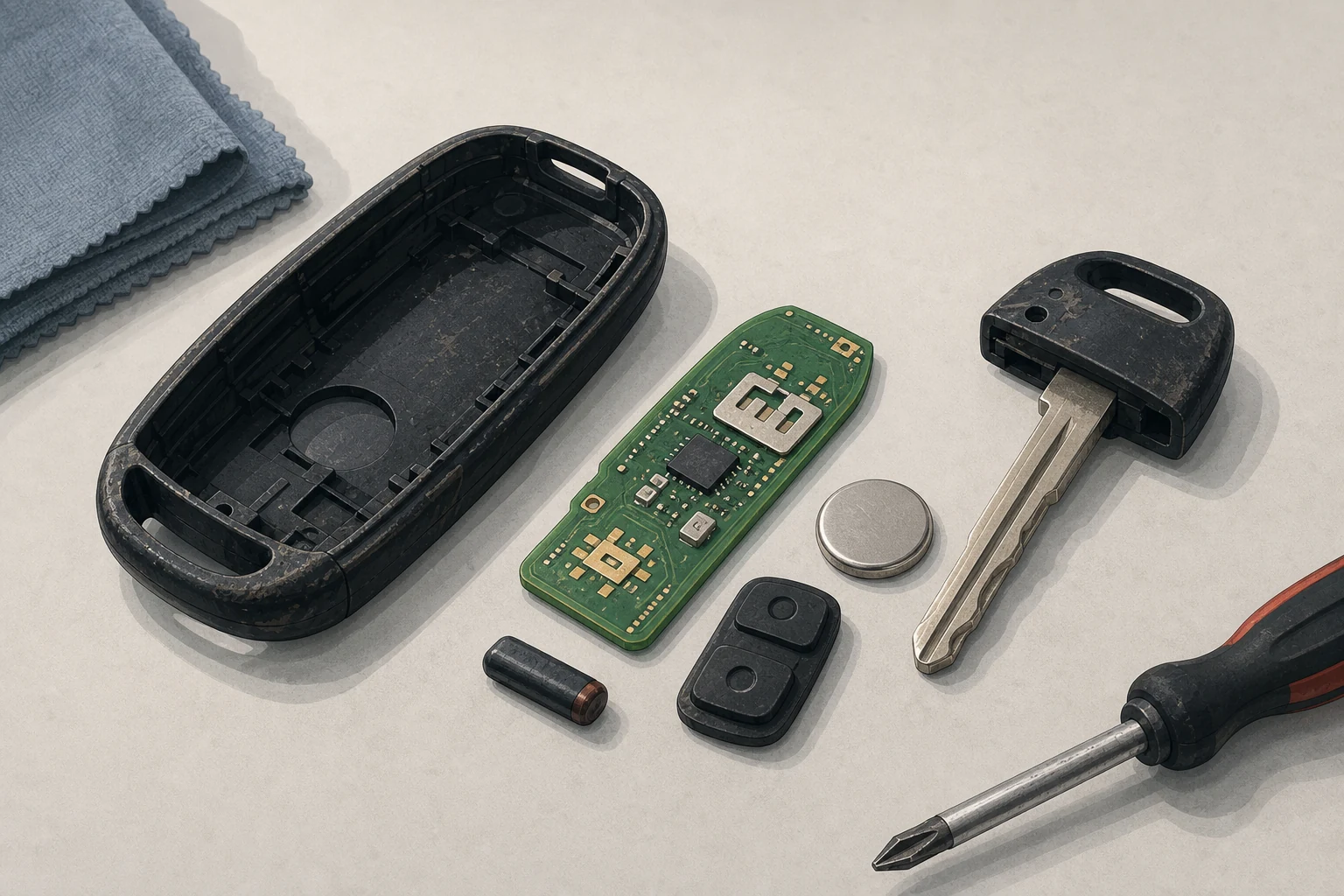
Compare the Original Key’s Housing From Every Angle
Before choosing a BMW E39 key shell, compare the original housing with the replacement listing’s photographs, dimensions and construction details. Do not rely on the vehicle model or the number of buttons alone. Two casings can look similar in a product image while using different moulds, fastening points or internal proportions.
Start with the visible layout
Look at the front of both housings from the same angle. Check:
- the number of buttons and their order;
- the shape and spacing of the button openings;
- the position of any indicator window or logo area;
- the outline of the front panel around the buttons;
- the location of the key-ring loop or other visible features.
Button count is useful, but button position is more informative. For example, a three-button BMW E39 key shell may not match another three-button casing if one has a longer central button, different spacing or a differently shaped front insert. A listing should show the actual front layout clearly enough to compare it with your original key, not just a generic vehicle-compatible image.
Turn both housings over and compare the rear profile. Check whether the back is flat, rounded, stepped or raised, and inspect the position and shape of the casing seam. A seam that runs around the edge in one design may cross a different area in another. Also compare the rear panel’s texture, recesses and corner radius. These details affect how the two halves meet and whether the replacement has the same external shape as the original BMW E39 key housing.
Inspect the edges and openings
The side profile often reveals differences hidden by front-facing photographs. Place the original key on its edge and compare its thickness with the replacement shell’s stated dimensions or a scale photograph. Check the location of visible clips, notches and screw points. If one variant uses clips and another uses screws, or if the fasteners sit in different positions, the parts may not assemble as expected even when the outer outline appears close.
Examine the opening where the blade or folding section emerges, but treat this only as an exterior comparison at this stage. The opening’s width, shape and position should resemble the original, as should the surrounding hinge or mount area. A narrow opening, altered shoulder or different hinge cover can prevent the original moving section from sitting correctly. Detailed BMW E39 key blade and mounting compatibility should be checked separately rather than assumed from the casing’s appearance.
Use the listing to confirm the replacement’s external length, width, thickness and construction material where those details are provided. Compare measurements from matching points; overall length can be misleading if one shell includes a projecting loop or button surround. Photos should also show the seam, side edges and rear, not only the front.
If any exterior feature differs, pause before transferring components. A BMW E39 replacement key shell is a plausible match only when the front layout, outer profile, fastener arrangement and openings agree closely with the original. A seller’s broad “E39” description may cover several visually related variants, so ask for dimensions or additional photographs when the listing does not show these areas clearly.
- Match button count and exact button positions
- Compare front, rear and side casing profiles
- Inspect the seam, clips and screw points
- Check the blade opening and mounting area
- Allow for a separate electronics and battery check
Check the Blade Mount Separately From the Housing
A BMW E39 key shell can match the outside of your original casing and still be unsuitable for the blade. Treat the blade as a separate compatibility check, not as proof that the housing is correct. First identify the arrangement used by your key: it may have a fixed blade, a folding or hinged blade, or a blade mounted through a removable insert. A shell designed for one arrangement may not provide the correct space or fixing points for another.
Check the blade opening at the end of the shell. Compare its width, depth, shape and position with the original key. Then inspect how the blade is held in place. Depending on the design, the mounting interface may use a pin, screw, hinge, carrier or another retaining feature. The opening must align with the blade and its support; a similar-looking slot is not enough if the retaining point sits differently.
The product description should state whether a blade is supplied. It should also make clear whether the blade is already fitted, intended to be transferred from the old key, or supplied separately for later cutting. Do not assume that a photograph showing a blade means the purchase includes a usable, cut blade. If the listing is unclear, treat the blade as unconfirmed rather than relying on the vehicle name or button count.
If you plan to reuse the original blade, confirm that it can be removed without damaging its mounting area and that the intended BMW E39 replacement key shell accepts the same blade format. Some shells are made for a replacement blank instead. In that case, the blank may need to be cut to match the vehicle’s lock before it can be used mechanically. A shell that accepts the blank but cannot accommodate your original blade may therefore require a different solution.
Also separate a mechanical check from a complete key check. A blade that sits securely in the new housing may still be incorrectly cut, or may not turn the lock. Likewise, a blade that fits the opening does not confirm that the transferred key components will operate. The practical decision rule is simple: verify the blade style, mounting method and supply status independently before treating the BMW E39 key shell as a suitable match.
Assess Electronics, Battery Space and Internal Supports
A BMW E39 key shell is suitable only if it can hold the original electronics securely. Compare the replacement’s internal cavity with the opened original key, not just the two outer profiles. Check the circuit board’s length, width, thickness and outline, including any corners, cut-outs or raised components. A board may appear small enough to fit but still press against the lid, buttons or casing wall when the shell is closed.
Check the board supports and battery area
Look for the moulded posts, rails, clips and ledges that locate the circuit board. These features prevent the board from shifting and help keep the buttons aligned with the rubber button pad. Their positions must correspond with the board’s mounting holes or edges. If a replacement BMW E39 key housing uses different supports, the board may sit too high, move inside the case or leave one or more buttons unable to operate correctly.
Also compare the battery compartment in both housings. Confirm the original key’s battery format and observe its position, orientation and contact arrangement. The replacement shell must provide enough depth for the battery and leave the positive and negative contacts aligned with the board. A compartment that accepts the same battery physically may still be unsuitable if its retaining clip, contact channel or polarity layout differs. Do not force the board or bend contacts to make an almost-matching BMW E39 replacement key shell work; that can damage the electronics or create unreliable contact.
If the listing does not show the inside of the BMW E39 key case, request clear photographs or an internal drawing before ordering. Compare measurements from fixed reference points, such as the screw post or shell edge, rather than estimating from a product photograph. When several electronics variants exist, confirm that the seller supports the exact board shape and internal arrangement used by your key.
Check the transponder’s location and retention
The transponder may be a separate small component rather than part of the circuit board. Identify where it sits in the original housing and how it is retained. The replacement must provide a matching pocket, channel or secure locating feature so the transponder cannot move, fall out or become trapped under the board. If the shell has no equivalent space, transferring the component may require modification, and compatibility has not been established.
A practical transfer check has three outcomes: the original board fits without pressure, the battery sits correctly with its contacts aligned, and the transponder is held in the intended position. Only when all three points are confirmed should the shell be treated as a plausible internal match. An identical-looking exterior, matching button count or familiar BMW E39 label cannot prove that the internal layout is compatible.
When a Shell Is Enough—and When It Is Not
A shell-only repair is appropriate when the original housing is cracked, worn or no longer holds its parts securely, while the existing electronics, transponder and blade remain usable. In that situation, the BMW E39 key shell is only a replacement container: you transfer the original parts into a confirmed-compatible case. Before ordering, check the product’s exact contents. An empty BMW E39 key housing should not be assumed to include a blade, circuit board, battery or transponder.
The blade is a separate decision. If the replacement shell accepts your existing blade and its mounting arrangement, no new blade may be needed. If the original blade is damaged, missing or unsuitable for the new case, you may need a compatible blank and separate cutting or fitting work. Confirm whether the intended product includes a blade, and whether any required blade work is available separately. A housing that closes correctly does not prove that the blade will operate the lock.
A shell cannot compensate for damaged or incompatible electronics. If the circuit board, buttons, battery contacts or transponder cannot be reused, transferring parts into a BMW E39 replacement key shell may not produce a working key. At that point, the issue is no longer limited to the casing: the required replacement electronics and their compatibility must be assessed separately.
Programming is also outside a normal shell swap. Moving your original working electronics and transponder into a suitable case does not itself constitute programming. However, replacing those components can create a separate programming or pairing requirement, depending on the parts and vehicle system. Do not treat a complete-looking key case as proof that this work is included; verify the product contents and any programming arrangements independently.
Use this decision summary:
- Shell is enough: the original internal parts and blade are usable, and the new case matches them.
- Separate blade work is needed: the blade is damaged, absent or mechanically unsuitable.
- A broader replacement is needed: electronics or the transponder are damaged or incompatible.
- Programming must be checked separately: new or replacement electronic components are involved.
This keeps BMW E39 key compatibility decisions separate: housing fit, blade work and electronic operation are related, but they are not the same outcome.
The practical takeaway is simple: do not buy a BMW E39 key shell based only on the vehicle name or number of buttons. Match your existing key against the shell’s blade arrangement, button layout, overall shape, internal clips, and space for the original electronics. If any of these differ, the shell may not close, hold the circuit board, or accept the blade correctly. When the listing does not show these details clearly, treat compatibility as unconfirmed and compare the actual key—or obtain the seller’s confirmation—before ordering.
- Housing: does the outer casing match?
- Blade: can the blade mount or transfer?
- Electronics: does the board and battery fit?
- Vehicle function: are cutting or programming steps still required?
Choose the option that matches your vehicle and situation.
Frequently asked questions
Is a BMW E39 key shell the same as a complete replacement key?
No. A shell is the outer housing, usually supplied without the original circuit board, transponder, battery, or cut blade. A complete replacement key may include some or all of those parts, depending on the product. Before ordering, check exactly what is included and which components you intend to reuse.
Does matching the number of buttons prove that an E39 key shell will fit?
No. The button count is only an initial clue. The button shapes, their positions, the casing profile, seam, internal supports, and circuit-board layout must also match. Two keys with the same number of buttons can still use different housings, so compare the original key with detailed product photographs.
Can I move my original BMW E39 circuit board into a new shell?
Possibly, but this depends on the specific shell and board design. The board must sit correctly on its supports, the buttons must reach the switches, and the battery and transponder must have enough clearance. Do not assume transfer is possible solely because the replacement has the same external shape.
Can the original blade be reused in a BMW E39 key shell?
That depends on the shell’s blade opening and mounting arrangement. Some housings may accept an existing blade, while others require a different fitting method or a replacement blade. Reusing the blade and cutting a new blade are separate questions; the shell’s mechanical design must be checked before deciding.
Will changing the key shell program the key to the car?
No. Replacing the housing is a physical repair and does not, by itself, program the key or pair its electronics with the vehicle. Any programming, synchronisation, or immobiliser-related requirement is separate from fitting the shell and depends on the key’s existing components and the vehicle system.
What should I photograph before ordering an E39 key shell?
Take clear photos of the key’s front, rear, both sides, top and bottom, and the seam around the housing. Also photograph the blade opening, screw or clip locations, buttons, and any visible internal parts. Keep the camera close enough to show shapes and positions without obscuring details with reflections.
What if the replacement shell looks right but the buttons feel different?
That may indicate a poor match. Button height, shape, spacing, and contact alignment affect whether the original board can be operated correctly. A similar outer silhouette is not enough if a button presses beside the switch, remains depressed, or cannot pass through the housing opening.
Can a new shell fix a BMW key with damaged electronics or a missing transponder?
No. A shell replacement addresses physical housing damage, such as cracks or worn buttons. It does not automatically repair a faulty circuit board, replace a missing transponder, or restore other missing components. Those issues must be assessed separately before deciding whether a shell-only solution is suitable.
