
- A four-button layout is only an initial clue because button spacing, symbols, housing contours, and internal supports can differ.
- Compare the original key from the front, back, and side, including its seam, thickness, closure points, and button positions.
- The replacement shell must leave enough room and provide correct supports for the original circuit board, battery parts, buttons, and transponder.
- Blade shape, folding mechanism, attachment point, and cutting requirements are separate compatibility questions from the outer casing fit.
- A shell normally replaces the housing rather than automatically supplying a programmed remote, immobiliser transponder, battery, or vehicle-specific electronics.
- The supplied Hyundai product listing’s named models, button functions, blade arrangement, and transferable internal layout require manual confirmation before publication or recommendation.
A Hyundai model name and a four-button layout are not enough to confirm that a replacement key shell will fit. Hyundai used different housings across models, model years, markets, and key versions, so two keys with the same number of buttons can still differ in shape, internal layout, or blade connection.
The safest reference is the key you already have. Compare its outside profile, button positions, seam, blade attachment, and the space available for the existing electronics before ordering a Hyundai 4-button key shell. A shell may match the appearance of your key while failing to accept its circuit board, transponder, battery holder, or blade.
This guide explains how to identify the housing version and which details matter most when comparing listings or photos. It also separates shell compatibility from issues that the shell cannot solve, such as a different electronic module, an incompatible transponder, a non-matching blade, or vehicle-specific programming. The aim is to help you decide whether your current components can be transferred—or whether the apparent match is only cosmetic.
Start With the Key You Already Have
Your existing key is the most reliable starting point for a Hyundai 4-button key shell comparison. A vehicle name and four-button count narrow the possibilities, but they do not prove that two housings share the same shape or mounting points. Hyundai keys with the same number of buttons can still differ in casing design, folding mechanism, button spacing, or the way the two halves join.
Begin by recording the symbols and their order from left to right or top to bottom. Note whether the buttons show lock, unlock, boot release, panic, or another function, and check their relative sizes. A similar Hyundai key button layout should have matching positions, not merely the same number of symbols. For example, a boot-release button placed below the lock and unlock buttons is not equivalent to one positioned at the side.
Compare the original key with the proposed four-button Hyundai key casing from several angles:
- Front: Check the overall outline, button shapes, symbol positions, and the location of any indicator light or opening.
- Back: Look for differences in the rear cover profile, badge recess, screw position, and surface contours.
- Side: Compare thickness, curves, raised edges, and the angle of the folding section, if present.
- Seam: Follow the join between the two halves. A different seam path can indicate a different internal structure, even when the front looks close.
Also record whether your key is folding or non-folding. Among folding keys, compare where the blade pivots, how far the key extends when opened, and the shape of the hinge area. Among fixed keys, note whether the blade leaves the housing from the centre, side, or an angled section. These visible differences are useful for an initial Hyundai key shell compatibility check, but they are not proof of a match.
Photograph the key before opening it. Take clear, well-lit images of the front, back, both sides, the open position if it folds, and the seam. Include a ruler only if it does not obscure the outline. Keep the original photos with the listing images so you can compare proportions rather than relying on memory. If the button order, profile, or closure line is visibly different, treat the Hyundai replacement key shell as unconfirmed and seek a clearer match before ordering.
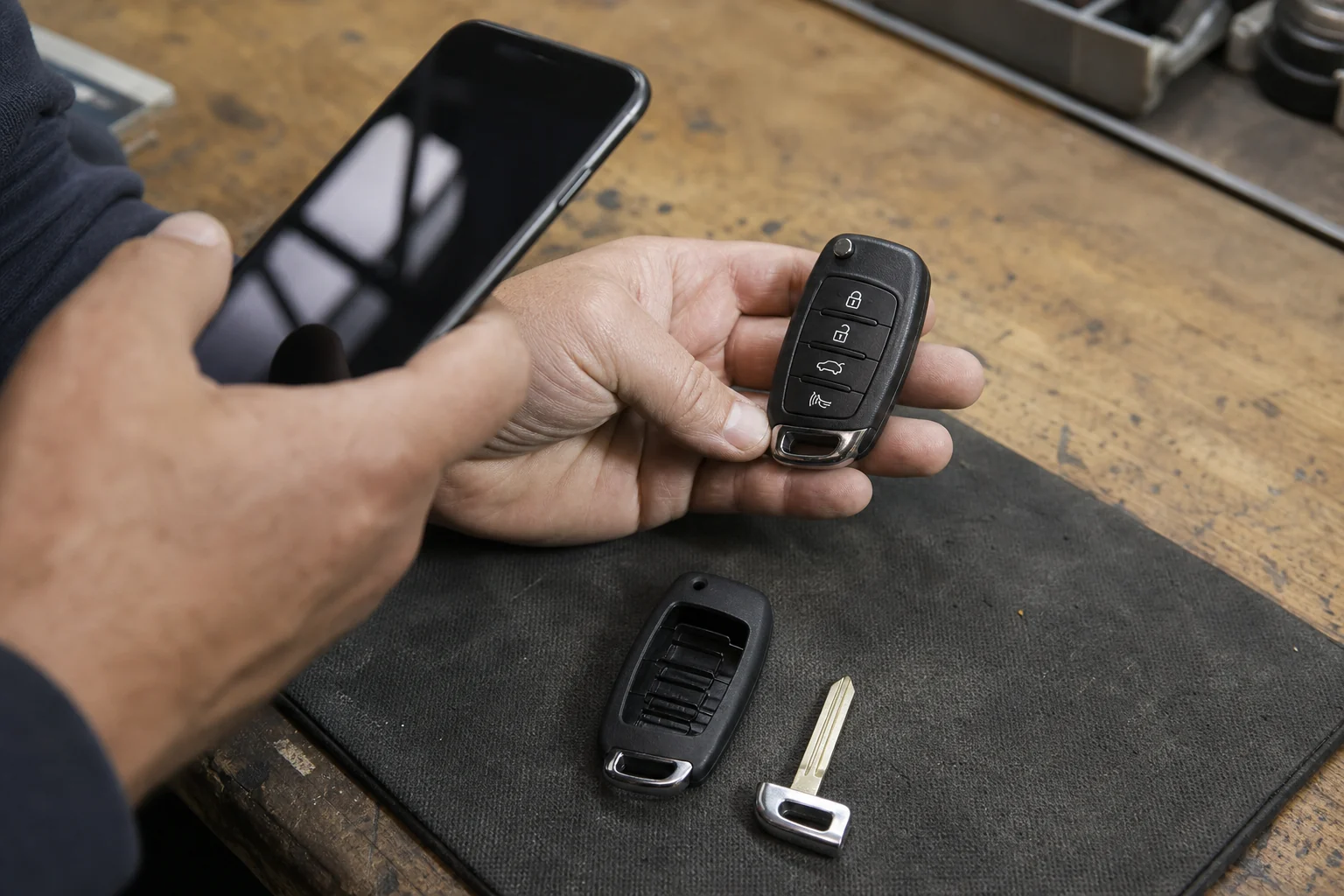
Compare the Housing, Cavity, and Closure Points
A Hyundai 4-button key shell should match the original housing in more than its general appearance. Place the two cases side by side on a flat surface and compare their overall length, width, and thickness. Check the contours around the corners, edges, front face, and rear cover. A replacement that is slightly narrower or thicker may still look similar in a product photo but leave internal parts loose, prevent the halves from meeting, or change how the buttons sit.
Check the outer casing
Look at the button openings from directly above. Their shapes, spacing, and distance from the case edges should correspond with the original. Also check whether each opening is round, oval, rectangular, recessed, or shaped around a raised guide. The same Hyundai key button layout can appear in housings with different openings, so matching the number and symbols alone is not enough.
Compare the case seam next. The seam should follow the same route around the housing, with no extra step, ridge, or change in corner shape. Then locate every visible screw hole, clip position, hinge-side joint, and other closure point. If one case uses a screw where the other relies on clips, or if the positions are offset, the two halves may not assemble correctly even when their exterior dimensions seem close.
Do not rely only on photographs when checking the inside of a four-button Hyundai key casing. Open the existing housing carefully, if it is already being disassembled, and compare the replacement cavity with it. Inspect the location and height of internal posts, rails, ledges, and board-support surfaces. These features determine where the inner components sit and whether the cover has enough clearance. Their shape and position need manual confirmation; a vehicle name or product title cannot confirm them.
Test the closing fit
Before treating a Hyundai replacement key shell as a match, bring the two replacement halves together without forcing them. The edges should meet evenly, the seam should remain closed, and the case should not rock when gently handled. Screws or clips should reach their intended points without being pulled sideways or pressed into place at an angle.
Stop if the housing closes only under pressure, leaves a visible gap, or springs apart after assembly. Those signs can indicate a different cavity depth, misplaced support, incorrect closure geometry, or interference inside the case. Do not file posts, bend clips, or tighten a screw to compensate before confirming the dimensions and internal layout. A clean-looking exterior is not sufficient evidence of Hyundai key shell compatibility; the housing must also close securely without movement.
- Button symbols and order
- Front, back, and side shape
- Case seam and closure points
- Blade style and attachment
- Interior supports and transferable parts
Check Every Part That Must Transfer
A Hyundai 4-button key shell is usually only the outer housing. Unless the listing clearly states that it includes a circuit board, buttons, battery parts, or an immobiliser component, assume that you must transfer the parts from your existing key. A similar-looking Hyundai key fob housing can therefore still be unsuitable if its internal supports do not hold your original components correctly.
Test the circuit board and buttons
Remove the original board only when you can do so without damaging the case or attached parts. Place it into the replacement shell and check whether it sits flat on the intended supports. The board should meet the posts, rails, ledges, or clips at the same points as in the original housing. It should not rock, bend, slide sideways, or press against the cover when the two halves are brought together.
Pay attention to the board’s orientation. A shell may have the right general outline but place the board upside down, off-centre, or at the wrong height relative to the button openings. Any gap around a support can allow movement, while excessive pressure can damage the board when the shell is closed. Manual confirmation of the circuit-board shape and mounting points is more reliable than a vehicle name or a product photograph.
Check how the buttons transfer as well. Some keys use a flexible rubber membrane attached to the board; others use separate plastic button pieces that sit in the front cover. Confirm which type your original key has and whether the replacement shell is designed for it. The button symbols, order, and spacing should already match your original key, but also check the physical contact points underneath. Each button should sit over its switch without being permanently pressed, and it should return to its normal position after you release it.
Confirm the battery and other small parts
Identify where the battery sits in the original key and compare the complete arrangement inside the replacement. Check whether the battery is held by a plastic recess, a removable holder, or metal contacts attached to the circuit board. The shell must leave enough clearance for the battery and contacts without forcing the board upward or preventing the case from closing.
Do not assume that a replacement housing includes a battery holder or contact parts. If those pieces are separate from the board, verify that they can be moved across and that the new shell has the matching retaining features. Also check for small insulators, clips, or spacers that prevent contact parts from shifting. A battery may fit into the cavity yet fail to maintain reliable contact if the holder is loose or the cover applies pressure in the wrong place.
If the original key contains a separate transponder, look for its exact position before transferring anything. It may be seated in a dedicated recess or retained by a small internal feature rather than attached to the circuit board. The replacement must provide an equally secure position, with no risk of the chip rattling, falling out, or being trapped between the case halves. Do not assume that every four-button Hyundai key uses the same arrangement.
Make a part-by-part checklist: circuit board, rubber membrane or separate buttons, battery, holder, contacts, spacers, and transponder if present. A four-button Hyundai key casing passes this internal check only when the original parts fit securely, remain correctly aligned, and allow the shell to close without pressure or movement. If the listing does not confirm which components are supplied, ask for that information before ordering rather than treating the shell as a complete replacement key.
- Housing: the main intended function of a shell
- Buttons: only if the layout and parts are compatible
- Circuit board: transfer depends on shape and supports
- Blade: a separate mechanical compatibility question
- Remote or transponder: never assume inclusion or programming
Treat the Blade and Vehicle Functions as Separate Checks
A matching Hyundai 4-button key shell does not automatically match the blade. Compare the blade profile, length, shoulder, thickness, and the point where it attaches to the housing. The attachment may use a pin, screw, pivot, or another arrangement, so a blade that looks similar may not seat securely in the replacement casing. Check the product listing manually to establish whether it includes a cut blade, an uncut blank, or no blade at all.
Check the blade mechanism
Also identify whether your original key uses a fixed blade or a folding mechanism. A folding key needs more than an opening in the case: the replacement must provide the correct pivot position, stop, spring arrangement, and clearance for the blade to open and close. A fixed-blade Hyundai replacement key shell may therefore be unsuitable even when its button layout and outer shape appear correct.
If the listing is intended to accept a transferable blade, compare the original blade’s mounting point with the replacement’s attachment arrangement before ordering. Some blades may be moved only after removing a pin or fastener; others may be permanently formed as part of the original key assembly. Do not assume that a locksmith can transfer every blade to every four-button Hyundai key casing. If the attachment is unclear, ask for a clear image of the blade channel and mounting point, rather than relying on the vehicle name alone.
Treat remote and immobiliser functions separately
Remote-button operation and engine-start recognition are different checks. The buttons may lock or unlock the vehicle when the remote electronics are installed correctly, while the immobiliser system may still fail to recognise the key. Conversely, a transponder may allow starting even if a remote button is not operating correctly. A successful case transfer therefore does not prove that all vehicle functions will work.
Before treating the Hyundai key shell compatibility check as complete, confirm separately whether the original remote can be used in the replacement housing and whether the immobiliser component remains correctly positioned. The listing must be checked for any vehicle-specific programming implications; a shell alone should not be treated as a replacement for pairing or programming.
Finally, separate three possible tasks: moving the existing blade, cutting a blank to match the vehicle, and pairing or programming the remote or immobiliser. Cutting may require the original key or a precise key code, while programming requirements depend on the vehicle and the replacement components. Confirm each requirement independently before disassembly.
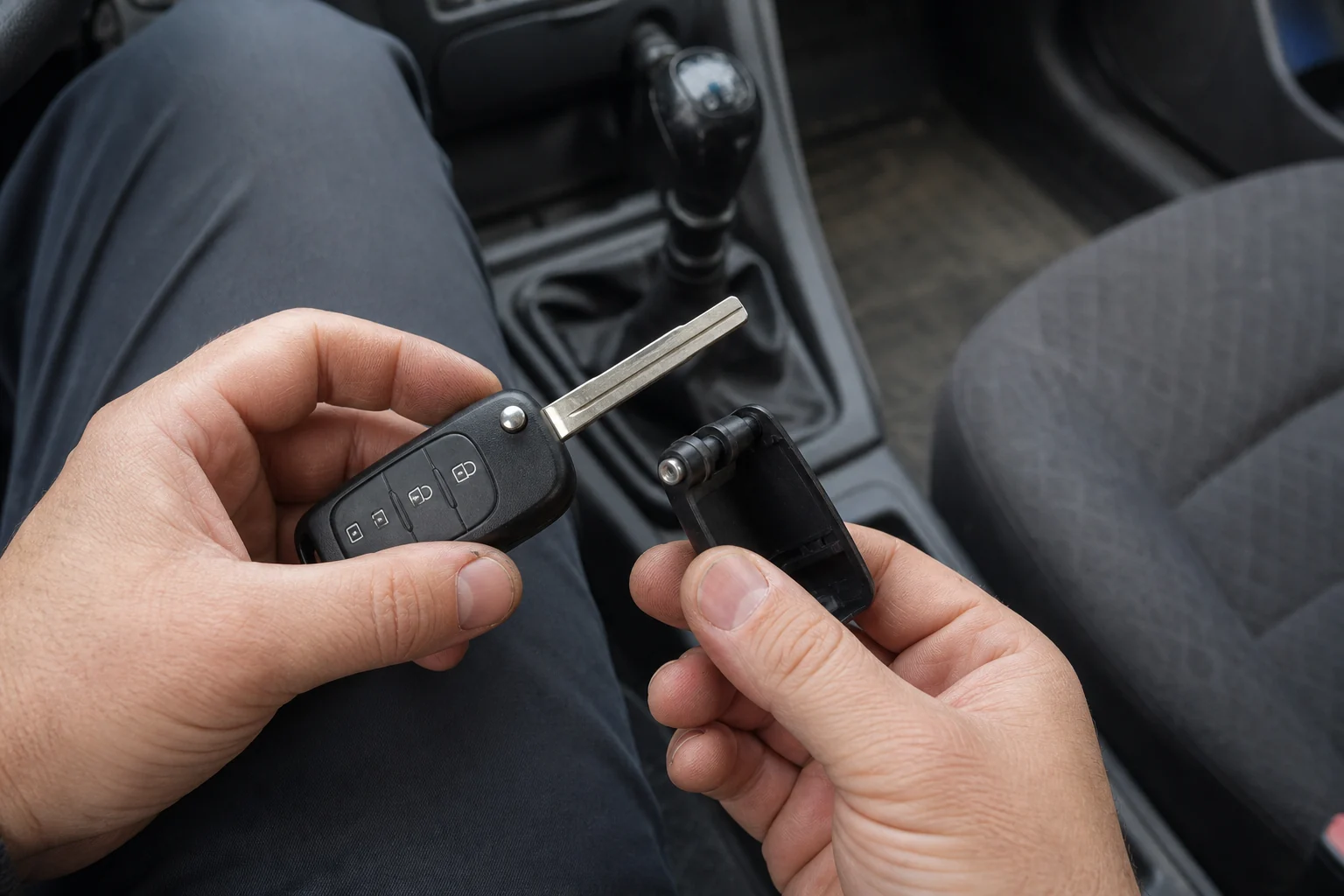
- Vehicle names can cover different key revisions
- Four-button layouts can use different housing shapes
- A casing match does not confirm electronics or blade compatibility
- Product-specific claims require manual confirmation before publication
Make a Careful Pre-Order Decision
Proceed with the Hyundai 4-button key shell only when the checks agree: the visible shape and Hyundai key button layout match, the internal supports accept your original parts, and the blade connection is consistent. The vehicle name and four-button count are useful search clues, not proof of Hyundai key shell compatibility. A decision is stronger when the listing states the exact fit claim rather than naming only a broad model range.
Pause before ordering if the product photos, stated dimensions, or listing details conflict. Warning signs include an unclear case profile, a different button order, missing measurements, or no explanation of the internal cavity and blade attachment. Do not treat a four-button Hyundai key casing as suitable merely because it resembles your key in one image.
If important information is missing, ask the seller to confirm the exact shell against clear photographs of your key: the front with buttons visible, the side profile, the back, and the open housing if it is already apart. Request matching product photographs or measurements where possible. Written confirmation is useful, but it cannot replace a clear physical match when the listing is vague.
Keep the original circuit board, buttons, battery parts, blade, fasteners, and any small transponder component together during transfer. Do not discard the old housing until the Hyundai replacement key shell closes securely and all parts are accounted for. If any check remains uncertain, stop and verify it rather than relying on model-year or button-count equivalence.
Before buying a Hyundai four-button key shell, treat the vehicle model and button count as starting clues, not proof of compatibility. Compare the old and replacement housing side by side: check the button positions, outer shape, internal cavity, blade connection, and whether the circuit board, transponder, and other reusable parts can transfer. If any of these details differ, pause rather than assuming the shell will work. The safest choice is the housing that matches the original in every relevant physical detail, with compatibility verified before purchase.
Choose the option that matches your vehicle and situation.
Frequently asked questions
Does a four-button Hyundai key shell fit every Hyundai key with four buttons?
No. Four buttons only describe the control layout. The shell may still differ in its outer shape, internal supports, battery space, circuit-board mounts, blade attachment, or closure points. Compare the original key with the replacement housing, including its interior, before treating the button count as evidence of compatibility.
Can I identify the correct shell from the Hyundai model name alone?
Usually not. The same model name may cover different years, markets, key revisions, or remote designs. Use the vehicle details as a starting point, then compare the original key’s shape, buttons, blade arrangement, seam, and internal layout. If those details are not shown in the listing, ask the seller for confirmation.
What photos should I take before ordering a replacement shell?
Take clear, well-lit photos of the front, back, sides, seam, blade, and any folding mechanism. If possible, open the key and photograph the circuit board, button area, battery position, mounting points, and cavity. These images help with comparison, but a photo alone may not prove that every component will transfer correctly.
Can the original circuit board be moved into a new Hyundai shell?
Possibly, but the board must match the shell’s internal cavity. Check its shape, mounting points, button alignment, battery clearance, and available space before ordering. A shell that looks identical outside can still prevent the board from seating correctly or stop the buttons from making proper contact.
Will a replacement shell include a working remote or immobiliser transponder?
A shell is normally a physical housing, not proof that it includes compatible electronics. Check the listing carefully to see whether it contains a circuit board, rubber buttons, battery parts, or a transponder. Remote operation and immobiliser recognition are separate matters, so do not assume either function is included or ready to use.
Can I move the blade from my old key into the replacement shell?
That depends on the blade profile, folding mechanism, pivot or attachment point, and the replacement shell’s internal design. Some housings accept the original blade; others require a compatible blank or blade transfer. Confirm how the blade is fitted before ordering, and treat cutting a new blade as a separate requirement.
Why can a replacement shell look correct but fail after assembly?
Small internal differences can cause failure even when the outside appears right. Common problems include supports in the wrong position, a cavity that is too shallow, button interference, insufficient battery clearance, or a case that will not close evenly. Compare the opened housings and test the fit carefully before forcing the parts together.
What should I do if the listing does not show the internal cavity?
Pause the order and request clear interior photos or written confirmation that the shell accepts your original board, buttons, battery parts, and blade. Do not rely on the Hyundai model name or button count alone. If the seller cannot provide useful compatibility details, choosing a listing with a documented interior match is safer.
