
- A two-button layout identifies the control count but does not by itself confirm that a Fiat key shell will fit.
- Compare the replacement shell with the existing key’s outer shape, button positions, seams, and internal cavity before ordering.
- The key’s blade arrangement and attachment point must match the replacement housing or require separate compatibility confirmation.
- A shell replacement generally depends on transferring the original electronic parts, so their size and placement need checking first.
- A replacement housing is different from a complete programmed key because the shell alone may not contain the vehicle-specific electronics.
- Fiat model names and production versions can cover different key designs, making the exact existing key shape more reliable than the badge alone.
Choosing a Fiat two-button key shell is not simply a matter of matching the number of buttons. Two keys may share the same button count while differing in housing shape, button positions, blade arrangement, opening method and space for the original electronic parts. A shell that looks similar can still be unsuitable if its internal layout or blade type does not match your existing key.
Before ordering, compare the replacement with your current key from several angles. Check the overall outline, button symbols and spacing, the location and shape of the blade, and how the casing is joined. You should also confirm that the original transponder, remote circuit board and any other small components can be transferred without forcing or modifying them. The replacement shell normally protects and carries these parts; it does not replace the vehicle’s existing electronic identity.
This guide explains how to identify the right Fiat two-button key shell by using the old key as the main reference, which details matter most when product photos look alike, and when a shell should be rejected despite having two buttons. It also covers practical checks before dismantling the original housing, so you can reduce the risk of ordering an incompatible shell or damaging reusable components.
Why Two Buttons Are Only the Starting Point
Two buttons identify the number of controls, not the complete design of the key. A Fiat two-button key shell may still differ in its outer shape, button arrangement, blade position, or internal space. As a result, a listing described as a “two-button car key shell” is only a possible match—not proof that it will fit your key.
Different Fiat housings can use the same two-button layout while having different proportions or attachment details. One Fiat key fob housing may be rounded, another more angular, and the buttons may sit in different positions or use different openings. These differences affect whether the original parts can be placed into the replacement case correctly.
The model name and badge are useful clues, but they are incomplete identifiers. A Fiat model may have different key designs across generations, production periods, or equipment versions. Even if the vehicle badge appears on a product listing, that does not confirm key shell compatibility. The same caution applies to a Fiat key cover or Fiat replacement key case described only by vehicle name.
Your existing key is therefore the strongest starting reference. Treat its physical design as more important than the vehicle badge or the number of buttons. Check whether the replacement appears to follow the same housing pattern, rather than assuming that any two-button shell is interchangeable. For example, two keys may both have lock and unlock buttons but differ in the position of the blade or the way the housing closes.
A product photo can provide an initial visual clue, but it cannot confirm compatibility on its own. If the listing shows only the front face or gives only the button count, important differences may remain hidden. Pause before ordering when the replacement does not clearly resemble the complete existing key; a similar button layout is not enough evidence.
Compare the Existing Key With the Replacement Shell
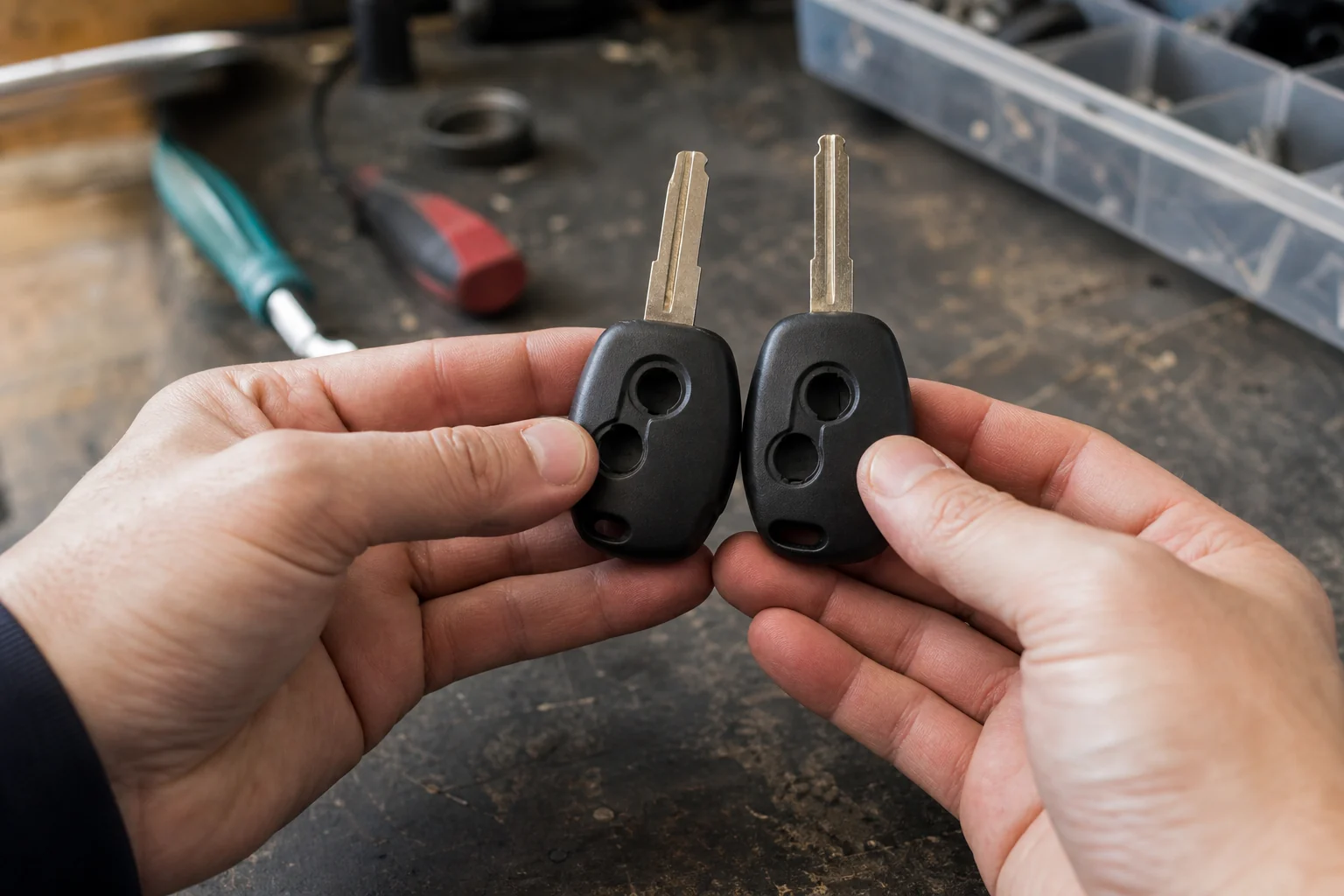
Place your existing key beside the product photographs and compare the outer housing before relying on the Fiat model name or the two-button description. Start with the overall outline: note the length-to-width ratio, rounded or squared ends, the shoulder around the buttons, and any taper along the sides. Two housings may both look broadly oval in a thumbnail but differ enough at the corners or edges to prevent a proper match.
Next, check the button area rather than counting buttons again. Compare the position of each button relative to the housing edges, including the distance between the buttons and the amount of plastic around them. Button shapes also matter: they may be circular, elongated, recessed, raised, or separated by a narrow divider. A Fiat key cover with the right number of buttons but a different button cut-out can indicate a different housing design.
Inspect the side profile and the seam between the shell halves. Look for differences in thickness, the height of the button panel, and whether the sides remain straight or curve inward. The corners should follow the same shape when viewed from above and from the side. A shell that appears similar from the front may still have a different back contour or a wider edge, so do not judge compatibility from one image alone.
Compare the key-ring opening and other visible attachment points on the housing. Check its position, size, and shape, as well as any visible screw recesses, clips, posts, or locating features shown on the replacement. These details can distinguish otherwise similar versions. Only treat a feature as relevant after confirming that it is part of the offered Fiat replacement key case, not merely an artefact of the photograph or a detail hidden by an assembled view.
Use clear photographs taken from matching angles: front to front, back to back, side to side, and, where available, close-ups of the edge and key-ring end. If the listing shows only the button face, it does not provide enough evidence to compare the complete housing outline. Enlarge the images and align the same end of each key before judging proportions; perspective can make a near edge look shorter or thicker.
Make a simple comparison list of matching and uncertain features. If the outline, button cut-outs, thickness, seam, key-ring opening, and visible attachment points all correspond, the photographs provide useful preliminary evidence for key shell compatibility. If one of these features is hidden, blurred, or visibly different, pause rather than assuming the Fiat key fob housing will match. The next checks should address the blade arrangement and the parts that must transfer before ordering.
Check the Blade Arrangement and Attachment Point
A Fiat two-button key shell can look correct at the front and still fail because the blade is arranged differently. Before ordering, identify whether your original key has a folding blade that retracts into the housing or a fixed blade that remains extended. A shell made for one arrangement is not automatically suitable for the other, even when the outer cover and button count appear similar.
Next, compare the blade’s position and orientation. Note which end of the housing it leaves from, whether it sits centrally or to one side, and which direction it faces when folded or stored. Also compare the blade’s width, shoulder and visible length. A blade that exits from the opposite side may prevent the housing from closing or place the key at the wrong angle in the ignition, depending on the vehicle’s original design.
The connection between the blade and housing needs its own check. For a folding design, inspect the hinge area and the location of the pin or other retaining point. The spacing, diameter and position of these attachment features must correspond with the replacement Fiat key cover. For a fixed-blade design, check how the blade enters and locks into the housing rather than assuming that a similar-looking slot is compatible.
Pay attention to what the listing says about the blade itself. A shell may be supplied with a blade, intended to retain the blade from the original key, or designed for the existing blade to be transferred. These are different replacement tasks. If a new blade is included, confirm whether its profile and attachment method match your key; if the original blade is retained, confirm that it can be removed without damaging the housing or its fixing point.
When the shell outline looks close but the blade details are unclear, request or locate a photograph showing the underside, hinge or blade-entry area. Do not use the two buttons as evidence of mechanical compatibility. Record the exact blade arrangement, exit position and attachment detail from your existing key, then compare those features with the product-specific information before treating the Fiat replacement key case as a possible match.
Make Sure the Existing Key Parts Can Transfer
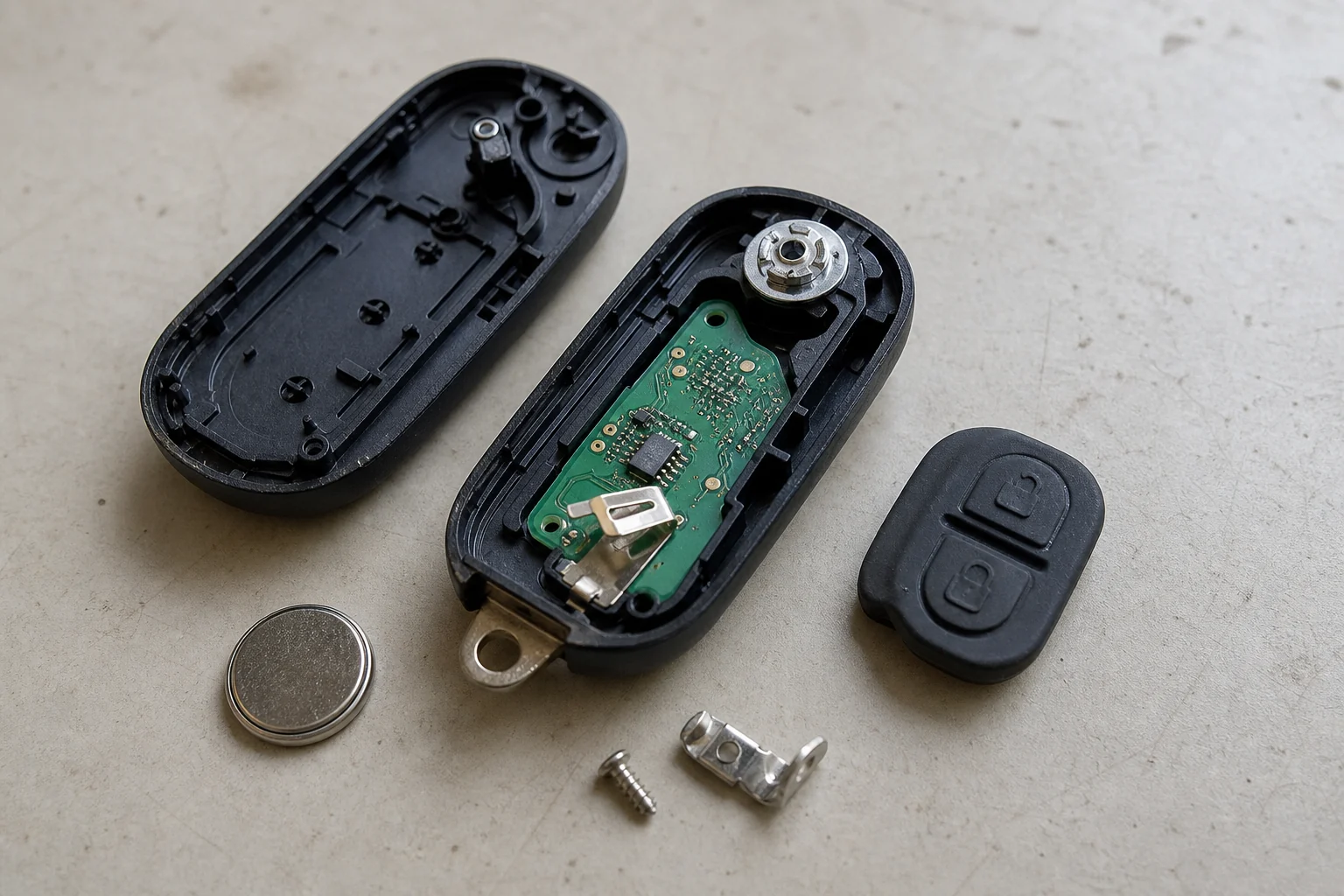
A Fiat two-button key shell is normally a replacement housing, not a complete programmed key. Its job is to hold the parts from your existing key, such as the circuit board, battery, button pad and any other vehicle-specific component fitted inside the original housing. Replacing the cover does not automatically replace, copy or program those parts.
Before ordering, check whether the replacement housing is designed around the same internal layout as your key. Compare the cavity’s length, width and depth, then look at the supports that keep the circuit board in position. These may include guide rails, clips, posts, recesses or screw points. Even a small difference can leave the board loose, prevent the housing from closing, or put pressure on the electronics when the case is assembled.
Also compare the board and battery positions rather than judging the cavity by eye alone. The board must sit beneath the correct button locations, while the battery must fit its recess without being forced against the cover. Check the shape and position of the rubber button pad and the contact points that operate the board. If the replacement Fiat key fob housing places its buttons or supports differently, pressing the outside buttons may not operate the switches correctly.
Keep the electronic components from the original key unless the listing or supplier specifically confirms that different parts are intended to be used. A remote board may have a different outline, switch position, battery arrangement or retaining method even when it comes from another Fiat key with two buttons. The vehicle-specific part may also need to remain with the original key. Do not assume that a board from another housing can simply be exchanged, or that an empty shell contains compatible electronics.
Read the product description carefully to establish what you are buying. A Fiat key cover or Fiat replacement key case may include only the front and rear housing pieces. Another product may include a blank blade, button pad or other mechanical parts, while a complete replacement key may be supplied with electronics and require separate vehicle-related setup. These are different products and should not be compared as though they were interchangeable.
If the listing does not clearly state whether it includes a blade, circuit board, battery, button pad or housing only, treat that as unresolved compatibility information. The safest shell replacement is one that accepts the original internal parts without modification and whose cavity, supports and contact positions match the key you already have.
Use a Compatibility-First Check Before Ordering
Before ordering, record the features of your existing key in one place. Note the number and position of the buttons, the housing outline, the key-ring opening, the blade arrangement, and any visible seam or attachment point. Take clear photographs of the front, back, sides, blade area and, if already accessible, the inside of the housing. These details give you a fixed reference instead of relying on memory or a general Fiat model name.
Then compare the candidate shell in a consistent sequence:
- Shell: Check the outer outline, proportions, thickness, corners, seam and key-ring opening against your photographs.
- Buttons: Compare their positions, shapes, spacing and the surrounding recess. Two buttons are not enough if the control area is shaped differently.
- Blade: Confirm whether the replacement uses the same folding or fixed arrangement, with the blade in the same position and orientation. Check the hinge, pin or other attachment point.
- Cavity: Compare the internal space and visible supports with the original housing. The circuit board, battery and button contacts must have room to sit in their intended positions.
- Listing evidence: Match your observations with the exact product photographs, dimensions, compatibility notes and other specifications for that particular Fiat key cover or replacement key case.
Do not compare your key with a generic catalogue image if the product page shows several variants. Select the exact housing shown in the photographs and check whether its button layout, blade arrangement and interior are documented. If the listing does not show a relevant view, treat that absence as an unresolved point rather than assuming that the unseen side is identical.
A practical decision rule is to proceed only when every critical feature has a clear match: housing shape, button layout, blade connection and internal cavity. A minor difference in colour or surface finish may be cosmetic, but uncertainty about the blade attachment or the space for the original components is not minor. It can prevent the replacement car key case from closing or stop the existing parts from transferring correctly.
Pause before ordering if one essential feature remains unclear, even when the front of the two-button car key shell looks convincing. This is particularly important when the product description uses broad wording such as “for Fiat” without showing the relevant internal or blade details. Do not treat a similar photo, a matching badge or the same number of buttons as a final confirmation of key shell compatibility.
For manual fitment review, prepare the clearest evidence available: photos of your complete key from matching angles, close-ups of the blade connection, and internal photographs if you can take them safely. Include the product link or exact item reference and identify the feature you cannot verify. Before sending the request, check what photographs, measurements or other information the seller requires for a manual comparison. Ask for confirmation of that specific Fiat two-button key shell rather than asking whether “any two-button shell” will fit. If the critical detail cannot be confirmed, keep the original housing until the uncertainty is resolved.
The key takeaway is that “two buttons” is only a starting point, not proof of compatibility. Before choosing a Fiat key shell, compare the original housing’s shape, button positions, blade arrangement, transponder or circuit-board layout, and any identifying markings or part numbers. If one of these details differs, the shell may not accept your existing components or close correctly, even when the button count matches. Use clear photos and the vehicle’s key details when checking an option on car-keys.lt, and treat any unverified match as something to confirm before ordering.
- Match the outer housing shape
- Match button positions and shell seams
- Confirm blade arrangement and attachment point
- Check the internal cavity and component layout
- Pause if any critical feature remains uncertain
Choose the option that matches your vehicle and situation.
Frequently asked questions
Can any Fiat two-button key shell replace another two-button Fiat shell?
No. Two buttons are only one identifying feature. The housing shape, button layout, folding or fixed blade arrangement, attachment point, and internal cavity may all differ. Compare the existing key with the replacement shell, and confirm that the original blade and electronic components are intended to transfer before ordering.
Is the Fiat model name enough to identify the correct key shell?
Not always. The same model name may cover different key designs across production years, versions, or equipment levels. Use the model information as a starting point, then compare the physical key itself: its outline, buttons, blade arrangement, seam, and internal layout. Product-specific confirmation is preferable when any detail is unclear.
What photographs should I compare before ordering a shell?
Use clear, well-lit photographs of both the existing key and the replacement shell. Compare the front, back, side profile, seam, button openings, blade, and the area where the blade joins the housing. A photo showing the shell opened can also help, provided the internal cavity and supports are visible.
How can I tell whether my key has a folding or fixed blade?
A folding blade pivots into the housing and is usually released by a button or similar mechanism. A fixed blade remains extended from the shell and does not fold into it. The replacement must support the same arrangement, unless the product clearly confirms a compatible alternative and the blade connection also matches.
Does a replacement shell include the original Fiat electronics?
That depends on the product. A shell-only replacement normally refers to the physical housing and may not include a circuit board, battery holder, transponder, or other vehicle-specific parts. Read the listing carefully and do not assume that a new housing contains working electronics or a complete programmed key.
Can the circuit board from my old key be moved into a new shell?
Possibly, but the board must fit the new cavity correctly. Check its size, supports, locating points, battery position, and alignment with the buttons or contact areas. If the board sits loosely, presses incorrectly, or cannot close the housing without force, the shell is not a suitable transfer option.
What should I do if the shell looks similar but one detail does not match?
Pause before ordering or modifying anything. A different seam, button position, blade mount, or internal support can prevent proper assembly even when the outer outline looks close. Gather clearer photographs and request product-specific compatibility confirmation rather than forcing the parts together or relying only on the Fiat model name.
Is replacing a key shell the same as getting a new programmed key?
No. Replacing a shell changes the physical housing, usually by transferring suitable parts from the old key. A complete replacement key may include compatible electronics and could require programming, depending on the product and vehicle. Confirm exactly what is supplied before treating a shell purchase as a replacement for the whole key.
