
Match the shell to the key’s shape, buttons, blade and internal components before ordering.
- A matching model name alone does not prove shell compatibility because key shape, button layout, blade style and internal cavity can differ.
- Compare the original shell with product photos for button count, emergency blade arrangement, housing profile and fastening points before ordering.
- A replacement shell normally preserves the original electronics only when the circuit board and battery compartment fit without modification.
- A shell may not include a cut blade, transponder, electronics or programming, so confirm exactly what the listing supplies.
- The vehicle’s model year and key generation can narrow options, but they should support physical comparison rather than replace it.
- If the original key is damaged, photograph both sides and record every button and opening before choosing a replacement.
A replacement Land Rover Range Rover Evoque key shell should be matched to the key you already have, not chosen by the vehicle name alone. Evoque keys can differ in their outer shape, button layout, blade arrangement and the way the original electronic parts sit inside the housing. A shell that looks suitable in a product photo may still have the wrong case profile, button positions or internal supports.
Before ordering, compare the existing key with clear photos or measurements of the replacement shell. Check the number and shape of the buttons, the location and style of the blade, the screw or clip positions, and whether the circuit board, battery and transponder components can be transferred. These details matter because a shell is normally a physical housing; it does not automatically replace or reprogram the key’s electronics.
This guide explains how to make that comparison in a practical order, which details are easy to overlook, and when a listing does not provide enough information to confirm compatibility. If the blade type or internal layout cannot be verified, treat the match as uncertain rather than relying on “Range Rover Evoque” in the product title.
Why the Evoque model name does not settle fitment
“Range Rover Evoque” identifies the vehicle family, not one universal key design. Keys supplied for different generations, production periods or equipment versions may use different outer shapes, button counts, button positions, blade arrangements and internal layouts. As a result, a product titled Land Rover Range Rover Evoque key shell may still be intended for only one physical variant.
The model year is useful as a starting clue, but it is not proof of compatibility. A seller’s stated year range may be broad, incomplete or based on a particular market and key version. Treat it as a filter for finding relevant listings, then check whether the product evidence matches your existing key. Do not assume that a shell listed for “Evoque 2012–2018”, for example, covers every key supplied during those years.
The strongest evidence is a direct match between the product listing and the key in your hand. Compare the seller’s photographs with clear images of your Range Rover Evoque key fob: overall outline, number and position of buttons, seam lines, blade location and the way the key opens or folds. If the listing shows only a generic Land Rover key fob shell or provides no useful photographs, the model name alone does not fill that gap.
A useful evidence hierarchy is:
- Specific product evidence — matching photographs, dimensions, button layout and blade arrangement.
- Manufacturer or seller fitment information — provided it clearly identifies the relevant key variant.
- Model year — helpful for narrowing the search, but insufficient on its own.
- A general “Evoque” description — the weakest basis for ordering.
Shell compatibility means more than recognising the vehicle badge. The replacement housing must match the original key’s external design and allow the relevant original components to sit in the correct places. A shell can look similar in a thumbnail yet fail because its key shell button layout, blade opening or internal shape differs.
If the listing and your key do not match clearly, pause before ordering. Request variant-specific confirmation or continue searching for an Evoque replacement key shell with comparable product evidence. That cautious approach is more reliable than treating the Evoque name as a complete fitment specification.
The physical checks to make against your original key
Place the original key beside the product photographs and compare the outside shape before considering any other detail. Use the same viewing angle where possible: front, back, top, bottom and both sides. A Land Rover Range Rover Evoque key shell should match the original key’s overall proportions, not merely resemble it in one promotional image.
Compare the visible layout
Start with the button count and button positions. Count every button on the original, including a separate boot, lock, unlock or panic button, then compare the spacing and order. The shape of each button opening also matters: a long horizontal opening is not interchangeable with two small circular or oval openings. Even when two keys have the same number of buttons, a different key shell button layout can leave the rubber controls misaligned.
Next, check the housing profile. Look at the width and thickness from the side, the curve around the top, the slope of the front face and the shape of the lower corners. Turn both keys edge-on and compare where the casing becomes thicker or narrower. A shell can look correct from the front but differ noticeably in side shape, which is a clear warning that the exterior parts are not the same variant.
Inspect the emergency blade arrangement closely. Confirm whether the original has a folding blade, a removable blade, a blade slot at the end, or a separate opening for an emergency key. Compare the blade’s exit point, hinge or retaining area, and the position of any release button or slot. Do not assume that an Evoque replacement key shell includes a compatible blade arrangement simply because the listing uses the same vehicle name. The pictured variant and the written product description should agree.
Also compare the openings, seams and fastening points. Check the location of the key ring opening, charging or access openings if present, release slots, moulded seams and visible screw or clip positions. Small differences in these areas can show that the two housings were moulded differently. Count and compare any external clips or retaining features shown in the photographs; do not rely on a generic image if the seller offers several variants.
Photograph a damaged key systematically
If the original is cracked or partly broken, photograph both sides before removing any pieces. Take clear images of the front and back, then capture the top, bottom and both side edges. Include close-ups of the button openings, blade area, key ring opening and every broken edge. Place a ruler beside the key if scale is difficult to judge, but keep the camera parallel to the casing to avoid distortion.
Keep loose fragments and photograph them in their original position where possible. A broken corner may hide the original outline, seam or fastening point, while a missing cover can make the housing appear to be a different design. Ask the supplier to confirm the exact physical features shown in the current listing, using real product photography or documentation for the pictured variant. If the button layout, side profile or blade opening cannot be matched with confidence, pause rather than treating a similar-looking Land Rover key fob shell as a confirmed fit.
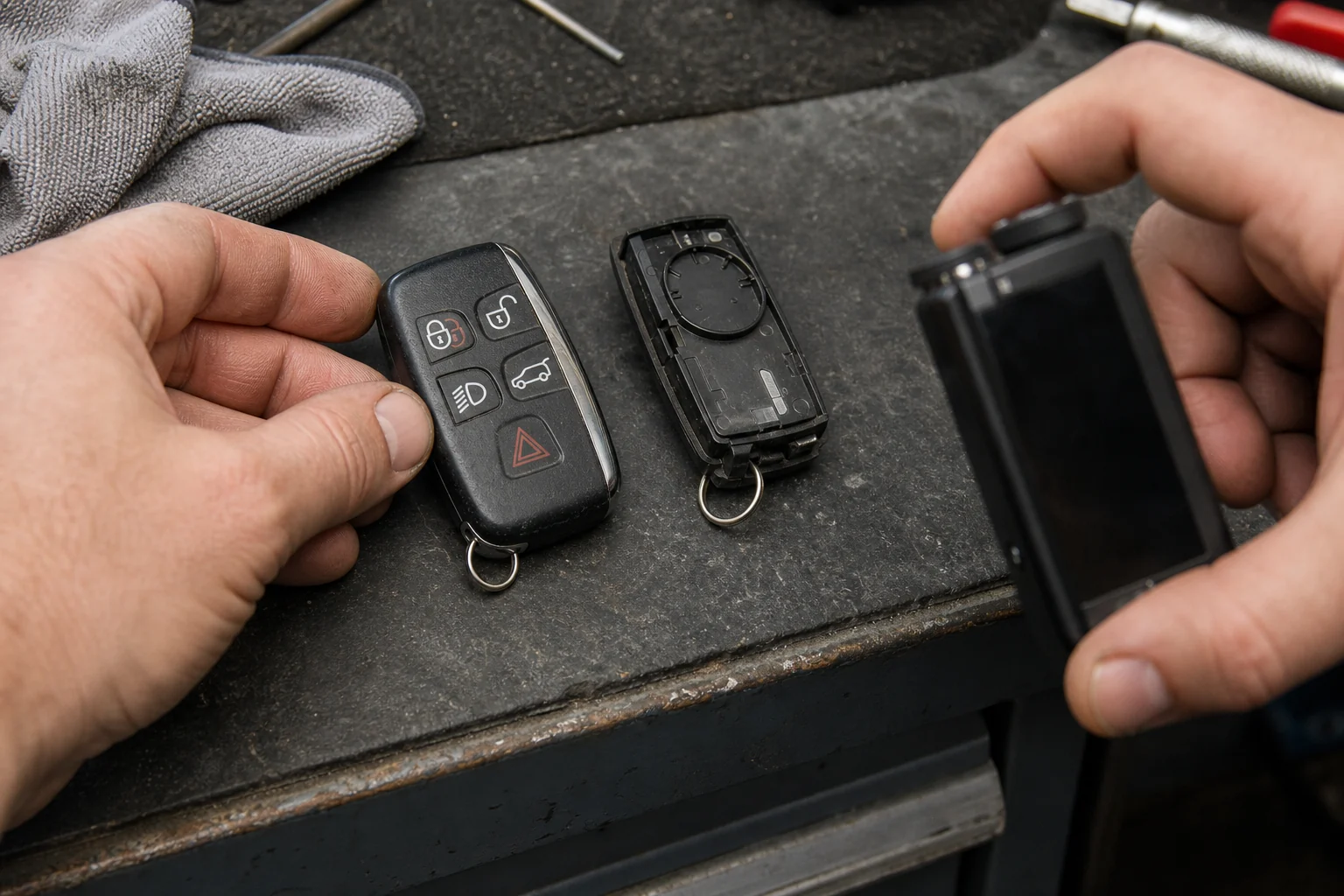
- Photograph both sides of the original key
- Count every button and note its position
- Record the blade arrangement and visible openings
- Keep the original key available for direct comparison
What must fit inside the replacement housing
A replacement shell is suitable only if your original internal parts can sit in the new housing in their intended positions. A close match on the outside does not prove Range Rover Evoque key shell compatibility. The cavity may have different supports, recesses or clearances even when the key looks almost identical.
Check the internal cavity and supports
If you can open the original key without damaging it, compare its interior with the seller’s internal photographs or technical diagrams. Check whether the circuit board has the same outline and whether its screw posts, clips or locating points line up. The board should be held securely rather than resting loosely inside the case.
Also compare the battery compartment. Its position, contact orientation and available height must match the original arrangement. A battery that fits the diameter of the compartment may still press against the circuit board, prevent the housing from closing or fail to meet the contacts correctly. Do not assume that the original battery or holder transfers simply because the outer Range Rover Evoque key fob has a similar shape.
Look for space and retention points for every other internal part, including a transponder or separate small module if the original key contains one. The relevant part may need a dedicated recess or clip to remain in the correct position. Reliable product evidence should identify the specific internal layout or show a clear cavity that can be compared with your key. If the listing provides only exterior images, treat internal compatibility as unconfirmed rather than filling the gaps with assumptions.
Do not force an internal mismatch
A circuit board that needs pressure to sit flat can be damaged when the case is closed. Filing away a support, drilling a new hole or removing a retaining feature can leave the board, battery contacts or other components unsecured. It may also create movement inside the housing, intermittent contact or a case that will not close properly. These are warning signs that the Evoque replacement key shell is not the correct variant, not invitations to modify it.
Finally, establish what is being replaced. A shell replacement is intended to reuse the original electronics and other transferable parts; an electronic replacement is a different compatibility question and cannot be assessed from the housing shape alone. Read the listing carefully to determine whether it includes an empty housing or any internal components, and whether those components are stated to match your exact key variant. If the original board or internal parts are damaged, do not assume a new shell will solve that separate problem.
Shell-only, replacement key or something else?
Before ordering a Land Rover Range Rover Evoque key shell, identify what the listing actually contains. “Shell”, “housing” or “case” usually refers to the outer plastic body, but the exact contents vary by product. A shell-only listing may provide the front and rear housing pieces, buttons or button pads, and a place for the original parts. It may not provide a circuit board, transponder, battery, remote electronics, emergency blade or any programming service. Treat the product description—not the product title or photographs—as the final source for what is included.
Check the blade and electronics separately
The emergency blade is another important distinction. The listing may include a cut blade ready for the lock, an uncut blank blade that still needs cutting, or no blade at all. “Blade included” does not by itself mean that it is cut for your vehicle. If the description does not clearly state the blade type, ask the seller before buying.
A shell also does not automatically include the electronics that make the Range Rover Evoque key fob operate. Your original circuit board and other reusable parts may be intended for transfer into the new housing, whereas a replacement key may contain different or no electronic components. A transponder is a separate item from the remote circuit board: one may be present without the other, and neither should be assumed to be included unless the listing explicitly says so.
Programming is a further distinction. A shell-only purchase does not, by that description alone, establish that a vehicle-ready key is supplied or that programming is included. Do not treat wording such as “replacement key shell” as evidence of cutting, coding or electronic compatibility.
You are considering a complete replacement key—not merely an Evoque replacement key shell—when the product is supplied with the required housing, blade and electronics as one documented unit. Even then, confirm whether the blade is cut and whether programming is included. If the relevant listing is unclear, obtain written confirmation of its contents before checkout; any product-specific recommendation should be manually verified.
- A shell may exclude the blade
- Electronics and transponder components may be absent
- Programming may not be part of the purchase
- Confirm the supplied parts before ordering
A cautious verification process before ordering
Use a short, evidence-based workflow rather than relying on the vehicle name in the listing. The aim is to establish that the specific Land Rover Range Rover Evoque key shell matches both the outside of your key and the parts you intend to reuse.
-
Record the key and vehicle details. Note the model year, the number and position of the buttons, the blade arrangement, and any visible markings or unusual features. If the original key is damaged, photograph every remaining side, including the back, edges and blade area. A broken corner or missing button should not prevent comparison with the housing profile.
-
Compare the complete listing with those records. Check the product title, description, photographs and any compatibility table together. Look for agreement in the key shell button layout, overall shape, seam lines, blade position and visible openings. Do not treat one matching image as sufficient: a different side profile or fastening arrangement can still indicate the wrong variant.
-
Check internal-fit information separately. External similarity does not confirm that your circuit board, battery arrangement or other original parts will sit correctly inside the housing. Look for the listing’s specific internal-fit information, not just a general statement that the shell is “for Evoque” or “for Land Rover”. If the listing does not identify the relevant internal version, record that as an unresolved point rather than assuming the Evoque replacement key shell will work.
-
Resolve conflicts before checkout. If the stated model years disagree with the photographs, the button count differs from your key, or the product description is vague, use the product-identification information and contact route provided on the site. Include the exact listing, your vehicle and key details, and clear photographs. Ask whether that specific shell matches the pictured key variant and whether the original internal parts are intended to transfer. Do not rely on a generic answer about a Land Rover key fob shell.
-
Stop when the evidence remains incomplete. If no clear comparison is possible, the listing lacks relevant photographs, or the seller’s information conflicts, postpone the order. The cost of choosing the wrong housing is not limited to the purchase: transferring parts may be difficult or may leave you without a usable key.
Keep the original key, its internal parts and any loose buttons together until compatibility has been established for the exact product. If the original is still partly usable, avoid opening or modifying it solely to make an uncertain comparison. Order only when the listing photographs and identification details support the same conclusion; otherwise, continue looking for a shell with clearer Range Rover Evoque key fob fitment evidence.
The safest way to buy a Range Rover Evoque key shell is to match the replacement against your existing key, not just the vehicle name. Check the shell’s shape, button positions, blade arrangement, and internal layout, and compare any part numbers or photographs carefully. If one of these details differs, treat compatibility as unconfirmed rather than assuming the shell will work. A careful physical comparison before purchase can prevent buying a casing that cannot hold your electronics, cannot accept your blade, or does not match your key’s controls.

- Match the external shape
- Match buttons and blade arrangement
- Check the internal cavity
- Confirm the supplied components
- Order only when the evidence agrees
Choose the option that matches your vehicle and situation.
Frequently asked questions
Does the Evoque model year identify the correct key shell?
The model year can narrow the likely options, but it does not confirm fitment. Different key variants may exist within the same model range, and listings may use broad vehicle descriptions. Compare your key’s button layout, housing shape, blade arrangement and internal design with the product information before ordering.
Can two Evoque keys with the same number of buttons use different shells?
Yes. The buttons may be positioned differently, while the housing shape, blade arrangement or internal mounting points may also vary. Two keys with the same button count are not necessarily interchangeable. Compare the complete outline and component layout rather than matching only the number of buttons.
What photographs should I take before ordering a shell?
Take clear photographs of the front, back, both sides, the blade end and any damaged areas. Use good lighting and include the full key in focus. Images can help compare visible details, but they may not reveal the internal cavity, so do not treat photographs alone as proof of compatibility.
Can I move my original circuit board into a replacement shell?
That depends on the exact key variant and the replacement housing. The cavity must accommodate the circuit board, battery and any other components, with suitable mounting points and clearance. A shell that looks correct externally may still fail to hold the original electronics securely or may interfere with the buttons.
Does a replacement key shell include a cut emergency blade?
Not necessarily. Product contents vary: a listing may describe a shell only, a housing with an uncut blade, or a more complete replacement. Read the contents carefully and check whether the blade is included, cut or absent. Do not assume that a photograph shows everything supplied.
Will a shell replacement program the vehicle automatically?
No assumption should be made about programming from a housing replacement. A shell is a physical enclosure, while the original electronics and any vehicle-related programming are separate matters. Replacing the housing does not, by itself, establish that the key will be electronically recognised or ready for use.
What if my original key is too damaged to compare?
Use every recoverable detail, including button count, visible shape, blade position, markings and photographs taken before the damage worsened. Compare those details with the listing and request confirmation when important information is missing. If the internal layout or variant remains uncertain, treat fitment as unresolved rather than guessing.
What should I do if the product photos do not show the inside of the shell?
Treat internal compatibility as unverified. The outside may resemble your key while the cavity, battery clearance or mounting points differ. Look for an internal view, a detailed component description or confirmation tied to the exact key variant. If none is available, pause before ordering rather than relying on appearance alone.
