
- A shell replaces the outer casing; it does not, by itself, replace the remote electronics, battery, transponder or blade.
- An XC70 label on a listing narrows the options but does not establish that its shell matches your particular key.
- Button count is an initial clue; compare button symbols, positions, spacing and the surrounding housing outline.
- Check the internal shape and supports against the original components; exterior similarity cannot prove that the circuit board will fit.
- Blade compatibility is separate from casing fit; confirm the mounting or folding arrangement and whether the listing includes a blade.
- A shell-only replacement is relevant when the retained electronics and mechanical parts are usable and can be transferred.
A listed Volvo XC70 remote key shell is a possible match only if its details agree with your original key; the vehicle name or a similar-looking photo alone does not prove compatibility. Start by comparing the two side by side. The number and arrangement of the buttons, the shell’s outline and any markings can help you spot an obvious difference, but they cannot confirm that the replacement will hold your original electronics or work with your blade.
The listing needs to provide enough information to check those less visible details. Look for clear photos of the inside and, where available, part numbers or other identifiers that match your key. Check separately whether the blade is included and whether its type is compatible; a shell that looks right on the outside may still differ internally or be sold with a different blade.
This guide on car-keys.lt explains which visible clues are useful, what the listing must clarify, and when you should ask the seller for more information before ordering. If the product page does not show the internal shape or identify the blade clearly, treat the match as unconfirmed rather than relying on the XC70 label.
What the XC70 Listing Does—and Does Not—Confirm
A replacement remote key shell is the outer casing for a key, not a complete working remote. Unless the listing explicitly says otherwise, do not expect it to include or replace the remote electronics, battery, transponder or blade. Those parts may need to be transferred from your existing key, so a shell listing alone does not establish that you will receive a ready-to-use key.
“XC70” in a product title is a useful first clue, but it is not proof that the shell matches every original key for that vehicle. A listing may name several Volvo models, as this Volvo key shell listing that includes the XC70 does. That tells you which vehicles the seller associates with the product; it does not, by itself, show which particular key versions the claim covers or confirm that your original key is one of them.
Before ordering, read the full fitment description rather than relying on the title or a search result. Look for any stated exclusions, such as a particular key type or version that is not covered. If the listing gives no detail beyond “XC70,” treat compatibility as unconfirmed and ask the seller to clarify what the claim applies to. A vehicle model name can narrow the search, but it cannot settle the match on its own.
Check the contents list separately from the fitment claim. It should make clear whether you are buying only a casing or also receiving items such as buttons, a blade or other parts. Do not assume that a pictured component is included: product photos can show an assembled example, while the package may contain only the shell. If the description does not state what comes in the package, ask before paying. For help understanding whether a replacement casing includes a blade, see this guide to checking what the shell listing says about the blade.
To assess a listing, use both the wording and the key you already have. First establish that the product is described as a remote-key shell, then check whether its stated fitment covers your original key and whether the package contains what you need. If either point is missing or ambiguous, do not treat “Volvo XC70” as enough evidence to order. A clear listing can support a match; a broad model label alone cannot confirm one.
Compare the Shell’s Exterior With Your Original Key
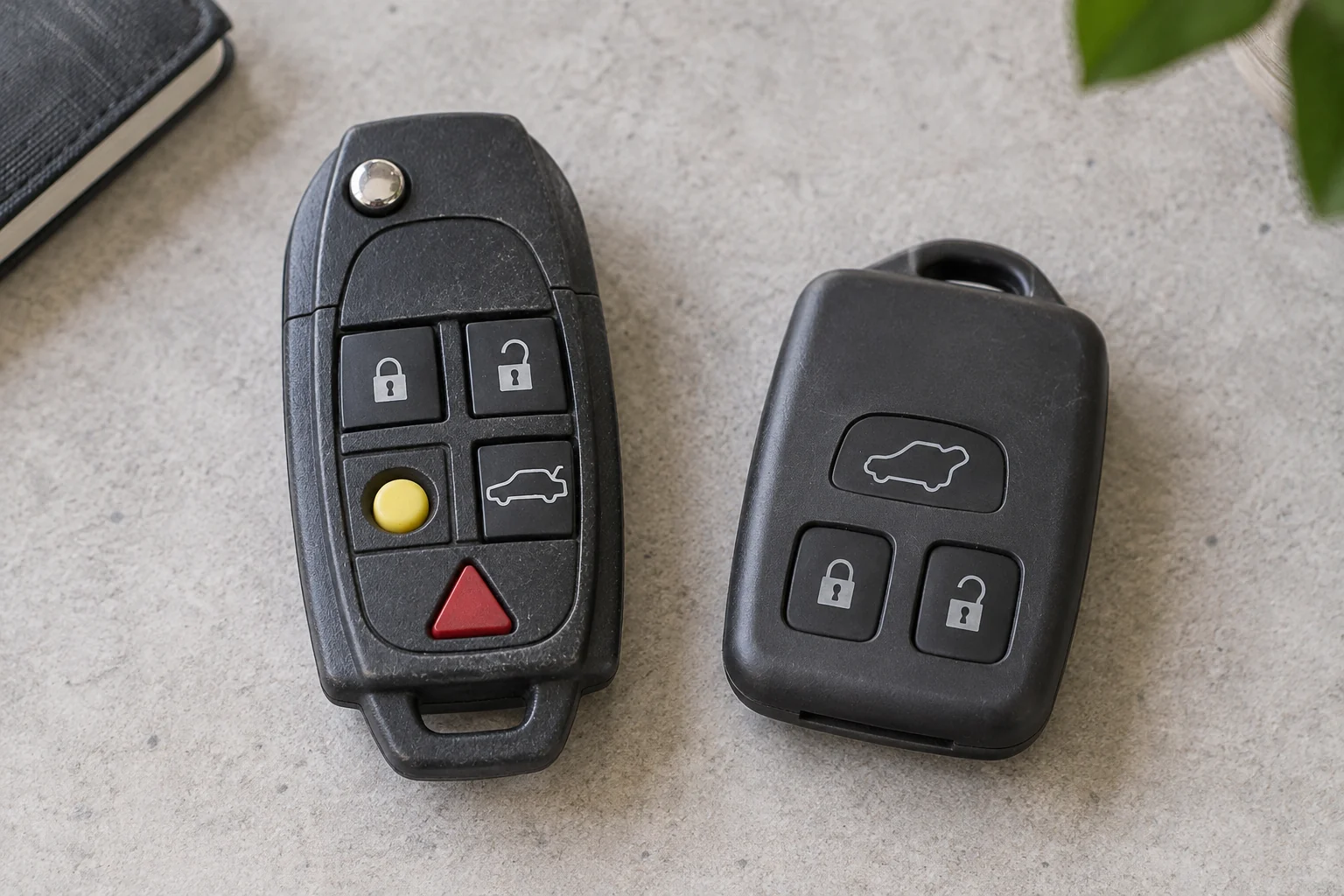
Start with the features you can see. Place your original key beside the listed Volvo XC70 remote key shell, then compare the button layout and the shape of the housing. A similar overall look is a useful first clue, but it cannot confirm compatibility on its own.
Count the buttons and compare their symbols, positions, shapes and spacing. For example, two keys may both have three buttons but arrange them differently, or use a different symbol on the middle button. Check whether the buttons sit in the same order and at similar distances from one another and from the edge of the housing. If the listing describes a particular button layout, compare that detail with your key rather than relying on the vehicle name alone. This guide to comparing a shell’s button layout with your original explains what to look for in the spacing and surrounding housing.
Next, compare the housing outline. Look at the overall length and width, the shape of the ends, and any curves or notches along the sides. Check the seam where the two halves meet, as well as visible openings or features such as a key-ring hole, if present. A housing can look broadly similar from the front yet have a noticeably different edge or opening. Those differences are reasons to pause and check the listing details more closely.
Use clear images of both keys taken from comparable angles. Compare the front with the front, then the back with the back; if the listing shows an edge view, compare that with the same edge of your original. Keep the keys oriented the same way, and look for small differences in button spacing, corner shape or seam position. A front-only product photo gives you less to compare than views showing the back and sides, so do not treat unseen surfaces as a match.
Account for photo limitations. An angled image can make one side appear shorter, while glare, shadows or a close crop can hide a seam or opening. Colour is also a weak comparison point when lighting and image processing differ. If a detail is unclear, look for another product photo or a written description of that specific exterior feature. Do not guess based on a vague resemblance.
Treat any clear mismatch in the button arrangement, housing outline or visible openings as a reason to pause before ordering. If the visible details line up, regard that as a preliminary match—not proof of Volvo XC70 key shell compatibility. Exterior photos can help you screen out an obvious mismatch, but they cannot show every detail needed to establish that the shell is suitable for your original key.
Check Whether the Original Components Can Fit Inside
To judge whether the listed Volvo XC70 remote key shell can take your original components, compare the inside of the replacement with the inside of your key—not just its exterior. If you can inspect your original key without damaging it, note the shape and position of the circuit board, battery and any separate retained parts. Then look for listing photos or details that show the replacement shell’s interior.
Check whether the board has a matching outline and orientation, and whether the shell has supports in the right places to hold it. Posts, clips, grooves or screw points may locate the board; their positions matter as much as the space around it. A cavity that looks large enough can still be wrong if the board cannot sit flat or be secured. A matching board shape alone is not proof of Volvo XC70 key shell compatibility.
Check the battery area separately. Compare the available space with the battery’s position and the way it is held in your original key. Look for a matching recess and any retaining feature, rather than assuming that a similar-sized cavity will keep the battery in place. If the shell uses a flexible button membrane or another internal part from the original, check whether the replacement has corresponding seats or openings for it. Missing or misplaced supports can leave components loose or prevent the casing from closing properly.
The key’s age and condition also affect what you can verify. If the original shell is damaged, inspect the components before relying on it as a template: a cracked housing may have lost clips, and loose or broken internal parts may not show how they were originally secured. Do not assume every part can be transferred simply because the replacement is described as a shell. The listing should make clear which components are supplied and which are expected to come from your key.
A useful product listing shows clear interior views or gives specific information about the internal design and the key version it suits. Compare those details with your original components, ideally from corresponding angles. A statement naming the vehicle, or an exterior that looks familiar, does not establish that your circuit board will fit. Nor does a photo prove compatibility if it does not show the relevant supports or is too unclear to identify them.
If the listing does not show or describe the board area, battery space and relevant retaining features, mark internal fit as unconfirmed. That is different from knowing the shell will not fit; it means you do not yet have enough evidence to order confidently. Ask the seller for an interior photo or for confirmation based on the exact key version and internal layout you have. If that information is unavailable, treat the match as unresolved rather than inferring it from “XC70” in the title.
- Read the listing’s exact fitment and included-parts details
- Compare the button layout and housing outline
- Look for evidence of internal component fit
- Check blade attachment and inclusion separately
- Leave any detail the listing does not establish as unconfirmed
Check Blade Fit Separately From Casing Fit

A matching housing does not establish that the blade will fit. Compare how the blade attaches to your original key with the arrangement shown or described in the Volvo XC70 remote key shell listing. If your key has a folding blade, check that the replacement is also designed for a folding blade and that the hinge area appears to correspond. If your blade is fixed, look for a shell made for that arrangement rather than assuming a folding-key listing will accept it.
Check the attachment details, not just the blade’s outline. Look for a visible pivot, hinge or blade-retaining point in the product photos, then compare its position and form with your original key. A photo that shows only the closed exterior may not reveal enough to judge this. If the original key’s blade connection is hidden, use a clear view of the opened key or ask the seller for an image of the relevant area.
Next, establish what the listing includes. It may specify that the shell is supplied without a blade, with an uncut blank, or with a blade already attached. These are different arrangements: a shell without a blade requires you to confirm whether your existing blade can be transferred, while a blank or attached blade still needs its own compatibility and cutting checks.
Do not treat an included blade as ready to use. An uncut blank has not been shaped for your vehicle, and a listing that says “blade included” does not by itself confirm that the blade is cut for your key. Check the wording and photos for the blade type and its status. If the listing does not say whether it is blank, cut or absent, that detail remains unresolved.
Use a simple decision rule: proceed only when the listing’s blade arrangement matches your original key, or when the seller confirms how your existing blade is meant to fit. For example, if your original has a folding blade but the listing shows a fixed blade with no explanation, do not assume that the outer casing match settles the issue. This is a separate part of Volvo XC70 key shell compatibility.
If blade details are missing, ask the seller whether the shell accepts the blade from your exact original key and whether any blade is included. Provide a clear photo of the original blade and its attachment point, and ask for a corresponding view of the replacement. Until those details are confirmed, treat the casing match as preliminary—not as confirmation that the complete key arrangement will work.
Treat the listing as a match only when its details agree with the key in your hand—not simply because it names the XC70 or shows a similar shape. Compare the shell’s button layout, blade arrangement and visible case details with your original, and check any stated part number or model-year limits against reliable information for that key. If the listing leaves an important detail unclear, do not assume the shell will fit; confirm compatibility with the seller before ordering. The vehicle name is a starting point, not proof.
Choose the option that matches your vehicle and situation.
Frequently asked questions
Does the XC70 name on a listing identify the exact remote-key version?
No. “XC70” is a vehicle-model reference, not proof that the shell matches every remote key used with that model. Compare the listing’s photos and fitment details with your key, including its buttons, interior layout and blade attachment. If those details are missing, ask the seller to confirm compatibility before ordering.
Can a shell listing include the circuit board or battery?
It depends on what the seller is offering. A shell-only listing may include just the casing, while another product may state that additional parts are included. Check the current product description and photos, and ask about any part that is not clearly shown or listed; don’t assume the board or battery comes with it.
Will replacing the shell fix a remote that already works intermittently?
Not by itself. A new casing changes the housing, but it does not establish why the remote works only sometimes or repair an electronic fault. If the problem continues after the casing is replaced, the cause may need to be checked separately rather than assuming the new shell has resolved it.
Does transferring the original remote electronics always avoid programming?
There is no universal answer. Replacing only the casing is different from replacing or changing electronic components, but the requirements can depend on the specific key and work being done. Before ordering, confirm whether the intended transfer uses your original components unchanged and whether any additional steps are required.
What details should I send the seller if the listing is unclear?
Send clear photos of your key’s exterior, its interior if it can be opened safely, and the blade attachment. Include the listing link or product details, then ask about the exact points you cannot verify. If you are still unsure what to compare, car-keys.lt can be a useful next step in your search.
Can I use a shell if the original casing is too damaged to compare?
Possibly, but missing or damaged casing details can leave the fit uncertain. Use any intact components, along with reliable photos of the original key or identifying details, to compare against the listing. If the internal layout cannot be confirmed, ask the seller rather than treating a similar-looking exterior as proof.
Does a replacement shell restore a damaged circuit board?
No. The shell is the casing; the circuit board is a separate component it may hold. Replacing the housing does not repair a damaged board. If the board itself is faulty, a shell-only replacement will not address that problem, so confirm what is damaged before choosing a product.
Is a shell-only replacement suitable if a retained component is missing?
Only if the remaining parts are sufficient for the intended replacement, or the listing explicitly includes the missing component. A shell-only purchase does not supply parts that are absent from the package. Check the included-items description and ask the seller to confirm any part you need but cannot see listed.
