
- A key shell normally means the outer housing rather than a complete programmed key, so included components must be verified for each product.
- Button count and button placement are useful compatibility clues, but matching counts alone cannot confirm that two Audi shells are interchangeable.
- The shell’s external shape, seam lines, battery-cover arrangement and key-blade position should correspond closely with the existing housing.
- A replacement shell may require transferring the original electronics, transponder and blade, depending on what the specific product includes.
- Audi model names span different key designs, so model compatibility should be checked alongside the original key’s physical identifiers.
- A shell that fits physically may still fail functionally if the electronics, transponder arrangement or blade profile cannot be transferred correctly.
An Audi smart key shell is only the outer housing. It does not automatically match your vehicle, even when the replacement is listed for the same Audi model or looks almost identical to your existing key. Compatibility depends on whether the new housing can accept and correctly position your original internal components, including the circuit board, transponder, battery holder and emergency key blade.
Before ordering, compare the key you already have with the proposed shell as a complete assembly. Start with the number and arrangement of the buttons, then check the housing’s outline, seams, recesses and attachment points. The blade setup also matters: some keys use a folding blade, while others have a separate or differently mounted emergency blade. A shell may be physically similar but still be unsuitable if its interior supports a different board or blade design.
This guide explains how to carry out that comparison using visible identifiers and transferable parts rather than relying on the Audi model name alone. It also clarifies which differences are minor cosmetic variations, which indicate a genuine mismatch, and when the available information is not sufficient to confirm compatibility before purchase.
Shell, complete key and repair part: identify what is being sold
An Audi smart key shell is usually the outer housing only: the front and rear casing, button section, and sometimes a separate emblem or key-ring piece. It is intended to replace a cracked, worn or damaged cover while the owner reuses suitable parts from the original key. The shell itself is not automatically a working key.
A complete key is a different product. Depending on the listing, it may include the housing, circuit board, battery holder, transponder-related parts, buttons, emergency blade or a blank blade. Some complete keys still require cutting, programming or coding before they can operate a particular vehicle. Those requirements are separate from whether the housing has the right shape.
Listings can also describe a smaller repair part rather than a full Audi key fob shell. For example, the offer might be for a single back cover, a button pad, a front face, an emblem, a blank blade or an internal retainer. Such a part may repair one damaged area but cannot replace the entire housing. A product photograph may show a fully assembled key for illustration, so the written contents list matters more than the image.
The phrase “replacement key” is therefore ambiguous. One seller may use it for an empty Audi replacement key shell, while another may mean a complete key body with electronics. “Cover,” “case,” “housing,” and “repair kit” can also describe different contents. Do not treat “Audi smart key cover” as proof that the listing includes the complete casing or any working components.
Before checking Audi key shell compatibility, confirm these points in the listing or with the seller:
- Is it a shell, complete key, or single repair part?
- Which components are included, and which must be transferred?
- Is a blade included, and is it blank or already cut?
- Are electronics, buttons, battery parts or a transponder included?
- Does the seller define “two-button” or “three-button Audi key shell” by the button layout, product version or another identifier?
- Are any compatibility terms limited to particular original part numbers or key variants?
Only after the product category and contents are clear can the relevant comparison be made.
- Use the original key as the reference
- Do not rely on model name, year or button count alone
- Confirm included components before ordering
Start with the original key: build a reliable identifier record
Use the key you already own as the starting point, not the vehicle model name alone. Model names can cover several key designs, while an Audi key shell listing may apply only to one housing shape or button layout. Before comparing products, create a short record of the original key and use the same details when checking listing photographs and descriptions.
Record the visible identifiers
Begin with the button layout. Count the buttons and note what each one does, if the symbols are still visible. Record their positions rather than writing only “two-button” or “three-button Audi key shell”: for example, two buttons may be arranged vertically, horizontally, or with a separate lower button. Also note whether the buttons are individual inserts, part of one rubber panel, or set into a shaped recess. These details can distinguish keys that otherwise look similar.
Describe the housing proportions and silhouette. Compare the apparent length, width and thickness, including any rounded corners, tapered ends, raised sections or narrowing near the key-ring end. If possible, measure the original housing with a ruler or caliper. Take measurements at consistent points and write down the units. A simple record such as “length, maximum width, thickness, button area width” is more useful than an informal description such as “small Audi fob.”
Inspect the seam lines around the casing. Note where the front and rear sections meet, whether the seam runs continuously around the edge, and whether there is a separate panel on the back. Examine the battery-cover arrangement as well: record whether the cover is a distinct sliding or removable section, where it is located, and its approximate shape. These observations help you compare an Audi smart key cover with the original without relying on a catalogue title.
Record the blade arrangement separately. Check whether the blade folds into the housing, sits outside it, or is integrated into the key assembly. For a folding blade, note the pivot position and the direction in which the blade opens. Also record where the blade exits or rests when closed. Do not assume that a similar-looking key has the same blade position; this is a separate physical identifier that should appear in your comparison notes.
Photograph and organise the evidence
Take clear photographs of the front and back of the key, with the entire outline visible. Add side and end views if the thickness, blade position or casing profile is difficult to judge from above. Use even lighting, remove anything that hides the buttons or seams, and place a ruler beside the key when taking scale photographs. Keep the camera parallel to the key for front and back images so the proportions are not distorted.
If the housing can be opened without damaging it, photograph the inside as well. Capture the internal shape, locating features, battery-cover area and blade-related section, but do not rely on a single close-up. Take one full open-housing image and additional close-ups of details that a product listing may show. If the original key is damaged, photograph the undamaged side and record which measurements or features could not be checked.
Finally, compare this record with the listing’s photographs, stated identifiers and product views. Mark each point as matching, unclear or different. A listing that shows only a similar front face does not provide enough evidence for confident Audi key shell compatibility; the missing rear, side, seam or blade information should remain an open question rather than an assumption.
- Button count and positions
- Housing outline and seam lines
- Battery-cover arrangement
- Blade position and folding direction
- Clear photos from multiple angles
Compare the housing before considering the electronics
A similar-looking Audi key shell is not enough to establish fit. Compare the original housing with clear product images at the same viewing angles: front, rear, side, top, bottom and, where shown, the opened case. A front view may hide a different internal wall, hinge area or battery-cover design. If the listing shows only one image or a generic vehicle illustration, treat the match as unconfirmed rather than assuming that the model name covers every key version.
Check the controls and casing details
Start with the button area, but look beyond the number of buttons. Compare each button’s shape, order, spacing and position within the housing. A two-button Audi key shell and a three-button Audi key shell are obvious examples, yet two shells with the same button count may still differ in button size, recess depth or the distance between the buttons and the edge. Also check whether the buttons sit in one continuous panel or in separate openings.
Next, compare the overall silhouette and the details that are difficult to alter without changing the mould. Look for differences in length, width, thickness, rounded corners, tapered ends and raised or recessed sections. The seam line should follow the same path around the case, with matching breaks near the buttons, key ring and side edges. A replacement Audi key fob shell can appear correct from above while having a different side profile that prevents the two halves from closing evenly.
The battery cover is another useful physical identifier. Compare its location, outline, size and opening direction. Check whether it forms part of the rear housing or uses a separate removable panel, and note the position of any notch or sliding section. If the cover is in a different place, or its perimeter does not match the original, the housing is not a reliable physical match even when the front design looks almost identical.
Verify the blade opening and fit evidence
For a folding key, compare the blade channel, the pivot position and the direction in which the blade folds into the case. The channel must line up with the opening and leave enough clearance for the blade to sit inside the housing. A listing may show a visually similar Audi replacement key shell but use a different blade arrangement, such as a fixed channel, a different pivot location or a cut-out intended for another folding mechanism. Confirm this from product photographs or explicit fitment information rather than from the vehicle name alone.
Use exact dimensions when the seller provides them, comparing like for like and allowing for measurement tolerances. Dimensions can rule out an obvious mismatch, but they do not prove that every contour, clip or opening is identical. The strongest physical evidence is agreement across button recesses, seam lines, battery-cover layout, overall shape and blade arrangement. If only the colour and general appearance match, regard that resemblance as a clue—not proof of Audi key shell compatibility.
Confirm which original components can transfer
A physical match does not prove that your original key can be rebuilt in the new housing. Before ordering an Audi smart key shell, check whether the product is designed to accept the same internal parts as your key. The listing should make clear whether it includes a circuit board, battery holder, transponder-related part or blade, or whether it is an empty housing for transferred components. If the description does not identify the included parts, do not treat the product photographs as confirmation.
Check the circuit board and transponder
Open the original key, if this can be done without damaging it, and compare its circuit board with the replacement shell’s internal cavity. Look for the same board outline, button-contact positions, battery location, retaining clips, screw points and internal supports. A board may have a similar shape but still fail to sit correctly if a switch, battery contact or edge connector meets a different wall inside the Audi key fob shell.
The product information should show or describe the cavity that holds the electronics, not only the outside of the case. Check whether the shell accommodates a complete original board or only a particular board layout. If the listing mentions a compatible board reference, compare that reference with the markings on your original board where visible. Do not assume that a two-button Audi key shell accepts every two-button board, or that a three-button Audi key shell accepts every three-button board; button count does not identify the internal layout by itself.
The transponder requires a separate check. Depending on the original key and the replacement design, it may be integrated with the electronics or held in a separate position inside the housing. Confirm whether the product provides a place for the original transponder and whether that part can be moved without damage. A cavity that holds the circuit board may not hold the transponder in the required position. If the listing does not show the transponder location or state that the original part transfers, treat this as unresolved rather than assuming the Audi replacement key shell is functional.
Verify the blade transfer and separate programming
Compare the original blade’s profile, thickness, length and shoulder shape with the replacement shell’s blade channel. Also check how the blade is retained: a folding blade may use a pivot and pin, while another design may require a fixed insert or a different mounting arrangement. The new housing must accept the original blade physically; an apparently similar channel is not enough if the pivot hole, stop or retaining point differs.
Finally, separate component transfer from programming or coding. Moving a working board, transponder and blade into an Audi key shell does not itself program a key, adapt it to a vehicle or prove that the transferred electronics remain usable. Conversely, programming cannot correct a board that does not fit, a missing transponder location or an incompatible blade mount. Consider the shell compatible only when the required original components can be transferred securely and the separate programming requirements, if any, have also been verified.
- Housing shape can match while internal cavities differ
- A transferable blade does not prove electronics compatibility
- A complete functional check may require product-specific confirmation
When the match is incomplete, resolve the uncertainty before ordering
If the comparison produces both matches and unknowns, separate them instead of treating the closest-looking result as compatible. A confirmed match should have consistent identifiers, clear product-specific images and documented evidence for that exact Audi smart key shell. A vehicle model or production year can help narrow the search, but neither is final proof because the same model range may use different key designs.
When one detail conflicts—such as the button arrangement, folding-blade position or case structure—pause the order. Ask the seller to confirm the specific listing against your key, rather than asking whether the shell fits your Audi in general. Request clear photographs of the relevant sides and, if needed, details of the internal component layout or mounting points. If the seller cannot provide product-specific evidence, record the result as unconfirmed.
Until fit is established, keep the original key intact. Do not discard a damaged cover, cut the blade, move the electronics or force the case apart simply to test a suspected match. A cracked housing may still preserve useful identification evidence, and an unsuccessful transfer can make comparison more difficult.
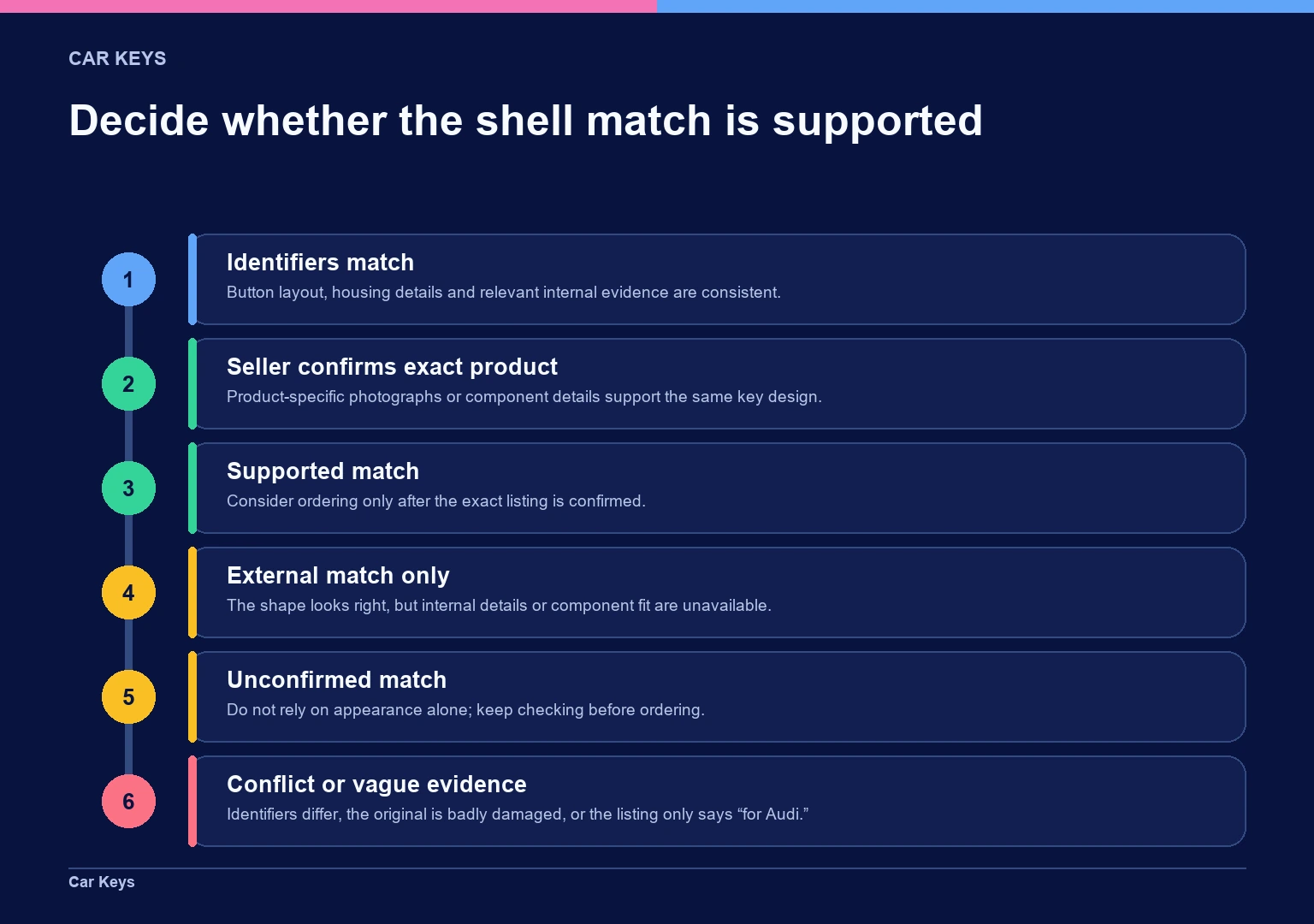
Use this decision rule:
- All relevant identifiers match and the seller confirms the exact product: the match is sufficiently supported to consider ordering.
- The external shape matches but internal details are unavailable: treat the Audi replacement key shell as unconfirmed.
- Identifiers conflict or the original key is badly damaged: do not rely on photographs alone.
- The listing uses broad wording such as “for Audi” without specific evidence: ask for clarification or reject it.
When the original key or the replacement’s internal details cannot be interpreted confidently, ask a qualified key professional whether they can inspect both items before any irreversible work. This is especially useful when fragments, hidden retaining points or unclear component markings prevent a reliable comparison.
The safest way to choose an Audi smart key shell is to match identifiers, not appearance alone. Compare the original shell’s part number, button layout, key-blade position, circuit-board shape, battery arrangement, and any relevant frequency marking with the replacement listing. Also check whether the shell is designed for your exact key generation and whether your existing electronics can be transferred. A shell that looks identical may still differ internally or fit poorly. If any identifier is missing, unclear, or inconsistent, treat compatibility as unconfirmed rather than relying on photographs alone.
Choose the option that matches your vehicle and situation.
Frequently asked questions
Does an Audi key shell normally include the battery?
Not necessarily. The word “shell” usually refers to the housing, but listings differ: some may include a battery cover or other small parts, while others may provide only the casing. Check the exact product description and photographs for included components. Do not assume that a battery, circuit board, transponder or blade is supplied.
Can the original Audi key blade be moved into a replacement shell?
Sometimes, but it depends on the blade profile, hinge or mounting arrangement, and the design of the replacement housing. A shell may look correct while using a different blade attachment. Compare the original blade and its mounting point with the replacement details before ordering; never force a blade into a housing that does not support it.
Can two similar-looking Audi shells use the same electronics?
Not reliably. Similar shape or button layout does not prove that the circuit board, transponder or internal cavity will match. Check the board position, retaining features, button contacts and transponder space against the original key and the seller’s compatibility information. If those details are missing, treat the match as unconfirmed.
Does the Audi model year prove that a key shell will fit?
No. The model and year provide useful context, but they do not identify every key housing variation. Different key designs, equipment versions or production changes may exist within a model range. Use the vehicle details alongside the original key’s shape, button layout, blade arrangement and internal identifiers rather than relying on the year alone.
What photographs should I take before asking about shell compatibility?
Take clear, well-lit photographs of the key’s front, back and side, including the blade and hinge area. Photograph each button and any visible markings. If it can be opened safely without damaging clips or seals, include images of the housing interior, circuit board position and transponder area. Keep the camera square to the key where possible.
Will replacing the housing fix buttons that no longer work?
Only if the problem is caused by worn, cracked or misaligned housing parts. A non-working button may instead result from a damaged switch, circuit board, battery, transponder-related issue or vehicle-side fault. Before ordering, check whether the original electronics still respond and whether the button problem is physical rather than electrical.
What if the original blade does not fit the new shell?
Stop rather than forcing it or filing the housing. The replacement may require a different blade profile, a separate compatible blade or another mounting arrangement. Compare the blade dimensions and attachment method with the product details. If they do not match, ask for confirmation of the correct blade solution before ordering.
What should I do if the shell fits but the car does not respond afterward?
Recheck that the original circuit board, battery, transponder and button components were transferred correctly and are seated as intended. A housing replacement does not automatically resolve programming or coding requirements. If the physical fit is correct but the vehicle remains unresponsive, confirm the product’s specific requirements before assuming that the shell itself is defective.
