
- A replacement key shell is the outer housing, so it does not automatically replace the remote electronics, transponder, or key blade.
- Button count and layout provide useful compatibility clues, but matching buttons alone cannot prove that a shell fits a Golf 7 key.
- A replacement blade may be included, removable, or absent, making the listing’s blade description an essential part of compatibility checking.
- The original key remains the best physical reference because vehicle model and year alone may not identify every key-shell variant.
- A shell swap can preserve existing components only when the board, battery holder, blade arrangement, and housing supports match physically.
- Key-shell replacement is separate from cutting a blade or programming a key, so a housing change does not by itself establish vehicle operation.
A Volkswagen Golf 7 key shell is not automatically compatible with every Golf 7 key. The vehicle model identifies the car, but the replacement housing must also match the original key’s physical design and internal arrangement. Golf 7 keys can differ in button layout, blade style, folding mechanism and the shape or position of the internal components.
Before buying, compare the replacement shell with the key you already have. Check the number and position of the buttons, the blade opening, hinge or folding section, casing shape and the way the circuit board, battery and transponder are held inside. A shell can look similar in a product photo yet fail to close properly or leave the electronics unsupported.
This guide explains how to make that comparison and what information to confirm when listings use broad terms such as “Golf 7 compatible”. It also separates a shell replacement from tasks that are not solved by changing the housing. Moving your existing electronics into a matching shell is different from cutting a new blade, programming a key to the car or replacing damaged electronic components. Those steps may require separate checks. The safest choice is based on the original key’s details and internal fit, not on the Golf 7 model name alone.
What a Golf 7 Key Shell Actually Replaces
A key shell is the outer housing of the key, not the complete working key. It normally provides the plastic body, button covers, hinge or blade area, and the internal space that holds the original components. A Volkswagen Golf 7 key shell therefore replaces the worn, cracked, or damaged casing while the key’s existing electronics and security components may remain in use.
The vehicle name alone does not make every shell suitable. A Golf 7 replacement key shell must physically match the original key’s internal layout, button openings, fastening points, and blade arrangement. Two keys listed for the same Golf 7 may still use different housings. Compatibility is consequently a physical comparison, not a conclusion based only on “Golf 7” in a product title.
A shell swap usually means transferring the original remote board, battery contact arrangement, and transponder-related component into another housing. Those parts are not automatically supplied with an empty Golf 7 remote key housing. Some products contain only the plastic case; others may include buttons, a blade, or additional pieces. The exact contents must be checked in the individual listing rather than assumed from a product photograph or a broad compatibility statement.
The blade also requires separate attention. A Volkswagen Golf Mk7 key case may be sold with no blade, with a separate replacement blade, or with a blade intended to be transferred from the original key. A fixed blade and a removable or folding-blade design are not interchangeable simply because both are described as Volkswagen keys. If the listing does not clearly identify what is included, its compatibility remains unconfirmed.
A new shell does not prove that the vehicle will recognise or operate the key. The housing only protects and positions the parts placed inside it. Vehicle operation still depends on the original or separately supplied electronic components, the transponder, and any required electronic adaptation. Replacing a damaged case can preserve a working key, but it does not create a new programmed key by itself.
This distinction also separates a replacement car key shell from a complete replacement key: the shell addresses the casing, while a complete key must account for all components required for vehicle use.
- A shell is the outer housing.
- Existing electronics may need to be transferred.
- A blade may be included, reusable, or absent.
- Cutting and programming are separate considerations.
Use the Original Key as the Compatibility Reference
The key you already use is the best physical reference for choosing a Volkswagen Golf 7 key shell. The Golf 7 name covers more than one key variant, so the vehicle model and registration year are not enough on their own. Before ordering, place the original key beside a ruler and take clear photos of both sides, the open edge, the blade area and the inside if the housing can be opened without damage.
Record the visible layout
Start with the buttons. Count them and note their exact arrangement, including the position of the lock, unlock and boot-release buttons where those functions are present. A two-button key shell cannot be treated as interchangeable with a three-button key shell simply because both are described as Golf 7 compatible. Button shapes also matter: some housings use separate raised buttons, while others use one moulded rubber pad with distinct symbols.
Compare the overall housing shape next. Check its length, width, thickness, rounded corners and the position of the seam between the two halves. Look for changes around the key ring, hinge, button panel and blade end. A Volkswagen Golf Mk7 key case may look similar in a product photo yet have a different profile, screw position or joining edge. If the original casing has a visible step, recess or curved side that the replacement lacks, treat that as a possible mismatch rather than a cosmetic difference.
Photograph the blade and where it attaches to the housing. Note whether the key has a folding blade, a removable blade or a fixed blade, and check the pivot, pin, slot or other attachment point. Blade shape and housing attachment are separate physical identifiers: a replacement can have the correct button layout but still fail because its blade section uses a different hinge or mounting arrangement. Do not assume that all Golf 7 keys use the same blade design.
Check access and internal reference points
If the key includes a separate emergency key, record where it is stored and how it is released. Some variants may have a concealed mechanical key or a dedicated retaining feature; the replacement housing must provide the same space, opening and release path. If the emergency key is absent from your original, do not use that feature alone to identify the correct variant.
Finally, inspect the battery and board access features. Note where the housing opens, whether there is a battery cover or tray, the shape of the internal cavity and the location of clips, posts and screw points. These details help distinguish a Golf 7 remote key housing from a visually similar replacement car key shell. Take a photo of the original board and battery area for reference, but do not use appearance alone as proof of fit: internal dimensions and retaining points must also correspond. When any recorded feature conflicts with the seller’s description, pause the purchase and seek confirmation rather than relying on the Golf 7 label.
Match the Shell Listing to the Physical and Internal Fit
Treat the product listing as a set of features to compare with your original key, not as proof that the shell fits. A listing that says “Golf 7” may cover only one housing variant, while another Volkswagen Golf Mk7 key case may use a different button layout, blade arrangement or internal moulding. Open the product photographs, specification details and variant selector, then compare the exact version shown with your key.
Compare the outside before ordering
Begin with the front of the housings. Count the buttons and check their positions, spacing and shape. A two-button key shell is not interchangeable with a three-button key shell simply because both are described as Golf 7 products. Also compare the button symbols where visible: a different arrangement can indicate a different rubber pad and a different recess inside the housing.
Next, compare the housing geometry rather than relying on overall length. Look at the rounded ends, side profile, seam position, screw location, key-ring opening and the shape of the upper blade section. Two cases can appear similar in a listing thumbnail but use different internal depths or locating points. If the seller shows several variants, select the one whose front, rear and side photographs match your original—not just the option with the closest vehicle description.
The blade area needs its own check. Confirm whether your original uses a folding blade with a hinge, a fixed blade, or a separate emergency blade stored in the housing. The replacement must provide the same attachment design and enough room for the blade mechanism to move. Read the contents carefully: some listings include an uncut blade, some include only the plastic housing, and some are supplied without a blade. “Blade not included” means you must account for the original blade or a separately suitable replacement; it does not confirm that either option will attach to that shell.
Confirm the internal moulding and listing details
External similarity is not enough if your original board cannot sit securely inside the case. Compare the listing’s internal photographs with your opened housing, if it can be opened safely. Check the board cavity’s outline, retaining clips, guide rails, screw posts and pressure points. A replacement Golf 7 remote key housing may have the correct outer buttons but lack the supports that hold a particular remote board in position.
Check the battery arrangement as well. The cavity must accept the same battery type and orientation, with the holder, contact points or retaining features in the correct places. A different battery layout can prevent the cover from closing or leave the contacts unable to press against the battery. Do not assume that a board listed for the same vehicle model uses the same battery support or case moulding.
Finally, read every variant and omission in the actual listing. Part-number differences, button-count options and separate left- or right-hand blade versions can change compatibility. Treat “fits Volkswagen Golf 7” as a useful lead, not a decision rule. Before buying a replacement car key shell, manually verify the chosen variant against the original shell’s buttons, geometry, board cavity, battery supports and blade attachment. If the listing does not show the inside, blade contents or relevant part-number variant clearly, compatibility remains unconfirmed rather than implied.
- Photograph the original key.
- Count and map the buttons.
- Compare blade attachment and storage.
- Check board and battery support details.
- Read what the listing excludes.
Shell Swap, Blade Cutting and Programming Are Different Jobs
Finding a physically compatible Volkswagen Golf 7 key shell solves only the housing problem. It does not confirm that the remote buttons, transponder or vehicle security system will continue to work after the change. These tasks should be treated separately, even when they involve the same key.
A shell swap means transferring the usable components from the old housing into the new one. The original remote board, battery arrangement and security-related parts must be positioned correctly and protected from movement or damage. A housing can close properly while still failing to support the board or button contacts accurately, so physical closure alone is not evidence of successful operation.
The blade is another separate issue. If the replacement housing is supplied without a blade, the existing blade may need to be transferred, provided its attachment and dimensions match. If a new blank blade is included, it normally has to be cut to match the vehicle’s lock. Blade cutting should be confirmed with a qualified automotive key professional; a visually similar blade is not automatically usable.
Programming or adapting the key to the vehicle is different again. A replacement Golf 7 remote key housing cannot by itself add a new authorised key, pair remote functions or make an unrecognised transponder work. Whether existing electronics remain usable after a shell swap depends on their condition and on the vehicle’s security system. Any programming requirement should therefore be confirmed with a qualified source before components are moved.
A complete replacement key may arrive with its own electronics, transponder and blade rather than relying on parts from the old key. It may still require cutting and vehicle-specific programming, and its compatibility must be checked separately from that of a Volkswagen key shell compatibility listing.
The practical rule is simple: shell fit proves only that the housing may accept the relevant parts. It does not establish lock operation, remote control or engine-start authorisation. Confirm each required job separately before treating the replacement as a working key.
A Low-Risk Decision Process Before You Order
Use the key you already own as the final reference, rather than relying on the vehicle model shown in a product title. Before ordering a Golf 7 replacement key shell, create a simple record that you can compare with the listing or send to the seller for confirmation.
-
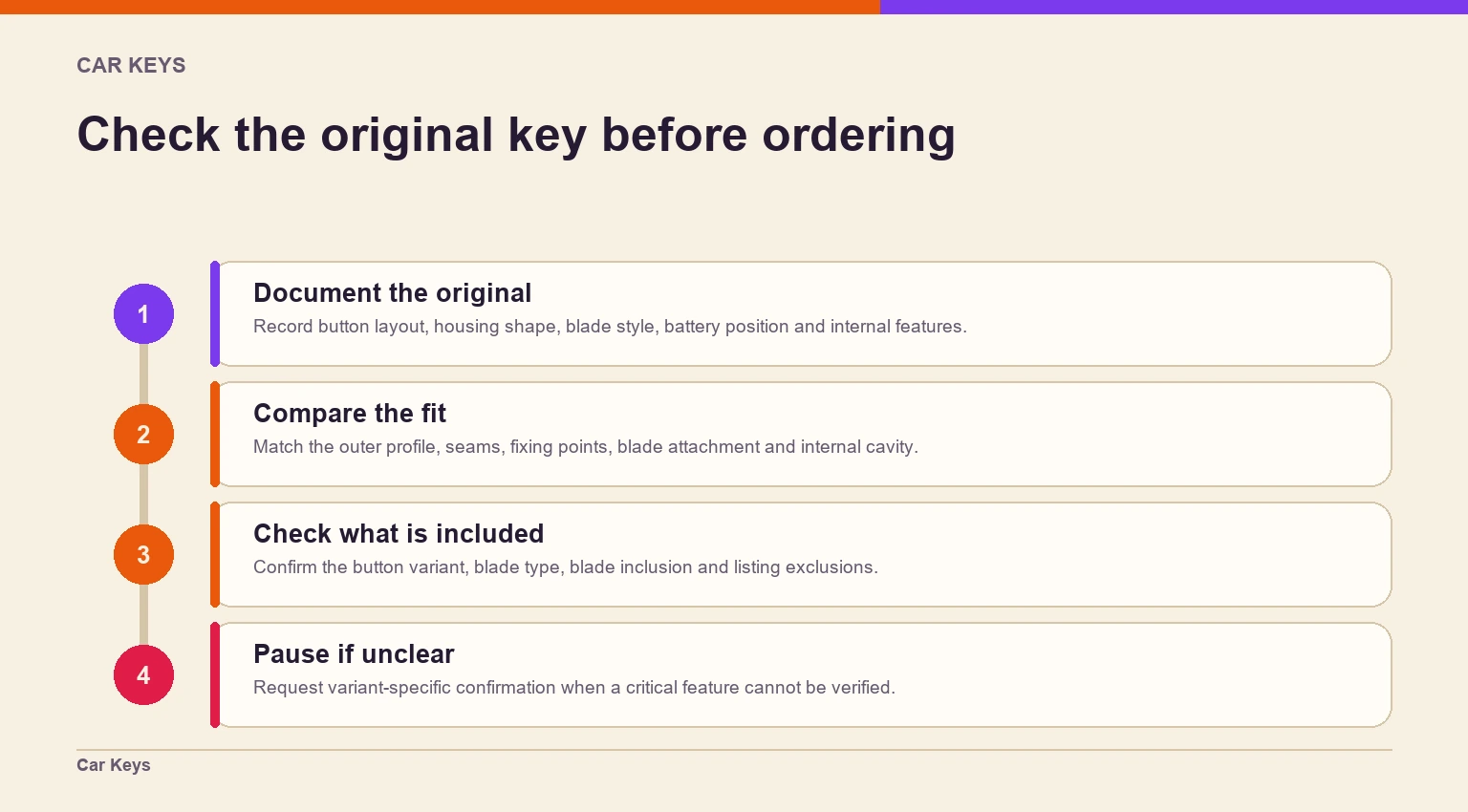
Photograph and record the original key. Take clear images of both sides, the button side, the blade end, the hinge or attachment point, and the opened housing if it can be accessed without forcing or damaging it. Record the button count and arrangement, housing shape, blade style, battery position, board layout and any emergency-key compartment. These details make a more useful reference than “Golf 7” alone.
-
Compare every visible and internal feature. Check that the proposed Volkswagen Golf Mk7 key case has the same button positions, outer profile, seam locations, blade arrangement and fixing points. If the housing will receive your original board, also compare the cavity, supports, battery holder and clearances. A shell that looks correct from the outside can still prevent the original components from seating properly.
-
Read exclusions and blade details carefully. Confirm whether the listing describes a two-button key shell, three-button key shell or another layout. Check whether a blade is included, supplied blank, fixed, hinged or omitted, and whether the listing excludes a particular key variant. Do not treat a product photograph as proof if the written description is narrower or unclear.
-
Stop when a critical feature cannot be confirmed. Pause the purchase if the button layout, internal supports, blade attachment or board cavity differs—or cannot be seen clearly. Ask for variant-specific confirmation using your photographs, or choose a listing that provides the missing information. A lower price or broad vehicle-fit wording does not resolve an unidentified mismatch.
-
Transfer and test only after physical compatibility is established. Once the housing has been matched to the original, move components only in accordance with instructions appropriate to that specific variant. Check that parts sit securely and that the casing closes without pressure or distortion. Test the transferred key only after the physical fit is confirmed; a successful fit still does not by itself verify every electronic or vehicle-related function.
The practical takeaway is simple: do not choose a Golf 7 key shell by vehicle model alone. Before ordering in Lithuania, compare the existing key’s button layout, blade shape, and internal component arrangement with the replacement, and verify the exact version where any detail differs. A shell that looks right externally may still be unsuitable if the blade or electronics cannot be transferred. When those details are unclear, treat compatibility as unconfirmed rather than relying on a generic “Golf 7” description.
- A Golf 7 label may cover more than one key-shell variant.
- Matching buttons alone is not enough.
- Unclear internal fit should be confirmed before purchase.
- A fitted shell does not guarantee vehicle operation.
Choose the option that matches your vehicle and situation.
Frequently asked questions
Does every Volkswagen Golf 7 use the same key shell?
No. “Golf 7” and the vehicle’s year may not identify one universal physical shell. Keys can differ in button layout, blade arrangement, housing shape, battery position and internal supports. Use the original key as the main reference, then compare those details with the complete replacement-shell description before ordering.
Can I match a Golf 7 key shell by button count alone?
Button count is only an initial clue. Two shells with the same number of buttons may have different layouts, housing dimensions, board supports or battery arrangements. Compare the button positions, overall shape and internal cavity with the original key rather than relying on the number of buttons alone.
What if the replacement shell includes a blank blade?
A blank blade may need to be cut to match the vehicle’s lock. Its inclusion does not confirm that the shell accepts your original electronics or that its internal supports and blade attachment match your key. Check whether the listing describes the blade type and the housing separately.
Can the original remote board be moved into a new shell?
Possibly, but only when the new housing accommodates that board correctly. The cavity, locating supports, button contacts, battery arrangement and other physical interfaces must match. A shell that looks similar from the outside may still prevent the original board from seating or operating correctly.
Will a new key shell make the car start?
No. A shell is a physical housing, not a programming service. Replacing it does not by itself adapt the remote electronics or establish immobiliser operation. Whether the car starts depends on the original or replacement electronic components and any programming or adaptation they require.
How can I identify the correct blade arrangement?
Compare the original blade’s shape, position and attachment method with the complete listing description. Also check whether the blade folds into the housing, remains fixed, or is supplied separately. Do not assume that a visually similar blade arrangement will accept the original blade or fit the mechanism.
What should I do if the listing only says it fits Golf 7?
Treat that wording as insufficient evidence. Look for, or request, details about button layout, housing shape, blade arrangement, board cavity, battery position and internal supports. If the seller cannot confirm the relevant physical interfaces, pause the purchase rather than relying on the model name alone.
When is a shell replacement the wrong option?
A shell swap may be unsuitable if the electronics are damaged or missing, the internal layout is incompatible, or the replacement requires a separately cut blade or programmed key. In those cases, identify which part is actually needed—housing, blade work, electronics or programming—before choosing a replacement.
