
- The current case shows what was assembled last time, but it may not identify the key’s original housing or hidden fittings.
- Matching button count, positions and case profile can narrow options, but exterior similarities do not prove internal compatibility.
- The new shell must accommodate the retained circuit board, battery and any separate transponder; button alignment alone is insufficient.
- Compare the blade’s shape and attachment method separately, since a blade fitted to the current case may not transfer to another.
- If the key already has faulty remote or starting functions, changing its housing alone will not resolve those faults.
- Check the listing’s stated contents and clear images; a pictured blade or electronic component is not proof that it is included.
If a car key has already been re-cased, use the key you have as evidence of what was assembled—not as proof of the vehicle’s original key design. The current housing may be an aftermarket shell, and earlier work may have changed which parts sit inside it. Before ordering a replacement shell for a re-cased car key, compare the assembled key’s visible layout with the listing, then check whether the internal arrangement and blade are compatible.
A similar outline is not enough. Two shells can look alike from the outside but differ in button positions, case shape or the way their internal parts are held. Conversely, a different-looking case does not automatically mean the key’s electronics or blade are different. The important question is whether the replacement can accommodate the components you actually have and match the blade arrangement—not whether it resembles a remembered factory key.
This comparison is useful whether you’re browsing listings on car-keys.lt or checking a shell offered elsewhere. The sections below explain which clues are reliable, which can mislead, and what information to confirm before you buy. That helps narrow the options without treating a seller’s broad vehicle description or a familiar photo as a guarantee of fit.
Treat the Current Case as Evidence, Not Proof

A replacement case for a re-cased car key tells you what was assembled most recently. It does not prove that the housing matches the key’s original specification or was the right match in the first place. The previous case may have been selected as a substitute, and parts may have been moved from an older housing. Treat it as a useful reference, not a definitive template.
Separate what you can verify from what you are assuming. For example, if the key works, that is evidence that the current assembly performs its intended function; it does not establish that every part is original or that another shell will suit it. A model name or marking on the current case identifies that case, not necessarily the key. If the key works only intermittently, even its current performance offers limited reassurance.
Before searching, note which details are directly known, which are supported by records, and which are guesses. A previous repair receipt, the old shell, its packaging, or photos taken before the re-case may help confirm what was changed. If you still have the original housing, keep it as a reference rather than assuming the latest case is more accurate.
Retained components can also help resolve questions about what the key needs, but do not assume that a part was transferred unchanged just because it came from the same key. Where the vehicle or key identification is uncertain, confirm any model-specific guidance with a reliable source before using it to narrow your options. Make, model, or year alone may not settle which replacement housing is appropriate.
If you cannot establish whether the present case was correctly matched, record that as unresolved rather than treating its markings or history as confirmation. Use reliable records and the retained parts as evidence, then compare the candidate shell against those sources. That gives you a sounder basis for judging car key shell compatibility than copying the current case alone.
Compare the Shell’s Shape and Button Layout
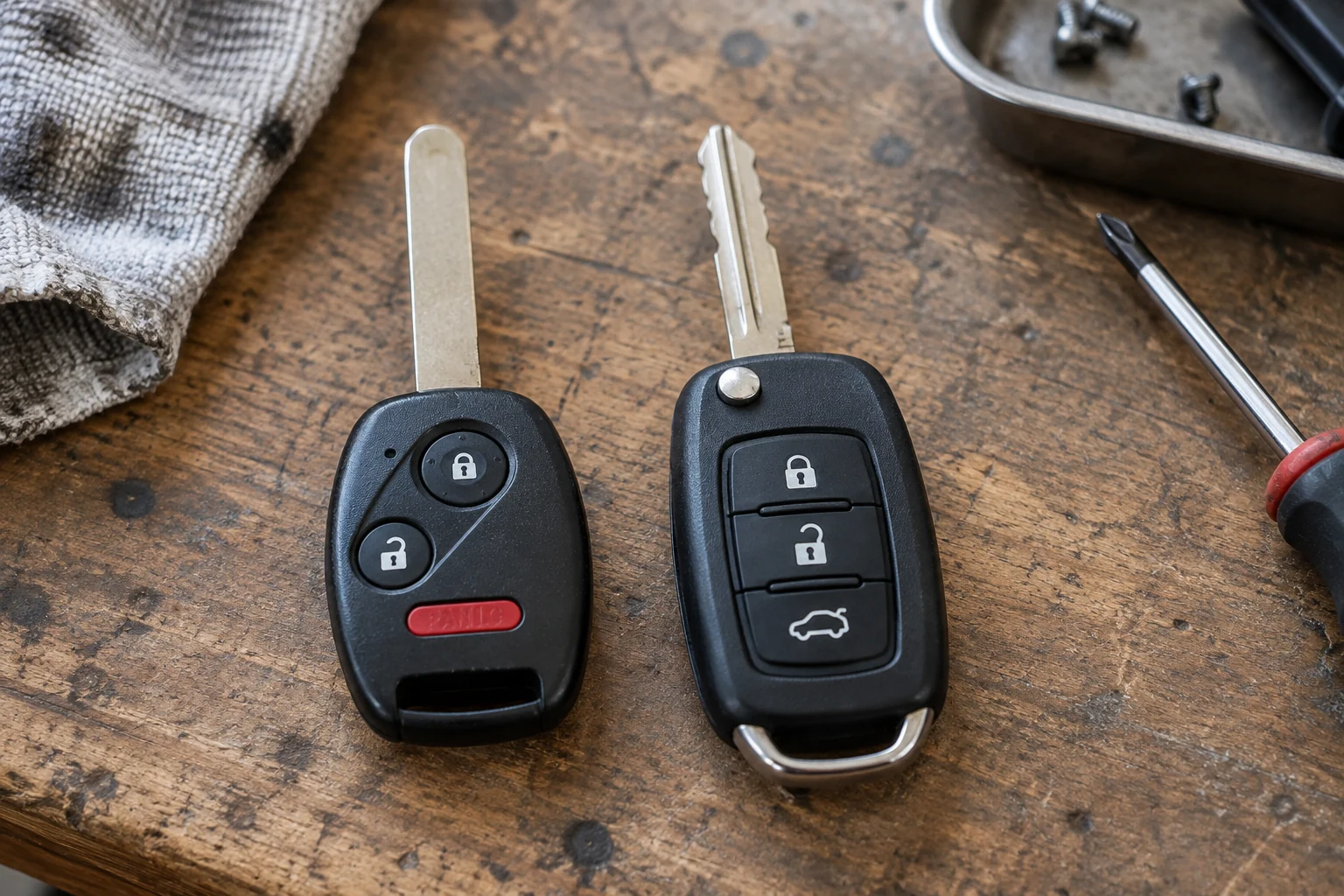
Start with the overall outline, not just the key’s length. Compare the shell’s width and thickness, the shape of its ends, the curve of its sides and the position of any corners or tapers. A case that looks similar in a product photo may be noticeably wider or thicker in person, or have a different profile around the buttons. If possible, place the current key beside the listing image at the same angle and compare proportions rather than relying on a general resemblance.
Next, count the buttons and note where each sits. Record their order, spacing and shape: for example, two buttons arranged vertically are not the same layout as two side by side. Check whether the buttons are round, oval or shaped to follow the edge of the case, and whether one is noticeably larger. Look at the symbols too, but give more weight to the physical positions and outlines; printed icons can vary between listings even when the visible button arrangement is similar.
Inspect the edges and openings that can be seen from outside. Note where the case halves meet, whether the seam runs around the full edge or follows a particular contour, and whether there are openings for features such as an indicator light or a key ring. Compare their shape and location, if present. A small difference in an opening or seam can help rule out a shell that otherwise looks close. Do not assume that every visible detail is functional or required; use it as a comparison point, not proof of fit.
Photos can distort proportions, especially when the seller shows the shell from only one angle. Look for clear front, back and side views, and check whether the pictured buttons and openings match your key. If the listing shows only a front view, you may not be able to compare thickness, side contours or the rear seam. For more examples of details to compare when a shell needs reordering, see this guide to checking a replacement against the key.
Use exterior similarity to narrow the options, not to make the final fit decision. A close match in shape and button layout is a useful first filter, but it does not establish car key shell compatibility. Keep a short list of visible matches and differences, then compare the listing’s stated compatibility and other fit details before ordering. If the photos leave an important exterior feature unclear, treat that as unresolved rather than guessing from the closest-looking case.
Check That the Retained Components Can Fit
Before choosing another shell, identify what must transfer from the current key. Usually, that means the circuit board and battery, but their arrangement can vary: the battery may sit in a holder on the board or in a separate recess in the case. If you cannot see the components clearly without opening the key, do not guess from the outside. Compare with a clear view of the inside, or get the key checked before ordering.
The replacement shell needs more than enough room for the board’s outline. Its internal supports, recesses and retaining points must line up with the board so it sits securely rather than shifting or being pressed out of position when the case closes. Compare the position of screw posts, clips and other locating features, as well as the board’s shape. A cavity that looks roomy can still be a poor match if a support lands on a component or a fixing point does not meet the board.
Check the battery separately. The new housing must leave room for its thickness and keep it in the correct position for contact with the board. Note whether the current case holds the battery in a moulded compartment or whether it is attached to the circuit board. If the listing does not show the relevant internal area, an exterior photo is not enough to confirm car key circuit board fit.
Button alignment is not proof of internal compatibility. The buttons may line up with the board’s contact points while the board itself has a different outline, mounting points or battery arrangement. For example, two shells can have the same number and placement of buttons but use different internal supports. Treat matching buttons as a separate check from whether the retained parts can be seated and secured.
Some keys also have a separate transponder chip; in others, that function is incorporated into the electronics. If your key has a distinct chip, the shell needs a suitable place to hold it in the right position. Do not assume that a shell with room for the circuit board will also accommodate a separate transponder. If you are unsure whether your key has one, avoid removing parts just to find out.
When the arrangement is unclear, do not force the board, battery or chip into a new case. Pressure can damage components or leave them loose, and a case that closes only when parts are pushed out of position is not a reliable fit. Compare the internal layout with the parts you can identify; if the locating points or chip position remain uncertain, pause before ordering rather than relying on exterior similarity alone.
Match the Blade and Its Attachment Separately
Before ordering, assess the blade separately from the rest of the key. A shell can look right and accommodate the retained components yet use a different blade profile or attachment. The blade in the current case is a useful reference, but it does not prove that the blade will transfer to another housing; the previous re-casing may have involved a different blade or fitting.
Compare the blade’s outline and the dimensions that affect how it sits in the case: its length and width, the shape of its shoulder or stop, and the position of grooves or cuts. Use reliable compatibility information for the candidate shell rather than relying on a broad label such as “flip key” or “remote key.” Those terms describe general styles, not necessarily matching blade geometry. A similar-looking tip alone is not enough to confirm a match.
Next, compare how the blade attaches. Depending on the design, it may sit in a fixed slot, pivot in a folding mechanism, or be held by a pin or screw. Check the position and form of the attachment point, as well as the space around it. Even a blade with a similar outline may not suit the shell if its pivot, hole or retaining method does not align.
Do not assume that a blade can be moved just because it is fitted to the current case. Its attachment may differ from the new shell’s, or the current blade may not be the one originally used with the key. If you cannot establish that the blade and attachment match, treat transferability as unresolved rather than ordering on appearance alone.
Also check whether the offer is for a housing only or includes a blade. A replacement shell may come without one; an included blade may be supplied uncut. Confirm what is included before treating the blade shown or described as part of the order.
Keep cutting or replacing the blade separate from shell fit. A blade may attach to a shell but still need the correct cuts to work with the vehicle’s locks. Choosing a replacement housing for a re-cased car key does not, by itself, confirm that a blade is cut correctly or that a new blade is compatible.
Verify the Listing Before You Order
Read the listing’s description and “what’s included” details before using its photos to judge the offer. A pictured key may be assembled for illustration, while the order may contain only the outer shell. Check whether the stated contents include items such as buttons, a blade or other fittings, and compare that list with what you actually need to transfer or replace. Do not assume a pictured part is included unless the listing says so.
Then compare the product images with the details you have already checked on your key. Look for clear views of the exact shell being sold, including its inside where available; a single front-facing image may not reveal whether the listed version matches. If the listing offers several versions, make sure the selected option—not just the main product photo—is the one described as compatible. Images can help confirm a match, but they do not establish it on their own.
Give more weight to specific compatibility information than to broad labels such as “fits many models.” Check whether the listing identifies the relevant key type or other distinguishing details, and whether those details agree with your key. If the seller’s wording is unclear, ask for clarification before ordering rather than treating a visual resemblance as confirmation. For a recap of how to compare a current replacement case with the next one, use the earlier checks as a reference.
Keep the current case and any retained parts available while you review the listing. They can help you verify details that are hard to judge from a photo, or show a seller what you are trying to match. If the listing omits a relevant view or leaves a compatibility point unanswered, mark it as unresolved. Do not fill the gap with an assumption based on the previous case.
Finally, separate a housing decision from an electronic fault. Replacing the shell changes the case; it should not be treated as a fix for a remote that does not work or a key that has a starting problem. If a fault is already present, confirm its cause separately before ordering, since another housing alone may leave it unchanged. When a key detail remains uncertain, pause and get it checked rather than choosing the nearest-looking option.
Treat the key in your hand as the reference, not the housing it originally came with. Before ordering, confirm that the replacement shell matches both the visible details and the parts inside your re-cased key, including the blade, button layout, circuit board and any fixing points. A similar-looking case can still differ where it matters. If you cannot confirm the internal match from clear photos or measurements, do not rely on appearance or the vehicle model alone; check the shell details before choosing.
Choose the option that matches your vehicle and situation.
Frequently asked questions
Can the current replacement case’s markings identify the right shell?
They can provide a useful clue, especially if a code or part number matches reliable fitment information. But a marking on a case does not prove that the case was correct for your key in the first place. Treat it as a lead to check, not as the final basis for ordering.
Is matching the number of buttons enough?
No. Button count helps narrow down the options, but two cases with the same number of buttons can differ in shape, internal supports or blade attachment. Compare the button positions and openings as well, then check whether the case can hold your key’s retained parts.
Should I keep the old case after taking the key apart?
Yes. Keep the old case, its small fittings and any parts that come out with it until you have checked the replacement. They can help you compare shapes and attachment points, and may be useful if the new shell does not fit. Store small pieces together so they are not lost.
Can replacing the shell fix a remote that has stopped working?
Not by itself. A new housing may address physical damage or a poor fit, but it does not identify or repair an existing electronic fault. If the remote already fails, keep that problem separate from the shell choice; changing housings alone may leave the fault unchanged.
Does a shell listing include the blade or electronics shown in its photos?
Not necessarily. Photos may show a complete-looking key for illustration, while the sale includes only the shell or a different set of parts. Read the written contents carefully, and ask the seller if they are unclear. Do not assume the blade, circuit board or other fittings are included just because they appear in an image.
Can the vehicle model and year alone identify the correct shell?
They can narrow the search, but may not distinguish between different key housings or retained fittings used with the same vehicle details. Compare the key itself and check the listing’s stated compatibility. If those details do not resolve the choice, car-keys.lt is a useful next place to look for guidance before ordering.
Do I need programming when changing only the housing?
There is no single answer for every key. What matters is which parts you keep, replace or disturb during the change. If the existing electronic components remain intact and are transferred, the situation differs from replacing or altering them; check guidance for your specific key before assuming programming is or is not needed.
What should I do if the replacement case may already be the wrong one?
Treat its apparent fit as uncertain rather than using it as the model for your next purchase. Compare the retained components and blade with the proposed shell, and check the seller’s written fitment details. If those checks still leave a mismatch or unanswered question, pause before ordering another case.
